 54
MSI GeForce RTX 5090 Suprim Liquid SOC Review
Overclocking & Power Limits »Energy Efficiency
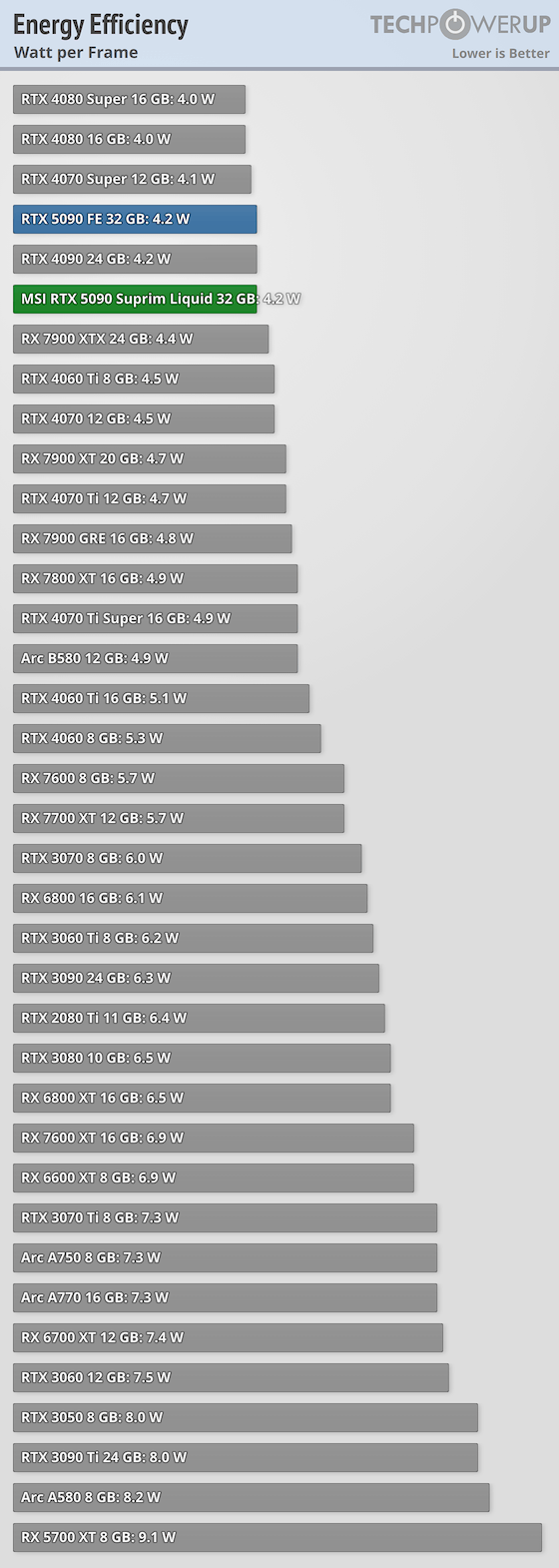
Energy Efficiency calculations are based on measurements using Cyberpunk 2077. We record power draw and FPS rate to calculate the energy efficiency of the graphics card as it operates.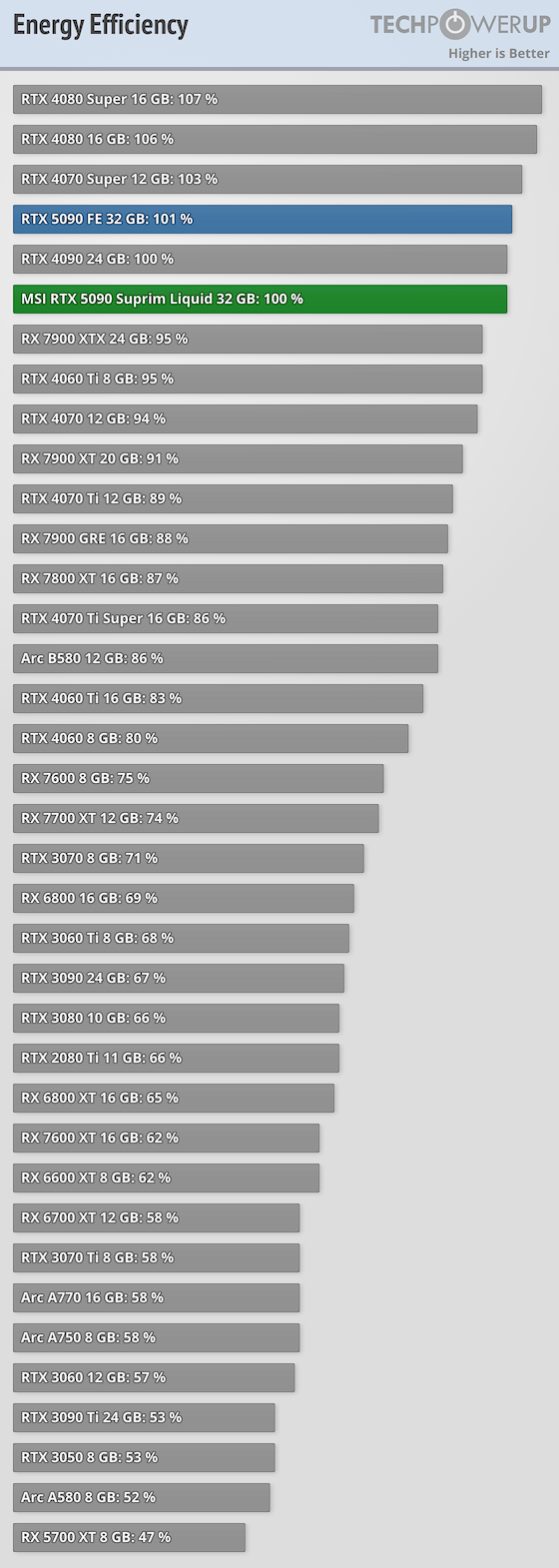
Voltage Frequency Curve
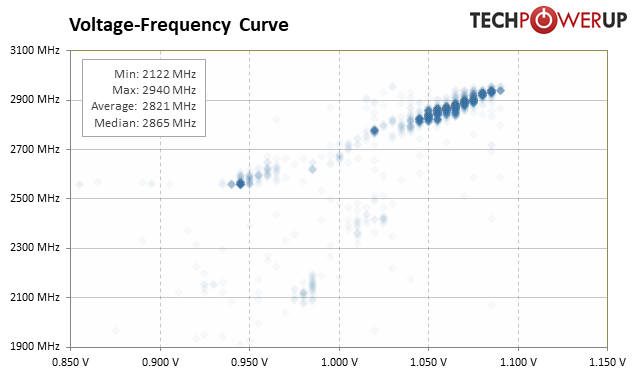
The card will dynamically adjust clocks and voltage based on render load, temperature, and other factors.For the graph below, we recorded all GPU clock and GPU voltage combinations of our 1440p resolution benchmarking suite. The plotted points are transparent, which allows them to add up to indicate more often used values. A light color means the clock and voltage combination is rarely used, and a dark color means it's active more often. The minimum and maximum values are 99th and 1st percentile, so outliers are excluded.
Clock States
| Clock Frequencies & Voltage | |||
|---|---|---|---|
| GPU Clock | Memory Clock | GPU Voltage | |
| Idle | 226 MHz 217 to 270 MHz | 51 MHz | 0.800 V 0.800 to 0.805 V |
| Multi-Monitor | 225 MHz | 51 MHz | 0.800 V |
| Video Playback | 459 MHz 420 to 502 MHz | 51 MHz | 0.822 V 0.820 to 0.825 V |
| Furmark | 2190 MHz 2175 to 2205 MHz | 1750 MHz | 0.917 V 0.915 to 0.925 V |
| Gaming (Cyberpunk 2077) | 2771 MHz 2760 to 2797 MHz | 1750 MHz | 1.028 V 1.025 to 1.030 V |
| Ray Tracing (Cyberpunk 2077) | 2318 MHz 2280 to 2362 MHz | 1750 MHz | 0.926 V 0.925 to 0.930 V |
| V-Sync (Cyberpunk 2077) | 772 MHz | 798 MHz 101 to 875 MHz | 0.813 V 0.810 to 0.815 V |
| Gaming (25 Games) | 2821 MHz 2122 to 2940 MHz | 1750 MHz | 1.045 V 0.875 to 1.085 V |
Nov 23rd, 2026 14:25 CST
change timezone
Latest GPU Drivers
New Forum Posts
- UPS what one to get? (56)
- Your PC ATM (36474)
- Refurbished Gaming Laptop (5070 TI) 2,000 dollars (2)
- Increasing Power Limit? (18)
- RAM overclock cause worse feeling than JEDEC (9)
- Gacha Games - Discussions, Pulls, Updates, etc. (1159)
- What's your latest tech Freebie? (88)
- repair an NVIDIA Quadro M4000 (5)
- WarpCoreBench scores! (90)
- TPU's Nostalgic Hardware Club (22201)
Popular Reviews
- Microsoft Surface Laptop Ultra Review - The Next-gen Arm Laptop
- Corsair RM1200e (Second Generation) Review
- Upcoming Hardware Launches 2027 (Updated Nov 2026)
- Pulsar Office Tour & First Look at P1 Dual-Sensor Mouse
- AMD Ryzen 7 9800X3D Review - The Best Gaming Processor
- Ugreen NASync DXP4800 GT Review
- ASRock X870E Challenger Wi-Fi White Review
- AMD Zen 6 Technical Deep Dive
- Phantom Blade Zero Performance Benchmark Review - 35 GPUs Tested
- AMD Ryzen 7 5800X3D 10th Anniversary Review
TPU on YouTube
Controversial News Posts
- NVIDIA Co-Founder and CEO Jensen Huang Officially Resigns (492)
- Jensen Huang Reinstated as CEO of NVIDIA (309)
- Report: Jensen Huang Eyes NVIDIA Comeback (278)
- Open Letter Asking NVIDIA to Reinstate Jensen Huang Passes 115,000 Signatures (184)
- OpenAI CEO Argues Home PCs Waste the World's Limited DRAM Supply (152)
- NVIDIA Launches Investigation Into Jensen Huang's Relationship With Suspected Chinese Spy (136)
- Intel "Raptor Lake Next" 16-Core and 20-Core CPUs Surface (130)
- NVIDIA GeForce RTX 50-Series Scheduled for up to $500 Price Hike This Week (89)