 27
MSI MEG X870E Godlike X Edition Review
(27 Comments) »Value and Conclusion
- The MSI MEG X870E Godlike X Edition's suggested retail price is $1,299
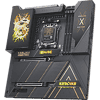
- Looks incredible
- Fantastic SSD temperatures
- Amazing packaging
- Dynamic Dashboard II display looks great
- 60 W Type-C front panel Power Delivery
- SSD heatsinks easy to install and access
- M.2 Xpander-Z Slider Gen card is very effective
- 10 Gbps + 5 Gbps Ethernet
- Loads of fan headers
- EZ Control Hub makes cable tidying easier
- Eye-wateringly expensive
- EFI and software not quite as flexible as competition
- Using more than one PCIe Gen 5 SSD results in bandwidth sharing
- VRMs could be cooler
- Tuning Controller not included
- E-ATX form factor limits case choice
- Not much new over original model
The lucky few who get to own boards such as the MSI MEG X870E Godlike X Edition will no doubt have a blast using its features and having it sit at the heart of a high-end PC. We would absolutely love having it in ours and whether you're overclocking or not, or whether you plan on using a bunch of PCIe Gen 5 SSDs or sticking to more mainstream models, this is a board that should keep you satisfied well beyond the life of AMD's Socket AM5.
It's not just about supporting the latest hardware, though. It's the way the Godlike X-Edition's unique design and features play out that makes it unique, even compared to competing boards such as the ASUS Crosshair X870E Extreme. That's partly thanks to MSI focusing more on extreme features than extreme overclocking.
The board will no doubt eventually have liquid nitrogen thrown at it in overclocking tournaments, but for those at home with deep pockets, it's the added features that are the main selling points and that's what MSI has done very well here. It's still a highly capable board when it comes to overclocking, with plenty of VRM cooling headroom, a decent EFI and most of the features on the PCB that you'd need for extreme benchmarking sessions, besides actual physical clock speed controls.
The M.2 Xpander card is a nice addition as it gives you the option of easily removing SSDs without having to dismantle watercooling loops, and can easily handle the heat of two PCIe Gen 5 SSDs. Thankfully—while it's actively-cooled—unlike previous versions you're able to control the fan speed and even at inaudible noise levels it offers excellent cooling.
Another perk you'd expect is the ability to use two PCIe Gen 5 M.2 ports without stealing PCIe lanes from your graphics card. That's true here, but you'll still have to make sacrifices. Using the second onboard PCIe Gen 5 M.2 slot will disable the USB4 ports, but with so many alternative Type-C options on the rear panel that's only an issue if you need the extra bandwidth USB4 provides.
The fan and RGB hub is just as much a useful feature as it is a necessary one. The design does a great job of hiding unsightly ports, but some of the fan and RGB headers have been removed from the main PCB to the hub instead. Thankfully, this isn't your average hub, as its proprietary cable still gives you full access over each header as normal, with the added bonus of making cable tidying easier.
Other tick-box features are 10 Gbps Ethernet with 5 Gbps as a secondary port, a funky customizable display on the I/O shroud, a full array of tool-free M.2 heatsinks, and 60 W Power Delivery over its 20 Gbps front panel Type-C port. There are twin thermistor headers and the EFI and software make it easy to set up elaborate cooling systems, whether they're air- or water-cooled.
There probably aren't many arguments we can make to justify spending $1,300 on a motherboard. Three quarters of that would be better spent elsewhere and spending this much does not result in notably more performance. It's a motherboard that's designed for one thing: giving you the bragging rights for owning one of the craziest motherboards available.
Yes, it has 10 Gbps Ethernet, can handle multiple PCIe Gen 5 SSDs, has 60 W USB power delivery, USB4, Wi-Fi 7, and PCIe Gen 5 GPU support, but these things are available on far cheaper boards too. If you want to spend big—but not this big—in an attempt to keep your PC as long as possible without it feeling its age in a few years, while the MEG X870E Godlike X Edition has the credentials to do that, there are far cheaper ways to do it just as effectively.
The competition is slim to say the least and is limited to the non X- Edition model, the ASUS Crosshair X870E Extreme and Gigabyte's new X870E Aorus Xtreme X3D AI TOP. All cost insane amounts of money and take slightly different approaches to delivering the eye candy. MSI and Gigabyte certainly have the more edgy aesthetics, while ASUS perhaps has the advantage when it comes to EFI, software and extreme overclocking, with all three ticking the usual high-end feature boxes such as 10 Gbps Ethernet, and the two we've tested, being the ASUS and MSI, offering excellent SSD cooling as well as plenty of headroom with VRM cooling, although ASUS definitely has an advantage there.
In the end, there's likely to be some brand loyalty in the equation too, but all three boards are similarly matched in terms of features and all three are real head turners. If overclocking is likely to fill most of your spare time then the ASUS Crosshair X870E Extreme or indeed the Apex would be slightly better options.
For cutting edge aesthetics and features, it would be between the MSI MEG X870E Godlike X Edition and Gigabyte X870E Aorus Xtreme X3D AI TOP. None of these boards would be a disappointment and MSI has done a fabulous job here in almost every respect. It's just a shame it will be out of reach in terms of price for all but a lucky few, assuming the limited run doesn't sell out.


It's not just about supporting the latest hardware, though. It's the way the Godlike X-Edition's unique design and features play out that makes it unique, even compared to competing boards such as the ASUS Crosshair X870E Extreme. That's partly thanks to MSI focusing more on extreme features than extreme overclocking.
The board will no doubt eventually have liquid nitrogen thrown at it in overclocking tournaments, but for those at home with deep pockets, it's the added features that are the main selling points and that's what MSI has done very well here. It's still a highly capable board when it comes to overclocking, with plenty of VRM cooling headroom, a decent EFI and most of the features on the PCB that you'd need for extreme benchmarking sessions, besides actual physical clock speed controls.
The M.2 Xpander card is a nice addition as it gives you the option of easily removing SSDs without having to dismantle watercooling loops, and can easily handle the heat of two PCIe Gen 5 SSDs. Thankfully—while it's actively-cooled—unlike previous versions you're able to control the fan speed and even at inaudible noise levels it offers excellent cooling.
Another perk you'd expect is the ability to use two PCIe Gen 5 M.2 ports without stealing PCIe lanes from your graphics card. That's true here, but you'll still have to make sacrifices. Using the second onboard PCIe Gen 5 M.2 slot will disable the USB4 ports, but with so many alternative Type-C options on the rear panel that's only an issue if you need the extra bandwidth USB4 provides.
The fan and RGB hub is just as much a useful feature as it is a necessary one. The design does a great job of hiding unsightly ports, but some of the fan and RGB headers have been removed from the main PCB to the hub instead. Thankfully, this isn't your average hub, as its proprietary cable still gives you full access over each header as normal, with the added bonus of making cable tidying easier.
Other tick-box features are 10 Gbps Ethernet with 5 Gbps as a secondary port, a funky customizable display on the I/O shroud, a full array of tool-free M.2 heatsinks, and 60 W Power Delivery over its 20 Gbps front panel Type-C port. There are twin thermistor headers and the EFI and software make it easy to set up elaborate cooling systems, whether they're air- or water-cooled.
There probably aren't many arguments we can make to justify spending $1,300 on a motherboard. Three quarters of that would be better spent elsewhere and spending this much does not result in notably more performance. It's a motherboard that's designed for one thing: giving you the bragging rights for owning one of the craziest motherboards available.
Yes, it has 10 Gbps Ethernet, can handle multiple PCIe Gen 5 SSDs, has 60 W USB power delivery, USB4, Wi-Fi 7, and PCIe Gen 5 GPU support, but these things are available on far cheaper boards too. If you want to spend big—but not this big—in an attempt to keep your PC as long as possible without it feeling its age in a few years, while the MEG X870E Godlike X Edition has the credentials to do that, there are far cheaper ways to do it just as effectively.
The competition is slim to say the least and is limited to the non X- Edition model, the ASUS Crosshair X870E Extreme and Gigabyte's new X870E Aorus Xtreme X3D AI TOP. All cost insane amounts of money and take slightly different approaches to delivering the eye candy. MSI and Gigabyte certainly have the more edgy aesthetics, while ASUS perhaps has the advantage when it comes to EFI, software and extreme overclocking, with all three ticking the usual high-end feature boxes such as 10 Gbps Ethernet, and the two we've tested, being the ASUS and MSI, offering excellent SSD cooling as well as plenty of headroom with VRM cooling, although ASUS definitely has an advantage there.
In the end, there's likely to be some brand loyalty in the equation too, but all three boards are similarly matched in terms of features and all three are real head turners. If overclocking is likely to fill most of your spare time then the ASUS Crosshair X870E Extreme or indeed the Apex would be slightly better options.
For cutting edge aesthetics and features, it would be between the MSI MEG X870E Godlike X Edition and Gigabyte X870E Aorus Xtreme X3D AI TOP. None of these boards would be a disappointment and MSI has done a fabulous job here in almost every respect. It's just a shame it will be out of reach in terms of price for all but a lucky few, assuming the limited run doesn't sell out.
Nov 15th, 2026 09:07 CST
change timezone
Latest GPU Drivers
New Forum Posts
- Recommendations Wanted - Affordable Enterprise SSD for Boot (5)
- budget home NAS – X79, X99 or another platform? (149)
- WireView Pro II GPU Alignment: Wired | Variant: Black (1)
- Planning for Prolonged High Prices and Maintaining What You Already Have (74)
- Technical Issues - TPU Main Site & Forum (2026) (409)
- What generation of Wi-Fi do you use at home (98)
- I'll flash a ASUS ROG Strix RX480 O8G in Cause of Code 43, as a Newbie (5)
- Honestly, do you care about GTA VI? (58)
- Is this anyhow possible, that a GPU (ROG Strix RX480 O8G) can crash the whole PC after "ReFlash" in normal Mode? (2)
- WarpCoreBench scores! (47)
Popular Reviews
- AMD Zen 6 Technical Deep Dive
- ASUS ROG Strix B850-I Gaming Wi-Fi7 W Review
- Corsair HX1000i Shift Crystal Review
- Upcoming Hardware Launches 2027 (Updated Nov 2026)
- Montech King 95 3D PRO Review
- NZXT C1200 Platinum Review
- NZXT H7 RGB+ Review
- NZXT H5 Review
- Phantom Blade Zero Performance Benchmark Review - 35 GPUs Tested
- AMD Ryzen 7 9800X3D Review - The Best Gaming Processor
TPU on YouTube
Controversial News Posts
- NVIDIA Co-Founder and CEO Jensen Huang Officially Resigns (412)
- OpenAI CEO Argues Home PCs Waste the World's Limited DRAM Supply (152)
- NVIDIA Launches Investigation Into Jensen Huang's Relationship With Suspected Chinese Spy (136)
- Intel "Raptor Lake Next" 16-Core and 20-Core CPUs Surface (130)
- Open Letter Asking NVIDIA to Reinstate Jensen Huang Passes 115,000 Signatures (111)
- Legendary Game Studio BioWare Shuts Down Following EA Layoffs (104)
- Dell CEO Says the Memory Shortage Will Get Worse in 2027 (95)
- NVIDIA GeForce RTX 50-Series Scheduled for up to $500 Price Hike This Week (89)