 34
MSI MPG 322UR QD-OLED X24 Review - Less Expensive and Even Better
(34 Comments) »Value and Conclusion
- The MSI MPG 322UR QD-OLED X24 is available online for $1,099. It comes with a three-year warranty that includes burn-in.
- Fourth generation QD-OLED panel with improved coating and 3H hardness
- Outstanding text clarity at 140 PPI despite triangular subpixel layout
- Excellent overall picture quality after minor OSD tweaks
- Outstanding motion clarity at 240 Hz with no overshoot
- Higher SDR brightness than previous QD-OLED generations
- Uncompressed 4K 240 Hz via DisplayPort 2.1a UHBR20
- USB-C with DP Alt Mode and 98 W power delivery
- Comprehensive OLED Care 3.0 and AI Care Sensor features
- $200 cheaper than its predecessor
- Three-year warranty with burn-in coverage
- No pivot adjustment
- Glossy surface can still show reflections in bright rooms
- MPRT mode is very dim and disables VRR, not practical for most users
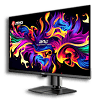
The MSI MPG 322UR QD-OLED X24 is a significant generational upgrade that delivers a better panel, more features, and a lower price than the model it replaces. It pairs Samsung Display's fourth generation QD-OLED technology with a 32-inch 4K panel running at 240 Hz, and the result is a monitor that excels in every major category.
Text clarity is excellent. The 4K resolution at 140 PPI produces crisp text and clean interface elements, and while the panel retains the triangular subpixel layout of earlier QD-OLED generations, color fringing is negligible at this pixel density. I used the monitor for extended text-heavy workloads and fringing never drew my attention, making the MPG 322UR QD-OLED X24 genuinely suitable for mixed-use workflows where you spend most of the day reading and writing, then switch to gaming in the evening.
Color performance is excellent in wide-gamut operation, with complete coverage of sRGB and very strong extension toward DCI-P3 and BT.2020. In native gamut mode the monitor delivers the saturated, high-impact look expected from QD-OLED. Switch to sRGB mode and accuracy tightens substantially, with an average ∆E of just 1.45. With minimal OSD tuning—brightness to 83 and a small RGB gain adjustment—grayscale ∆E drops to 1.54, gamma tracks the 2.2 target closely, and the white point stabilizes near 6,500 K. SDR brightness also improves significantly over the previous generation, reaching 273 cd/m² at maximum compared to 202 cd/m² on the MPG 322URX, which translates to better usability in well-lit rooms.
In HDR mode, the panel reaches just over 1,000 cd/m² on small highlights and maintains stronger mid-range luminance than its predecessor. The customizable Uniform Luminance feature lets you fine-tune the brightness curve across different window sizes, which reduces the jarring ABL pumping that can affect standard HDR implementations. Panel uniformity is very good, with tight brightness and color consistency across the full measurement grid.
Gaming performance is one of the monitor's clear strengths. Average perceived response time of 1.26 ms with practically zero overshoot places this display among the fastest available, and the near-instant transitions make 240 Hz feel effortless. Input lag averages about 5.85 ms, keeping the monitor well within competitive territory. The DisplayPort 2.1a UHBR20 interface is a meaningful differentiator, delivering native uncompressed 4K at 240 Hz with 10-bit color, which benefits NVIDIA DSR/DLDSR users and eliminates DSC compression artifacts from the signal path.
MSI carries over the practical features that made the 322URX appealing. The USB-C port delivers a confirmed 99.50 W of power, making the monitor a viable single-cable docking solution. The USB hub and automatic KVM switch work reliably. The addition of AI Care Sensor and OLED Care 3.0 from the newer generation platform brings customizable presence detection and a wider set of burn-in prevention tools, all of which operate unobtrusively and strike me as genuinely useful.
The stand does not offer pivot adjustment. For a 32-inch 4K panel that lends itself to productivity just as much as gaming, the lack of portrait-mode rotation is a surprising omission. If you need to rotate the display, a VESA arm with pivot support is the only way to go.
At $1,099, the MPG 322UR QD-OLED X24 costs $200 less than the MPG 322URX did at launch, while offering a newer panel generation with higher brightness, improved HDR certification, and additional AI features. That is a strong value proposition. If you want a 32-inch 4K monitor that handles competitive gaming, HDR content, and daily productivity with equal confidence, this is an excellent option.

Text clarity is excellent. The 4K resolution at 140 PPI produces crisp text and clean interface elements, and while the panel retains the triangular subpixel layout of earlier QD-OLED generations, color fringing is negligible at this pixel density. I used the monitor for extended text-heavy workloads and fringing never drew my attention, making the MPG 322UR QD-OLED X24 genuinely suitable for mixed-use workflows where you spend most of the day reading and writing, then switch to gaming in the evening.
Color performance is excellent in wide-gamut operation, with complete coverage of sRGB and very strong extension toward DCI-P3 and BT.2020. In native gamut mode the monitor delivers the saturated, high-impact look expected from QD-OLED. Switch to sRGB mode and accuracy tightens substantially, with an average ∆E of just 1.45. With minimal OSD tuning—brightness to 83 and a small RGB gain adjustment—grayscale ∆E drops to 1.54, gamma tracks the 2.2 target closely, and the white point stabilizes near 6,500 K. SDR brightness also improves significantly over the previous generation, reaching 273 cd/m² at maximum compared to 202 cd/m² on the MPG 322URX, which translates to better usability in well-lit rooms.
In HDR mode, the panel reaches just over 1,000 cd/m² on small highlights and maintains stronger mid-range luminance than its predecessor. The customizable Uniform Luminance feature lets you fine-tune the brightness curve across different window sizes, which reduces the jarring ABL pumping that can affect standard HDR implementations. Panel uniformity is very good, with tight brightness and color consistency across the full measurement grid.
Gaming performance is one of the monitor's clear strengths. Average perceived response time of 1.26 ms with practically zero overshoot places this display among the fastest available, and the near-instant transitions make 240 Hz feel effortless. Input lag averages about 5.85 ms, keeping the monitor well within competitive territory. The DisplayPort 2.1a UHBR20 interface is a meaningful differentiator, delivering native uncompressed 4K at 240 Hz with 10-bit color, which benefits NVIDIA DSR/DLDSR users and eliminates DSC compression artifacts from the signal path.
MSI carries over the practical features that made the 322URX appealing. The USB-C port delivers a confirmed 99.50 W of power, making the monitor a viable single-cable docking solution. The USB hub and automatic KVM switch work reliably. The addition of AI Care Sensor and OLED Care 3.0 from the newer generation platform brings customizable presence detection and a wider set of burn-in prevention tools, all of which operate unobtrusively and strike me as genuinely useful.
The stand does not offer pivot adjustment. For a 32-inch 4K panel that lends itself to productivity just as much as gaming, the lack of portrait-mode rotation is a surprising omission. If you need to rotate the display, a VESA arm with pivot support is the only way to go.
At $1,099, the MPG 322UR QD-OLED X24 costs $200 less than the MPG 322URX did at launch, while offering a newer panel generation with higher brightness, improved HDR certification, and additional AI features. That is a strong value proposition. If you want a 32-inch 4K monitor that handles competitive gaming, HDR content, and daily productivity with equal confidence, this is an excellent option.
Nov 20th, 2026 15:35 PST
change timezone
Latest GPU Drivers
New Forum Posts
- How to prevent OLED burn damage due to PC freezes or power outtages? (49)
- RX 9000 series GPU Owners Club (2249)
- WarpCoreBench scores! (82)
- Honestly, do you care about GTA VI? (209)
- Logitech Headsets Modded Driver — Unlock Dolby in G HUB (23)
- 1 - 5 person file storage server equivalent accasible from anywhere + general VM server. (1)
- When you could finally run Crysis maxed out? (63)
- GTA VI (20)
- Anthrophics IPO (25)
- GeekMagic Ultra Smart WiFi Weather Station (8)
Popular Reviews
- AMD Zen 6 Technical Deep Dive
- Microsoft Surface Laptop Ultra Review - The Next-gen Arm Laptop
- Ugreen NASync DXP4800 GT Review
- Corsair RM1200e (Second Generation) Review
- Acemagic Retro X3 Review
- Upcoming Hardware Launches 2027 (Updated Nov 2026)
- Pulsar Office Tour & First Look at P1 Dual-Sensor Mouse
- Biwin Black Opal NV7400 2 TB Review
- AMD Ryzen 7 9800X3D Memory Performance Scaling
- AMD Ryzen 7 9800X3D Review - The Best Gaming Processor
TPU on YouTube
Controversial News Posts
- NVIDIA Co-Founder and CEO Jensen Huang Officially Resigns (491)
- Report: Jensen Huang Eyes NVIDIA Comeback (256)
- Open Letter Asking NVIDIA to Reinstate Jensen Huang Passes 115,000 Signatures (184)
- OpenAI CEO Argues Home PCs Waste the World's Limited DRAM Supply (152)
- NVIDIA Launches Investigation Into Jensen Huang's Relationship With Suspected Chinese Spy (136)
- Intel "Raptor Lake Next" 16-Core and 20-Core CPUs Surface (130)
- Legendary Game Studio BioWare Shuts Down Following EA Layoffs (104)
- Dell CEO Says the Memory Shortage Will Get Worse in 2027 (95)