 5
MSI MPG X870I Edge Ti Evo Wi-Fi Review
Component Analysis »Board Layout


There isn't anything too eyebrow-raising in the design top-down, with the usual M.2 stack at the bottom of the board and single VRM heatsink that is actively cooled by a small fan, but unlike the B850 model, there's no active M.2/chipset cooling. The color is MSI's venerable titanium with some white details, so wouldn't look out of place in a white case. The rear of the PCB features a heatsink cooling the rear of the VRMs, and a PCIe Gen 4 M.2 port.
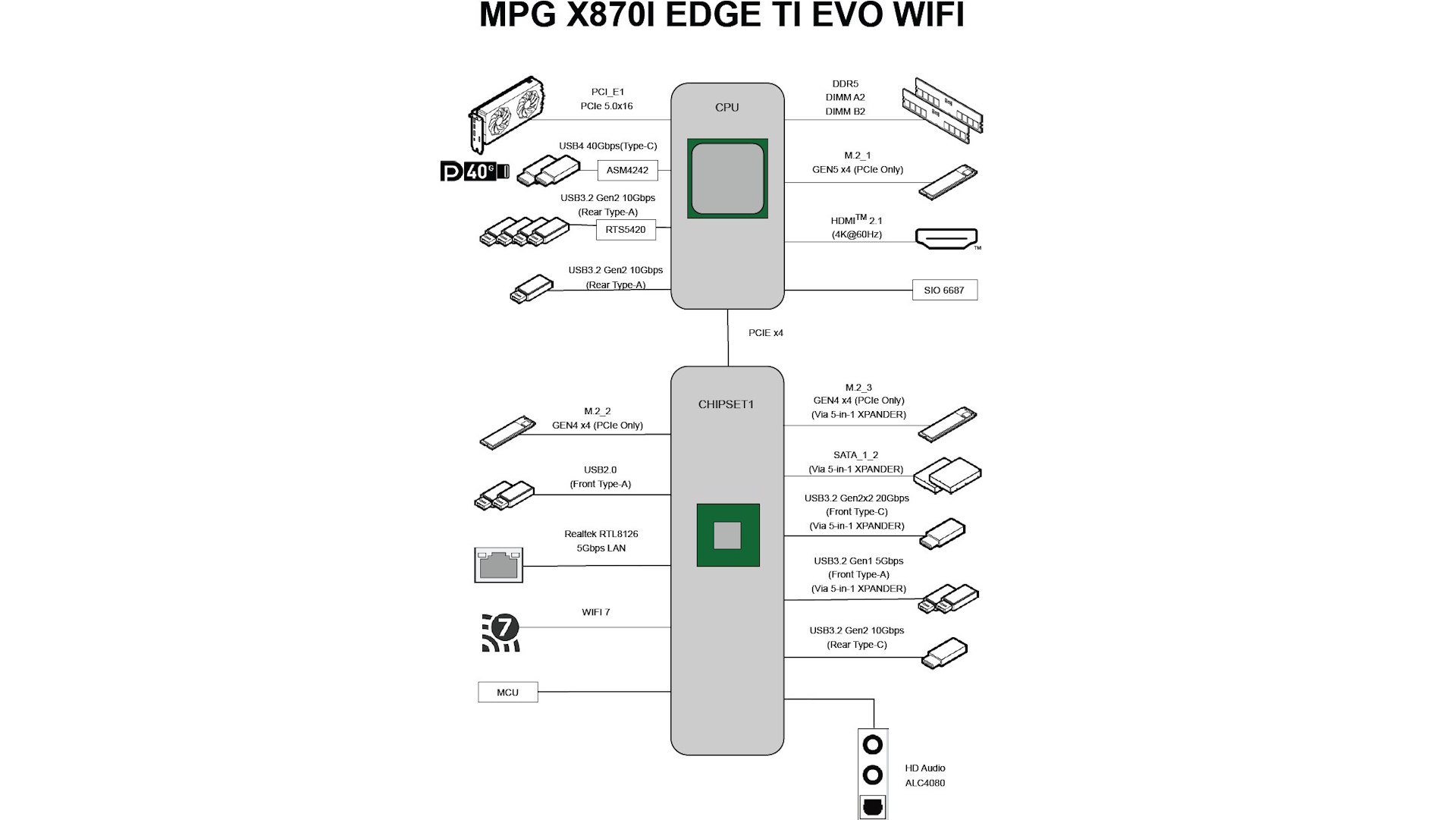
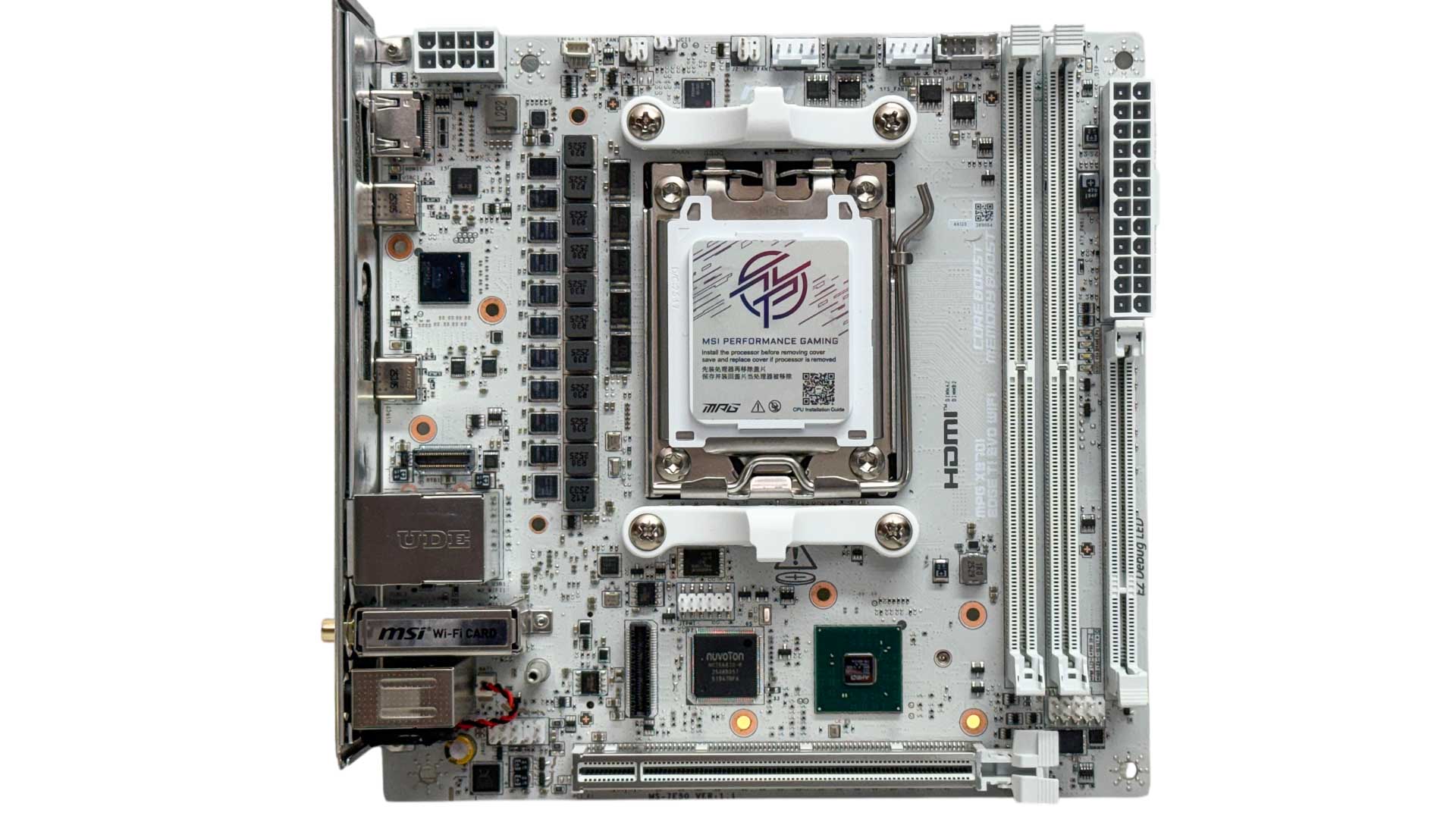
There's no bandwidth sharing here, so all three M.2 ports and USB4 ports can be used concurrently with no lane sharing or stealing bandwidth from your graphics card either. We have seen extreme versions of AMD chipsets used on Mini-ITX boards in the past, but there's little point doing so as the additional chipset rarely adds features due to space limitations, and steals valuable PCB real estate. Still, MSI has had to employ several daughter boards.
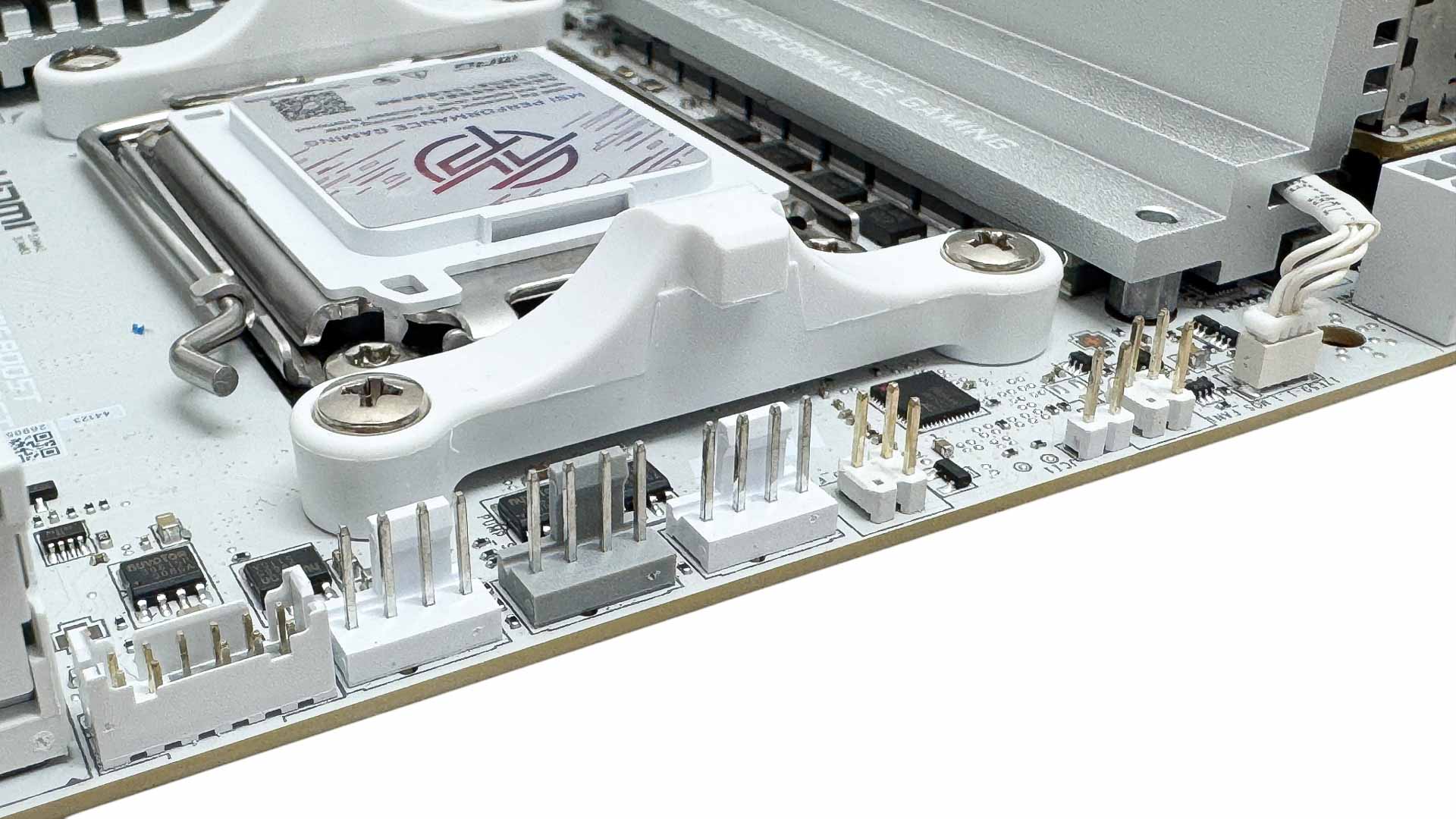
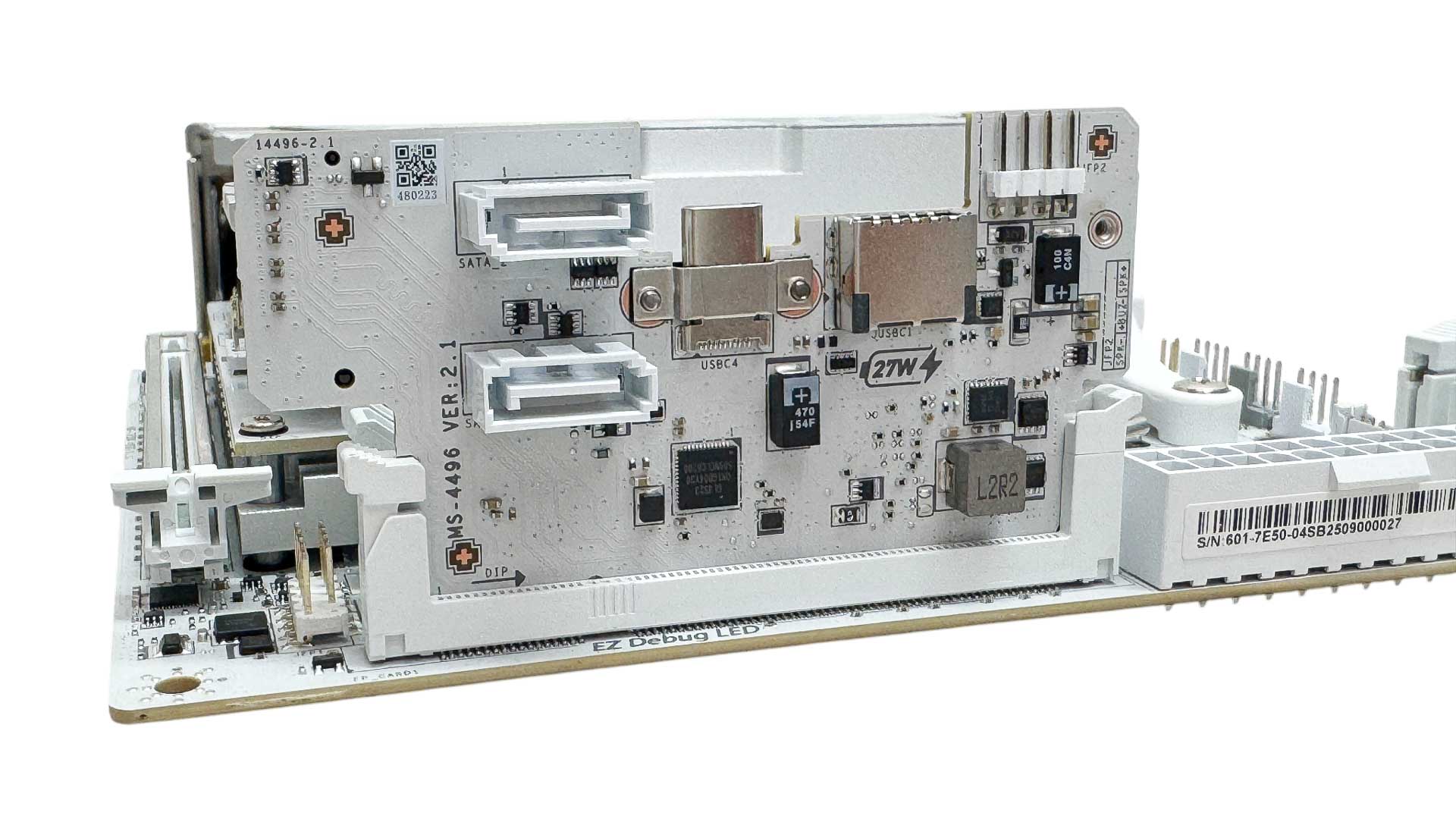
The three PCB-mounted 4-pin fan headers have the full spectrum of power available. The CPU header offers 2 A/24 W, the PUMP_ SYS header an impressive 3 A/36 W and the SYS_FAN1 header 1 A/12 W. The fourth header comes via a splitter cable that attaches to the EZ Conn header next to the fan headers. The 5-in-1 Xpander card uses a slot next to the 24-pin ATX connector. It's optional, but it provides the board's only SATA ports as well as its USB 3.2 Gen 2x2 20 Gbps Type-C header with 27 W power delivery, its USB 3.0 header via a Type-C header cable and the third M.2 port.
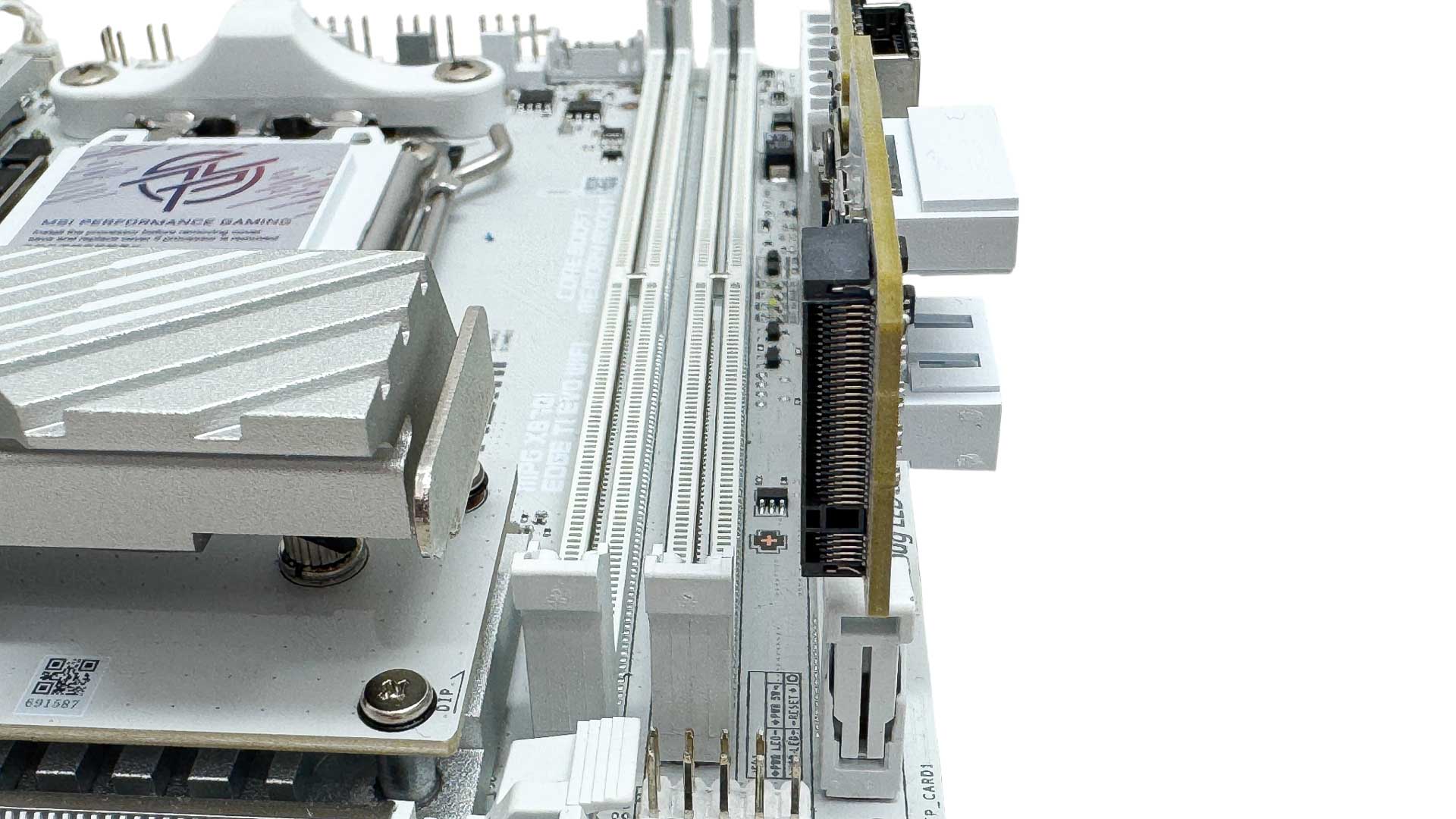
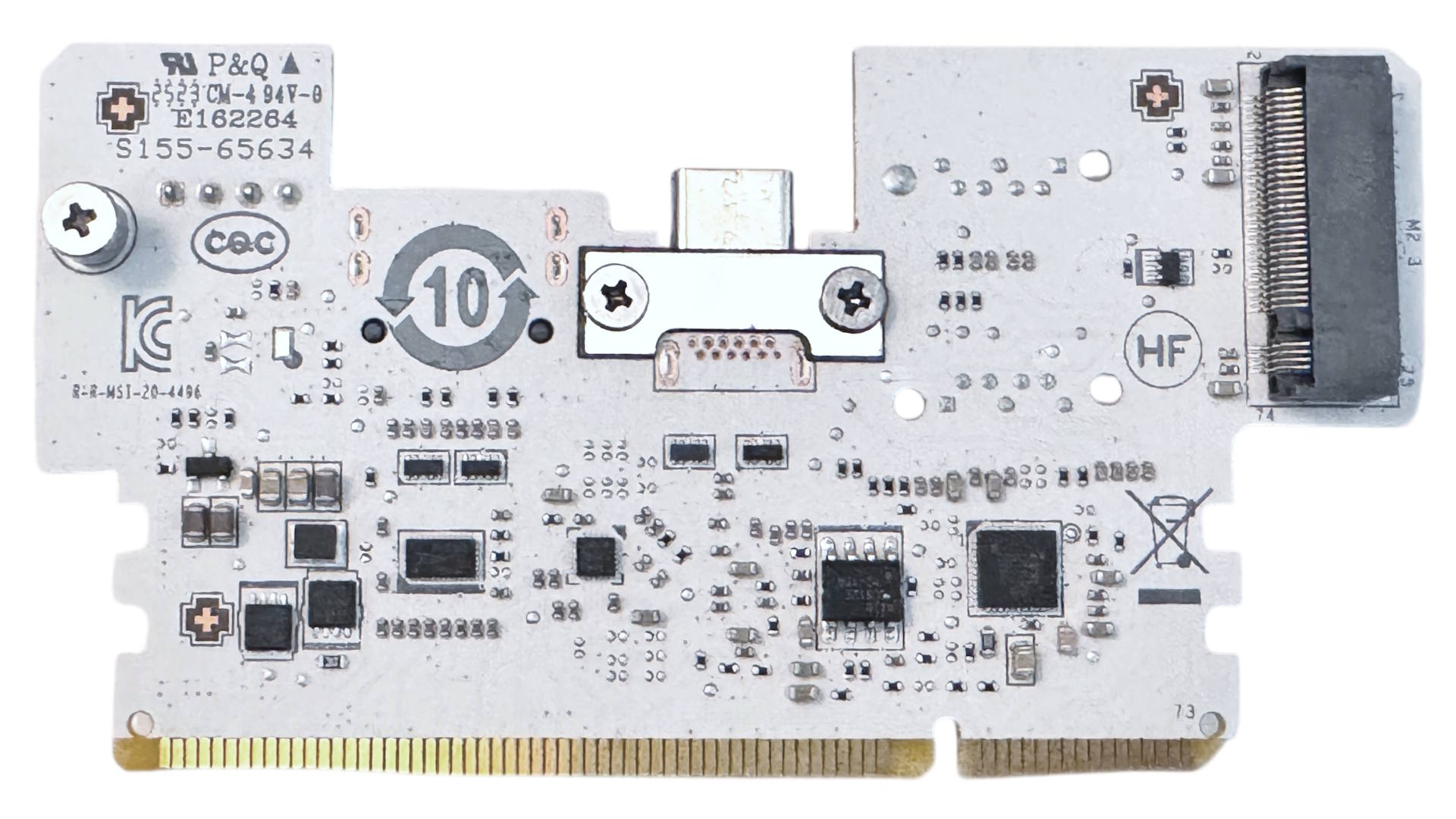
Slim M.2 heatsinks will be possible, but compatibility will depend on how wide your memory is. It's a shame that there wasn't a way of utilizing this vertical space for a larger heatsink, but plenty of low-end PCIe Gen 4 and PCIe Gen 3 SSDs will be perfectly fine without one, even some of the more efficient Gen 5 drives.
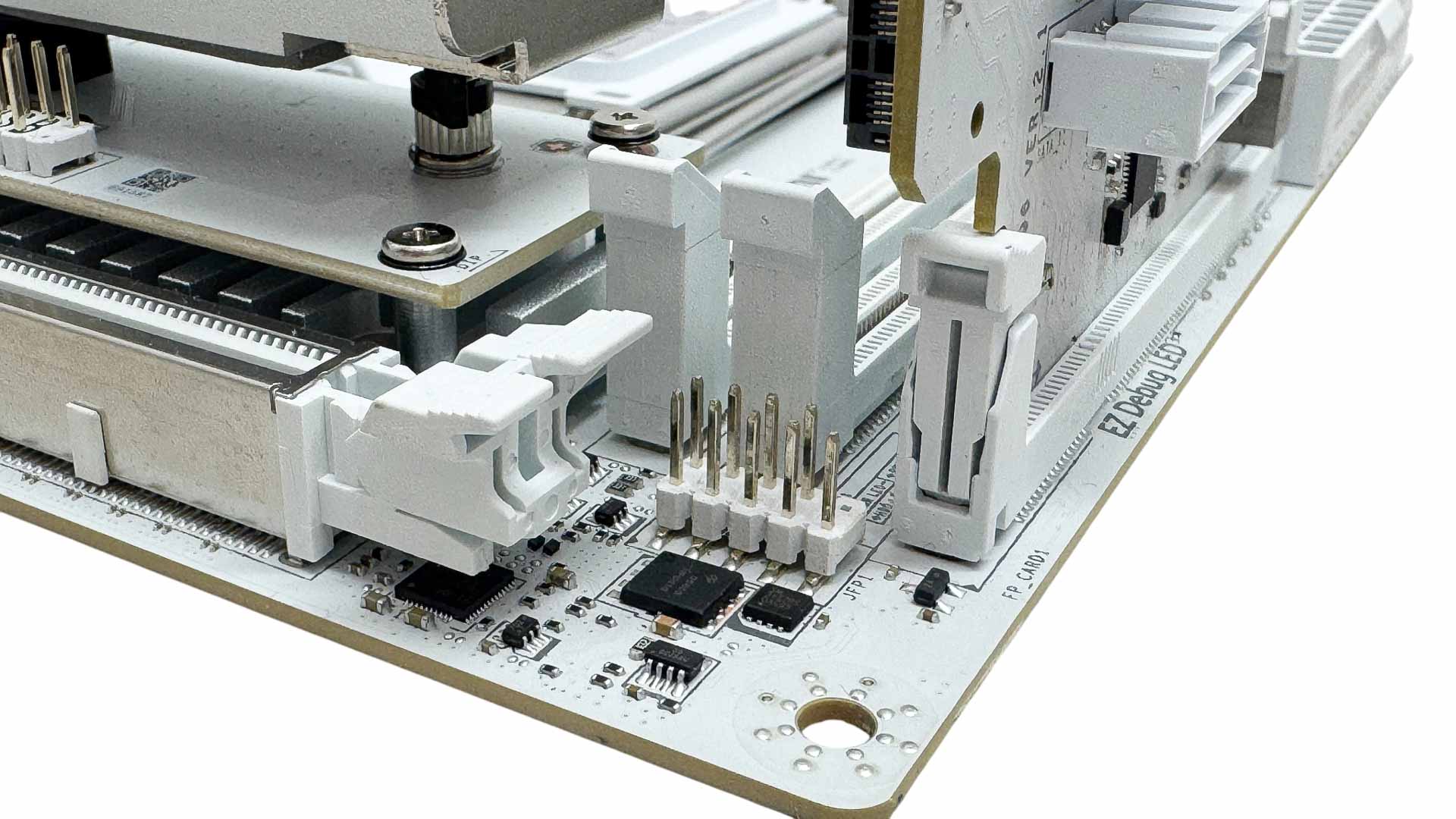
The card does, however, make getting at the front panel header and GPU release lever quite difficult. MSI has a solution to one of these, which is the front panel header, as it includes an extension cable in the box so if you manage to dislodge one of the case front panel cables, you won't be fiddling around for hours with a pair of long nose pliers trying to get it back in. Sadly, there's no enhanced GPU release here like you get on Gigabyte and ASUS alternatives, which would be very useful in Mini-ITX systems.
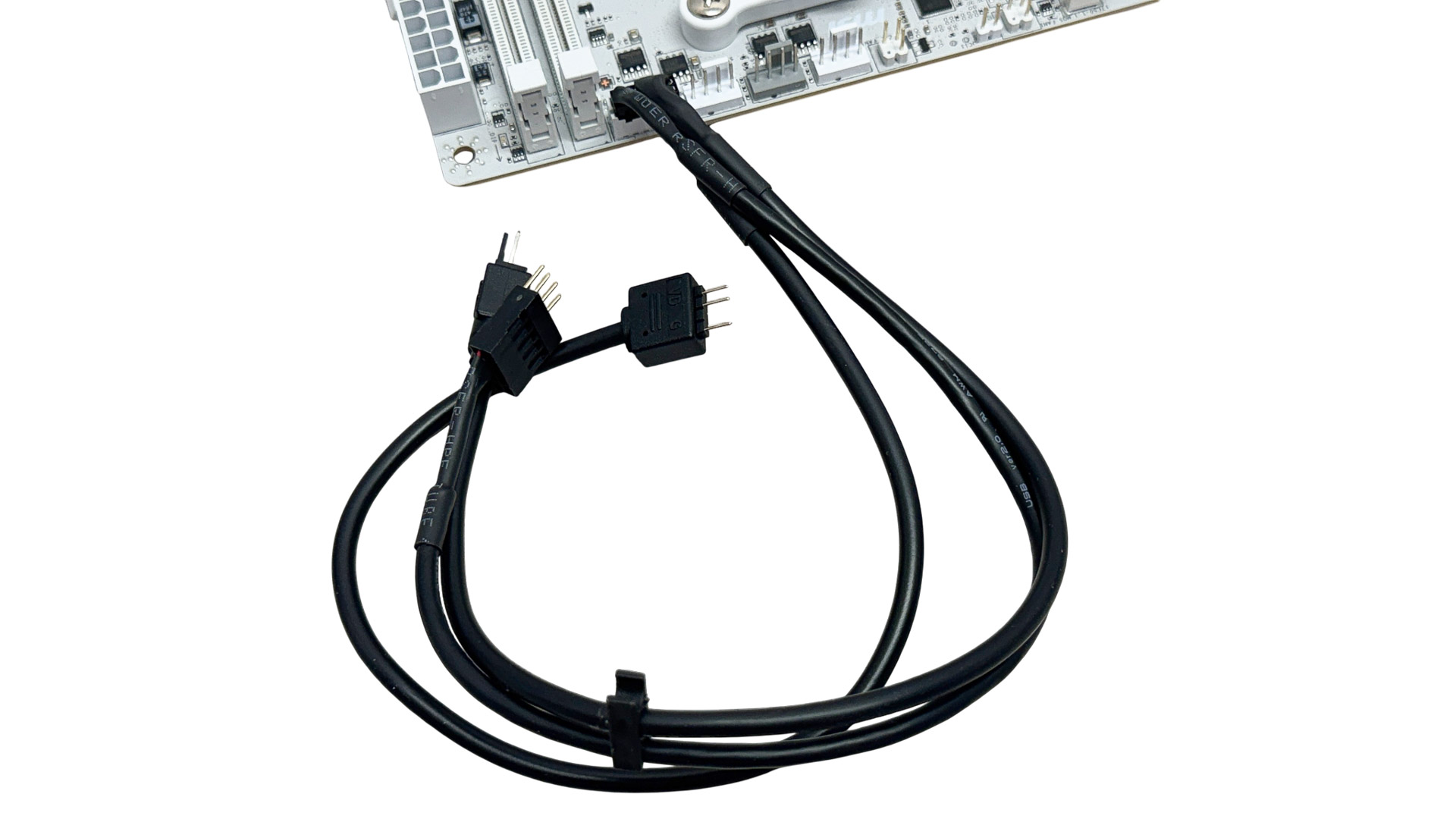
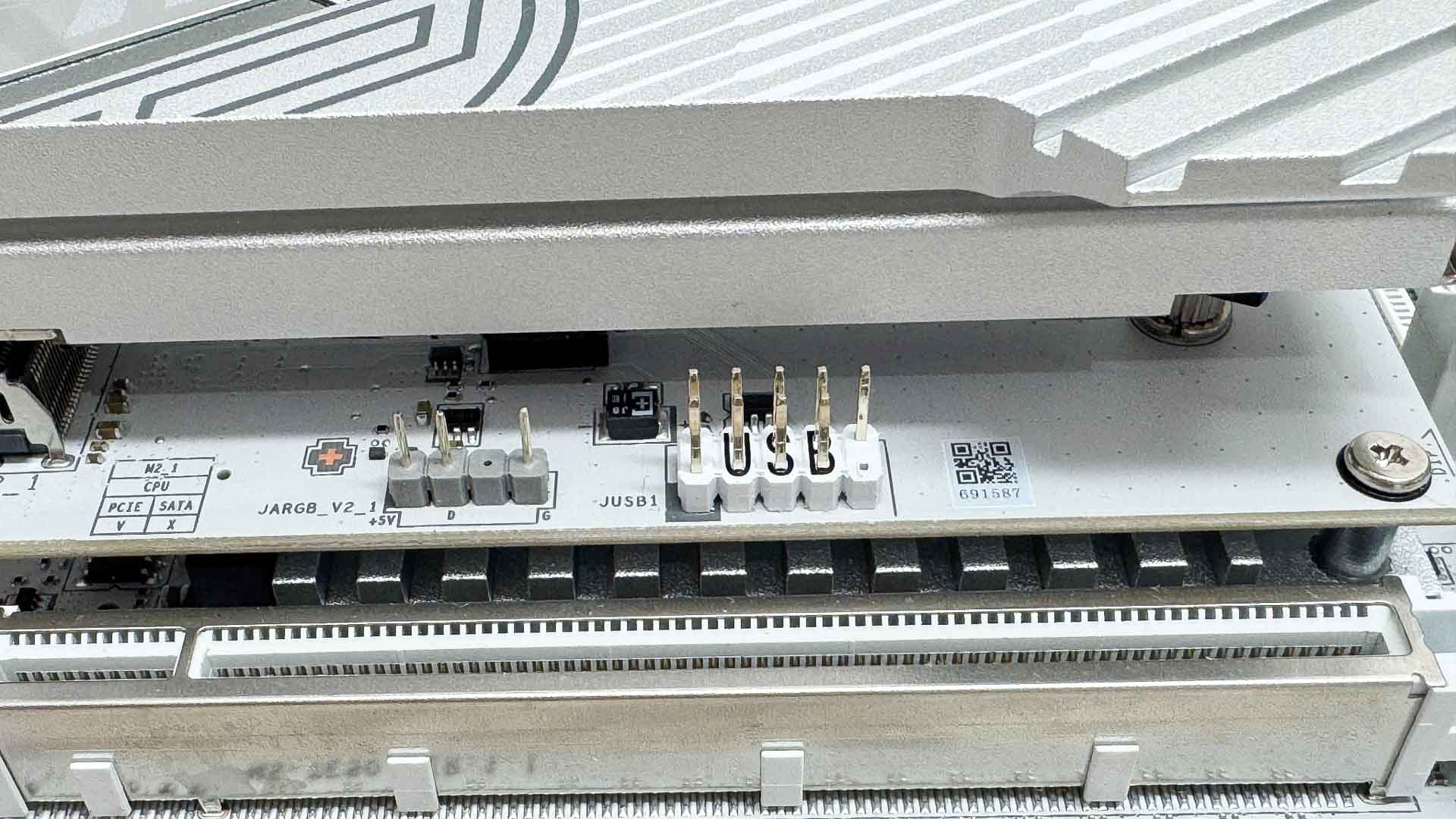
The 1 to 3 EZ Conn-Cable (V2) cable splits out into 3-pin ARGB, USB 2.0 and 4-pin fan headers with a cable that's long enough to head down behind the motherboard and will likely mean you won't need any extension cables. The cables themselves can be split in different directions by detaching them from the cable-tidying clip. Moving down to the first daughterboard that houses the only PCIe Gen 5 M.2 port, and we also have a second USB 2.0 header along with another 3-pin ARGB header.
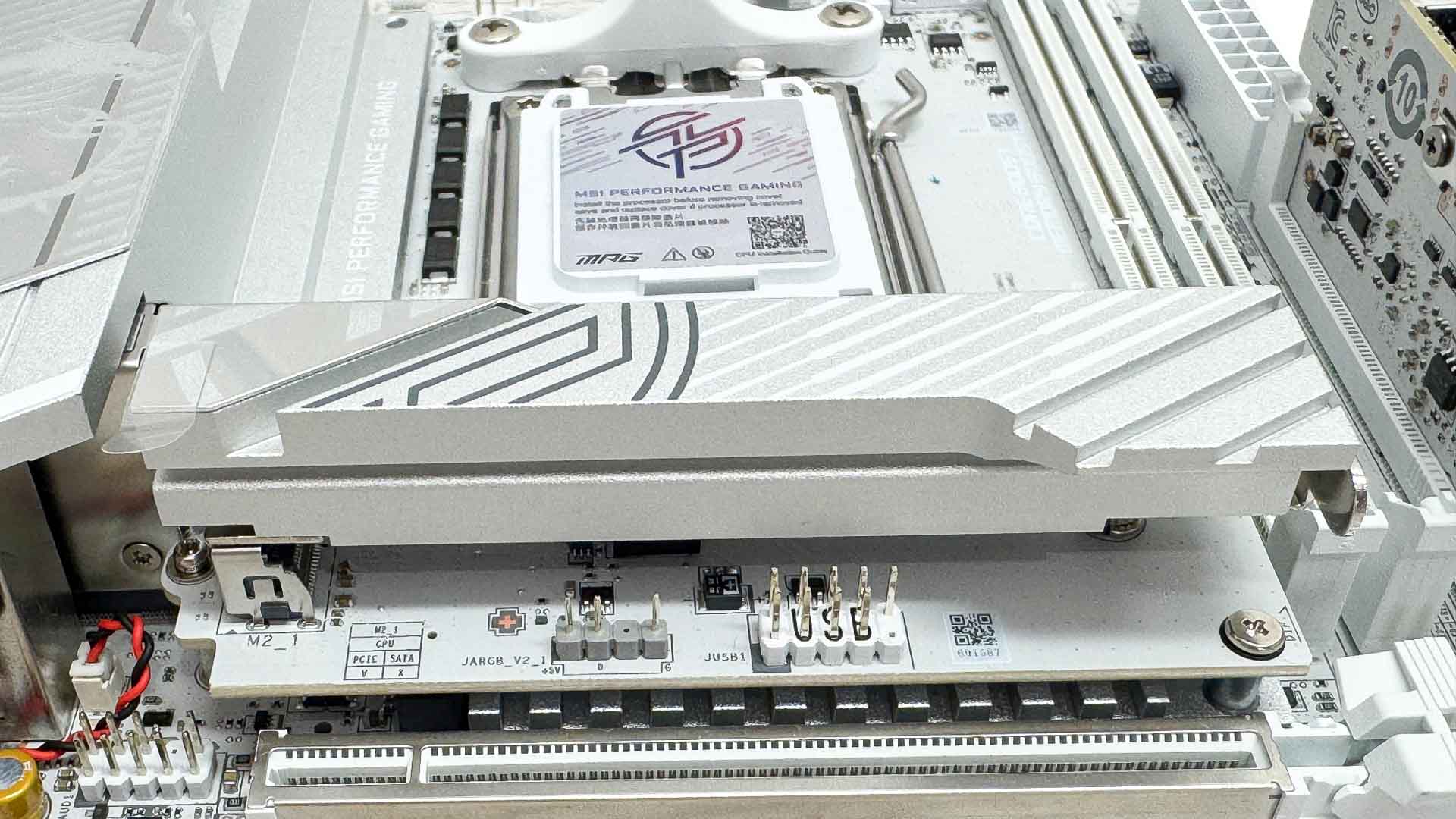
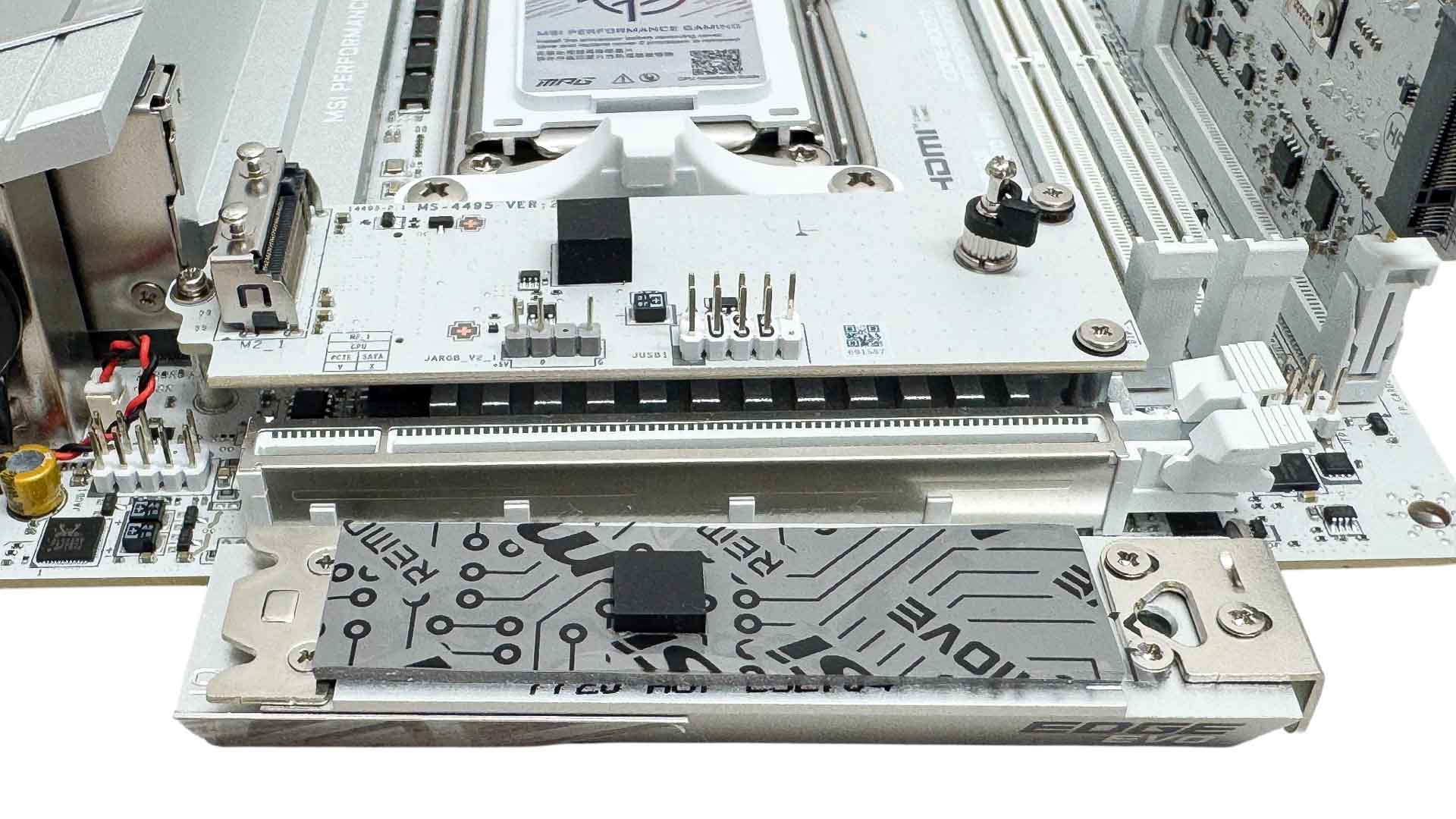
Sadly, the M.2 port lacks underside SSD cooling, but the large heatsink should fare well with single-sided SSDs, of which there are plenty around in both PCIe Gen 4 and Gen 5 flavors. The heatsink is mostly easy to install although the 5-in-1 Xpander card does hamper access to the tool-free release lever. The sloped M.2 heatsink is combined with a different VRM heatsink design to the Z890 board, here there are none of the compatibility issues it and other boards faced. Noctua, ARCTIC, NZXT and various other low profile coolers and AIO liquid coolers all fitted fine in terms of mounting mechanisms and pumps.
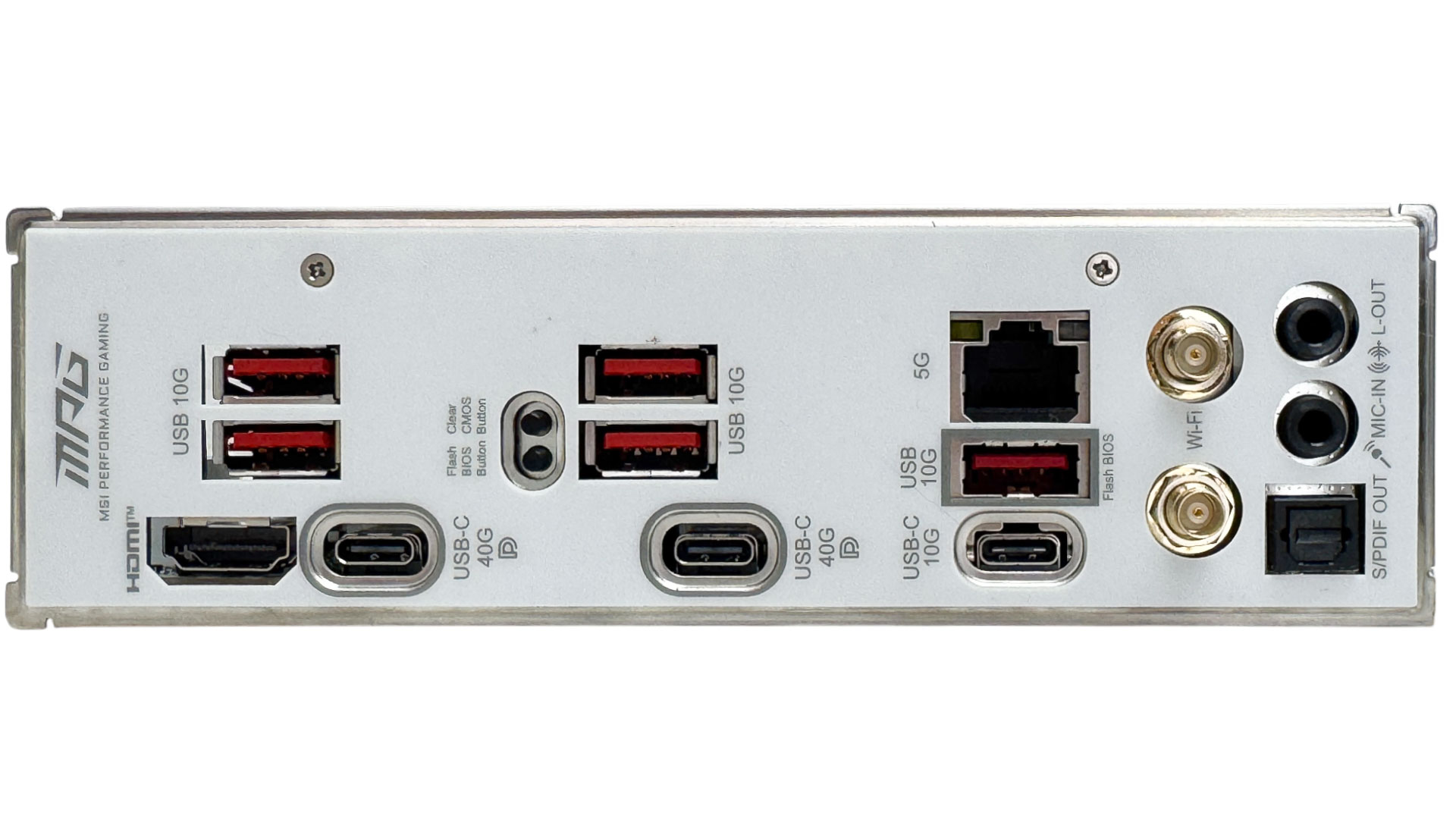
Five Type-A USB ports isn't earth-shattering, but it's better than average on the rear I/O panel, and these are all USB 3.2 Gen 2 10 Gbps as well. Of course, there's a big focus on Type-C too with a pair of USB4 40 Gbps Type-C ports that double as DisplayPort outputs running off your CPU's iGPU, plus a further 10 Gbps Type-C. There's also a HDMI port plus USB BIOS Flashback and Clear CMOS buttons. You get 5 Gbps Ethernet too, and two EZ Antenna-compatible connectors that are also compatible with standard Wi-Fi antenna threads. Finally, there's the usual audio outputs consisting of a pair of 3.5 mm jacks and optical output.
Nov 19th, 2026 16:14 CST
change timezone
Latest GPU Drivers
New Forum Posts
- Honestly, do you care about GTA VI? (164)
- Windows 11 General Discussion (7736)
- Current Sales, Bundles, Giveaways (10448)
- Last game you purchased? (1409)
- WarpCoreBench scores! (76)
- Got the EOL 32GB TridentZ 6000 CL26 1.4V (12)
- Dell Workstation Owners Club (3516)
- Making a game in Godot engine (4)
- DTS DCH Driver for Realtek HDA [DTS:X APO4 + DTS Interactive] (2815)
- Security Apps (2)
Popular Reviews
- Acemagic Retro X3 Review
- Ugreen NASync DXP4800 GT Review
- Upcoming Hardware Launches 2027 (Updated Nov 2026)
- Pulsar Office Tour & First Look at P1 Dual-Sensor Mouse
- AMD Zen 6 Technical Deep Dive
- Biwin Black Opal NV7400 2 TB Review
- Sapphire Radeon RX 7700 XT Pure Review
- Sapphire Radeon RX 7700 XT Pulse Review
- AMD Ryzen 7 9800X3D Review - The Best Gaming Processor
- Chieftec Iceberg PRO 360 DARK Review
TPU on YouTube
Controversial News Posts
- NVIDIA Co-Founder and CEO Jensen Huang Officially Resigns (489)
- Report: Jensen Huang Eyes NVIDIA Comeback (223)
- Open Letter Asking NVIDIA to Reinstate Jensen Huang Passes 115,000 Signatures (184)
- OpenAI CEO Argues Home PCs Waste the World's Limited DRAM Supply (152)
- NVIDIA Launches Investigation Into Jensen Huang's Relationship With Suspected Chinese Spy (136)
- Intel "Raptor Lake Next" 16-Core and 20-Core CPUs Surface (130)
- Legendary Game Studio BioWare Shuts Down Following EA Layoffs (104)
- Dell CEO Says the Memory Shortage Will Get Worse in 2027 (95)