 6
MSI MEG Z890 ACE Review
(6 Comments) »Value and Conclusion
- The MSI MEG Z890 Ace is available online for $489
- Looks great
- 10 Gbps Ethernet
- Hardware well suited to overclocking
- 60 W Type-C front panel power delivery
- Loads of fast USB ports, both Type-A and Type-C
- Tool-free M.2 heatsinks and M.2 ports
- Front USB 3.2 Gen 2×2 20 Gbps Type-C header
- Two Thunderbolt 4 40 Gbps Type-C ports
- Disappointing SSD temperatures, even for Gen 4 drives
- VRMs could be cooler
- Still a little expensive compared to the competition
- Lower M.2 heatsink is tricky to install
- A dual PCIe Gen 5 SSD setup steals GPU bandwidth
- Lower M.2 heatsink requires GPU removal
- Some EFI fan control options missing from software
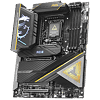
The MSI MEG Z890 ACE's recent price cut has brought it into contention for anyone considering a high-end LGA1851 motherboard. This is especially true if they'd also benefit from the likes of 10 Gbps Ethernet, a huge amount of expansion possibilities, and impressive number of both Type-A and Type-C USB ports.
These features are backed up by the usual PCIe Gen 5 GPU and M.2 support, with the latter boasting dual Gen 5 SSD support too, albeit at the expense of GPU lanes, which are cut to eight. There's also dual Type-C Thunderbolt 4 ports, and its Type-C front panel header is not only USB 3.2 Gen 2x2 20 Gbps-capable, but can also dish out up to 60 W for fast-charging smartphones, tablets or even some laptops.
We also love the design, with restrained RGB lighting that's in keeping with the aesthetics, the board is bristling with extra RGB headers too. If you're looking to do some overclocking, then the MEG Z890 ACE isn't just gunning for mainstream here. It has many features that benefit going sub-zero, and an EFI almost overflowing with settings besides hardware controls.
There are, unfortunately, some issues. The SSD temperatures were not what we expect to see from a high-end motherboard. There doesn't seem to a clear reason for them other than the heatsinks not applying enough pressure. This seems to be more of an issue for the upper heatsinks, seeing as our single-sided PCIe Gen 4 SSD's result was by far the biggest outlier. This is also at odds with pretty much every other MSI board we've tested over the last year. The sub-par SSD cooling didn't result in significant throttling, though, and was in a worst case scenario with no airflow over the motherboard. Better results would likely be seen in a system with reasonable airflow. Still, other boards have fared much better.
The VRM temperatures were a little disappointing when you consider boards costing half the price fared better. There are obvious comparisons to make here with other high-end overclocking-focussed competition, such as the ASRock Z890 Taichi OCF which has received a $100 price cut since we looked at it six months ago. It offered far better SSD and VRM temperatures and is a real overclocking-focussed board. The Taichi OCF does lack 10 Gbps Ethernet, enhanced Type-C front panel power delivery and has far fewer USB ports, though. Other options include the ASUS ROG Maximus Z890 Hero, which is now regularly available for under $550. It's arguably even better-looking, also offers dual PCIe Gen 5 SSD support, albeit with the same halving of GPU lanes, also has 60 W Type-C front panel power delivery, and offers far better SSD and VRM temperatures. However, while it has dual Ethernet ports, it peaks at 5 Gbps rather than the MEG Z890 Ace's 10 Gbps. ASRock's Phantom Gaming Z890 Riptide Wi-Fi may have an inferior EFI and software, but for basic overclocking it's enough, costs $300 less, and again offered cooler VRMs and SSD temperatures.
In short, you are paying for the extras here. The 10 Gbps Ethernet, huge array of USB connectivity, dual PCIe Gen 5 SSD support and lavish overclocking features are adding a good $300 to the price tag over solid options with fewer features. The SSD temperatures we can maybe forgive, given they're still unlikely to actually result in throttling with reasonable airflow, so it's best to focus on the features you'll be benefitting from. This is all assuming you're dead-set on an Intel system. If you're looking for a similar high-end featured board from AMD, there are a few options out there, not to mention MSI's soon-to-be-released MEG MAX series boards on Socket AM5, which will all have 10 Gbps Ethernet, amongst other features.
The MSI MEG Z890 Ace has its niche, then, and is overall an impressive option despite disappointing SSD temperatures. However, similarly specced X870E options are compelling alternatives, even then, 10 Gbps Ethernet PCIe cards are available for less than $100. Install a 10 GbE AIC to a much cheaper Z890 board, and you should save money. Given its downward price trajectory, though, the MSI MEG Z890 ACE may well end up being even cheaper soon, potentially tempting paired with price cuts in Intel's Core Ultra CPUs.
Nov 25th, 2026 18:24 CST
change timezone
Latest GPU Drivers
New Forum Posts
- Smokin Hot Lappy (7)
- Sexy Hardware Close-Up Pic Clubhouse. (10345)
- AAF Optimus Modded Driver For Windows 10 & 11 - Only for HDAUDIO Chips [WINDOWS 11 RECOMMENDED] (1155)
- Which ryzen am5 cpu ? (219)
- {NA} 2026 Black November prices / deal (7)
- TPU's Nostalgic Hardware Club (22208)
- UPS what one to get? (74)
- More Nova Lake specs (5)
- Share your CPUZ Benchmarks! (2680)
- X79 and/or rampage IV OC'ing thread for those of us still left.... (2457)
Popular Reviews
- ASRock X870E Challenger Wi-Fi White Review
- VZMORE AX9 Max Review
- Upcoming Hardware Launches 2027 (Updated Nov 2026)
- Microsoft Surface Laptop Ultra Review - The Next-gen Arm Laptop
- AMD Ryzen 7 9800X3D Review - The Best Gaming Processor
- AMD Zen 6 Technical Deep Dive
- Corsair RM1200e (Second Generation) Review
- Phantom Blade Zero Performance Benchmark Review - 35 GPUs Tested
- Pulsar Office Tour & First Look at P1 Dual-Sensor Mouse
- Ocypus lota P1000 Review
TPU on YouTube
Controversial News Posts
- Jensen Huang Reinstated as CEO of NVIDIA (572)
- NVIDIA Co-Founder and CEO Jensen Huang Officially Resigns (492)
- Report: Jensen Huang Eyes NVIDIA Comeback (281)
- Open Letter Asking NVIDIA to Reinstate Jensen Huang Passes 115,000 Signatures (184)
- OpenAI CEO Argues Home PCs Waste the World's Limited DRAM Supply (152)
- NVIDIA Launches Investigation Into Jensen Huang's Relationship With Suspected Chinese Spy (136)
- Intel "Raptor Lake Next" 16-Core and 20-Core CPUs Surface (130)
- Intel Razor Lake Gets a 12 P-Core bLLC Chip With No E-Cores, Per Leak (94)