 13
Neo Forza MARS DDR4-4000 2x 32 GB Review
(13 Comments) »Introduction

Neo Forza is one of the newer manufacturers of DRAM memory modules and flash memory products in the consumer market. Under the guidance of parent company Goldkey, Neo Forza is a Taiwanese company founded in 2018 that focuses on enthusiast-grade products.
Neo Forza has a number of established and successful products, of which its memory lineup is the largest. The Neo Forza MARS line is designed to meet the needs of PC enthusiasts. The company prides itself for selecting high-quality chips in a strict filtering process, with the Encke, Faye, Finlay and Mars product lines offering appropriate kits for every consumer type. The Neo Forza Mars offers speeds that range from 3200 MT/s to 4400 MT/s and has listed DIMM sizes of 8 GB, 16 GB, and 32 GB.
What makes this memory somewhat special, is that it is a dual-rank ultra-high capacity kit. Unlike the majority of enthusiast-grade system memory kits on the market today, dual-rank has ICs placed on both sides, which can increase bandwidth and decrease access time to separate sets of data. The immediate advantage is that there is more memory per DIMM, with the second advantage being that only two slots are required for the same amount as eight 8 GB DIMMs could provide. Thus allowing for higher operating frequencies and lower stress on the CPU memory controller, with the same memory capacity accessible to the system.
That being said, this is the highest density commercially available kit outside of the enterprise market and is not for every type of user. Cue the prosumer! Not the average gamer, but rather those who need multiple programs open at once during a game stream. YouTube, Twitch, OBS, web browsers and games combined can use a tremendous amount of system memory. This extends to software developers, graphic designers and video editors as well, that need more system memory at their disposal. For PC enthusiasts, especially ITX board owners, who are looking to push their systems to the limit, this memory kit offers something tantalizing. Getting dual-rank memory to operate synchronously with the CPU memory controller in a 1:1 ratio (Gear 1) is quite a challenge, but the payoff can be quite rewarding to accomplish!

The Neo Forza Mars DDR4-4000 64 GB kit I have for review today has an 4000 MT/s XMP profile with 19-23-23-46 timings operating at 1.4 V. In this review, we will be testing the memory at its advertised speed before looking into what tuning can offer in terms of extra performance. Without further ado, let's see how this Neo Forza Faye MARS kit stacks up to the competition!
Specifications
| Specifications | |||
|---|---|---|---|
| Manufacturer: | Neo Forza | Neo Forza | |
| Model: | NMGD432F82-4000FF20 | NMGD432F82-4000FF20 | |
| XMP Profile: | XMP-1 | JEDEC | |
| Speed Rating: | DDR4-4000 MT/s | DDR4-2666 MT/s | |
| Rated Timings: | 19-23-23-46-70 | 19-19-19-43-61 | |
| Tested Capacity: | 64 GB (2x 32 GB) | 64 GB (2x 32 GB) | |
| Tested Voltage: | 1.4 V | 1.2 V | |
| Registered/Unbuffered: | Unbuffered | Unbuffered | |
| Error Checking: | No | No | |
| IC Manufacturer: | SK Hynix | SK Hynix | |
| Form Factor: | 288-pin DIMM | 288-pin DIMM | |
| Warranty: | Limited Lifetime | Limited Lifetime | |
Packaging


The Neo Forza MARS memory kit is packaged in a cardboard box and does a great job of making sure all the necessary information is covered. The front has a cutout showing off the actual memory, with a picture below depicting what the RGB portion will look like as well. This is fairly accurate, always nice to see.
Neo Forza MARS supports several software ARGB managers, including ASUS Aura Sync, GIGABYTE RGB Fusion, MSI Mystic Light Sync and ASRock Polychrome Sync, but fails to list details of compatibility on the box. This information can be found on the website however.
The only misshap Neo Forza has going on here is the incorrect use of Megahertz (MHz) for the XMP operating frequency. The memory does have an effective clock of 4000 MHz, due to DDR being double data rate. However, it is actually operating at 2000 MHz for this XMP profile. This type of marketing is common to see, though not technically correct. Writing "effective clock" next to the frequency could cause confusion. To make matters even more complicated, the PC4 DRAM rating is using effective clock for the caluations. For example, PC4-32000 equates to DDR4-4000. This 32000 value is the maximum number of bits tansferred per second. To get this number, multiply the effective clock by 8 (4000 x 8).
These naming convention habits aren't just with Neo Forza, as motherboard vendors often convey the DDR frequency in multiple ways as well. It is easier to market a higher number than the technical operating frequency. If we get right to the core issue, no vendor, memory, or motherboard manufacturer can agree on what is the best way to market this. In the motherboard BIOS, an equal amount of motherboards will list the true clock frequency of the memory (2000 MHz), the other half will list the values DDR4-4000, and a few will be even more incorrect by listing as DDR4-4000 MHz. Ultimately, all these errors do is confuse the end-user.
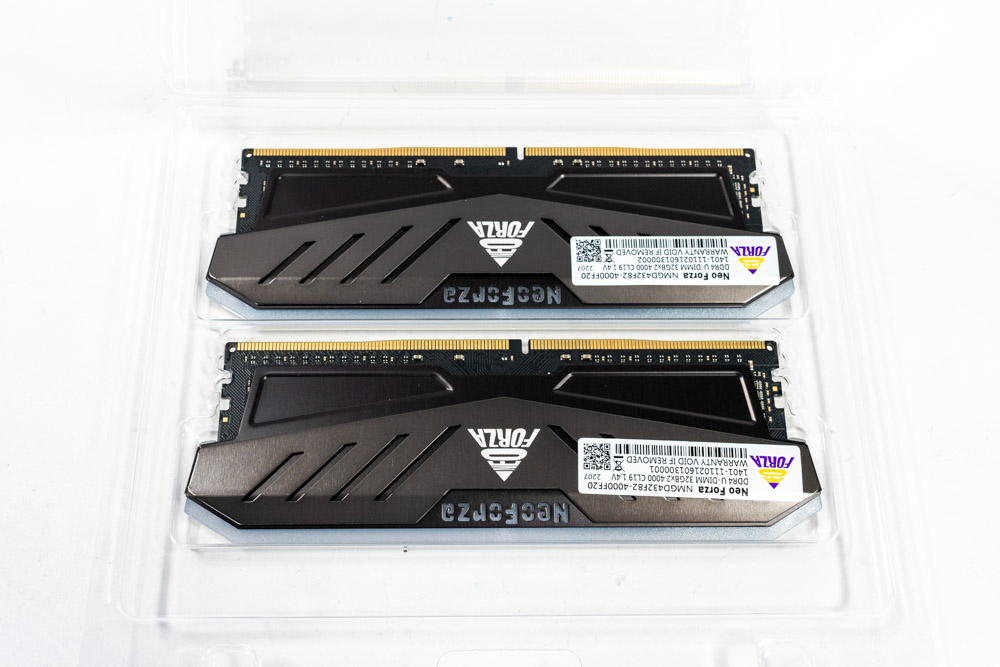
Removing the memory from the box only requires cutting some tape—the memory sticks are secured and protected from minor damage with a clamshell inside the outer box.
Our Patreon Silver Supporters can read articles in single-page format.
Nov 24th, 2026 09:55 CST
change timezone
Latest GPU Drivers
New Forum Posts
- Increasing Power Limit? (32)
- AMD ULL settings tinkering thread - post settings and Zen pics (88)
- Games at first startup always worse why? (1)
- Linpack Xtreme Released (509)
- Power supply noise stops when I move the mouse (11)
- Primary DisplayPort Monitor Not Waking After Driver Updates 621.01 and 621.14 (10)
- HP ZBook 17 G3 i7 – black screen and fans running at max speed after switching SSD to GPT (2)
- Your PC ATM (36490)
- GTA VI (33)
- I forced a 16 Year Old 64GB SSD to write 1 PETABYTE (And it didn't die) (194)
Popular Reviews
- Microsoft Surface Laptop Ultra Review - The Next-gen Arm Laptop
- ASRock X870E Challenger Wi-Fi White Review
- Upcoming Hardware Launches 2027 (Updated Nov 2026)
- Corsair RM1200e (Second Generation) Review
- AMD Ryzen 7 9800X3D Review - The Best Gaming Processor
- AMD Zen 6 Technical Deep Dive
- AMD Ryzen 7 7700X3D Review
- Pulsar Office Tour & First Look at P1 Dual-Sensor Mouse
- Phantom Blade Zero Performance Benchmark Review - 35 GPUs Tested
- Ugreen NASync DXP4800 GT Review
TPU on YouTube
Controversial News Posts
- NVIDIA Co-Founder and CEO Jensen Huang Officially Resigns (492)
- Jensen Huang Reinstated as CEO of NVIDIA (469)
- Report: Jensen Huang Eyes NVIDIA Comeback (281)
- Open Letter Asking NVIDIA to Reinstate Jensen Huang Passes 115,000 Signatures (184)
- OpenAI CEO Argues Home PCs Waste the World's Limited DRAM Supply (152)
- NVIDIA Launches Investigation Into Jensen Huang's Relationship With Suspected Chinese Spy (136)
- Intel "Raptor Lake Next" 16-Core and 20-Core CPUs Surface (130)
- Intel Razor Lake Gets a 12 P-Core bLLC Chip With No E-Cores, Per Leak (90)