 16
NETGEAR Orbi Pro SXK80 WiFi 6 System Review
(16 Comments) »Introduction

Ah, WiFi 6, you are finally here! We took a look at a 60 GHz IEEE 802.11ad based product last year, which was just one of a handful of implementations using the high bandwidth, terrible signal attenuation protocol. Indeed, companies that had plans to make routers supporting 802.11ad/ay quickly canceled them in favor of some WiGig networking solutions and instead began to focus on WiFi 6. Technically known as the IEEE 802.11ax standard, WiFi 6 got a nice marketing coat of paint for consumers to better relate it to the more widespread 802.11n/ac, wherein the latter is now referred to as WiFi 5. It is 2021, WiFi 6 has become more common in consumer products to where we now have WiFi 6E, the upstart aiming to make things more complicated again. NETGEAR is how we kickstart our coverage of WiFi 6 consumer products, and thanks again to the company for sending TechPowerUp a review sample!

NETGEAR had actually sent a set of three new WiFi 6-compatible networking solutions, and this just happened to be the first one out of the box. We have previously looked at the company's Orbi lineup of successful mesh WiFi systems, be it the then-flagship Orbi RBK50 for 802.11ac or newer hybrid wired/mobile Orbi LBR20 earlier this year. I have the consumer side of the Orbi WiFi 6 lineup here too, but did you know that there is a separate Orbi Pro line from NETGEAR intended for small businesses and prosumers who want more control and monitoring compared to the more user-friendly Orbi products? We go through the two-pack Orbi Pro SXK80 AX6000 WiFi system in detail now.
Specifications
| NETGEAR Orbi Pro SXK80 WiFi System | |
|---|---|
| WiFi Technology: | 6000 (2,400 + 2,400 + 1,200) Mbps, Simultaneous Tri-band WiFi |
| Radio 1: | IEEE 802.11b/g/n/ax 2.4 GHz - 256QAM support |
| Radio 2/3: | IEEE 802.11a/n/ac/ax 5 GHz - 1024QAM support |
| Antennas: | Eight high-performance antennas with high-power amplifiers |
| MU-MIMO: | OFDMA and bi-directional MU-MIMO WiFi 6 throughput |
| Beamforming: | Implicit/Explicit Beamforming for 2.4 GHz and 5 GHz bands |
| Link Aggregation Grouping: | Local Area Network Ports for Router Unit 4x GbE, of which two can be formed in a LAG. Local Area Network Ports for Satellite Unit 1x 2.5GbE; 4x GbE, of which two can be formed in a LAG |
| Ports – Orbi Pro WiFi 6 Router: | One Gigabit or 2.5 Gigabit Ethernet WAN or LAN port. Two Gigabit Ethernet LAN ports, Link Aggregation Mode4 optional. Two Gigabit Ethernet LAN ports |
| Ports – Orbi Pro WiFi 6 Satellite: | One Gigabit or 2.5 Gigabit Ethernet LAN port. Two Gigabit Ethernet LAN ports, Link Aggregation Mode4 optional. Two Gigabit Ethernet LAN ports |
| Security: | Four SSID wireless networks (Administration, Employee devices, Guest WiFi, IoT devices) with Flexible VLAN configuration on all four. Client isolation by default on Guest SSID and configurable on other SSIDs. WPA/WPA2/WPA3 support. |
| Insight: | Insight App and Web Portal - Secured cloud and local management |
| Local Admin: | Local Admin UI available for extensive feature setting and maintenance |
| Dimensions (each router/satellite unit): | 17.3 x 8.4 x 24.6 cm |
| Weight (each router/satellite unit): | 0.93 Kg / 2.06 lbs |
| Warranty and Support: | One year hardware warranty + 90-day ProSupport (24x7 on call technical support) + One year NETGEAR Insight Premium Subscription |
Packaging and Accessories
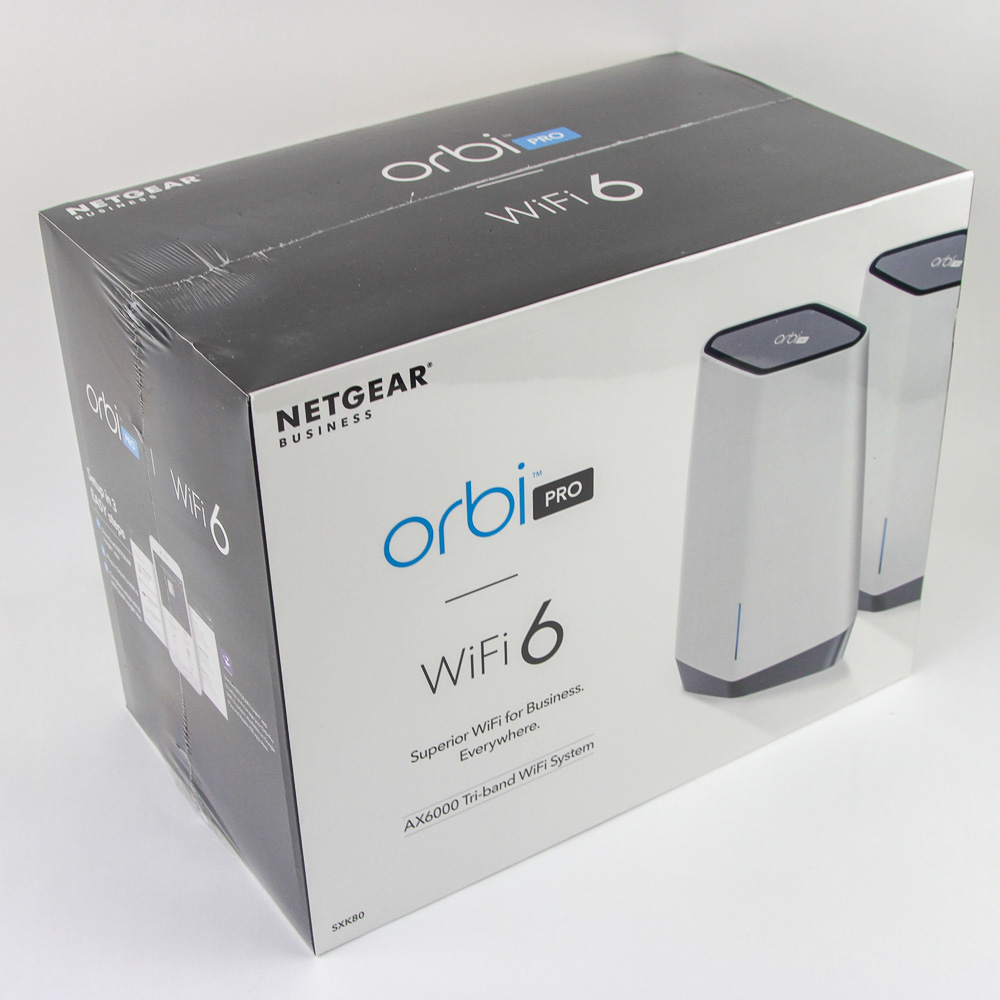
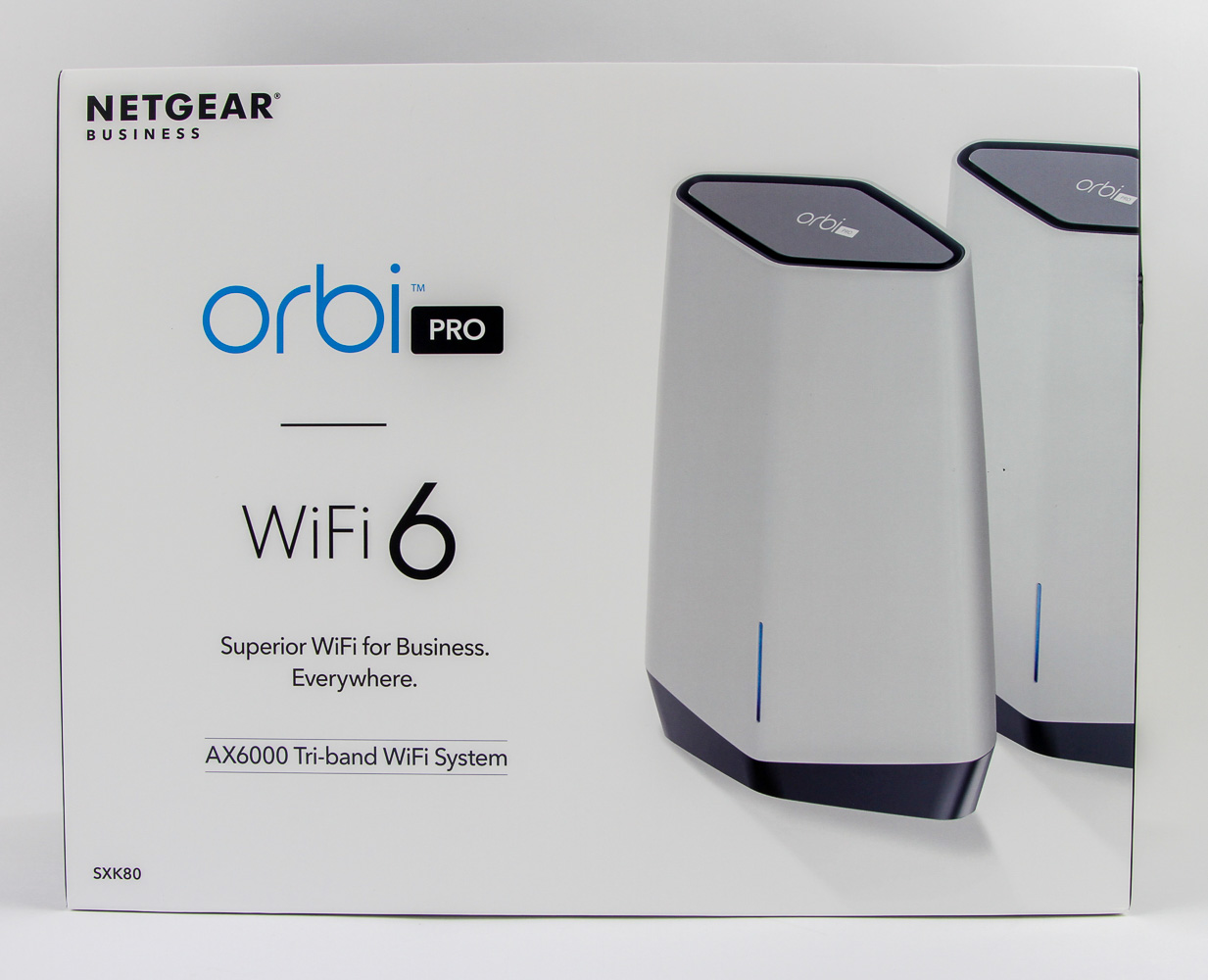


Here's a teaser for next time—the box for this two-pack Orbi Pro SKU is almost the same size as the upcoming three-pack Orbi set. I was not expecting that when taking everything out of the larger box, which incidentally shipped from a marketing hub and not directly from NETGEAR. What this means is that there is more going on inside compared to the cube-shaped box I was otherwise expecting based on my experience with the Orbi RBK50. We also see a departure from blue accents on the NETGEAR WiFi 5 Orbi systems as they are black here, which the product box reflects as well.
The box comes wrapped in plastic, and we have a similar design as before since pretty much all sides are covered in information galore. On the front is the company and product name alongside salient marketing features and a render of the product showing this is a two-pack system. We also see the NETGEAR Business logo to clarify who this is meant for, with more specifications and features in multiple languages on the back and sides. Also interesting is the clear recommendation to use the NETGEAR Insight mobile app for setup rather than a desktop system, which I will do to go through the average customer user experience. Turns out everything seen thus far is just an outer box, opening which we have a bare cardboard box with a double flap in the middle to keep the contents in place during transit.


Opening the box, we see lots of paperwork first up, including quick start guides in multiple languages (online copy here) along with a bunch of other documentation that goes with the prosumer/professional territory. There is also a much more detailed user manual online, which I highly recommend going over for users who actually plan to make the most of the product and remote monitoring features. The two Orbi Pro units are on either side of another smaller cardboard box.


Here we go, the first of the distinguishing features with the Orbi Pro line: included wall mounts. These are made out of white plastic to match the router and satellite and allow for them to be installed in a more optimal spot than just on a table somewhere. Ever noticed how access points are up above your head in a typical business setting? NETGEAR is aiming for something similar, but it obviously goes hand in hand with cable management and whether you want wired connectivity as well. Underneath these in a separate layer are the other accessories, including a hilariously large WiFi sticker.


More relevant are the two sets of installation hardware for the wall-mounting option, which come separately packed with plastic screw guides and supports, as well as long self-tapping metal screws. I have the EU version here, meaning I get separate power adapters for the router and satellite, but also wall plugs for the UK and most of mainland Europe. These are white as well and can output a whopping 42 W.


Last and certainly not least is a flat, two meter long Ethernet cable, which allows for a decent amount of room for cable management along a wall if needed. It is used to feed the internet signal from your modem/gateway to the Orbi Pro router and terminates in a standard RJ45 connector on either end. The cable is compatible with the 1/2.5 Gigabit Ethernet LAN ports on the two units. The AWM style, 32 AWG 2854 hook-up wire in the cable has reliably been used by other industries for harsher applications, so I am confident this cables will work just fine, especially considering we got the same cable on the Orbi RBK50 and LBR20 as well. What I would have liked, however, are more of these cables given the link aggregation support and Pro part of this Orbi Pro unit.
Our Patreon Silver Supporters can read articles in single-page format.
Nov 21st, 2026 12:52 PST
change timezone
Latest GPU Drivers
New Forum Posts
- Can you guess Which game it is? (345)
- GeekMagic Ultra Smart WiFi Weather Station (10)
- RX 580 2048SP 8GB - SK Hynix - Ardiyes - BIOS Needed (1)
- UPS what one to get? (22)
- Zen 3 IF/IMC degradation (243)
- State of the HPC-AI Market 2026: Processing Elements (0)
- 1 - 5 person file storage server equivalent accasible from anywhere + general VM server. (3)
- Honestly, do you care about GTA VI? (225)
- RX 9000 series GPU Owners Club (2251)
- Windows 11 General Discussion (7746)
Popular Reviews
- Microsoft Surface Laptop Ultra Review - The Next-gen Arm Laptop
- Ugreen NASync DXP4800 GT Review
- Corsair RM1200e (Second Generation) Review
- Pulsar Office Tour & First Look at P1 Dual-Sensor Mouse
- Upcoming Hardware Launches 2027 (Updated Nov 2026)
- Acemagic Retro X3 Review
- Biwin Black Opal NV7400 2 TB Review
- AMD Ryzen 7 9800X3D Review - The Best Gaming Processor
- AMD Zen 6 Technical Deep Dive
- Chieftec Iceberg PRO 360 DARK Review
TPU on YouTube
Controversial News Posts
- NVIDIA Co-Founder and CEO Jensen Huang Officially Resigns (492)
- Report: Jensen Huang Eyes NVIDIA Comeback (260)
- Open Letter Asking NVIDIA to Reinstate Jensen Huang Passes 115,000 Signatures (184)
- OpenAI CEO Argues Home PCs Waste the World's Limited DRAM Supply (152)
- NVIDIA Launches Investigation Into Jensen Huang's Relationship With Suspected Chinese Spy (136)
- Intel "Raptor Lake Next" 16-Core and 20-Core CPUs Surface (130)
- NVIDIA GeForce RTX 50-Series Scheduled for up to $500 Price Hike This Week (89)
- Intel Razor Lake Gets a 12 P-Core bLLC Chip With No E-Cores, Per Leak (86)