 16
NVIDIA 6800GS 256MB Review
(16 Comments) »NVIDIA 6800 GS
NVIDIA provided our test sample. Thank you.The 6800 GS is NVIDIA’s latest product in the GeForce 6 series line up. Manufactured using a 110nm process, this new GPU features 12 pixel pipelines, 5 vertex pipelines, and a 256-bit memory interface. The reference clocks for this card are 425 MHz GPU and 1000 MHz GDDR3. Like most modern NVIDIA cards, this one too has a SLI connector, so you can pair up two 6800 GS in SLI.

As you can see from the table above, the 6800 GS has a higher GPU clock than the 6800 Ultra (which is not being manufactured anymore) by 25 MHz, albeit having less pixel pipes. However, the memory is backed down on the 6800 GS in comparison to the Ultra, this time by 50 MHz (100 MHz effectively).

The card
The card that we received was the reference sample from NVIDIA.

At first glance, we can immediately point out some differences when compared to the 6800 Ultra. The one slot cooling solution pops right up. After closer inspection we also see that the voltage controlling circuitry is designed differently.
After removing the top plate, we can see the all-copper heatsink (smaller than the one of the 6800 Ultra), a blower that blows through the heatsink, and a piece of metal that cools the memory. This black piece of metal is similar to the memory cooler used on the 7800 series, except painted black.

The blower is manufactured by Delta, and is rated at 0.36A

After removing the heatsink, we can proceed to take a look at the core and memory.


One thing worth noticing is the actual writing on the core: it says GF-6800-GTS-G3-B1. It seems that NVIDIA was uncertain about the naming of the card until the very last moment.
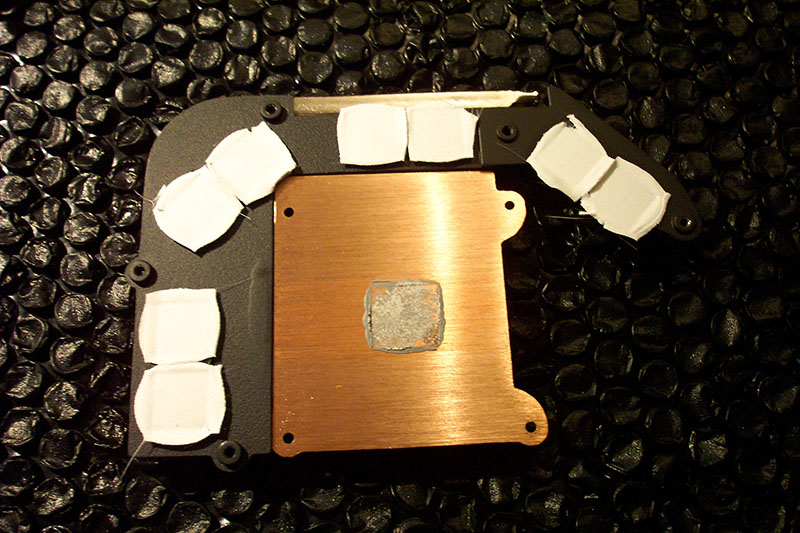
The thermal paste used on the GPU seems to be of good quality (it is silver colored), but I would be more concerned with the thermal pads used as the TIM between the memory and the memory HSF. I think it would be much better if NVIDIA used the same thermal paste on the memory as it did on the GPU.
Next comes a comparison of the 6800 GS and the 6800 Ultra:

From the picture we can see that the 6800 GS has 1 DVI port and 1 VGA port. I think that this is a shame, considering the fact that CRTs are slowly finding their way out of PC shops.
The one slot cooler can be considered both a benefit as well as a disadvantage. It will allow you to fit the card onto motherboards where there is no PCI or PCI-E slot after the PEG slot (small SFF systems), but it will not cool the card as well as the two slot cooler.
Installation:
Installing the card was no sweat. After securing the 6800 GS and plugging in its 6 pin power connector, I proceeded to boot up the PC. All I had to do to get the card running was download the latest drivers from the NVIDIA website. As far as your PSU is concerned, NVIDIA claims that this card has a maximum power draw of 70W, so a 350W PSU is recommended for a single card setup, 420W for SLI. We used an Enermax EG-701 (600W) and everything ran without problems.The card is quiet even when the fan spins at 100%, nothing like the 6800 Ultra at full blast.
Our Patreon Silver Supporters can read articles in single-page format.
Nov 11th, 2026 17:59 CST
change timezone
New Forum Posts
- When you could finally run Crysis maxed out? (43)
- WarpCoreBench scores! (14)
- Warning for Windows 10 and 11 users running newer AMD GPU drivers (49)
- Bought MAX-P495 - Which model? (29)
- GeekMagic Ultra Smart WiFi Weather Station (3)
- DTS DCH Driver for Realtek HDA [DTS:X APO4 + DTS Interactive] (2809)
- Rare GPUs / Unreleased GPUs (2271)
- Samsung 870 EVO - Beware, certain batches prone to failure! (1486)
- Windows new update 26H2 - Throttlestop (10)
- TPU's F@H Team (20569)
Popular Reviews
- AMD Zen 6 Technical Deep Dive
- Upcoming Hardware Launches 2027 (Updated Nov 2026)
- Gigabyte Z890I Aorus Ultra Review
- XPG NIMBUS PLUS Review - Mid-range Chair With Strong Competitors
- INNOCN 45C1R Review - Two QHD Screens, Zero Bezels
- NZXT H7 RGB+ Review
- Phantom Blade Zero Performance Benchmark Review - 35 GPUs Tested
- Gears of War: E-Day Performance Benchmark Review - 35 GPUs Tested
- NZXT H5 Review
- be quiet! Light Mount TKL Keyboard Review
TPU on YouTube
Controversial News Posts
- OpenAI CEO Argues Home PCs Waste the World's Limited DRAM Supply (152)
- NVIDIA Launches Investigation Into Jensen Huang's Relationship With Suspected Chinese Spy (136)
- Intel "Raptor Lake Next" 16-Core and 20-Core CPUs Surface (130)
- Legendary Game Studio BioWare Shuts Down Following EA Layoffs (104)
- Dell CEO Says the Memory Shortage Will Get Worse in 2027 (95)
- NVIDIA GeForce RTX 50-Series Scheduled for up to $500 Price Hike This Week (89)
- Modder Fits RTX 5090 With Four 8-Pin Connectors, Halving Current per Wire (80)
- AMD Radeon Owners Can Now Run Nearly Every DLSS Feature Through Fan-Made Mod (80)