 94
NVIDIA DLSS 4.5 Ray Reconstruction Review - Transformer Improved
Conclusion »Performance
NVIDIA's position is that the second-generation model comes at no meaningful cost on RTX 40 and 50-series hardware, and at a "minor" cost on RTX 20 and 30-series. We tested this on a RTX 5090, with path tracing enabled and DLSS Super Resolution set to Quality, at all three common resolutions.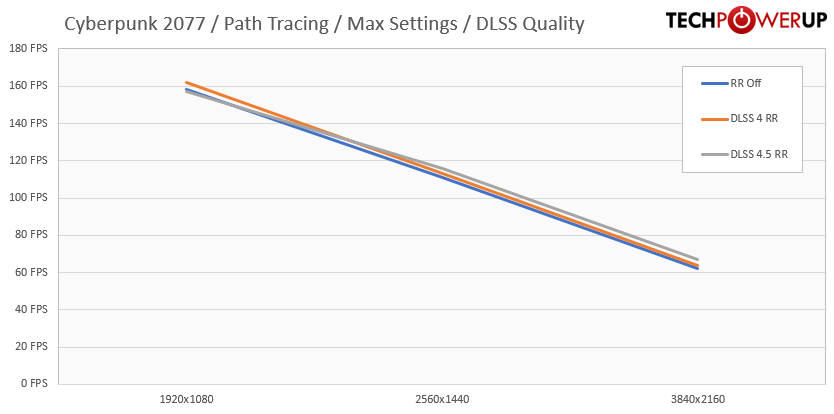
I think the most important takeaway from this chart is that performance is pretty much the same—there is no big performance hit for Ray Reconstruction, not with DLSS 4 RR, not with DLSS 4.5 RR.
If you take a closer look you can see that DLSS 4.5 RR is actually slightly faster than its predecessor at resolution of 2560x1440 and 3840x2160. I wouldn't call this a rule though, I'm sure, depending on the game, the in-game location, and even the direction you're looking, this will very a little bit. We'll have per-game numbers a bit further down, which confirms that there will be some small differences.
Scaling with Upscaling Factor
The resolution numbers above change both the render resolution and the output resolution, both at once. As additional data point I set a fixed resolution of 4K and swept through the various DLSS quality modes, which changes only how many pixels the model receives, while the output frame size remains constant at 3840x2160.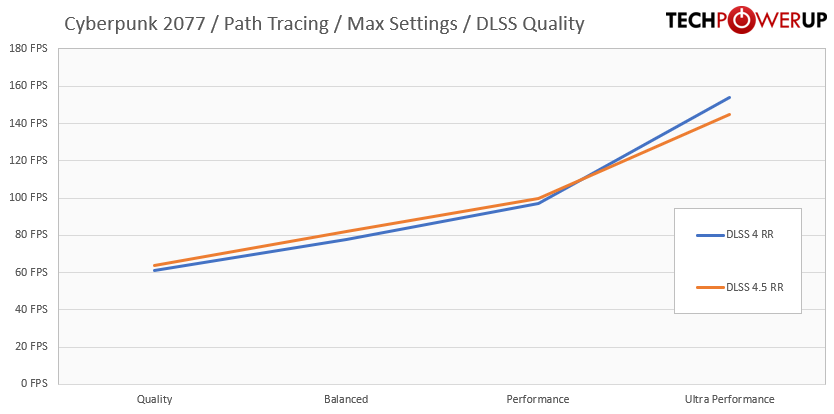
Here, too, both lines track each other closely across the whole range, which is the same answer as before: there isn't any noteworthy performance difference between DLSS 4 and DLSS 4.5 Ray Reconstruction. For the first three upscaling factors, DLSS 4.5 RR is slightly faster, but at Ultra Performance, the new model gives up a few percent. Here, too, I wouldn't generalize these numbers, I'm pretty confident these depend on a lot of factors, too.
VRAM Usage
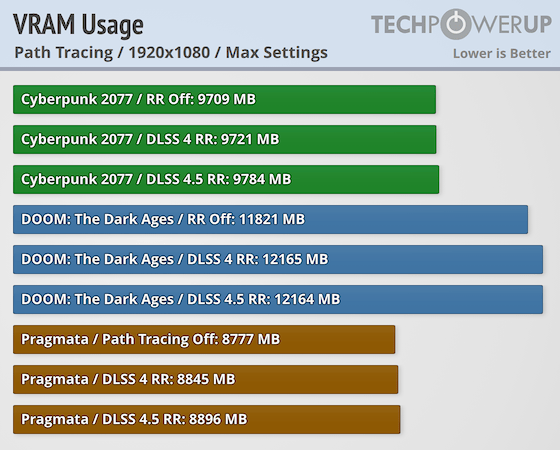
A model carrying 20% more parameters has to put them somewhere, so the obvious question is whether Ray Reconstruction's memory footprint has grown. It hasn't, in any way you'd notice. Going from the old model to the new one costs 63 MB in Cyberpunk 2077, 51 MB in Pragmata, and nothing at all in DOOM: The Dark Ages—differences of half a percent, on cards that ship with 8 GB at the low end and 32 GB at the top. Nobody is going to run out of memory because of this.
Switching Ray Reconstruction on in the first place is the larger effect, and even that is modest: 12 MB in Cyberpunk and 344 MB in DOOM. Pragmata can't answer the question, because it ties Ray Reconstruction to path tracing and won't let you separate them—its baseline in the chart is path tracing switched off entirely, which is why it sits lower.
One correction to our own past reporting. When we tested DLSS 3.5 Ray Reconstruction in 2023 we found it reduced VRAM use, 11.8 GB down to 10.9 GB at 4K in Cyberpunk, and suggested the classic denoiser's history buffers were the reason. That is no longer what we measure—here Ray Reconstruction costs slightly more memory rather than less. Different resolution and three years of model revisions sit between the two results, so this isn't necessarily a regression, but the old finding shouldn't be repeated as though it still holds.
Per-Game Performance
Here's a breakdown of FPS for our tested games, at 1080p, max settings, path tracing.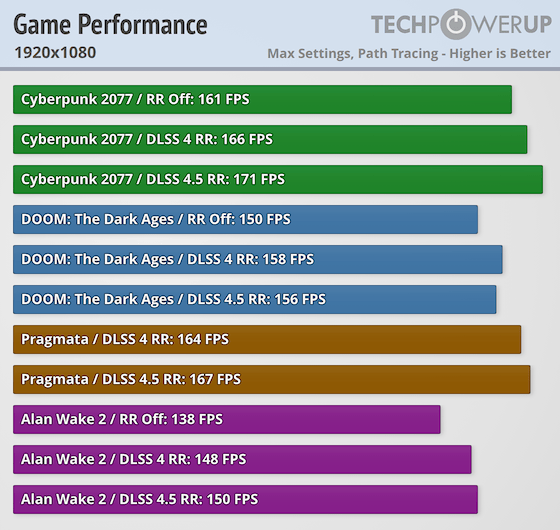
This confirms both findings across a wider spread of games. Ray Reconstruction beats the default denoiser in the game every time: 3% in Cyberpunk 2077, 5% in DOOM: The Dark Ages, 7% in Alan Wake 2. And the gap between DLSS 4 and DLSS 4.5 RR stays small and unpredictable—Cyberpunk gains 3% on the new model, Pragmata 2%, Alan Wake 2 just 1%, while DOOM loses 1%.
Test System
| Test System - GPU 2025.2 | |
|---|---|
| Processor: | AMD Ryzen 7 9800X3D Zen 5, 5.2 GHz, 8 cores/16 threads |
| Motherboard: | MSI X870E Carbon Wi-Fi BIOS 7E49v1A3 |
| Resizable BAR: | Enabled on all supported cards (NVIDIA, AMD & Intel) |
| Memory: | Thermaltake TOUGHRAM XG 2× 16 GB DDR5 6200 MT 28-36-36-76 UCLK 1:1 |
| Cooling: | Arctic Liquid Freezer III 280 mm AIO |
| Thermal Paste: | Arctic MX-6 |
| Storage: | 4 TB M.2 NVMe SSD |
| Power Supply: | Seasonic Focus GX 1000 W ATX 3.0 / 16-pin 12VHPWR |
| Case: | darkFlash DY470 |
| Operating System: | Windows 11 Professional 64-bit 25H2 VBS enabled (Windows 11 default) |
| Drivers: | NVIDIA: 610.88 WHQL |
Nov 19th, 2026 02:19 PST
change timezone
Latest GPU Drivers
New Forum Posts
- Time to upgrade CPU and MOBO (44)
- Without Jensen, PC gaming will be (48)
- 3DMARK "LEGENDARY" (475)
- [Poll] 12V-2x6 Connector Protection: What Are You Using? (WireView / Ampinel / Equalizer / Other / Nothing) (43)
- Windows HDR on = Tinted colors (5)
- WarpCoreBench scores! (68)
- Honestly, do you care about GTA VI? (155)
- Very unusual two gaming-pc scenarios. (13)
- TPU's Nostalgic Hardware Club (22168)
- Dual B70 or Dual R9700 Pro on Linux (7)
Popular Reviews
- Acemagic Retro X3 Review
- Ugreen NASync DXP4800 GT Review
- Upcoming Hardware Launches 2027 (Updated Nov 2026)
- AMD Zen 6 Technical Deep Dive
- Pulsar Office Tour & First Look at P1 Dual-Sensor Mouse
- Biwin Black Opal NV7400 2 TB Review
- Sapphire Radeon RX 7700 XT Pure Review
- Sapphire Radeon RX 7700 XT Pulse Review
- Chieftec Iceberg PRO 360 DARK Review
- AMD Ryzen 7 9800X3D Review - The Best Gaming Processor
TPU on YouTube
Controversial News Posts
- NVIDIA Co-Founder and CEO Jensen Huang Officially Resigns (483)
- Report: Jensen Huang Eyes NVIDIA Comeback (196)
- Open Letter Asking NVIDIA to Reinstate Jensen Huang Passes 115,000 Signatures (184)
- OpenAI CEO Argues Home PCs Waste the World's Limited DRAM Supply (152)
- NVIDIA Launches Investigation Into Jensen Huang's Relationship With Suspected Chinese Spy (136)
- Intel "Raptor Lake Next" 16-Core and 20-Core CPUs Surface (130)
- Legendary Game Studio BioWare Shuts Down Following EA Layoffs (104)
- Dell CEO Says the Memory Shortage Will Get Worse in 2027 (95)