 106
NVIDIA GeForce RTX 3050 6 GB Review - The Fastest Slot-Powered GPU
(106 Comments) »Introduction

A few weeks ago, NVIDIA released the new GeForce RTX 3050 6 GB as its new entry level discrete GPU—here's our review. This new GPU slipped into NVIDIA's product stack with much less fanfare than the RTX 40 SUPER series, and replaces the likes of the GTX 1650 and GTX 1660 as sub-$200 options. In case you haven't noticed, the latest crop of discrete graphics cards are expensive—three-figure prices are normal, gone are the days of the $70 entry-level, because processor integrated graphics solutions have grown powerful over the years. Besides an entry level price, the RTX 3050 6 GB is particularly energy efficient, and is designed to operate without additional power connectors, needing just the PCIe slot power to run.
The GeForce RTX 3050 6 GB that we review today is based on the older Ampere graphics architecture, which meets the full DirectX 12 Ultimate feature set, including real time ray tracing; as well as support for DLSS. Is the card fast enough for ray tracing? We'll answer this question later in the review. If you recall, NVIDIA's argument against ray tracing for entry-level products was that the hardware would be too slow for gameplay at acceptable frame-rates, which is why when it debuted RTX with Turing, it had carved out an entire lower end product stack—the GTX 16-series, which lacked ray tracing capabilities. So, what's changed now? We believe it's the growth in popularity of DLSS, and Intel's debut into the GPU market.

Intel in 2022 released its Arc Alchemist discrete graphics, and even its entry-level Arc A380 features the full DirectX 12 Ultimate feature set along with XeSS, a modern upscaling technology. The A380 is a really slow GPU, but later in 2023, the company released the Arc A580 for less than $200, which is based on a larger silicon, and capable of 1080p gaming, or gaming with ray tracing when you engage XeSS. Combine this with Intel's channel marketing muscle, and its ability to get DIY retailers to push combos of the A580 with entry-level Core i3 processors and H610 chipset motherboards, and the company was in a position to grab a slice of the entry-level e-sports gaming pie. We believe that NVIDIA is responding to exactly this trend—to give the entry-level a convincing new GeForce RTX option that features DirectX 12 Ultimate, including ray tracing; and NVIDIA's popular DLSS super resolution technology. NVIDIA's play with the RTX 3050 6 GB is to address the crowd that games on a 1080p display, but with DLSS enabled, which means the game is actually rendering at a lower resolution, such as 720p, but being upscaled and made to look close to 1080p native.
The GeForce RTX 3050 6 GB is a significantly different product from the original RTX 3050 that NVIDIA launched two years ago—January 2022 to be exact. The original RTX 3050, with 8 GB of memory, had released at a time when the gaming GPU market was reeling with acute shortages in supplies due to the double whammy of the pandemic and the GPU crypto-currency mining craze. It was the only GPU that was available at a relatively acceptable price, and was very much capable of 1080p native resolution gameplay. The RTX 3050 8 GB was initially based on a cut-down GA106 silicon—the same chip which NVIDIA used to build its popular RTX 3060—but later switched to the smaller GA107 silicon without any change in specs, as the RTX 3050 8 GB specs sheet exactly aligned with that of the GA107. In fact, these newer revisions of GA107-based RTX 3050 8 GB were more energy efficient, with a 10-20 W reduction in gaming power draw, compared to the GA106-based ones.
For the new RTX 3050 6 GB, NVIDIA stuck with the same 8 nm GA107 silicon, but lowered various specs—not only memory size. To begin with, the most obvious change with the RTX 3050 6 GB is the VRAM size, which sees a 25% reduction to 6 GB from 8 GB, and a proportionate reduction in memory bus width, to 96-bit from 128-bit. The memory bus ticks at 14 Gbps, which yields 168 GB/s in memory bandwidth, compared to the 224 GB/s on the original RTX 3050. That's not all, the core count is slightly reduced, too. While the original RTX 3050 maxes out all 20 streaming multiprocessors (SM) present on the GA107, the new RTX 3050 6 GB enables 18 out of those 20. This works out to 2,304 CUDA cores, 72 Tensor cores, 18 RT cores, 72 TMUs, and the chip's full 32 ROPs.
Perhaps the biggest impact of this reduction in SM has been on power—it comes with a TGP of just 70 W. This means that the card is optimized to work without any power connectors (the original RTX 3050 came with a 6-pin connector to meet the 115 W TGP). The spartan 70 W power reflects in thermals, and partners are allowed to use simple extruded aluminium fan-heatsinks that cost just a few dollars to make. It also vastly simplifies the power design of the GPU.
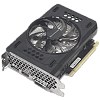
NVIDIA has no reference design for the RTX 3050 6 GB, and so we have with us the Gainward RTX 3050 6 GB Pegasus. We chose Gainward because its PCBs tend to be designed close to NVIDIA's internal reference design boards and their cards are sold at highly competitive pricing. This card offers all there is to have with this GPU, and even makes things easy for the entry-level crowd, with legacy display connectivity, such as a DVI connector. It features a simple aluminium monoblock fan-heatsink. Gainward is pricing the card at $180, which is the baseline price set by NVIDIA for the RTX 3050 6 GB.
| Price | Cores | ROPs | Core Clock | Boost Clock | Memory Clock | GPU | Transistors | Memory | |
|---|---|---|---|---|---|---|---|---|---|
| RX 6500 XT | $140 | 1024 | 32 | 2685 MHz | 2825 MHz | 2248 MHz | Navi 24 | 5400M | 4 GB, GDDR6, 64-bit |
| Arc A580 | $165 | 3072 | 96 | 1700 MHz | N/A | 2000 MHz | ACM-G10 | 21700M | 8 GB, GDDR6, 256-bit |
| RTX 3050 6 GB | $180 | 2304 | 32 | 1042 MHz | 1470 MHz | 1750 MHz | GA107 | Unknown | 6 GB, GDDR6, 96-bit |
| RTX 3050 | $230 | 2560 | 32 | 1552 MHz | 1777 MHz | 1750 MHz | GA106 | 12000M | 8 GB, GDDR6, 128-bit |
| Arc A750 | $200 | 3584 | 112 | 2050 MHz | N/A | 2000 MHz | ACM-G10 | 21700M | 8 GB, GDDR6, 256-bit |
| RX 6600 | $170 | 1792 | 64 | 2044 MHz | 2491 MHz | 1750 MHz | Navi 23 | 11060M | 8 GB, GDDR6, 128-bit |
| RX 6600 XT | $200 | 2048 | 64 | 2359 MHz | 2589 MHz | 2000 MHz | Navi 23 | 11060M | 8 GB, GDDR6, 128-bit |
| RTX 3060 | $240 | 3584 | 48 | 1320 MHz | 1777 MHz | 1875 MHz | GA106 | 12000M | 12 GB, GDDR6, 192-bit |
| RX 7600 | $270 | 2048 | 64 | 2250 MHz | 2625 MHz | 2250 MHz | Navi 33 | 13300M | 8 GB, GDDR6, 128-bit |
| RX 7600 XT | $330 | 2048 | 64 | 2470 MHz | 2755 MHz | 2250 MHz | Navi 33 | 13300M | 16 GB, GDDR6, 128-bit |
| RTX 4060 | $300 | 3072 | 48 | 1830 MHz | 2460 MHz | 2125 MHz | AD107 | 18900M | 8 GB, GDDR6, 128-bit |
| Arc A770 | $280 | 4096 | 128 | 2100 MHz | N/A | 2187 MHz | ACM-G10 | 21700M | 16 GB, GDDR6, 256-bit |
| RTX 3060 Ti | $250 | 4864 | 80 | 1410 MHz | 1665 MHz | 1750 MHz | GA104 | 17400M | 8 GB, GDDR6, 256-bit |
Packaging


The Card


Gainward's card is very compact, with a black color theme on the main cooler. A backplate is not available.


Dimensions of the card are 16.0 x 11.5 cm, and it weighs 411 g.


Installation requires two slots in your system. We measured the card's width to be 40 mm.

Display connectivity options include one HDMI 2.1, one DisplayPort 1.4a and one DVI port (without analog support).
There is one NVENC and one NVDEC unit in the chip, which supports hardware-accelerated decode for H.264, H.265 and AV1. For encoding H.264 and H.265 are supported, but not AV1.

The card requires no additional power cables, it runs with just PCIe slot power.
Teardown


The fan assembly can be removed independently of the heatsink, which makes it easy to clean both. It also lets you replace the fan should it die after a few years.


While we usually see heatpipes here, the Gainward card uses just a very basic heatsink—which is good enough for the card's low heat output. The heatsink provides cooling for the three memory chips, too, but not for the VRM, which is cooled by the airflow of the cooler.
High-resolution PCB Pictures
These pictures are for the convenience of volt modders and people who would like to see all the finer details on the PCB. Feel free to link back to us and use these in your articles, videos or forum posts.

High-resolution versions are also available (front, back).
Circuit Board (PCB) Analysis


GPU voltage is an 3-phase design, managed by a Richtek RT8845A.

Sinopower SM4503+ SM4507 MOSFETs are used for GPU voltage; they are rated for 80 A of current each.

Memory voltage is a two-phase design, managed by a Richtek RT8237 (not pictured)

For memory, SM4507NH/4503NH are used, too.
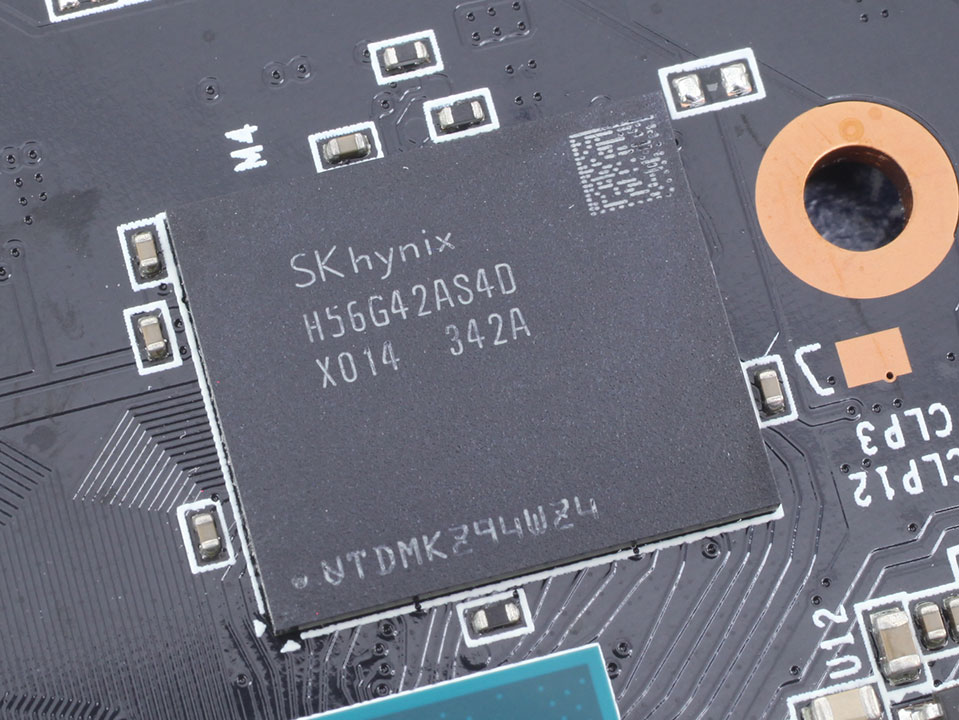
The GDDR6 memory chips are made by Hynix and carry the model number H56G42AS4DX014. They are specified to run at 2000 MHz (16 Gbps GDDR6 effective).
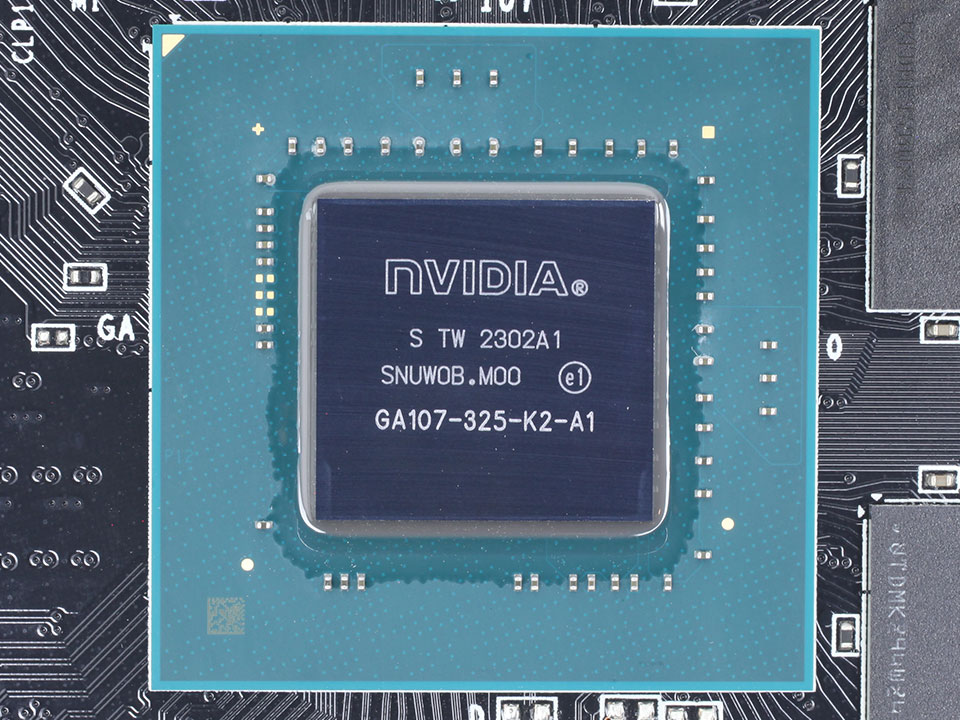
NVIDIA's GA107 graphics processor is built using a 8 nanometer process at Samsung, with a transistor count of 8.7 billion and a die size of 200 mm².
Test System
| Test System - GPU 2024.1 | |
|---|---|
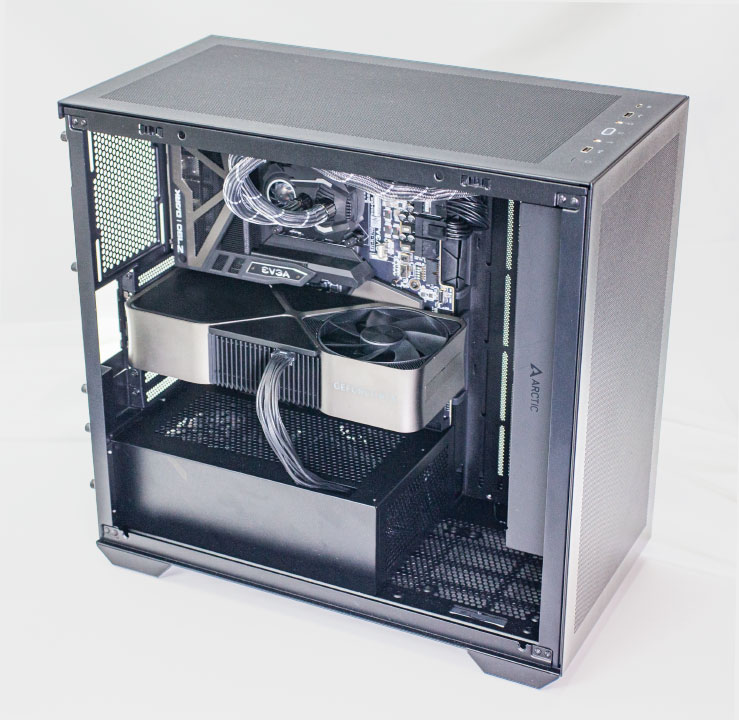
| Processor: | Intel Core i9-14900K Raptor Lake, 6.0 GHz, 8+16 cores / 32 threads PL1 = PL2 = 330 W |
| Motherboard: | EVGA Z790 Dark BIOS 1.13 |
| Resizable BAR: | Enabled on all supported cards (NVIDIA, AMD & Intel) |
| Memory: | Thermaltake TOUGHRAM XG 2x 16 GB DDR5-7200 MHz 36-46-46-96 |
| Cooling: | Arctic Liquid Freezer II 280 mm AIO |
| Thermal Paste: | Arctic MX-6 |
| Storage: | 2x 2 TB M.2 NVMe SSD |
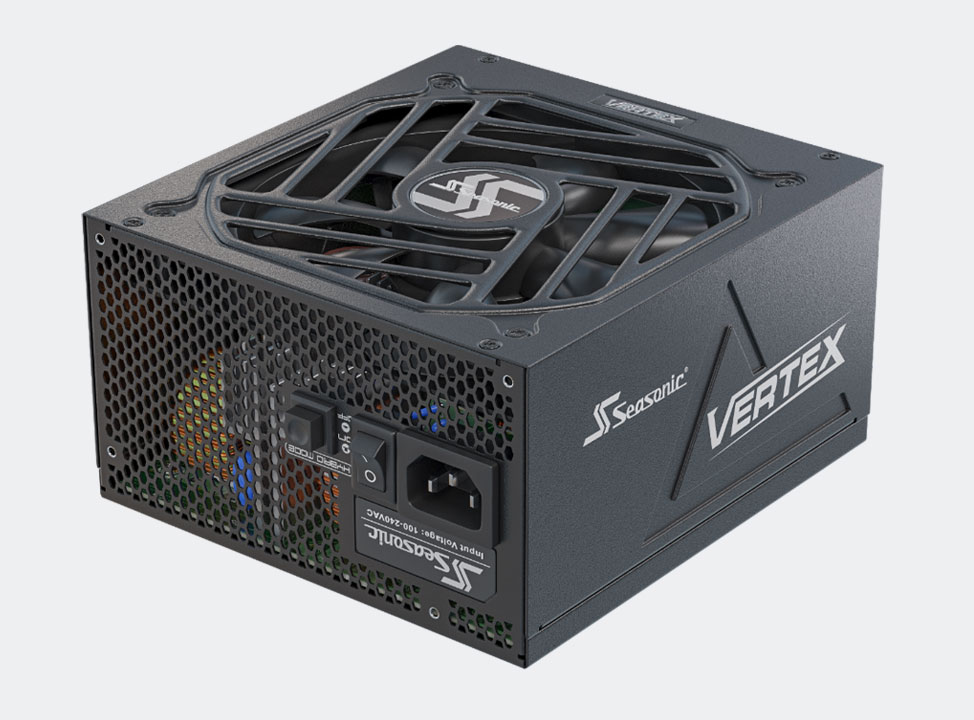
| Power Supply: | Seasonic Vertex GX 850 W ATX 3.0 / 16-pin 12VHPWR |
| Case: | darkFlash DLX4000 Mesh |
| Operating System: | Windows 11 Professional 64-bit 23H2 VBS enabled (Windows 11 default) |
| Drivers: | RTX 3050 6 GB: 551.23 WHQL RTX 4080 Super: 551.22 Press Driver RTX 4070 Super & 4070 Ti Super: 551.23 WHQL NVIDIA: 546.17 WHQL AMD: 23.11.1 WHQL Intel: 101.4953 WHQL Arc A580: 101.5252 Beta Date of Retest |




- All games and cards are tested with the drivers listed above—no performance results were recycled between test systems. Only this exact system with exactly the same configuration is used for all results in this review.
- All graphics cards are tested using the same game version.
- All games are set to their highest quality setting unless indicated otherwise.
- AA and AF are applied via in-game settings, not via the driver's control panel.
- Before starting measurements, we heat up the card for each test to ensure a steady state is tested. This ensures that the card won't boost to unrealistically high clocks for only a few seconds until it heats up, as that doesn't represent prolonged gameplay.
- For better real-life applicability, all game tests use custom in-game test scenes, not the integrated benchmarks
- All cards used for comparison are reference designs. When a reference design does not exist, we go the extra mile and buy the closest possible match, using reference clocks and default power limit.
- 1920x1080: Most popular monitor resolution.
- 2560x1440: Intermediary resolution between Full HD and 4K, with reasonable performance requirements.
- 3840x2160: 4K Ultra HD resolution, available on high-end monitors.
Our Patreon Silver Supporters can read articles in single-page format.
Nov 18th, 2026 13:12 CST
change timezone
Latest GPU Drivers
New Forum Posts
- Very unusual two gaming-pc scenarios. (6)
- [Poll] 12V-2x6 Connector Protection: What Are You Using? (WireView / Ampinel / Equalizer / Other / Nothing) (38)
- Honestly, do you care about GTA VI? (142)
- Wireless Internet sharing between PC and router both-ways, is it possible? (18)
- WarpCoreBench scores! (64)
- ProArt X870E-CREATOR WIFI - Bifurcation~Complication (15)
- My Final Barrier to Exclusively Using Linux has Fallen (Azure Virtual Desktops) (9)
- Ghetto Mods (4883)
- [Intel AX1xx/AX2xx/AX4xx/AX16xx/BE2xx/BE17xx] Intel Modded Wi-Fi Driver with Intel® Killer™ Features (633)
- RX 580 2048SP 8GB Samsung – Black Screens in Games, Looking for a Compatible BIOS (2)
Popular Reviews
- Acemagic Retro X3 Review
- Upcoming Hardware Launches 2027 (Updated Nov 2026)
- AMD Zen 6 Technical Deep Dive
- ASUS ROG Strix B850-I Gaming Wi-Fi7 W Review
- Corsair HX1000i Shift Crystal Review
- Biwin Black Opal NV7400 2 TB Review
- Chieftec Iceberg PRO 360 DARK Review
- AMD Ryzen 7 9800X3D Review - The Best Gaming Processor
- Phantom Blade Zero Performance Benchmark Review - 35 GPUs Tested
- Montech King 95 3D PRO Review
TPU on YouTube
Controversial News Posts
- NVIDIA Co-Founder and CEO Jensen Huang Officially Resigns (477)
- Report: Jensen Huang Eyes NVIDIA Comeback (185)
- Open Letter Asking NVIDIA to Reinstate Jensen Huang Passes 115,000 Signatures (184)
- OpenAI CEO Argues Home PCs Waste the World's Limited DRAM Supply (152)
- NVIDIA Launches Investigation Into Jensen Huang's Relationship With Suspected Chinese Spy (136)
- Intel "Raptor Lake Next" 16-Core and 20-Core CPUs Surface (130)
- Legendary Game Studio BioWare Shuts Down Following EA Layoffs (104)
- Dell CEO Says the Memory Shortage Will Get Worse in 2027 (95)