 228
NVIDIA GeForce RTX 4080 Super Founders Edition Review - Savings of $200
(228 Comments) »Introduction

NVIDIA today debuted the GeForce RTX 4080 Super, the third and final part of the Super mid-lifecycle refresh of its RTX 40-series Ada generation. NVIDIA focused on housekeeping the upper end of its GeForce RTX product stack with this refresh. For the RTX 4070 Super and RTX 4070 Ti Super, this meant more performance at their existing $600 and $800 price points, respectively. The company's approach to the RTX 4080 Super is slightly different. There is some increased performance to be had over the original RTX 4080; but at a 20% lower price point of $1,000, compared to the RTX 4080, which launched at $1,200. Much like the RTX 4080 and the flagship RTX 4090, the new RTX 4080 Super is recommended by NVIDIA for maxed out AAA gaming at 4K Ultra HD, including with ray tracing.

Back when rumors of the RTX 40-series Super refresh started first pouring in, it was widely expected that the RTX 4080 Super would be carved out of the larger AD102 silicon that the RTX 4090 is based on; by giving it a higher number of shaders than available on the AD103 silicon, and a wider memory interface, such as 320-bit, driving a 20 GB video memory. This could have well been something NVIDIA continued to sell at $1,200, but the RTX 4080 Super turned out a whole different proposition. The RTX 4080 enabled 76 out of 80 streaming multiprocessors available on the AD103 silicon (95% of the SM enabled). To create the RTX 4080 Super, NVIDIA simply enabled all 80 SM, slightly increased the memory speed from 22.4 Gbps to 23 Gbps, and lowered the price by 20%, down to $1,000.
The RTX 4080 Super hence has the AMD Radeon RX 7900 XTX in its crosshairs, which had originally launched at the same $1,000 price, but is now available at a street price of around $900. Since the RX 7900 XTX is AMD's fastest graphics card, which maxes out its biggest GPU, there is no threat to the RTX 4090 from Team Red, and there was no need for NVIDIA to make the RTX 4080 Super a significantly bigger SKU based on the AD102, while holding onto the $1,200 price-point. Instead, the RTX 4080 Super is designed to be the RTX 4080 with a few extra shaders, and a touch faster memory, at a lower price.
With the AD103 silicon maxed out, the RTX 4080 Super gets 80 streaming multiprocessors, which work out to 10,240 CUDA cores, 320 Tensor cores, 80 RT cores, 320 TMUs, and 112 ROPs. The chip's memory interface is 256-bit wide, driving 16 GB of memory, but powered by the fastest graphics memory chips in the industry, 23 Gbps GDDR6X. This yields a bandwidth of 737 GB/s, which is cushioned by 64 MB of on-die L2 cache. The GPU frequency is slightly increased, from 2505 MHz boost, to 2550 MHz. Interestingly, NVIDIA didn't tinker with the total graphics power (TGP) of 320 W, which is unchanged from the RTX 4080.
As with the other GeForce RTX Super products, the RTX 4080 Super doesn't see the introduction of any new feature, it is an exercise and bringing more performance at existing or lower price points; the underlying technology is still the GeForce RTX Ada Lovelace architecture. Ada leverages the new 5 nm EUV foundry node to significantly dial up transistor counts, and improve energy efficiency. The new generation CUDA core, in addition to supporting higher clock speeds and providing higher IPC, supports shader execution reordering, something that speeds up ray tracing performance. The new 3rd generation RT core supports displaced micro-meshes, a technology that allows game production designers to increase complexity of ray traced objects. The new optical flow processor lets the GPU draw entire alternate frames using AI, and without involving the graphics pipeline, which is how the new DLSS 3 Frame Generation technology works.
Unlike the GeForce RTX 4070 Ti Super from last week, the new RTX 4080 Super gets the Founders Edition treatment from NVIDIA. The GeForce RTX 4080 Super Founders Edition isn't intended to be a reference design, but a first-party custom design that sells at the $1,000 MSRP, and sets design and quality standards for the other board partners to live up to, especially with their products priced at MSRP. The new RTX 4080 Founders Edition card features a physically identical product design to the RTX 4080 Founders Edition, except for a few visual changes—the gunmetal finish makes way for metallic matte black; with a distinctive RTX 4080 Super logo on the backplate, with the "RTX 4080" portion in recessed lettering, and the Super brand extension raised. The RTX 4080 Super Founders Edition, as we mentioned, comes in at the company's baseline price for this GPU, at $1,000.
Short 10-Minute Video Comparing 9x RTX 4080 Super
Our goal with the videos is to create short summaries, not go into all the details and test results, which can be found in our written reviews.
| Price | Cores | ROPs | Core Clock | Boost Clock | Memory Clock | GPU | Transistors | Memory | |
|---|---|---|---|---|---|---|---|---|---|
| RX 6800 XT | $500 | 4608 | 128 | 2015 MHz | 2250 MHz | 2000 MHz | Navi 21 | 26800M | 16 GB, GDDR6, 256-bit |
| RTX 3080 | $450 | 8704 | 96 | 1440 MHz | 1710 MHz | 1188 MHz | GA102 | 28000M | 10 GB, GDDR6X, 320-bit |
| RTX 4070 | $540 | 5888 | 64 | 1920 MHz | 2475 MHz | 1313 MHz | AD104 | 35800M | 12 GB, GDDR6X, 192-bit |
| RX 7800 XT | $500 | 3840 | 96 | 2124 MHz | 2430 MHz | 2425 MHz | Navi 32 | 28100M | 16 GB, GDDR6, 256-bit |
| RX 6900 XT | $650 | 5120 | 128 | 2015 MHz | 2250 MHz | 2000 MHz | Navi 21 | 26800M | 16 GB, GDDR6, 256-bit |
| RX 6950 XT | $630 | 5120 | 128 | 2100 MHz | 2310 MHz | 2250 MHz | Navi 21 | 26800M | 16 GB, GDDR6, 256-bit |
| RTX 3090 | $800 | 10496 | 112 | 1395 MHz | 1695 MHz | 1219 MHz | GA102 | 28000M | 24 GB, GDDR6X, 384-bit |
| RTX 4070 Super | $600 | 7168 | 80 | 1980 MHz | 2475 MHz | 1313 MHz | AD104 | 35800M | 12 GB, GDDR6X, 192-bit |
| RTX 4070 Ti | $750 | 7680 | 80 | 2310 MHz | 2610 MHz | 1313 MHz | AD104 | 35800M | 12 GB, GDDR6X, 192-bit |
| RTX 4070 Ti Super | $800 | 8448 | 96 | 2340 MHz | 2610 MHz | 1313 MHz | AD103 | 45900M | 16 GB, GDDR6X, 256-bit |
| RX 7900 XT | $720 | 5376 | 192 | 2000 MHz | 2400 MHz | 2500 MHz | Navi 31 | 57700M | 20 GB, GDDR6, 320-bit |
| RTX 3090 Ti | $1050 | 10752 | 112 | 1560 MHz | 1950 MHz | 1313 MHz | GA102 | 28000M | 24 GB, GDDR6X, 384-bit |
| RTX 4080 | $1200 | 9728 | 112 | 2205 MHz | 2505 MHz | 1400 MHz | AD103 | 45900M | 16 GB, GDDR6X, 256-bit |
| RTX 4080 Super | $1000 | 10240 | 112 | 2295 MHz | 2550 MHz | 1438 MHz | AD103 | 45900M | 16 GB, GDDR6X, 256-bit |
| RX 7900 XTX | $970 | 6144 | 192 | 2300 MHz | 2500 MHz | 2500 MHz | Navi 31 | 57700M | 24 GB, GDDR6, 384-bit |
| RTX 4090 | $1800 | 16384 | 176 | 2235 MHz | 2520 MHz | 1313 MHz | AD102 | 76300M | 24 GB, GDDR6X, 384-bit |
Architecture
The Ada graphics architecture heralds the third generation of the NVIDIA RTX technology, an effort toward increasing the realism of game visuals by leveraging real-time ray tracing, without the enormous amount of compute power required to draw purely ray-traced 3D graphics. This is done by blending conventional raster graphics with ray traced elements such as reflections, lighting, and global illumination, to name a few. The 3rd generation of RTX introduces the new higher IPC "Ada" CUDA core, 3rd generation RT core, 4th generation Tensor core, and the new Optical Flow Processor, a component that plays a key role in generating new frames without involving the GPU's main graphics rendering pipeline. The GeForce Ada graphics architecture driving the RTX 4080 Super leverages the TSMC 5 nm EUV foundry process to increase transistor counts.

The GeForce RTX 4080 Super is based on the same 5 nm AD103 silicon as the original RTX 4080. As a SKU, it has a lot in common with the RTX 2080 Super, which had maxed out the TU104 silicon, while the original RTX 2080 wasn't too far behind. The AD103 is NVIDIA's second largest silicon, powering not just the RTX 4080 and the RTX 4080 Super, but also the mobile RTX 4090. This 379 mm² beast packs nearly 46 billion transistors—more than that of the previous generation flagship GA102. It has 80 streaming multiprocessors, and since the RTX 4080 Super maxes the chip out, all 80 are enabled. This gives the RTX 4080 Super a phenomenal CUDA core count of 10,240, with 320 Tensor cores, 80 RT cores, 320 TMUs, and all of the chip's 112 ROPs. The AD103 features a 256-bit wide memory interface, and the RTX 4080 Super continues to get 16 GB of memory, running at 23 Gbps—higher than the 22.4 Gbps of the RTX 4080.
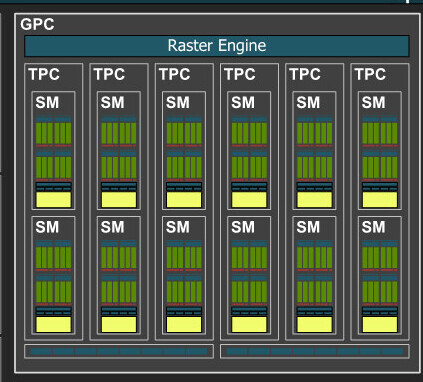
The AD103 features a PCI-Express 4.0 x16 host interface along with support for PCI resizable BAR; and its 256-bit wide GDDR6X memory interface. The GigaThread Engine serves as the main workflow controller for the GPU, dispatching work among the GPU's 7 graphics processing clusters (GPCs). Each GPC shares a Raster Engine and render backends among six texture processing clusters (TPCs), the indivisible subunit of the GPU; one of the GPCs has just four TPCs. Each TPC has two Streaming Multiprocessors (SM), and a Polymorph unit. Each SM contains 128 CUDA cores across four partitions. Half of these CUDA cores are pure-FP32; while the other half is capable of FP32 or INT32. The SM retains concurrent FP32+INT32 math processing capability. The SM also contains a 3rd generation RT core, four 4th generation Tensor cores, some cache memory, and four TMUs. One of the seven GPCs on the AD103 physically only has four TPCs.
With 80 SM that have 128 CUDA cores, each; we arrive at 10,240 CUDA cores. NVIDIA says that the RTX 4080 Super maxes out the AD103 silicon; and this statement is 99.999% true. The AD103 has four NVDEC and two NVENC units on the silicon; but for the RTX 4080 Super, just like the RTX 4080, three of these NVDEC units are disabled. This is irrelevant for a GeForce RTX product, and NVIDIA only put those large numbers of NVDEC units for pro-visualization graphics cards, such as the RTX 5000 Ada.
3rd Gen RT Core and Ray Tracing
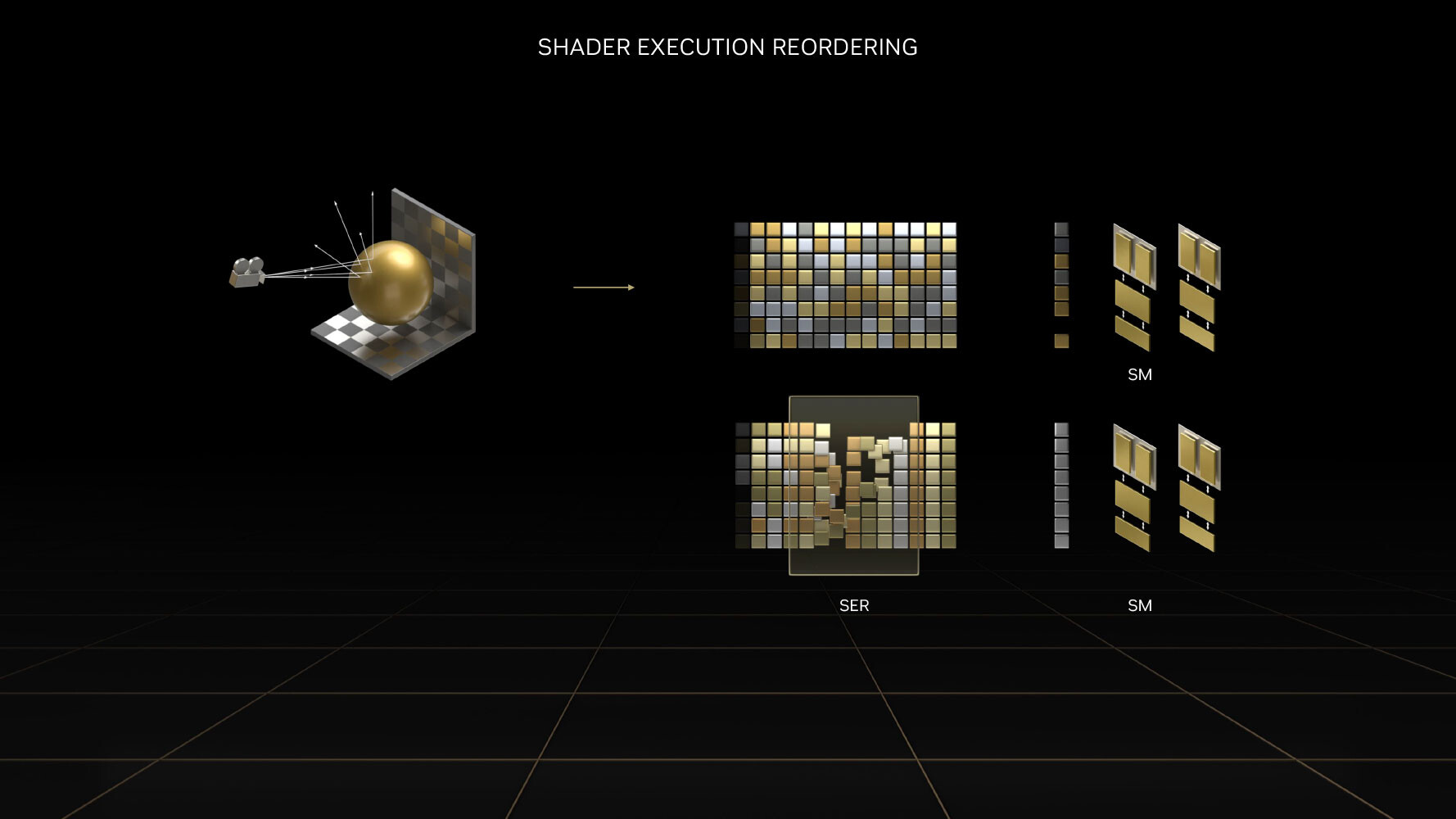

The 3rd generation RT core accelerates the most math-intensive aspects of real-time ray tracing, including BVH traversal. Displaced micro-mesh engine is a revolutionary feature introduced with the new 3rd generation RT core. Just as mesh shaders and tessellation have had a profound impact on improving performance with complex raster geometry, allowing game developers to significantly increase geometric complexity; DMMs is a method to reduce the complexity of the bounding-volume hierarchy (BVH) data-structure, which is used to determine where a ray hits geometry. Previously, the BVH had to capture even the smallest details to properly determine the intersection point. Ada's ray tracing architecture also receives a major performance uplift from Shader Execution Reordering (SER), a software-defined feature that requires awareness from game-engines, to help the GPU reorganize and optimize worker threads associated with ray tracing.
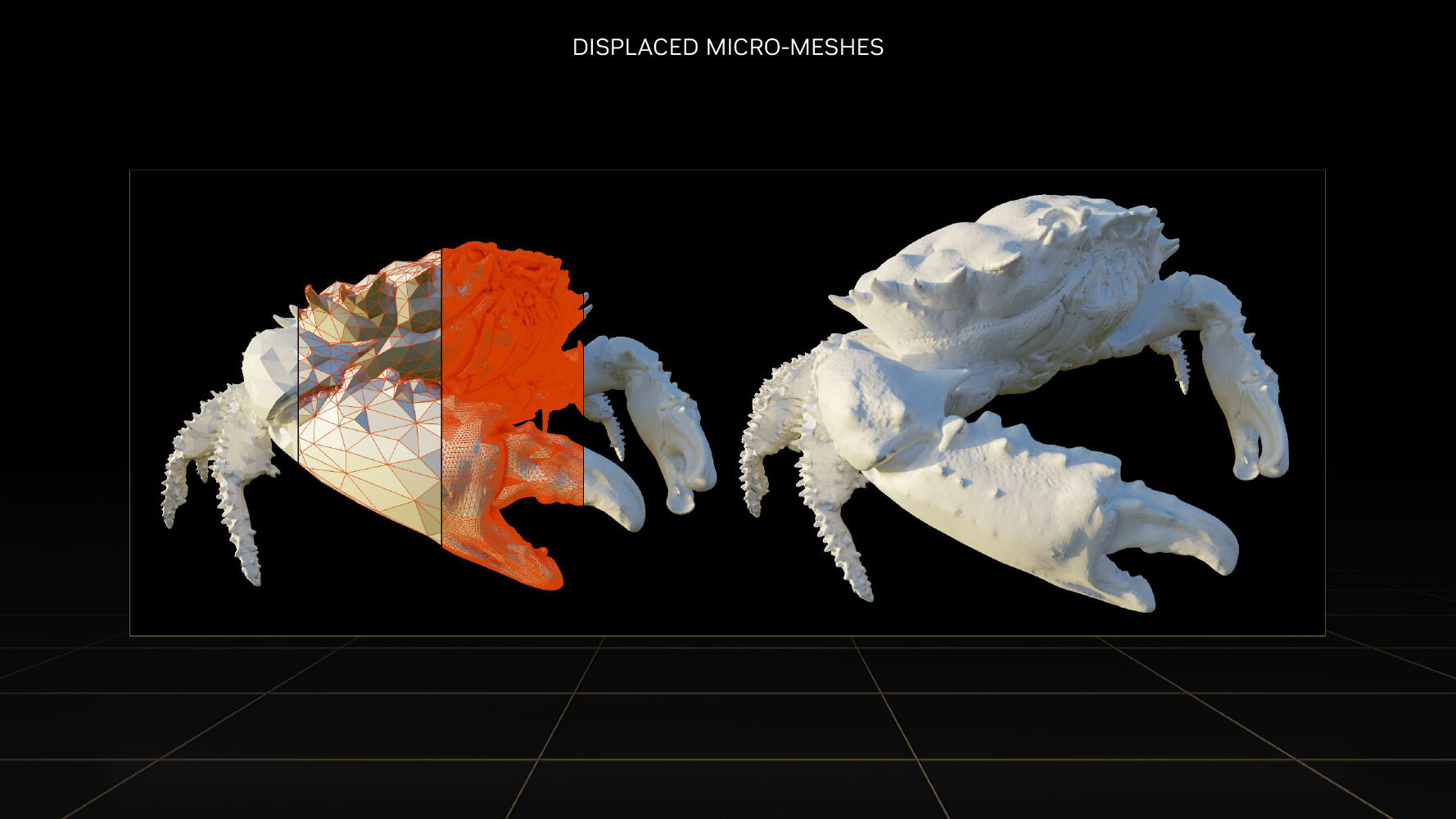
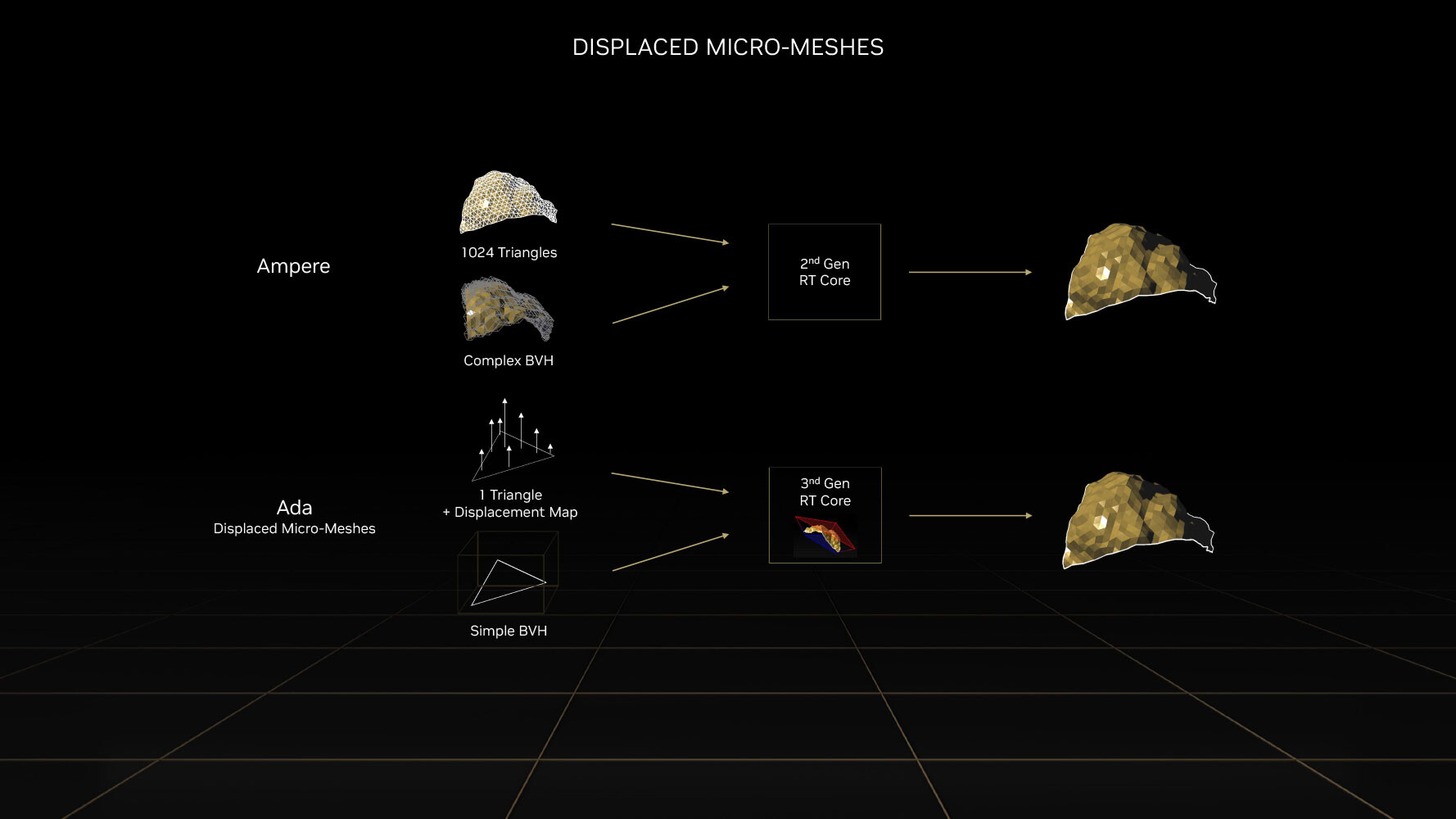
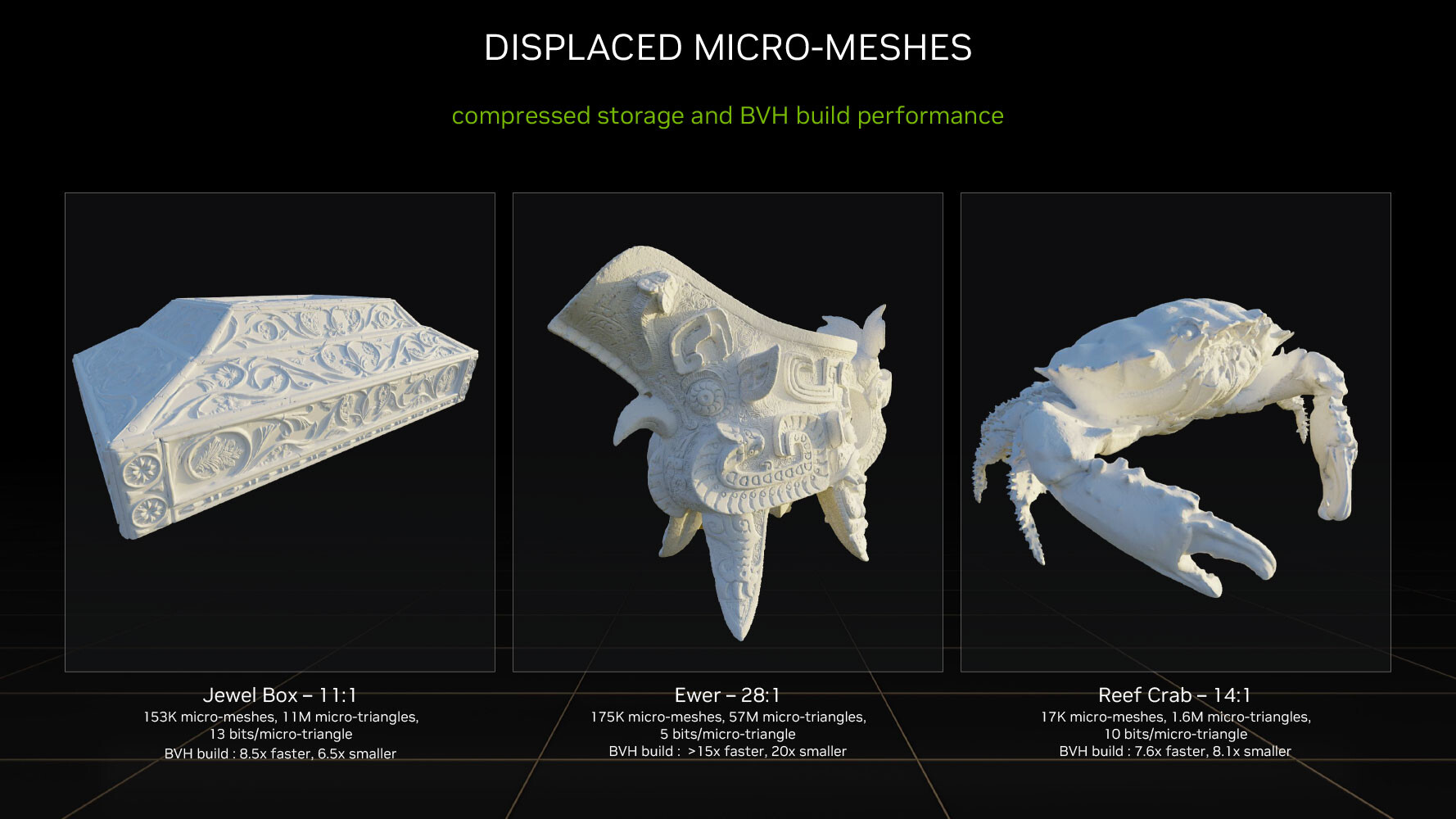
The BVH now needn't have data for every single triangle on an object, but can represent objects with complex geometry as a coarse mesh of base triangles, which greatly simplifies the BVH data structure. A simpler BVH means less memory consumed and helps to greatly reduce ray tracing CPU load, because the CPU only has to generate a smaller structure. With older "Ampere" and "Turing" RT cores, each triangle on an object had to be sampled at high overhead, so the RT core could precisely calculate ray intersection for each triangle. With Ada, the simpler BVH, plus the displacement maps can be sent to the RT core, which is now able to figure out the exact hit point on its own. NVIDIA has seen 11:1 to 28:1 compression in total triangle counts. This reduces BVH compile times by 7.6x to over 15x, in comparison to the older RT core; and reducing its storage footprint by anywhere between 6.5 to 20 times. DMMs could reduce disk- and memory bandwidth utilization, utilization of the PCIe bus, as well as reduce CPU utilization. NVIDIA worked with Simplygon and Adobe to add DMM support for their tool chains.
Opacity Micro Meshes
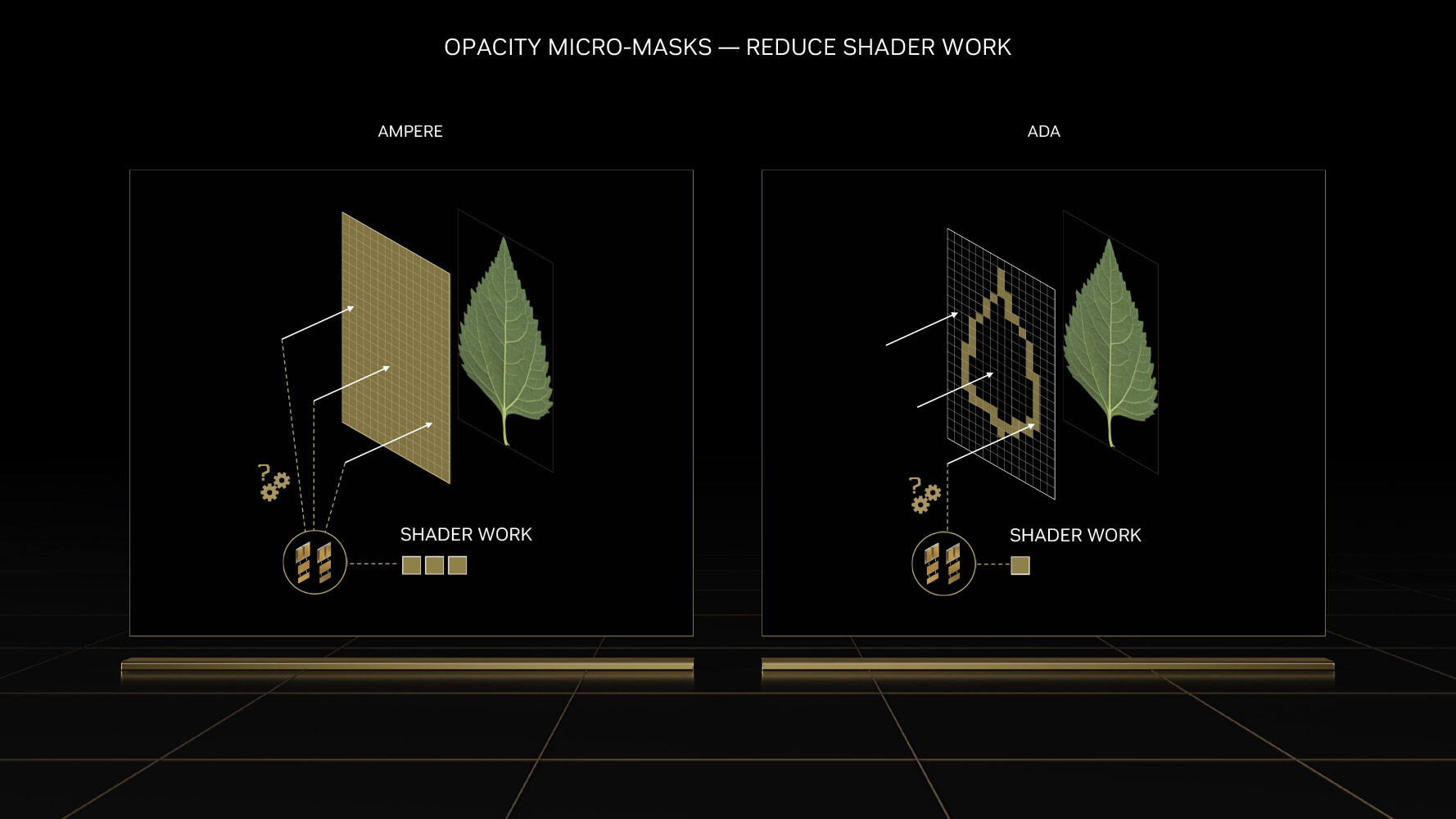
Opacity Micro Meshes (OMM) is a new feature introduced with Ada to improve rasterization performance, particularly with objects that have alpha (transparency data). Most low-priority objects in a 3D scene, such as leaves on a tree, are essentially rectangles with textures on the leaves where the transparency (alpha) creates the shape of the leaf. RT cores have a hard time intersecting rays with such objects, because they're not really in the shape that they appear (they're really just rectangles with textures that give you the illusion of shape). Previous-generation RT cores had to have multiple interactions with the rendering stage to figure out the shape of a transparent object, because they couldn't test for alpha by themselves.
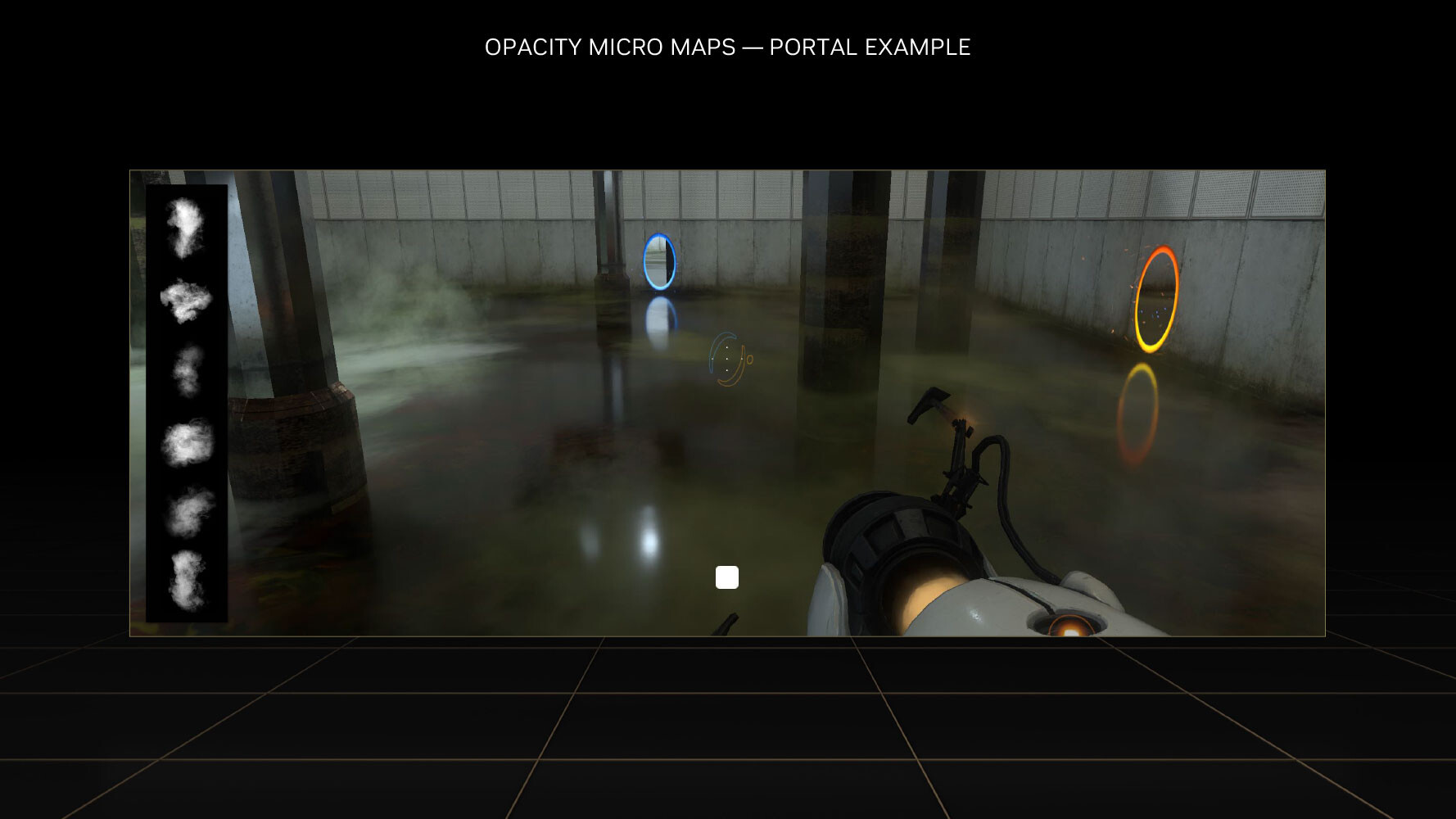
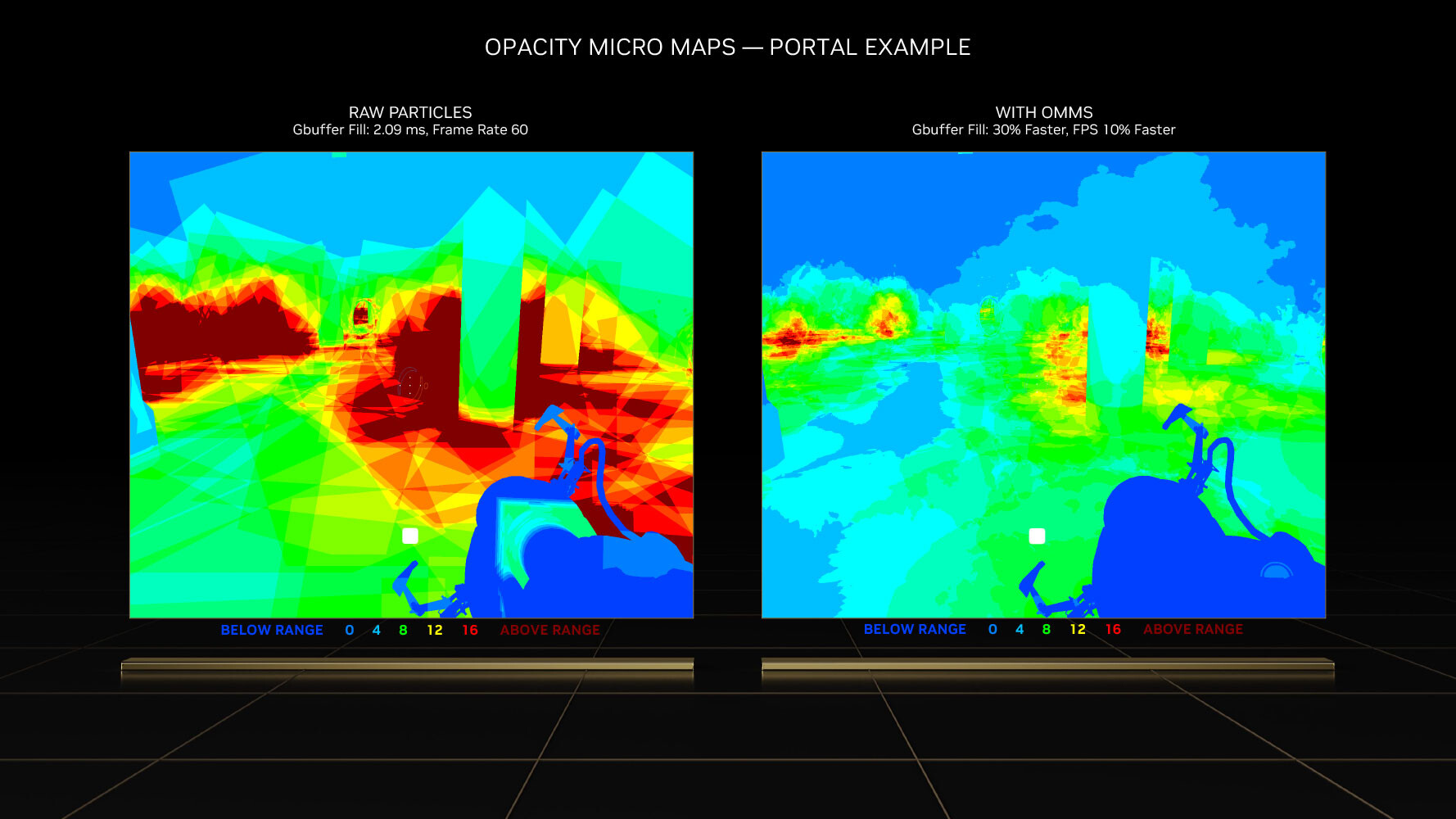
This has been solved by using OMMs. Just as DMMs simplify geometry by creating meshes of micro-triangles; OMMs create meshes of rectangular textures that align with parts of the texture that aren't alpha, so the RT core has a better understanding of the geometry of the object, and can correctly calculate ray intersections. This has a significant performance impact on shading performance in non-RT applications, too. Practical applications of OMMs aren't just low-priority objects such as vegetation, but also smoke-sprites and localized fog. Traditionally there was a lot of overdraw for such effects, because they layered multiple textures on top of each other, that all had to be fully processed by the shaders. Now only the non-opaque pixels get executed—OMMs provide a 30 percent speedup with graphics buffer fill-rates, and a 10 percent impact on frame-rates.
DLSS 3 Frame Generation
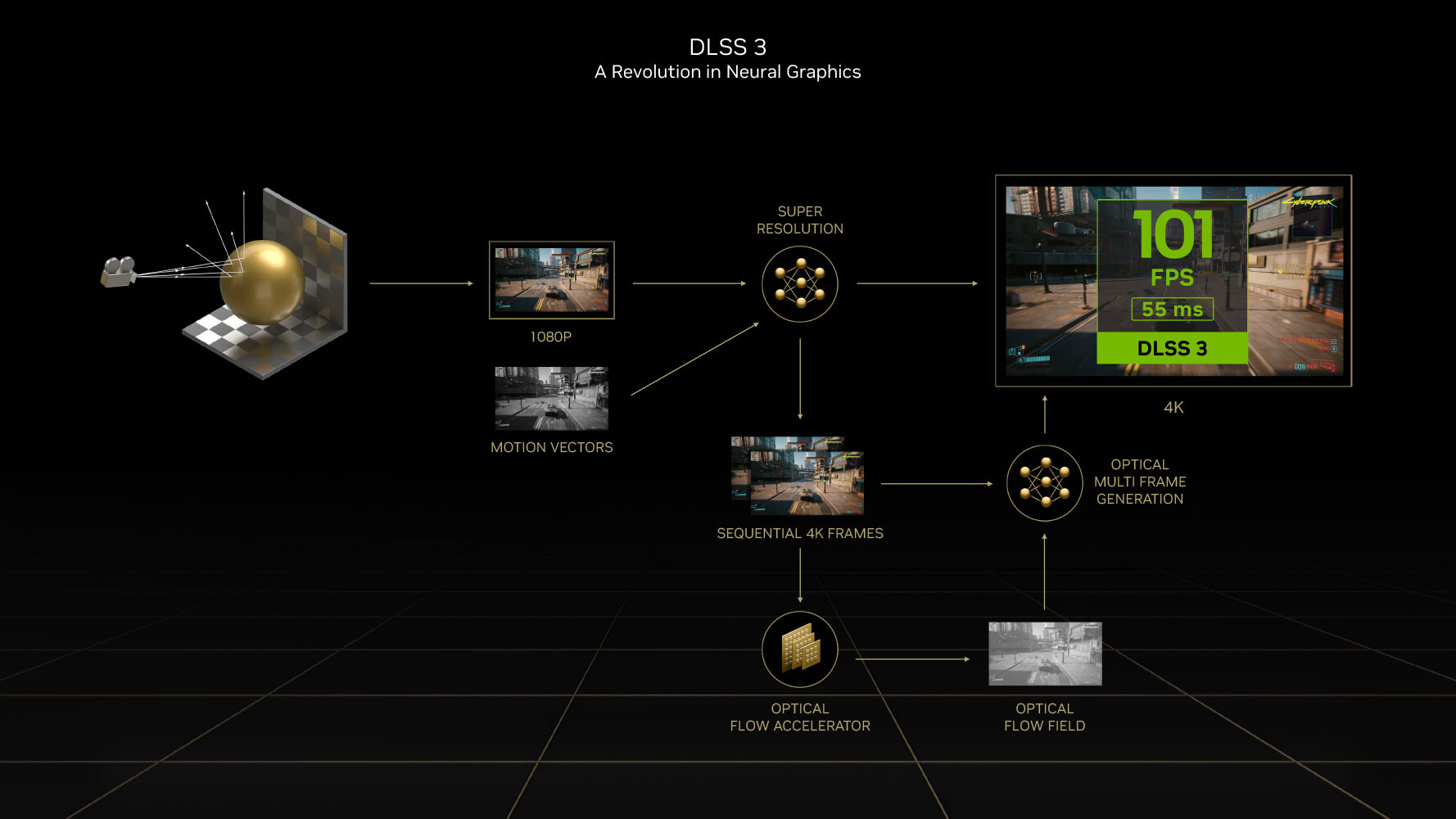
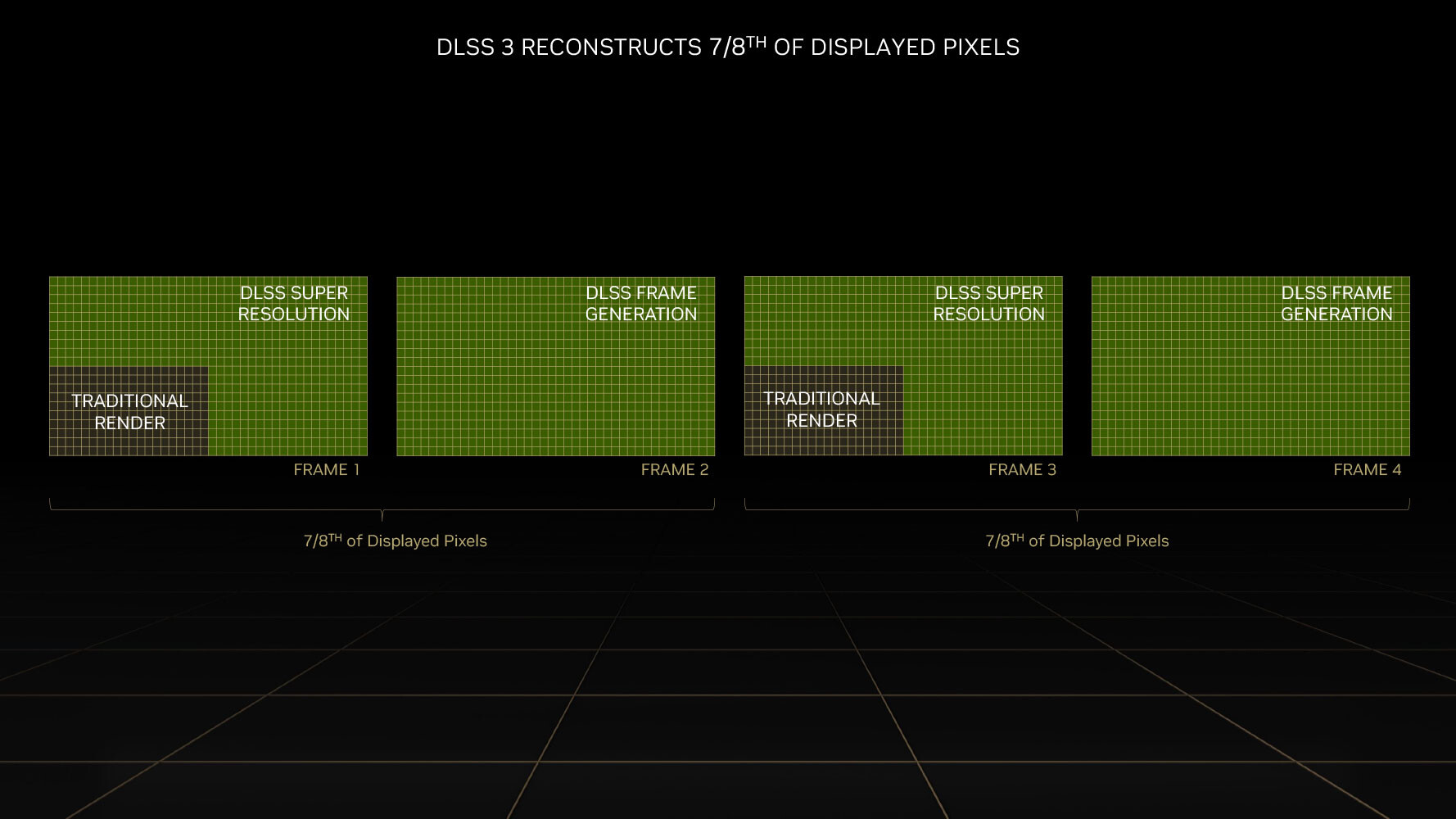
DLSS 3 introduces a revolutionary new feature that promises a doubling in frame-rate at comparable quality, it's called AI frame-generation. Building on DLSS 2 and its AI super-resolution (scaling up a lower-resolution frame to native resolution with minimal quality loss); DLSS 3 can generate entire frames simply using AI, without involving the graphics rendering pipeline, it's also possible to enable frame generation at native resolution without upscaling. Later in the article, we will show you DLSS 3 in action.

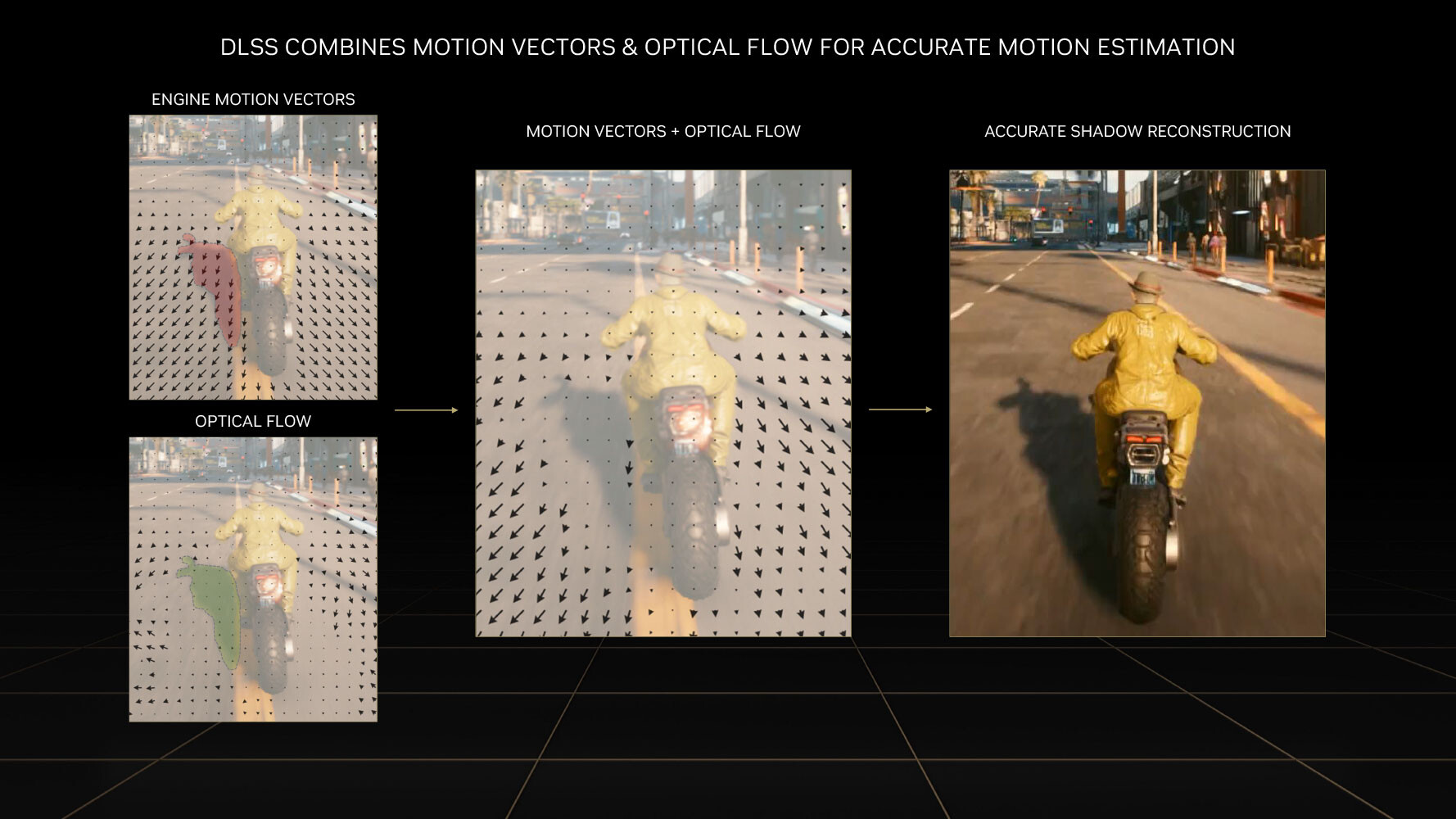
Every alternating frame with DLSS 3 is hence AI-generated, without being a replica of the previous rendered frame. This is possible only on the Ada graphics architecture, because of a hardware component called the optical flow accelerator (OFA), which assists in predicting what the next frame could look like, by creating what NVIDIA calls an optical flow-field. OFA ensures that the DLSS 3 algorithm isn't confused by static objects in a rapidly-changing 3D scene (such as a race sim). The process heavily relies on the performance uplift introduced by the FP8 math format of the 4th generation Tensor core. A third key ingredient of DLSS 3 is Reflex. By reducing the rendering queue to zero, Reflex plays a vital role in ensuring that latency with DLSS 3 enabled is at an acceptable level. A combination of OFA and the 4th Gen Tensor core is why the Ada architecture is required to use DLSS 3, and why it won't work on older architectures.
Packaging


The Card


The GeForce RTX 4080 Super FE looks exactly like the RTX 4080 FE, except for the color theme. I have to applaud NVIDIA's choice for an all-black design—it really looks fantastic. The card uses the through-flow concept that ensures air goes through the card and out the top, where it can be exhausted by a case fan.


Dimensions of the card are 31.0 x 14.0 cm, and it weighs 2131 g.


Installation requires three slots in your system. We measured the card's width to be 60 mm.

Display connectivity includes three standard DisplayPort 1.4a ports and one HDMI 2.1a (same as Ampere and same as non-Super Ada).
NVIDIA introduced the concept of dual NVDEC and NVENC Codecs with the Ada Lovelace architecture. This means there are two independent sets of hardware-accelerators; so you can encode and decode two streams of video in parallel or one stream at double the FPS rate. The new 8th Gen NVENC now accelerates AV1 encoding, besides HEVC. You also get an "optical flow accelerator" unit that is able to calculate intermediate frames for videos, to smooth playback. The same hardware unit is used for frame generation in DLSS 3.

All GeForce RTX 4080 and 4080 Super graphics cards use the 12+4 pin ATX 12VHPWR connector, an adapter cable is included in the box.

I really love the way they designed the Super logo on the card—it's embossed, yet still perfectly black.
Our Patreon Silver Supporters can read articles in single-page format.
Nov 11th, 2026 17:19 CST
change timezone
New Forum Posts
- WarpCoreBench scores! (13)
- Warning for Windows 10 and 11 users running newer AMD GPU drivers (49)
- Bought MAX-P495 - Which model? (29)
- GeekMagic Ultra Smart WiFi Weather Station (3)
- DTS DCH Driver for Realtek HDA [DTS:X APO4 + DTS Interactive] (2809)
- Rare GPUs / Unreleased GPUs (2271)
- Samsung 870 EVO - Beware, certain batches prone to failure! (1486)
- Windows new update 26H2 - Throttlestop (10)
- When you could finally run Crysis maxed out? (42)
- TPU's F@H Team (20569)
Popular Reviews
- AMD Zen 6 Technical Deep Dive
- Upcoming Hardware Launches 2027 (Updated Nov 2026)
- Gigabyte Z890I Aorus Ultra Review
- XPG NIMBUS PLUS Review - Mid-range Chair With Strong Competitors
- INNOCN 45C1R Review - Two QHD Screens, Zero Bezels
- NZXT H7 RGB+ Review
- Phantom Blade Zero Performance Benchmark Review - 35 GPUs Tested
- Gears of War: E-Day Performance Benchmark Review - 35 GPUs Tested
- NZXT H5 Review
- be quiet! Light Mount TKL Keyboard Review
TPU on YouTube
Controversial News Posts
- OpenAI CEO Argues Home PCs Waste the World's Limited DRAM Supply (152)
- NVIDIA Launches Investigation Into Jensen Huang's Relationship With Suspected Chinese Spy (136)
- Intel "Raptor Lake Next" 16-Core and 20-Core CPUs Surface (130)
- Legendary Game Studio BioWare Shuts Down Following EA Layoffs (104)
- Dell CEO Says the Memory Shortage Will Get Worse in 2027 (95)
- NVIDIA GeForce RTX 50-Series Scheduled for up to $500 Price Hike This Week (89)
- Modder Fits RTX 5090 With Four 8-Pin Connectors, Halving Current per Wire (80)
- AMD Radeon Owners Can Now Run Nearly Every DLSS Feature Through Fan-Made Mod (80)