 30
NZXT N9 X870E Review
BIOS Overview »VRM Overview

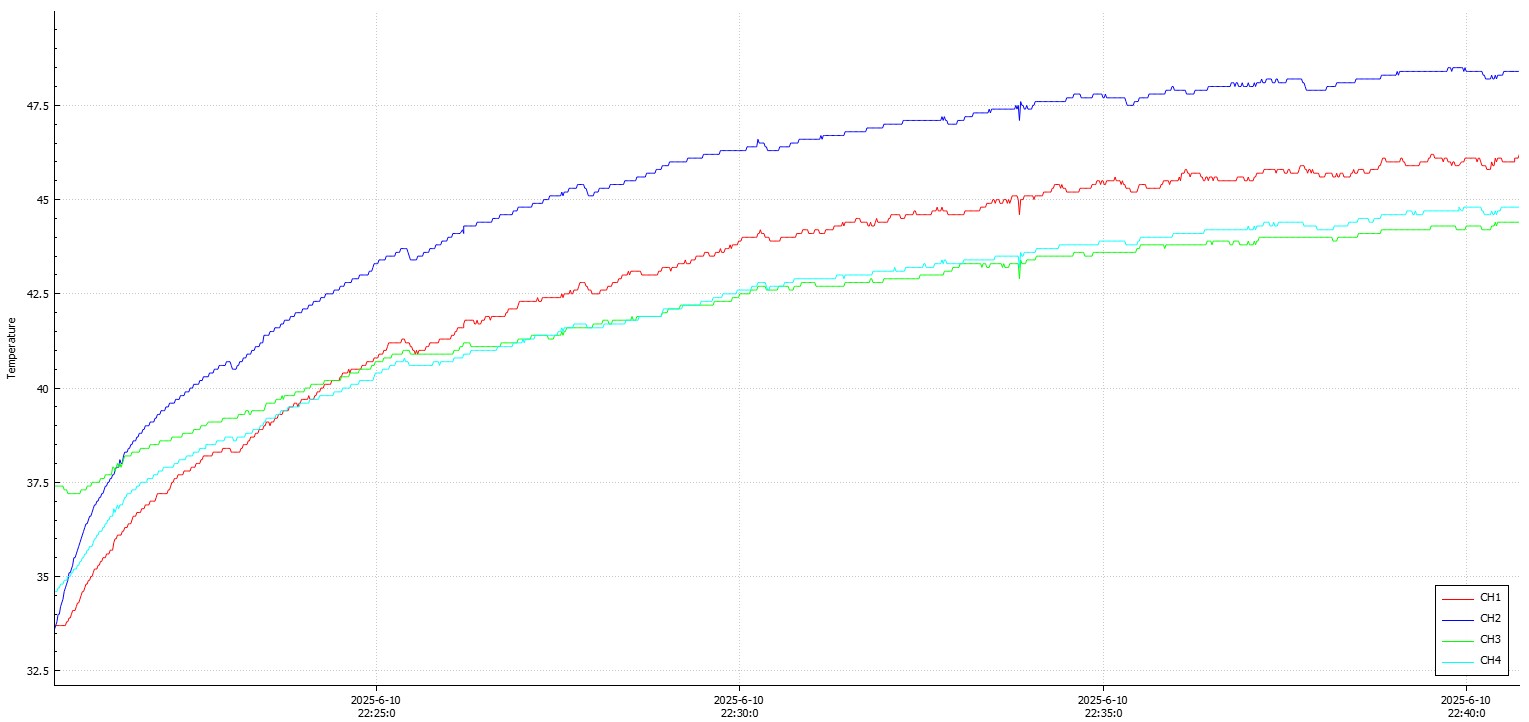
The 20+2+1 phase power delivery features two large heatsinks, with the largest sitting over the I/O panel and featuring two internal fans. This seems to be a good combination as the VRM temperatures levelled off after just 20 minutes and were kept comfortably below 50°C, which is one of the coolest results we've seen since we switched to our Ryzen 9 9950X for stress testing.


The fans sit vertically and direct airflow out the back of the I/O shroud through small vents, drawing air in through vanes in the heatsink. By default, they're set to respond to the CPU temperature—with the only alternative source in the software or EFI being the GPU—as a result these did become audible in the second half of our stress test and that's with a custom water-cooled test bench. Competing solutions offer additional source options, such as a two pin thermistor header, for example, allowing users to base fan speeds off coolant, VRM, or exhaust temperature. For anyone concerned by this, there's an easy fix, which is to manually set the upper limit of the fans to 40 percent or below using the CAM software. This is the upper limit of what's audible in a quiet system and didn't impact the VRM temperatures by more than a few degrees in our testing. The fans use a splitter cable that's fed from an eighth 4-pin header on the motherboard dedicated to them, but as this isn't accessible without removing the heatsink, which is why it's not listed in the specifications.


The second heatsink isn't linked to the first by way of a heatpipe sadly, which might help to even the heat load, but it cools both MOSFETs and chokes that make up half of the vCore power delivery. The PWM controller of choice is the Renesas RAA 229628, which we've unsurprisingly seen before on the likes of the ASRock X870E Taichi and that board's X670 predecessor too.


Apart from the MISC power stage that's via a Renesas RAA220075R0, the 22 other stages are Renesas R2209004 110 A smart power stages, which are also used on boards such as the MSI MPG X870E Carbon Wi-Fi and ASRock X870E Taichi.
Nov 19th, 2026 16:34 CST
change timezone
Latest GPU Drivers
New Forum Posts
- Dell Workstation Owners Club (3517)
- Making a game in Godot engine (6)
- Honestly, do you care about GTA VI? (166)
- Introducing DST Bench : one of the most advanced disk benchmark and storage analyzer real-time software (6)
- Windows 11 General Discussion (7736)
- Current Sales, Bundles, Giveaways (10448)
- Last game you purchased? (1409)
- WarpCoreBench scores! (76)
- Got the EOL 32GB TridentZ 6000 CL26 1.4V (12)
- DTS DCH Driver for Realtek HDA [DTS:X APO4 + DTS Interactive] (2815)
Popular Reviews
- Acemagic Retro X3 Review
- Ugreen NASync DXP4800 GT Review
- Upcoming Hardware Launches 2027 (Updated Nov 2026)
- Pulsar Office Tour & First Look at P1 Dual-Sensor Mouse
- AMD Zen 6 Technical Deep Dive
- Biwin Black Opal NV7400 2 TB Review
- Sapphire Radeon RX 7700 XT Pure Review
- Sapphire Radeon RX 7700 XT Pulse Review
- AMD Ryzen 7 9800X3D Review - The Best Gaming Processor
- Chieftec Iceberg PRO 360 DARK Review
TPU on YouTube
Controversial News Posts
- NVIDIA Co-Founder and CEO Jensen Huang Officially Resigns (489)
- Report: Jensen Huang Eyes NVIDIA Comeback (223)
- Open Letter Asking NVIDIA to Reinstate Jensen Huang Passes 115,000 Signatures (184)
- OpenAI CEO Argues Home PCs Waste the World's Limited DRAM Supply (152)
- NVIDIA Launches Investigation Into Jensen Huang's Relationship With Suspected Chinese Spy (136)
- Intel "Raptor Lake Next" 16-Core and 20-Core CPUs Surface (130)
- Legendary Game Studio BioWare Shuts Down Following EA Layoffs (104)
- Dell CEO Says the Memory Shortage Will Get Worse in 2027 (95)