 4
OLOY Blade Performance RGB DDR5-6000 32 GB CL30 Review
(4 Comments) »Introduction

Founded in 2018, OLOY is based out of Hong Kong with a main focus as a manufacturer of DRAM memory modules for the consumer market for both DDR4 and DDR5, with all products listed as made in Taiwan.
OLOY has made a name for itself in the memory market by offering a variety of products tailored to both budget and PC enthusiasts. The company is particularly recognized for its DDR4 Warhawk and OWL series, which provide speeds from 2400 MT to 4133 MT and capacities up to 32 GB in a 2x 16 GB configuration. In the realm of DDR5, OLOY has introduced the Blade series, which features speeds from 4800 MT to 6400 MT. The Blade series is available in configurations of 32 GB (2x 16 GB), 48 GB (2x 24 GB), and 96 GB (2x 48 GB), catering to a variety of performance needs of gamers.

In this review, we will be taking a closer look at the OLOY Blade Performance RGB DDR5-6000 32 GB (2x 16 GB) memory kit. Using primary timings of 30-38-38-96, the kit is aimed at PC enthusiasts. With two 6000 MT/s profiles covering both XMP and EXPO, this memory is well suited for both Intel and AMD. We will put this kit through a number of benchmarks to see what performance is like on multiple platforms. With the introduction out of the way, let us now see how this memory kit stacks up against the competition, beginning with a look at the specifications.
Specifications
| Specifications & SPD Profiles | ||||
|---|---|---|---|---|
| Manufacturer: | OLOY | |||
| Series: | Blade | |||
| Model: | ND5U1660306BRKDA | |||
| Tested Capacity: | 32 GB (2x 16 GB) | |||
| Registered/Unbuffered: | Unbuffered | |||
| CKD: | No | |||
| Form Factor: | 288-pin UDIMM | |||
| Dimensions (Z-Height): | 38 mm | |||
| IC Manufacturer: | SK Hynix (CL30) | |||
| Warranty: | Limited Lifetime | |||
| Ranks: | Single-Rank | |||
| XMP / EXPO Profile: | XMP-1 | EXPO-1 | JEDEC | |
| Speed Rating: | DDR5-6000 MT/s | DDR5-6000 MT/s | Up to DDR5-4800 MT/s | |
| Rated Timings: | 30-38-38-96-134 | 30-38-38-96-134 | 40-40-40-117 | |
| Tested Voltage: | 1.40 V | 1.40 V | 1.10 V | |
Packaging


Taking a quick look at the packaging, we can see OLOY's all black design with information on the box is easy to digest. On the front is the product branding with a cutout showing the actual memory inside the box. The identification sticker lists the product number, rated XMP/EXPO operating frequency, voltage, and primary CAS timings. At the bottom are RGB badges indicating support for ASUS Aura Sync, GIGABYTE RGB Fusion, MSI Mystic Light Sync, and ASRock Polychrome Sync motherboard RGB software.

The box has some tape to prevent anything from falling out during shipping. Once cut and removed from the outer packaging; the memory sticks are secured and protected from minor damage with a plastic clamshell within the outer box.
A Closer Look

OLOY's DDR5 UDIMM lineup is currently confined to the Blade series, which comes in White and Black. Regrettably, the OLOY website offers limited information on configurations, forcing us to speculate on the range of speeds available.

Every memory module prominently displays the OLOY branding on both sides of the DIMM.

On one side of each DIMM module is an identification sticker listing the product number, rated operating frequency, voltage and primary CAS primary. It is easy to read, but we would have liked to see the entirety of the primary timings, along with the XMP and EXPO badges printed.

Laying the memory on it's side, you can see an opaque plastic strip in the middle, this will be illuminated when the system is powered on. The RGB lighting effects can be customized and controlled using popular motherboard software, including ASUS Aura Sync, GIGABYTE RGB Fusion, MSI Mystic Light Sync, and ASRock Polychrome Sync.
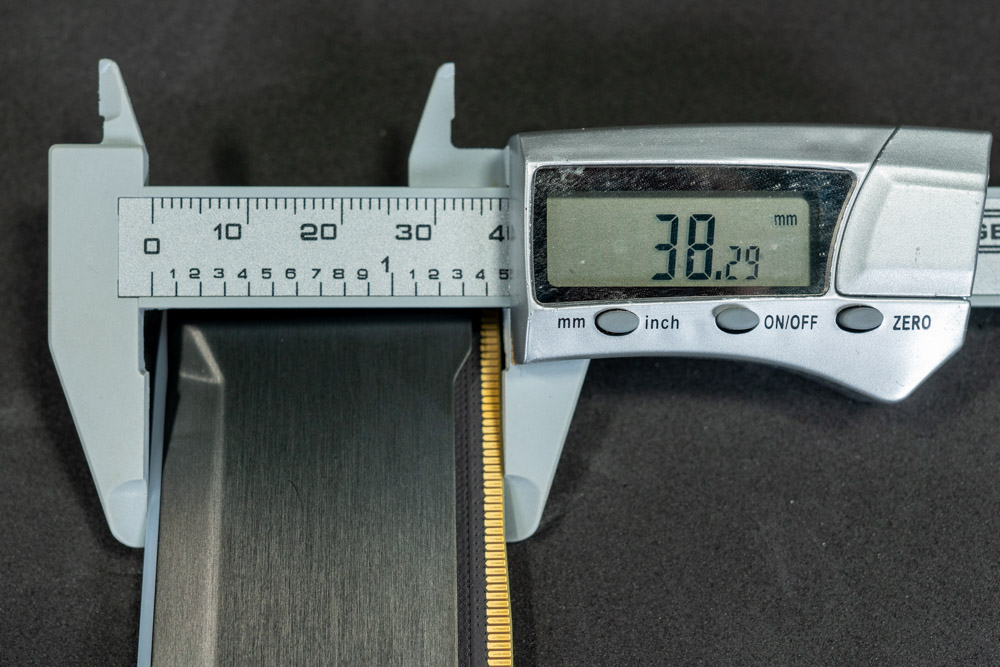

The OLOY Blade Performance RGB DDR5-6000 Z-Height is 38 mm measuring with calipers, and weighs 42 grams on the scale.

After taking the heat spreader off, we see that these are single-sided DIMMs with eight (16 Gbit) 2 GB ICs. Included is the standard thermal pad that covers all the memory ICs. This particular kit has coverage for the PMIC and surrounding components, well done OLOY.
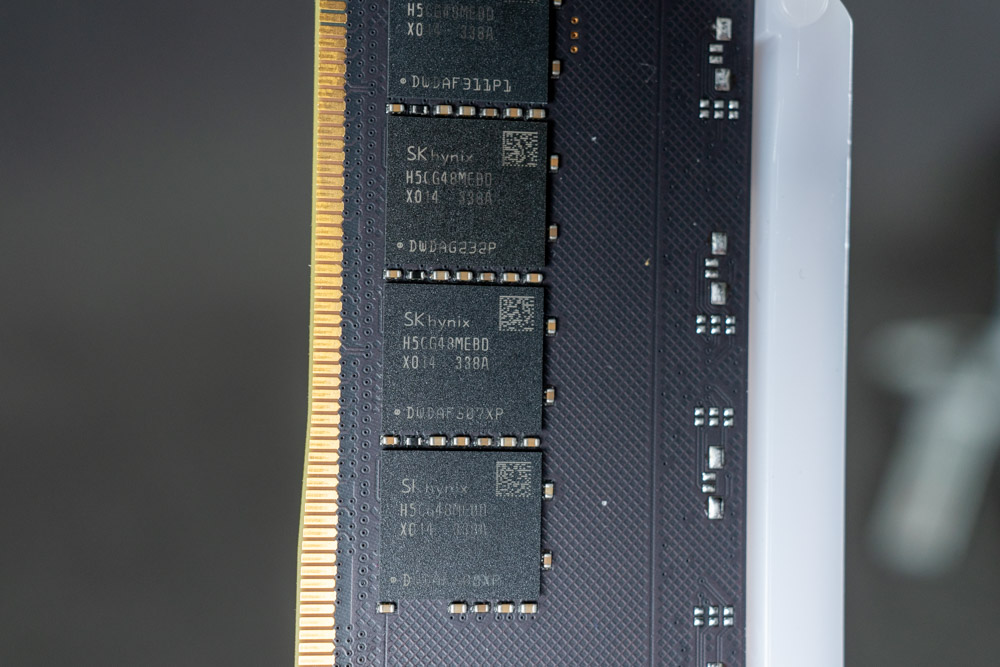
A detailed look at the ICs shows they are SK Hynix (H5CG48MEBD-X014), abbreviated to SK Hynix (16 Gbit) 2 GB M-Die. This is SK Hynix's debut revision for DDR5, though it doesn't scale as effectively as the subsequent (16 Gbit) 2 GB A-Die or (24 Gbit) 3 GB M-Die.
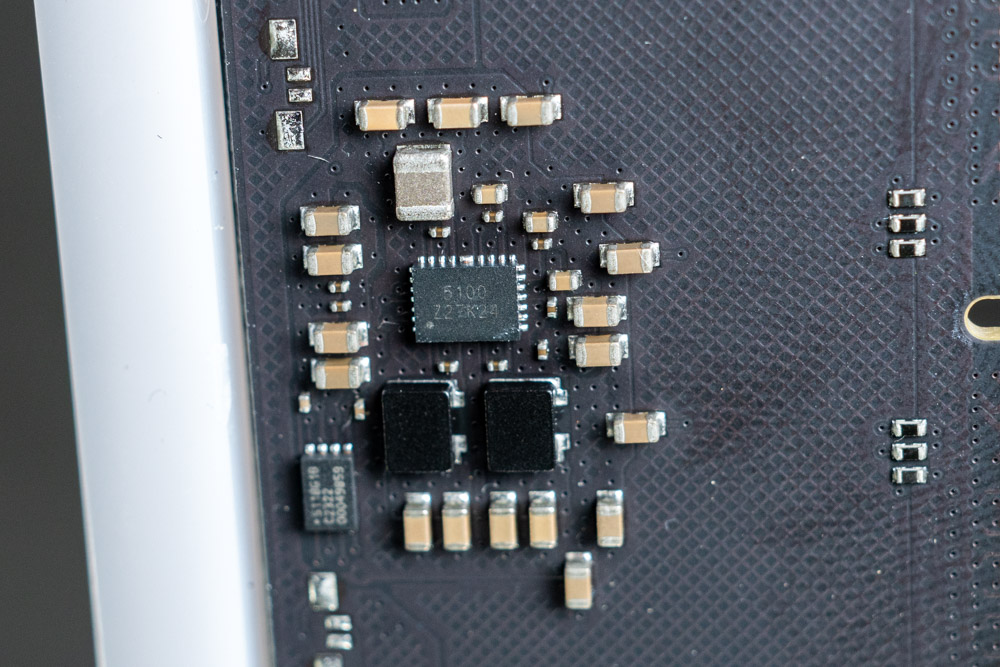
With DDR5, one of the major changes is how the motherboard directly provides 5 V to the memory module's PMIC, which is then stepped down and split accordingly. No longer is the motherboard responsible for regulating the voltages, as with DDR4. The PMIC has the part number "5100," with the software reporting this as RAMBUS being the manufacturer.
Test System
| Test System Memory 2025 | |
|---|---|
| Processor: (Intel) | Intel Core i9-13900K Raptor Lake, 8+16 cores / 32 threads P-Core @ 5.5 GHz, E-Core @ 4.3 GHz (Locked) |
| Processor: (Intel) | Intel Core Ultra 9 285K Arrow Lake, 8+16 cores / 24 threads P-Core @ 5.4 GHz, E-Core @ 4.6 GHz (Locked) |
| Processor: (AMD) | AMD Ryzen 9 9950X Zen 5, 16 cores / 32 threads |
| Processor: (AMD) | AMD Ryzen 7 9800X3D Zen 5, 8 cores / 16 threads All-Core 5.2 GHz (Locked) |
| Motherboard: | MEG Z890 UNIFY-X MPG X870E CARBON WIFI MSI MAG Z790 Tomahawk DDR4 |
| Graphics Card: | PNY GeForce RTX 4090 XLR8 |
| Cooling: | Custom Watercooling Loop |
| Harddisk: | Neo Forza NFS01 480 GB SATA SSD (OS) Neo Forza NFP07 1 TB M.2 NVMe SSD (Data) |
| Power Supply: | FSP MEGA TI Titanium 1650 W |
| Case: | Primochill Praxis Wetbench |
| Software: | Windows 11 Professional 64-bit |
| Drivers: | (RTX 4090) NVIDIA GeForce 552.12 WHQL |
Our Patreon Silver Supporters can read articles in single-page format.
Nov 26th, 2026 09:43 CST
change timezone
Latest GPU Drivers
New Forum Posts
- Can you guess Which game it is? (366)
- Post your CrystalDiskMark speeds (658)
- Wireless Internet sharing between PC and router both-ways, is it possible? (23)
- Making a game in Godot engine (20)
- What's your main Black Friday / Cyber Monday purchase? (17)
- X79 and/or rampage IV OC'ing thread for those of us still left.... (2459)
- Exploring Local LLMs: Models, Hardware and Setup Experiences (4)
- Linpack Xtreme Released (513)
- Claude credits purchased on or after Dec. 7 now have an expiry date (20)
- Acer TravelMate P414-51 (i5-1135G7): CPU stuck at x4 / ~200 MHz effective under 100% load, no throttle flags. How to find who's clamping it? (1)
Popular Reviews
- ASRock X870E Challenger Wi-Fi White Review
- VZMORE AX9 Max Review
- Upcoming Hardware Launches 2027 (Updated Nov 2026)
- Microsoft Surface Laptop Ultra Review - The Next-gen Arm Laptop
- AMD Ryzen 7 9800X3D Review - The Best Gaming Processor
- AMD Zen 6 Technical Deep Dive
- Corsair RM1200e (Second Generation) Review
- Phantom Blade Zero Performance Benchmark Review - 35 GPUs Tested
- Montech CyberFlow ARGB 360 Review
- Pulsar Office Tour & First Look at P1 Dual-Sensor Mouse
TPU on YouTube
Controversial News Posts
- Jensen Huang Reinstated as CEO of NVIDIA (585)
- NVIDIA Co-Founder and CEO Jensen Huang Officially Resigns (492)
- Report: Jensen Huang Eyes NVIDIA Comeback (281)
- Open Letter Asking NVIDIA to Reinstate Jensen Huang Passes 115,000 Signatures (184)
- OpenAI CEO Argues Home PCs Waste the World's Limited DRAM Supply (152)
- NVIDIA Launches Investigation Into Jensen Huang's Relationship With Suspected Chinese Spy (136)
- Intel "Raptor Lake Next" 16-Core and 20-Core CPUs Surface (130)
- Intel Razor Lake Gets a 12 P-Core bLLC Chip With No E-Cores, Per Leak (94)