 17
Orbital Pathfinder Review
(17 Comments) »Value and Conclusion
- The Orbital Pathfinder is available for $189.00.
- Highly customizable due to being modular
- True 8000 Hz wireless polling
- Very good sensor performance
- Very low click latency
- Very high button quality
- Good scroll wheel
- Good choice of components
- Lightweight
- Nicely gliding mouse feet
- Full software customizability
- Sets of replacement mouse feet included
- Very pricey
- 8000 Hz suffers from randomly increasing motion delay
- 4000 Hz shows elevated variance
- Mounting the attachable pieces can be cumbersome
- Battery life is a mystery
In an ever competitive market, gaming mice have reached a certain level of saturation. Differences in the weight, switches, and performance become increasingly miniscule, to where one category emerges as the most relevant one: shape. Naturally, the challenge in this regard is the fact that one has to try a shape first to know whether it suits one's hand, and the risk of a shape not being received positively by most users is part of the reason why many manufacturers opt for clones of already widely accepted, "safe" shapes—above all, such shapes are "safe" for the manufacturer. Accordingly, the market steers towards a direction where one of the few attributes differentiating mice from each other becomes increasingly samey.
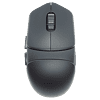
Part of the problem is that, typically, a shape is immutable. The qualifier "typically" is key here, as the Pathfinder is among the very few, if not only, mice where the shape indeed is mutable. Some attempts have previously been made by competitors such as Xtrfy, which allowed mounting differently shaped humps, or Mad Catz, which had different side modules and length adjustment, but ultimately, the possibilities were strictly limited. By contrast, the Pathfinder presents a much more extensive approach. Out of the box, the Pathfinder lacks side and hump pieces, essentially inviting the user to start experimenting. In the box, one finds four left-hand side pieces, seven right-hand side pieces, and four differently shaped humps, for a total of 128 base configurations. By adding spacers, one also has some level of control over the width and length of the Pathfinder. While three of the four hump pieces are of the ambidextrous type, one of them at least allows for a right-handed ergonomic design, so the Pathfinder isn't even restricted to a single form factor.
Still, there are some caveats to the modularity of the Pathfinder. Even though the wide array of differently shaped pieces allows for a great deal of customization, some parts of the shape cannot be changed. The main buttons, for instance, will always have the same height, curvature, and size, and the degree to which the mouse slopes down towards the front remains the same, too. The base body of the Pathfinder is mostly straight, with neither the front nor rear flaring out much if at all, and these traits are inherited by the modules at least to some degree. Due to the way the pieces attach, creating a significantly wider front or rear isn't really possible, and since there are only two sizes of spacers available, width and length adjustment isn't particularly granular, either. Since Orbital provides the necessary STL files, those so inclined can expand the possibilities further by designing and printing their own pieces, but ultimately, the Pathfinder is still best thought of as a template that is then refined further, instead of a fully modular mouse. That isn't a bad thing, however, and rather an intentional compromise made by Orbital. Said template is quite close to the OP1 shape from Endgame Gear—and any variant of the Pathfinder will, at least to some degree, be a variant of that shape—so those not liking that shape archetype at all may not like the Pathfinder either.
As far as the process of mounting the individual pieces goes, the Pathfinder leaves room for improvement. The hump attaches to a rail, which can be done with relative ease, and while dismounting takes a good bit of force, getting a good hold of the hump isn't difficult. The side pieces, on the other hand, have stems with indents locking the piece in place when inserted. On my sample at least, this locking mechanism is rigid to where getting a piece off again requires ridiculous amounts of force. Something like a screwdriver will work of course, but the risk of slipping and damaging the plastic is high. There is no suitable tool in the box, either, basically forcing the user to get creative. The mounting process being this cumbersome is particularly unfortunate given that the entire point of having a modular mouse is experimentation, yet that very experimentation is actively discouraged by the fact that the dismounting process quickly turns into a project. Conceivably, the mechanism will likely loosen up a bit over time, but this provides only so much consolation. Thankfully, when using the spacers, getting the side pieces off becomes much easier, which is why I recommend starting at least with the medium spacer set. Alternatively, using magnets with a latch that could be dislodged from the inside would be a far more convenient and user-friendly solution.
Mounting woes aside, modularity is realized well on the Pathfinder. As mentioned, each piece sits very tight, and the only rattle when shaking the mouse comes from the main buttons. The shell is thick enough to prevent any flexing, and the minor amount of creaking is entirely expected on a mouse that has detachable parts. In addition, the side buttons cannot be actuated by pressing below them. The weight also stays within a reasonable range. Without any pieces attached, the Pathfinder weighs 44 g, whereas the minimal configuration weighs in at 52 g. At this weight, the Pathfinder still weighs less than the similarly sized and shaped Endgame Gear OP1w 4K. By adding spacers and some of the larger pieces, the weight will go up further, but never exceeds 60 g. Considering the requirements modularity poses in ensuring structural rigidity, the Pathfinder cannot be faulted in this regard.
In terms of switches, the Pathfinder ends up falling closely in line with the competition. For the main buttons, Orbital has opted for the ever popular optical D2FP-FN2 switches from Omron, which are known for their actuation being the closest in feel to an actual mechanical switch. The Pathfinder utilizes a rather uncommon button design, yet with great results. Pre- and post-travel are at most moderate, and lateral button movement is kept to a minimum even when provoked. The side button switches likewise come from Omron and are surface-mounted (D2LS-21, blue plunger). Despite their small footprint, and despite the fact that the button covers can be removed, pre- and post-travel are low on the forward and a bit higher—but still within acceptable range—on the back button. The actuation point is perfectly even on the forward button, but less so on the back button. The scroll wheel is from TTC and of the blue/yellow core variety. Noise levels are somewhat elevated on this one, but tactility is quite good, with the individual steps being well-separated from each other, affording controlled scrolling. By default, four white-dyed PTFE dot skates are installed on the Pathfinder, but the box includes a rich supply of replacement dot sets, along with a full set of fitted feet. The bottom is even and there are no screw holes, so feet of virtually any size and shape may be installed on the Pathfinder.
Of course, a modular mouse is only worth as much as the internals it harbors, which is why Orbital didn't make any compromises in this regard. PixArt's latest PAW3950 sensor is paired with a Nordic nRF52840 MCU, and the included dongle allows for polling rates of up to 8000 Hz in wireless operation. At +5.0%, CPI deviation is higher than I'd want it to be, but still quite easily corrected and therefore not critical. General tracking shows no issues, irrespective of whether MotionSync is enabled or disabled. In terms of polling stability, the Pathfinder also fares well for the most part. In wireless operation, 125 and 500 Hz show periodic off-period polls, but since each polling interval is 0.125 ms by virtue of USB High-Speed being utilized, the absolute deviation is rather small and ultimately negligible. 1000, 2000, and 8000 Hz are fully stable, whereas 4000 Hz again shows the same elevated variance observed at 125 and 500 Hz. Essentially, instead of maintaining intervals of 0.250 ms, the Pathfinder continuously alternates between mostly 0.125 and 0.375 ms, which still gives the same average of 0.250 ms but won't feel as consistent. The variance at 4000 Hz is noteworthy in that it also directly affects motion delay, which varies by the same amount. Speaking of motion delay, the Pathfinder once again does very well at 1000 and 2000 Hz. At 2000 Hz and without MotionSync, an advantage of 1.0 ms is attained over the Logitech G403 (control subject), and by enabling "e-sports mode" (another name for the corded sensor run mode of the PAW3950) in the software, the same can be achieved at 1000 Hz. 4000 Hz, as mentioned, shows large variance and therefore isn't recommended to use. The same applies to 8000 Hz, which suffers from an issue where motion delay randomly increases through the motion. Obviously, this is fundamentally undesired for a mouse advertised to support 8000 Hz polling, and opting for stable and performant 1000 and 2000 Hz instead is recommended. In terms of click latency, the Pathfinder posts excellent numbers. At 1000 Hz, 0.8 ms are averaged, which goes down to 0.5 ms at 2000 Hz and 0.4 ms at 4000 and 8000 Hz. While a debounce time setting exists in the software, it has no effect on click (button-down) latency, and upon lift-off, no defer-type debounce is added, either. Despite this, I haven't been able to reproduce any slam-clicking, which describes inadvertent button actuation upon resetting the mouse, on the Pathfinder.
The software has all the usual options, low resource usage, and presents itself largely bug-free, which is highly appreciated. However, there is an oversight in that lift-off distance adjustment is limited to levels of "low" and "high," which correspond to the 1 and 2 mm settings of the PAW3950, respectively. The 0.7 mm level, on the other hand, is simply absent in the software, which is unfortunate in that this LOD level is one of the things differentiating the PAW3950 from the older PAW3395. The software also includes a percentage-based battery life indicator with single-digit accuracy, but the values given by this one originate from fantasy land. Even after seven hours of continuous usage at 8000, 2000, and 1000 Hz with corded mode enabled, the indicator refused to drop below 95%, which is simply impossible on a 300 mAh battery. Since the numbers cited by Orbital are given in days, which is a useless metric if not defined verbatim (i.e., equaling 24 hours of continuous usage at a specified polling rate), actual battery life on the Pathfinder remains a mystery. That said, I at least wouldn't expect battery life to be disastrous, based on battery capacity alone. Charging isn't exactly speedy on the Pathfinder at just below 0.2 A, but the charging cable is at least flexible enough to allow playing while charging without feeling overly restricted. It should also be mentioned that the Pathfinder already has the contacts necessary for a charging dock, so down the line those so inclined should be able to purchase a charging dock and thus free themselves from all cable shackles.
At $189.00, the Pathfinder is definitely pushing the price envelope. A modular mouse costing more than a non-modular one is expected, but the Pathfinder is veering toward a price region where most people simply lose interest. Still, for those indeed willing to pay this much for a gaming mouse, the Pathfinder delivers on a high level, be it in terms of performance, button, or build quality. For future renditions, it would be welcome if Orbital could streamline the mounting process, or at least include some kind of tool to make things a bit easier for the user. At the same time, for a project this ambitious, the execution is already on a good level, and I, for one, appreciate such bolder ideas still being put into reality. As such, the Pathfinder receives both our Innovation and Recommended awards.


Part of the problem is that, typically, a shape is immutable. The qualifier "typically" is key here, as the Pathfinder is among the very few, if not only, mice where the shape indeed is mutable. Some attempts have previously been made by competitors such as Xtrfy, which allowed mounting differently shaped humps, or Mad Catz, which had different side modules and length adjustment, but ultimately, the possibilities were strictly limited. By contrast, the Pathfinder presents a much more extensive approach. Out of the box, the Pathfinder lacks side and hump pieces, essentially inviting the user to start experimenting. In the box, one finds four left-hand side pieces, seven right-hand side pieces, and four differently shaped humps, for a total of 128 base configurations. By adding spacers, one also has some level of control over the width and length of the Pathfinder. While three of the four hump pieces are of the ambidextrous type, one of them at least allows for a right-handed ergonomic design, so the Pathfinder isn't even restricted to a single form factor.
Still, there are some caveats to the modularity of the Pathfinder. Even though the wide array of differently shaped pieces allows for a great deal of customization, some parts of the shape cannot be changed. The main buttons, for instance, will always have the same height, curvature, and size, and the degree to which the mouse slopes down towards the front remains the same, too. The base body of the Pathfinder is mostly straight, with neither the front nor rear flaring out much if at all, and these traits are inherited by the modules at least to some degree. Due to the way the pieces attach, creating a significantly wider front or rear isn't really possible, and since there are only two sizes of spacers available, width and length adjustment isn't particularly granular, either. Since Orbital provides the necessary STL files, those so inclined can expand the possibilities further by designing and printing their own pieces, but ultimately, the Pathfinder is still best thought of as a template that is then refined further, instead of a fully modular mouse. That isn't a bad thing, however, and rather an intentional compromise made by Orbital. Said template is quite close to the OP1 shape from Endgame Gear—and any variant of the Pathfinder will, at least to some degree, be a variant of that shape—so those not liking that shape archetype at all may not like the Pathfinder either.
As far as the process of mounting the individual pieces goes, the Pathfinder leaves room for improvement. The hump attaches to a rail, which can be done with relative ease, and while dismounting takes a good bit of force, getting a good hold of the hump isn't difficult. The side pieces, on the other hand, have stems with indents locking the piece in place when inserted. On my sample at least, this locking mechanism is rigid to where getting a piece off again requires ridiculous amounts of force. Something like a screwdriver will work of course, but the risk of slipping and damaging the plastic is high. There is no suitable tool in the box, either, basically forcing the user to get creative. The mounting process being this cumbersome is particularly unfortunate given that the entire point of having a modular mouse is experimentation, yet that very experimentation is actively discouraged by the fact that the dismounting process quickly turns into a project. Conceivably, the mechanism will likely loosen up a bit over time, but this provides only so much consolation. Thankfully, when using the spacers, getting the side pieces off becomes much easier, which is why I recommend starting at least with the medium spacer set. Alternatively, using magnets with a latch that could be dislodged from the inside would be a far more convenient and user-friendly solution.
Mounting woes aside, modularity is realized well on the Pathfinder. As mentioned, each piece sits very tight, and the only rattle when shaking the mouse comes from the main buttons. The shell is thick enough to prevent any flexing, and the minor amount of creaking is entirely expected on a mouse that has detachable parts. In addition, the side buttons cannot be actuated by pressing below them. The weight also stays within a reasonable range. Without any pieces attached, the Pathfinder weighs 44 g, whereas the minimal configuration weighs in at 52 g. At this weight, the Pathfinder still weighs less than the similarly sized and shaped Endgame Gear OP1w 4K. By adding spacers and some of the larger pieces, the weight will go up further, but never exceeds 60 g. Considering the requirements modularity poses in ensuring structural rigidity, the Pathfinder cannot be faulted in this regard.
In terms of switches, the Pathfinder ends up falling closely in line with the competition. For the main buttons, Orbital has opted for the ever popular optical D2FP-FN2 switches from Omron, which are known for their actuation being the closest in feel to an actual mechanical switch. The Pathfinder utilizes a rather uncommon button design, yet with great results. Pre- and post-travel are at most moderate, and lateral button movement is kept to a minimum even when provoked. The side button switches likewise come from Omron and are surface-mounted (D2LS-21, blue plunger). Despite their small footprint, and despite the fact that the button covers can be removed, pre- and post-travel are low on the forward and a bit higher—but still within acceptable range—on the back button. The actuation point is perfectly even on the forward button, but less so on the back button. The scroll wheel is from TTC and of the blue/yellow core variety. Noise levels are somewhat elevated on this one, but tactility is quite good, with the individual steps being well-separated from each other, affording controlled scrolling. By default, four white-dyed PTFE dot skates are installed on the Pathfinder, but the box includes a rich supply of replacement dot sets, along with a full set of fitted feet. The bottom is even and there are no screw holes, so feet of virtually any size and shape may be installed on the Pathfinder.
Of course, a modular mouse is only worth as much as the internals it harbors, which is why Orbital didn't make any compromises in this regard. PixArt's latest PAW3950 sensor is paired with a Nordic nRF52840 MCU, and the included dongle allows for polling rates of up to 8000 Hz in wireless operation. At +5.0%, CPI deviation is higher than I'd want it to be, but still quite easily corrected and therefore not critical. General tracking shows no issues, irrespective of whether MotionSync is enabled or disabled. In terms of polling stability, the Pathfinder also fares well for the most part. In wireless operation, 125 and 500 Hz show periodic off-period polls, but since each polling interval is 0.125 ms by virtue of USB High-Speed being utilized, the absolute deviation is rather small and ultimately negligible. 1000, 2000, and 8000 Hz are fully stable, whereas 4000 Hz again shows the same elevated variance observed at 125 and 500 Hz. Essentially, instead of maintaining intervals of 0.250 ms, the Pathfinder continuously alternates between mostly 0.125 and 0.375 ms, which still gives the same average of 0.250 ms but won't feel as consistent. The variance at 4000 Hz is noteworthy in that it also directly affects motion delay, which varies by the same amount. Speaking of motion delay, the Pathfinder once again does very well at 1000 and 2000 Hz. At 2000 Hz and without MotionSync, an advantage of 1.0 ms is attained over the Logitech G403 (control subject), and by enabling "e-sports mode" (another name for the corded sensor run mode of the PAW3950) in the software, the same can be achieved at 1000 Hz. 4000 Hz, as mentioned, shows large variance and therefore isn't recommended to use. The same applies to 8000 Hz, which suffers from an issue where motion delay randomly increases through the motion. Obviously, this is fundamentally undesired for a mouse advertised to support 8000 Hz polling, and opting for stable and performant 1000 and 2000 Hz instead is recommended. In terms of click latency, the Pathfinder posts excellent numbers. At 1000 Hz, 0.8 ms are averaged, which goes down to 0.5 ms at 2000 Hz and 0.4 ms at 4000 and 8000 Hz. While a debounce time setting exists in the software, it has no effect on click (button-down) latency, and upon lift-off, no defer-type debounce is added, either. Despite this, I haven't been able to reproduce any slam-clicking, which describes inadvertent button actuation upon resetting the mouse, on the Pathfinder.
The software has all the usual options, low resource usage, and presents itself largely bug-free, which is highly appreciated. However, there is an oversight in that lift-off distance adjustment is limited to levels of "low" and "high," which correspond to the 1 and 2 mm settings of the PAW3950, respectively. The 0.7 mm level, on the other hand, is simply absent in the software, which is unfortunate in that this LOD level is one of the things differentiating the PAW3950 from the older PAW3395. The software also includes a percentage-based battery life indicator with single-digit accuracy, but the values given by this one originate from fantasy land. Even after seven hours of continuous usage at 8000, 2000, and 1000 Hz with corded mode enabled, the indicator refused to drop below 95%, which is simply impossible on a 300 mAh battery. Since the numbers cited by Orbital are given in days, which is a useless metric if not defined verbatim (i.e., equaling 24 hours of continuous usage at a specified polling rate), actual battery life on the Pathfinder remains a mystery. That said, I at least wouldn't expect battery life to be disastrous, based on battery capacity alone. Charging isn't exactly speedy on the Pathfinder at just below 0.2 A, but the charging cable is at least flexible enough to allow playing while charging without feeling overly restricted. It should also be mentioned that the Pathfinder already has the contacts necessary for a charging dock, so down the line those so inclined should be able to purchase a charging dock and thus free themselves from all cable shackles.
At $189.00, the Pathfinder is definitely pushing the price envelope. A modular mouse costing more than a non-modular one is expected, but the Pathfinder is veering toward a price region where most people simply lose interest. Still, for those indeed willing to pay this much for a gaming mouse, the Pathfinder delivers on a high level, be it in terms of performance, button, or build quality. For future renditions, it would be welcome if Orbital could streamline the mounting process, or at least include some kind of tool to make things a bit easier for the user. At the same time, for a project this ambitious, the execution is already on a good level, and I, for one, appreciate such bolder ideas still being put into reality. As such, the Pathfinder receives both our Innovation and Recommended awards.
Nov 26th, 2026 10:43 CST
change timezone
Latest GPU Drivers
New Forum Posts
- What's your main Black Friday / Cyber Monday purchase? (19)
- Post your CrystalDiskMark speeds (659)
- Wireless Internet sharing between PC and router both-ways, is it possible? (24)
- Can you guess Which game it is? (366)
- Making a game in Godot engine (20)
- X79 and/or rampage IV OC'ing thread for those of us still left.... (2459)
- Exploring Local LLMs: Models, Hardware and Setup Experiences (4)
- Linpack Xtreme Released (513)
- Claude credits purchased on or after Dec. 7 now have an expiry date (20)
- Acer TravelMate P414-51 (i5-1135G7): CPU stuck at x4 / ~200 MHz effective under 100% load, no throttle flags. How to find who's clamping it? (1)
Popular Reviews
- ASRock X870E Challenger Wi-Fi White Review
- VZMORE AX9 Max Review
- Upcoming Hardware Launches 2027 (Updated Nov 2026)
- Microsoft Surface Laptop Ultra Review - The Next-gen Arm Laptop
- AMD Ryzen 7 9800X3D Review - The Best Gaming Processor
- AMD Zen 6 Technical Deep Dive
- Corsair RM1200e (Second Generation) Review
- Phantom Blade Zero Performance Benchmark Review - 35 GPUs Tested
- Montech CyberFlow ARGB 360 Review
- Pulsar Office Tour & First Look at P1 Dual-Sensor Mouse
TPU on YouTube
Controversial News Posts
- Jensen Huang Reinstated as CEO of NVIDIA (589)
- NVIDIA Co-Founder and CEO Jensen Huang Officially Resigns (492)
- Report: Jensen Huang Eyes NVIDIA Comeback (281)
- Open Letter Asking NVIDIA to Reinstate Jensen Huang Passes 115,000 Signatures (184)
- OpenAI CEO Argues Home PCs Waste the World's Limited DRAM Supply (152)
- NVIDIA Launches Investigation Into Jensen Huang's Relationship With Suspected Chinese Spy (136)
- Intel "Raptor Lake Next" 16-Core and 20-Core CPUs Surface (130)
- Intel Razor Lake Gets a 12 P-Core bLLC Chip With No E-Cores, Per Leak (94)