 10
OXS Thunder Duo X Review - Surround Sound Around Your Neck
(10 Comments) »Introduction

The $550 OXS Thunder Duo X is the surround-minded member of the new Thunder Duo family, a four-strong lineup that OXS is pitching as cinematic, studio-grade gaming audio for the desktop. The range starts with the plain Thunder Duo (a 3.1.2 pair of speakers, $450), adds a wireless subwoofer in the Thunder Duo S, swaps in a wireless neck speaker for the Thunder Duo X to reach 5.1.2, and throws in both extras for the range-topping Thunder Duo Max. OXS isn't new to this idea; it built the Thunder Pro+ 7.1.2 soundbar with a satellite neck speaker last year, and the Thunder Duo X takes the same trick and shrinks it down to a two-speaker desktop kit.

The pitch is simple enough: instead of running cables to rear speakers on stands, you strap a small wireless neck speaker to your chair and let it handle the rear surround channels. The two main speakers cover front and height (the up-firing Sky channels), Dolby Atmos is decoded on board, and OXS layers its Xspace spatial processing on top. Connectivity is broad, with HDMI 2.1 (4K/120 Hz passthrough), USB-C, optical and Bluetooth 5.3, though Dolby Atmos only travels over HDMI or eARC. There is RGB lighting across three zones, four EQ presets, and a Windows/macOS app for tuning. The catch, which we'll get to, is that the Thunder Duo X is sold as a 5.1.2 system but ships without a subwoofer or a dedicated center channel. More on that, and everything else worth knowing, on the following pages of this review.
Specifications
| OXS Thunder Duo X | |
|---|---|
| System Configuration | Dolby Atmos 5.1.2 (rear channels via wireless Satellite Neck Speaker) |
| Main Speaker Drivers | 2× 3.5" composite woofer, 2× 20 mm silk-dome tweeter, 2× 1.5" up-firing Sky driver |
| Neck Speaker Drivers | 2× 1.5" full-range |
| Power Output (RMS) | 130 W system total (main speakers 110 W + neck speaker 20 W) |
| Frequency Response | 45 Hz - 20 kHz |
| Max Sound Level | 95 dB |
| Total Harmonic Distortion | 0.5% |
| EQ Modes | Game, Movie, Music, Studio, Custom |
| Dolby Support | Dolby Atmos, Dolby TrueHD, Dolby Digital Plus, Dolby Digital (Atmos via HDMI/eARC only) |
| Other Audio Formats | SBC, LPCM, FLAC, MP3, WAV |
| Inputs | HDMI 2.1 IN (4K/120 Hz, PC/console), HDMI eARC (TV), USB-C, optical |
| Wireless | Bluetooth 5.3; 5.8 GHz USB-A dongle for neck speaker (and optional subwoofer) |
| Neck Speaker Latency | ≤20 ms (5.8 GHz connection) |
| Neck Speaker Battery | 2400 mAh, ~12 h playtime at 50% volume, 2 h charge (10 min quick charge = 2 h), input 9 V 1.7 A, usable while charging |
| Lighting | 6-ring RGB, 3 zones, 8 motion effects, 50 colors (via app), fully defeatable |
| Software | OXS Audio App (Windows/macOS via USB-C) |
| Dimensions | Main speaker 178 × 215 × 276 mm (7" × 8.5" × 10.9"); neck speaker 294 × 171 × 112 mm (11.6" × 6.7" × 4.4") |
The Package

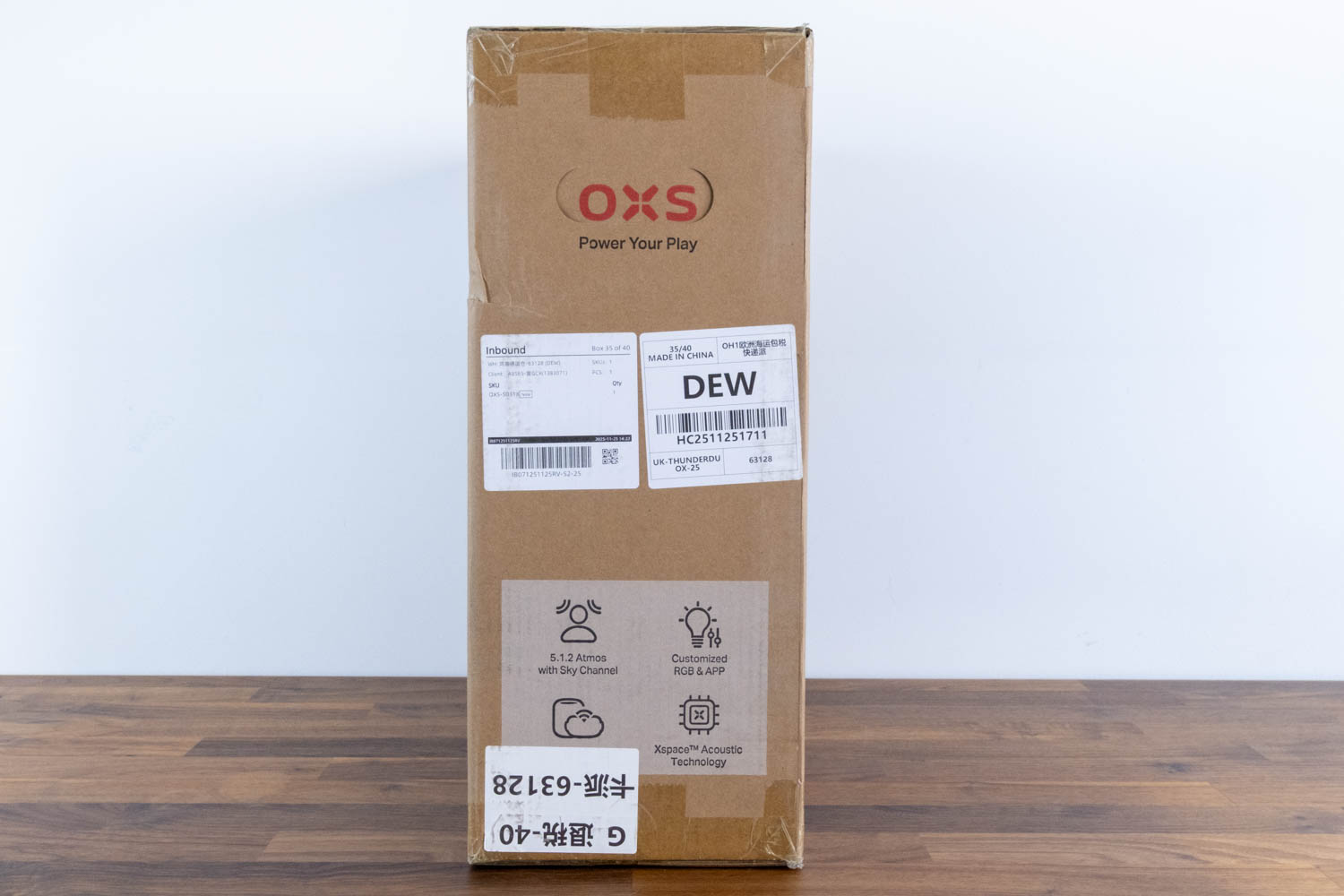
The Thunder Duo X turns up in a plain shipping carton, printed with the OXS logo, the Thunder Duo X name, and the obligatory Dolby Atmos, HDMI and Bluetooth badges, along with a line drawing of the two speakers flanking the neck unit. This outer box is, as it happens, the only place on the entire package where the product is actually called "Thunder Duo X," and that is the first clue to what this thing really is. My sample arrived a little battered, with scuffed corners and some crushing, though that is shipping luck rather than anything OXS can control.

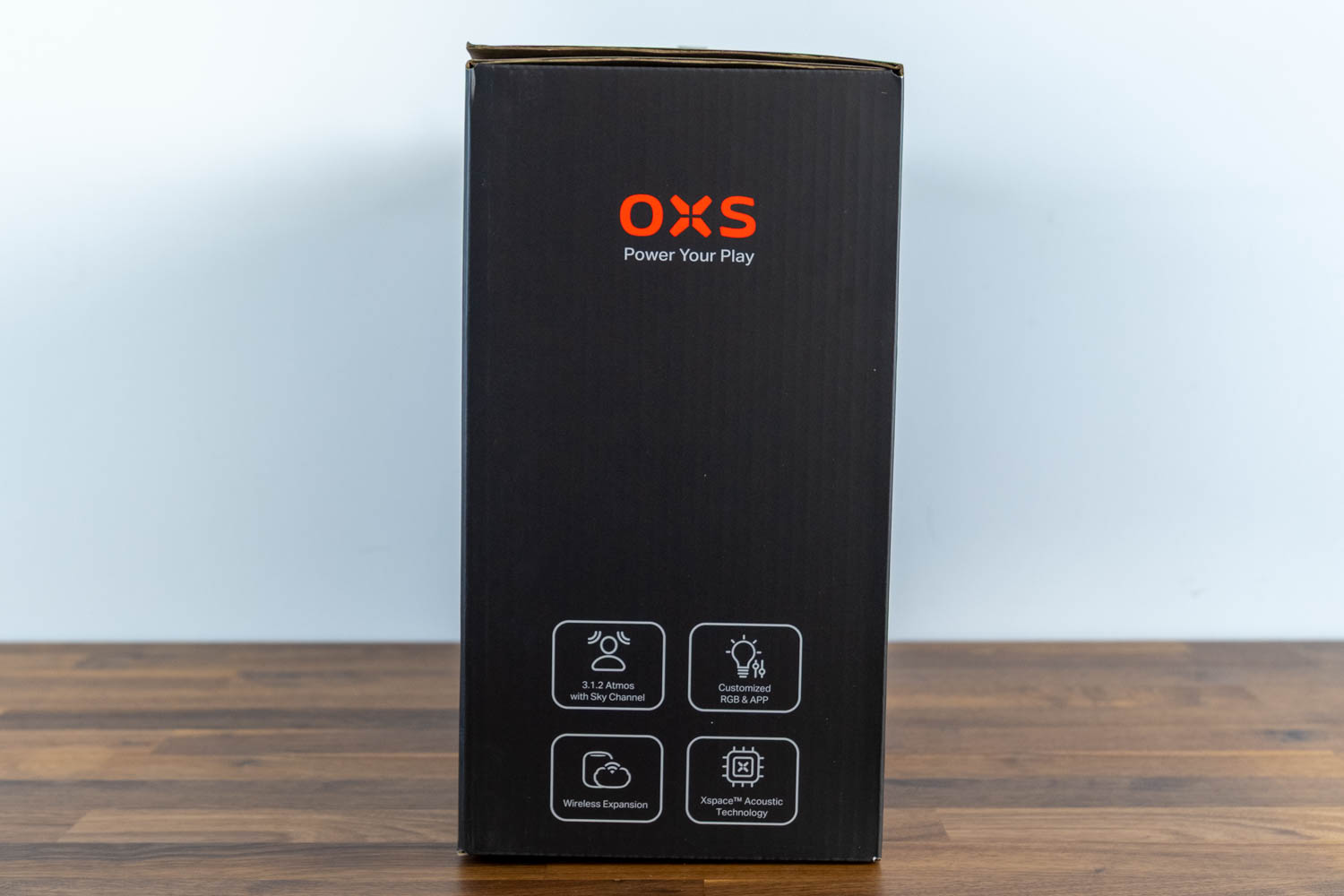
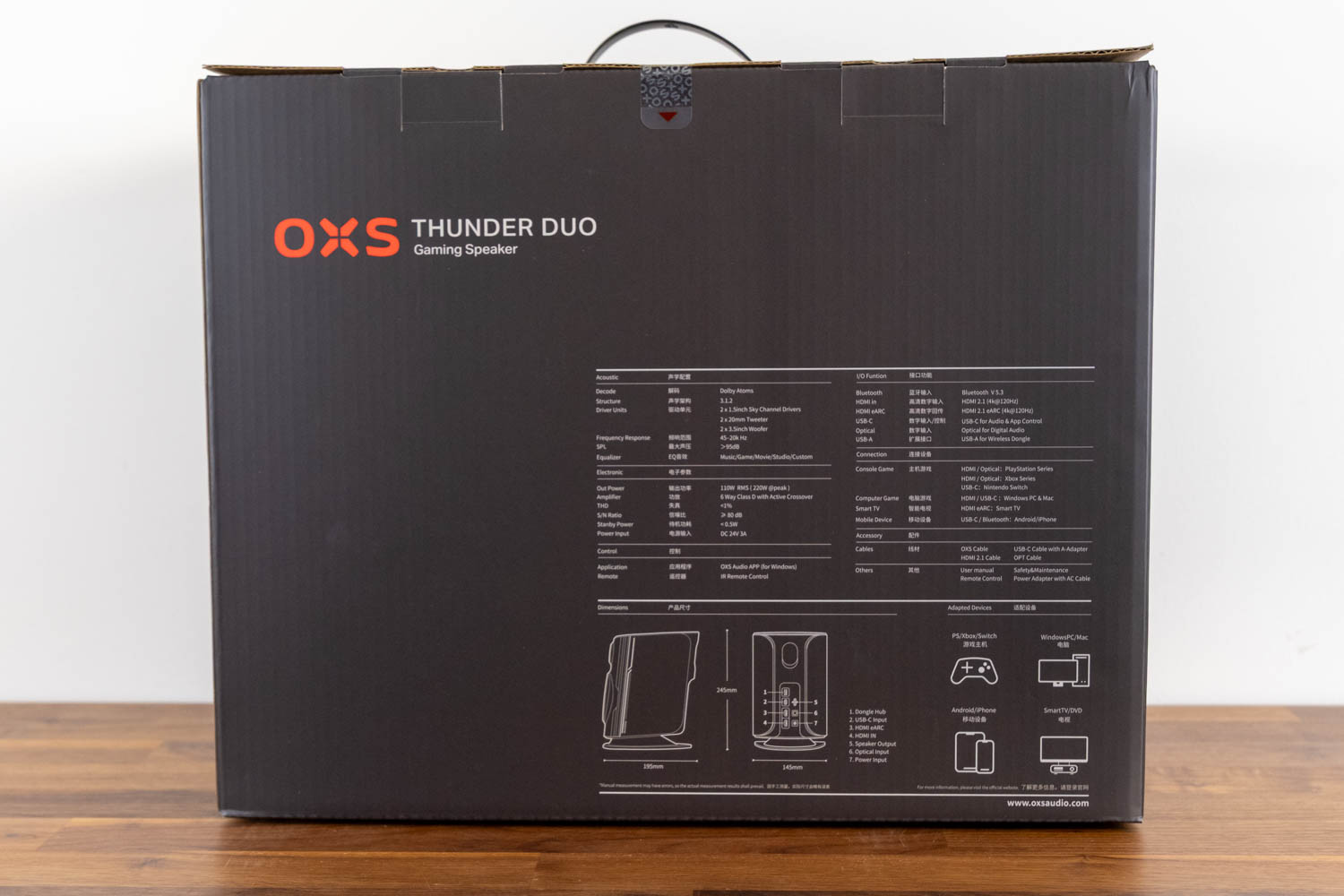
Open the carton and there is no dedicated Duo X retail box inside. Instead you get two separate black boxes, as if OXS pulled one base Thunder Duo and one Satellite Neck Speaker off the shelf and dropped them in together, which is functionally exactly what the Thunder Duo X is. The larger box holds the two main speakers and is branded simply "Thunder Duo," with no X anywhere on it, and a product render on the front. The back of the speaker box is unusually detailed for retail packaging, with a full spec panel. The highlights worth flagging are a 6-way Class D amplifier with active crossover, 110 W RMS (220 W peak), an S/N ratio of at least 80 dB, sub-0.5 W standby draw, and a DC 24 V/3 A power input. The same panel maps out the rear I/O, numbered one to seven (dongle hub, USB-C input, HDMI eARC, HDMI IN, passive speaker output, optical input, power input) and the supported platforms, from the PlayStation and Xbox families over HDMI or optical to Switch over USB-C and phones over USB-C or Bluetooth. Somewhat oddly, a couple of the printed numbers here do not match what OXS publishes online.
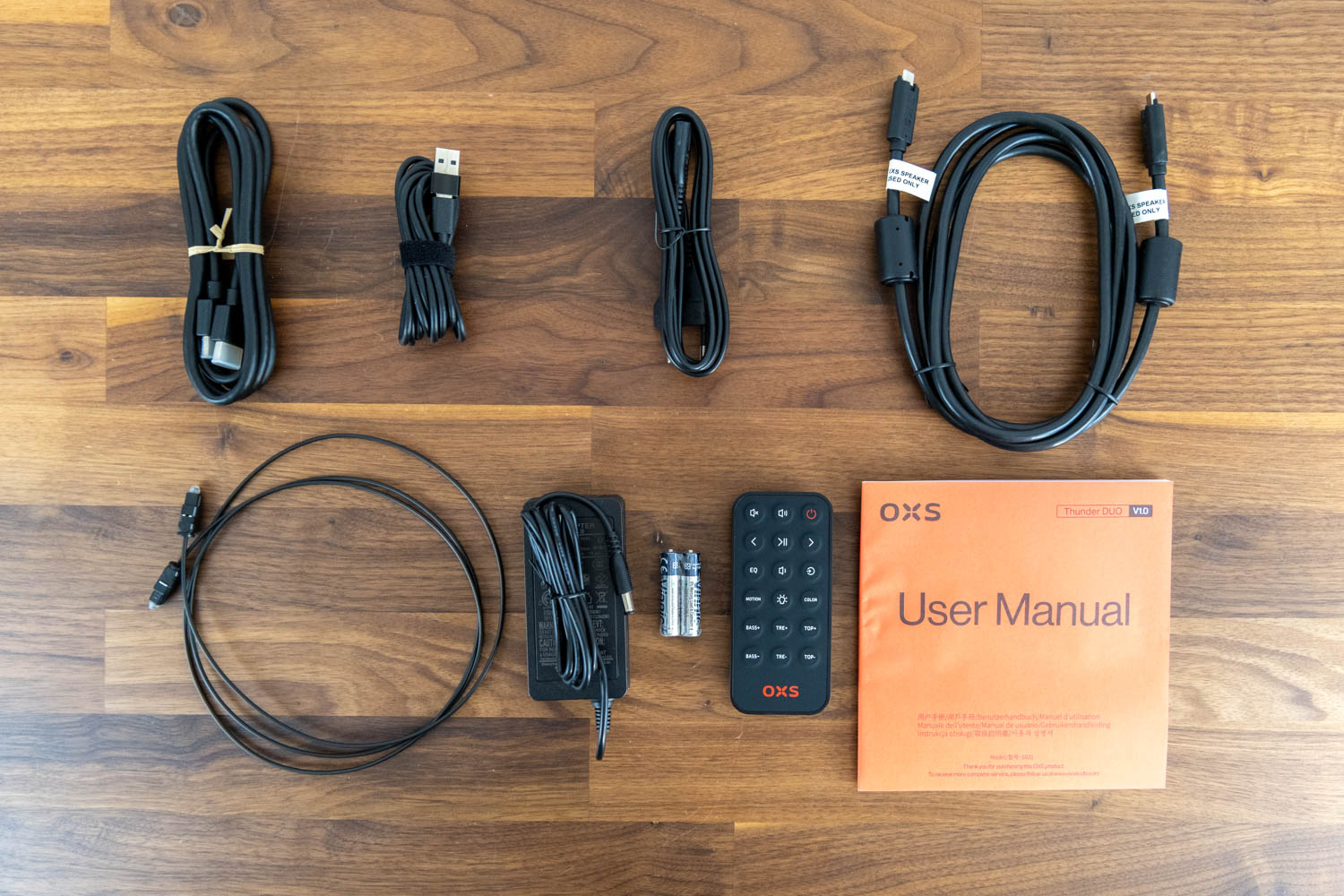
Here's what you get with the speakers. Across the top are an HDMI 2.1 cable, a short USB-C to USB-A data cable, a thinner USB-C data cable, and the thick 2.1-meter OXS interconnect that joins the two speakers, labeled "OXS SPEAKER USE ONLY" and fitted with a ferrite choke at each end. Along the bottom sit the optical cable, the external power brick and cord, two batteries for the remote, the remote itself, and the Thunder Duo user manual.
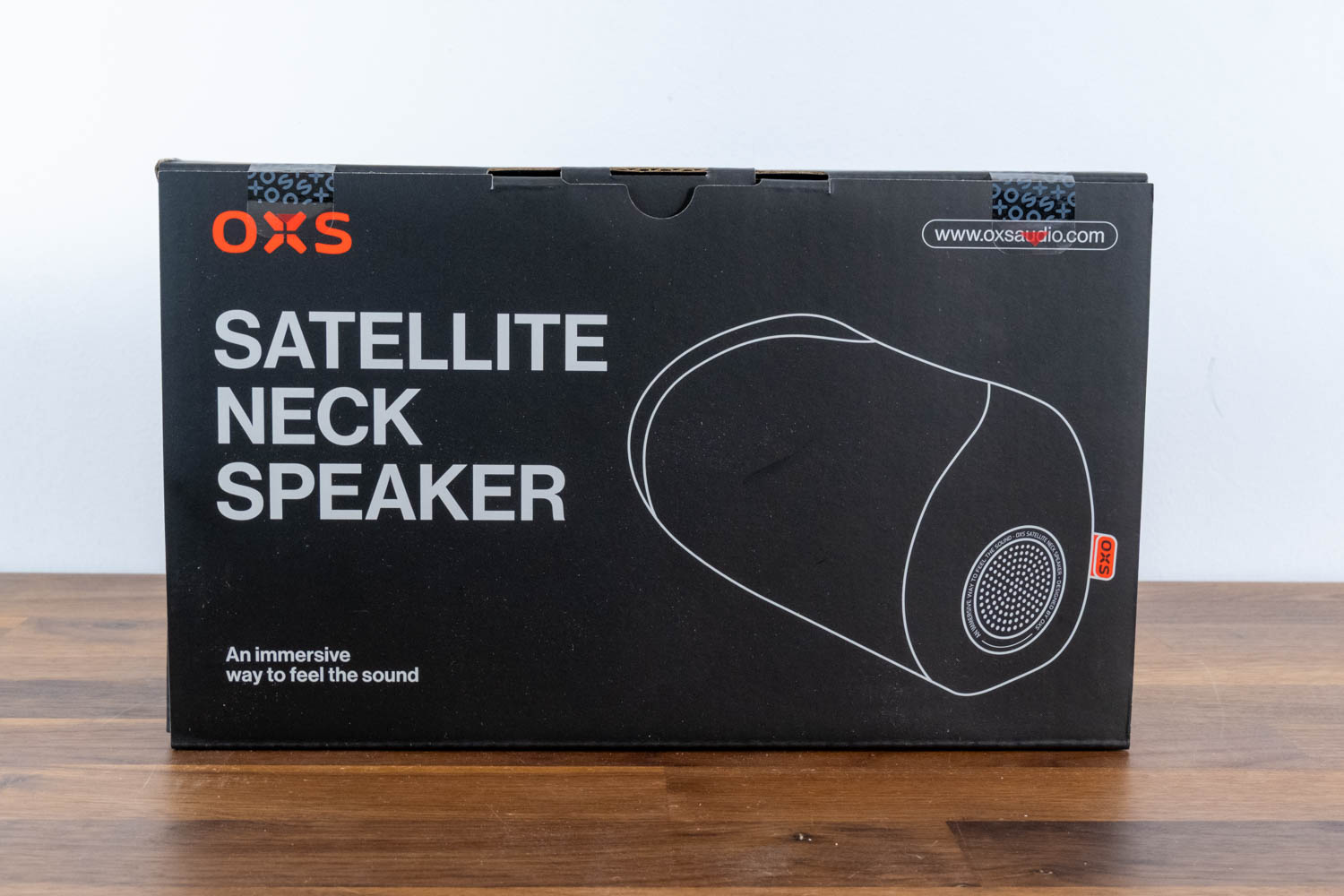
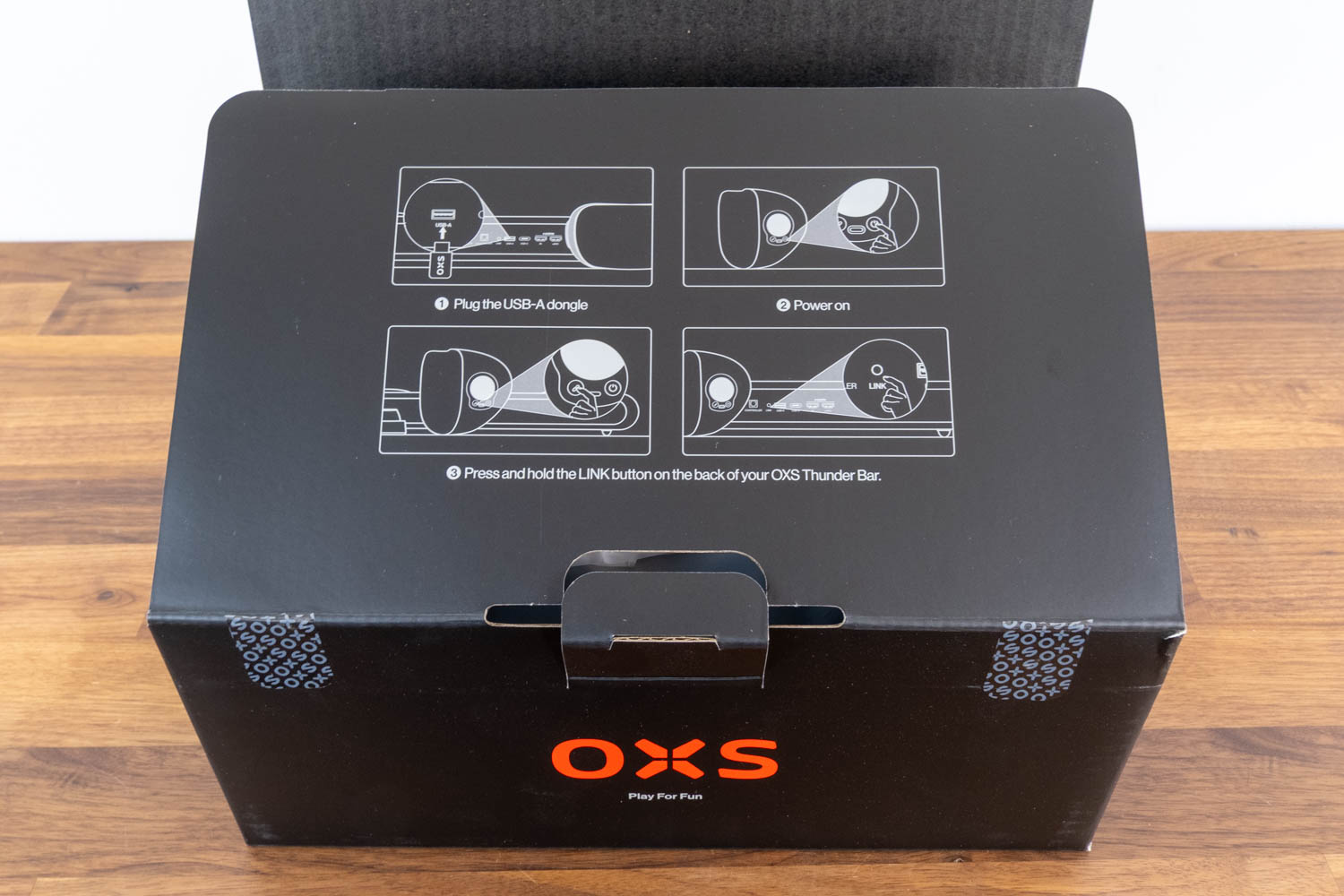
The second, smaller black box is the Satellite Neck Speaker, pitched as "an immersive way to feel the sound" and wearing OXS's "Play For Fun" branding on the end. This is the piece that earns the X badge and the price premium over the plain Duo, and packaging it separately only underlines how bolt-on the rear channel really is. Perhaps worth mentioning is that OXS also pairs it with their soundbars.
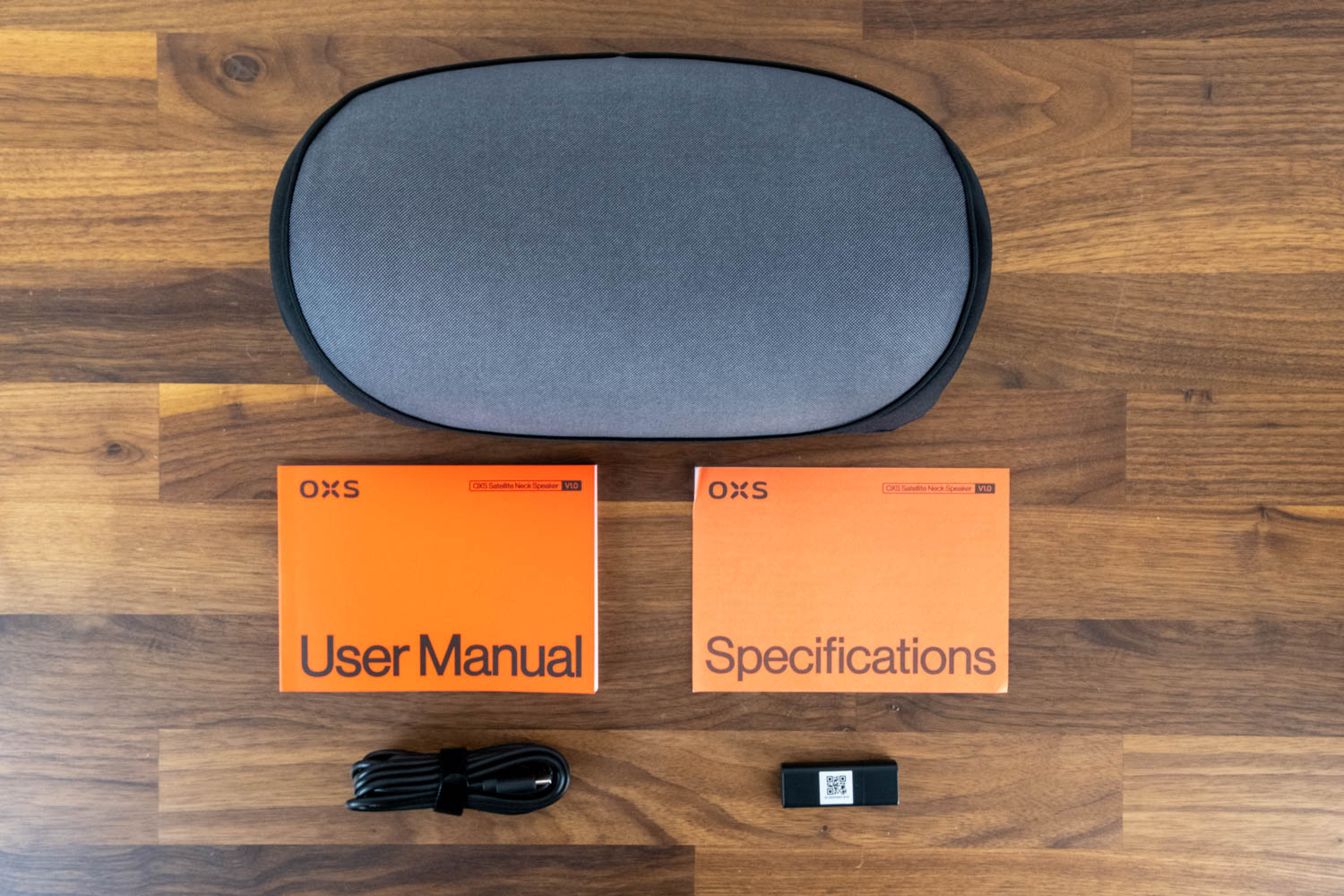
OXS gives the Satellite Neck Speaker a dedicated User Manual and a separate Specifications booklet, both branded for the Satellite Neck Speaker rather than the Thunder Duo, which underlines the point that the X is really the base system with this accessory bolted on. Rounding out its box are the USB-C charging cable for the neck speaker and the small 5.8 GHz wireless dongle that links it (and an optional subwoofer) to the main pair.
Our Patreon Silver Supporters can read articles in single-page format.
Nov 21st, 2026 04:35 PST
change timezone
Latest GPU Drivers
New Forum Posts
- WarpCoreBench scores! (88)
- What's your latest tech Freebie? (86)
- TPU's Nostalgic Hardware Club (22179)
- [Poll] 12V-2x6 Connector Protection: What Are You Using? (WireView / Ampinel / Equalizer / Other / Nothing) (50)
- UPS what one to get? (1)
- Anthrophics IPO (28)
- RX 9000 series GPU Owners Club (2252)
- Windows 11 General Discussion (7743)
- Without Jensen, PC gaming will be (52)
- Zen 3 IF/IMC degradation (242)
Popular Reviews
- Microsoft Surface Laptop Ultra Review - The Next-gen Arm Laptop
- Ugreen NASync DXP4800 GT Review
- Corsair RM1200e (Second Generation) Review
- Pulsar Office Tour & First Look at P1 Dual-Sensor Mouse
- Upcoming Hardware Launches 2027 (Updated Nov 2026)
- Acemagic Retro X3 Review
- Biwin Black Opal NV7400 2 TB Review
- AMD Ryzen 7 9800X3D Review - The Best Gaming Processor
- AMD Zen 6 Technical Deep Dive
- Chieftec Iceberg PRO 360 DARK Review
TPU on YouTube
Controversial News Posts
- NVIDIA Co-Founder and CEO Jensen Huang Officially Resigns (491)
- Report: Jensen Huang Eyes NVIDIA Comeback (257)
- Open Letter Asking NVIDIA to Reinstate Jensen Huang Passes 115,000 Signatures (184)
- OpenAI CEO Argues Home PCs Waste the World's Limited DRAM Supply (152)
- NVIDIA Launches Investigation Into Jensen Huang's Relationship With Suspected Chinese Spy (136)
- Intel "Raptor Lake Next" 16-Core and 20-Core CPUs Surface (130)
- Legendary Game Studio BioWare Shuts Down Following EA Layoffs (104)
- NVIDIA GeForce RTX 50-Series Scheduled for up to $500 Price Hike This Week (89)