 13
Patriot Viper Elite 5 RGB DDR5-7000 32 GB CL38 Review
Test System Setup »A Closer Look

Patriot's Viper Gaming brand offers a variety of DDR5 memory series, each catering to different consumer needs with unique aesthetics. The lineup includes Viper Ultra 5, Viper Xtreme 5, Viper Venom, and Viper Elite 5. The Viper Xtreme 5 series, ranging from 7600 MT/s to 8600 MT/s, stands as Patriot's flagship UDIMM product line. This review focuses on the Viper Elite 5 series, designed for users who desire more than the standard 4800 MT/s JEDEC memory but aren't chasing top-tier performance. The Elite 5 kits come exclusively with white heatspreaders, and non-RGB versions are also available on the Patriot website.
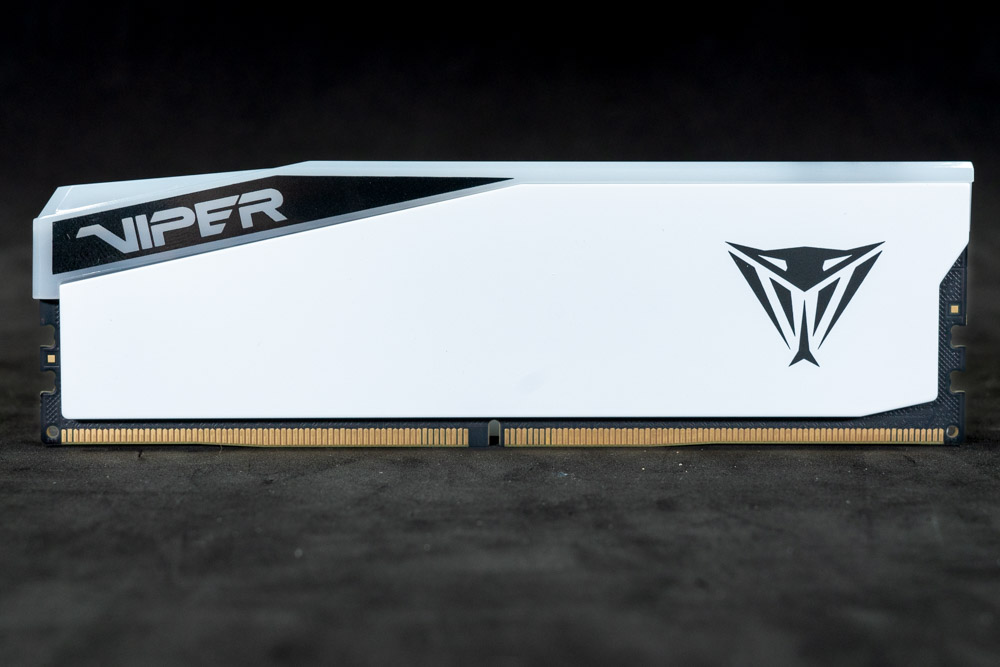
Similar to the rest of Patriot's lineup, Each memory module has the Viper branding on both sides of each memory DIMM.

On one side of each DIMM module is an identification sticker listing the product number, rated XMP operating frequency, voltage, and primary CAS timing.

Laying the DIMMs on the side, you can see "VIPER" written in black on one corner. The entire plastic strip in the middle will be illuminated when the system is powered on and lighting can be controlled with supported motherboard software. The RGB lighting effects can be customized and controlled using popular motherboard software, including ASUS Aura Sync, GIGABYTE RGB Fusion, MSI Mystic Light Sync, and ASRock Polychrome Sync.

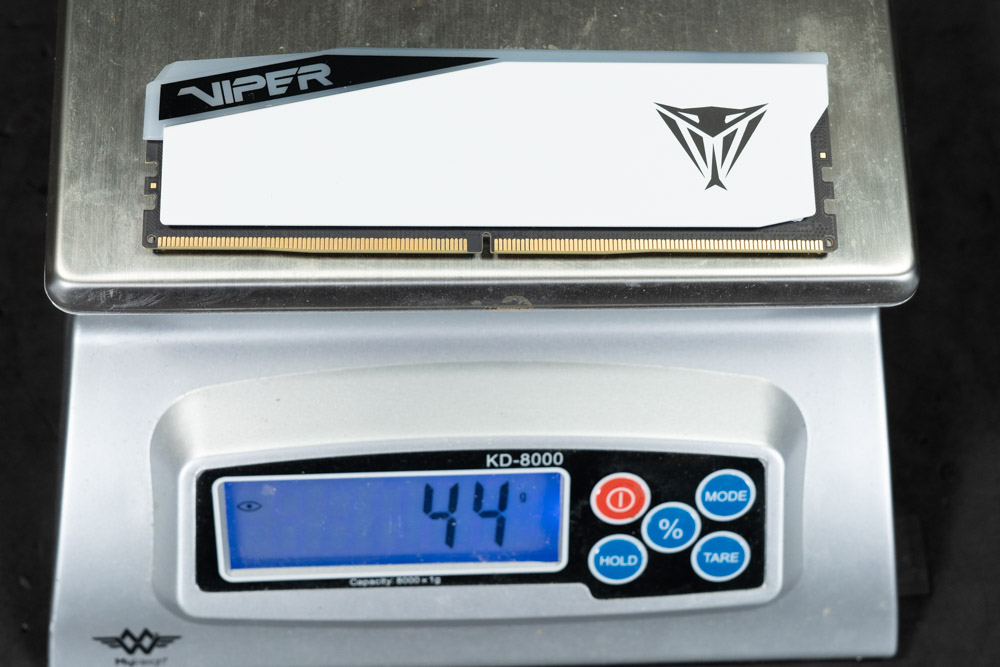
The Patriot Viper Elite 5 RGB DDR5-7000 Z-Height is 41 mm measuring with calipers, and weighs 53 grams on the scale.
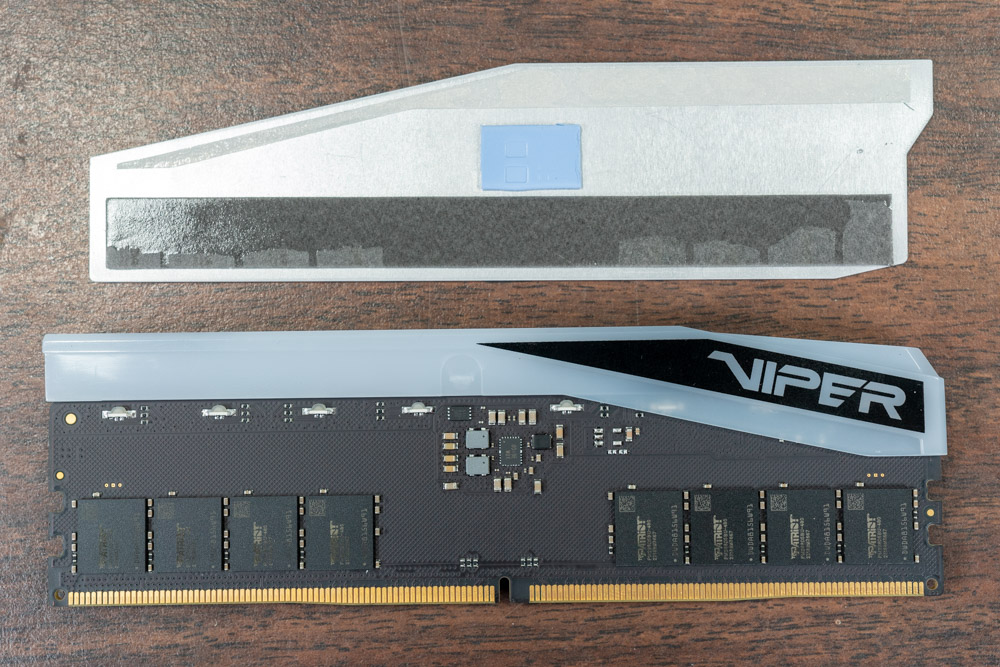
After taking the heat spreader off, we see that these are single-sided DIMMs with eight (16 Gbit) 2 GB ICs. Included is the standard thermal pad that covers all the memory ICs. This particular kit does have coverage for the PMIC and surrounding components.

Upon closer inspection, the ICs appear to be whitewashed, indicating they could be from any brand or revision. The software identifies them as SK Hynix, and given the 1.45 V XMP and loose timings, they are most likely the older SK Hynix (16 Gbit) 2 GB M-Die. This should not be confused with the later (24 Gbit) 3 GB M-Die. The 2 GB M-Die cannot achieve the same frequency as (16 Gbit) 2 GB A-Die, but with additional voltage, the primary timings can be tightened slightly.

With DDR5, one of the major changes is how the motherboard directly provides 5 V to the memory module's PMIC, which is then stepped down and split accordingly. No longer is the motherboard responsible for regulating the voltages, as with DDR4. The PMIC has the part number "OD=9E W0X," software reports this as Richtek being the manufacturer.
Nov 19th, 2026 13:51 CST
change timezone
Latest GPU Drivers
New Forum Posts
- How to prevent OLED burn damage due to PC freezes or power outtages? (22)
- Windows 11 General Discussion (7733)
- Anthrophics IPO (6)
- My Final Barrier to Exclusively Using Linux has Fallen (Azure Virtual Desktops) (10)
- Windows HDR on = Tinted colors (8)
- Dual B70 or Dual R9700 Pro on Linux (10)
- GTA VI (5)
- FINAL FANTASY XIV: Dawntrail Official Benchmark (226)
- Help with fixing Overclock (11)
- Why my RX 6800 XT read that it operate at x8 not x16 ? (47)
Popular Reviews
- Acemagic Retro X3 Review
- Ugreen NASync DXP4800 GT Review
- Upcoming Hardware Launches 2027 (Updated Nov 2026)
- Pulsar Office Tour & First Look at P1 Dual-Sensor Mouse
- AMD Zen 6 Technical Deep Dive
- Biwin Black Opal NV7400 2 TB Review
- Sapphire Radeon RX 7700 XT Pure Review
- Sapphire Radeon RX 7700 XT Pulse Review
- AMD Ryzen 7 9800X3D Review - The Best Gaming Processor
- Chieftec Iceberg PRO 360 DARK Review
TPU on YouTube
Controversial News Posts
- NVIDIA Co-Founder and CEO Jensen Huang Officially Resigns (486)
- Report: Jensen Huang Eyes NVIDIA Comeback (221)
- Open Letter Asking NVIDIA to Reinstate Jensen Huang Passes 115,000 Signatures (184)
- OpenAI CEO Argues Home PCs Waste the World's Limited DRAM Supply (152)
- NVIDIA Launches Investigation Into Jensen Huang's Relationship With Suspected Chinese Spy (136)
- Intel "Raptor Lake Next" 16-Core and 20-Core CPUs Surface (130)
- Legendary Game Studio BioWare Shuts Down Following EA Layoffs (104)
- Dell CEO Says the Memory Shortage Will Get Worse in 2027 (95)