 27
Patriot Viper Elite 5 Ultra RGB DDR5-6000 96 GB CL28 Review
Value & Conclusion »Intel Memory Overclocking
After a year of using Intel's Ultra 285K CPU, we've gained a solid grasp of memory overclocking and the platform's specific quirks. This overclocking section will focus on a combination of adjusting the memory frequency and fine-tuning the primary, secondary, and tertiary timings, alongside increasing the CPU Ring Cache, Die-to-Die (D2D), and NGU (Next-Generation Uncore) to extract maximum performance without pushing the voltages too far. Our goal is to achieve an overclock suitable for long-term use, not world records.Intel's 1-Click 200S Boost feature is set to a maximum frequency of 8000 MT/s to accommodate varying silicon quality and anything above this frequency must be manually configured in the BIOS. During our testing, we observed that the maximum stable Ring Cache, D2D, and NGU ratios could be achieved without increasing stock voltage stopped around 8000 MT/s. For instance D2D 32x ratio running DDR5-9000 required 0.89 V (VNNAON), while DDR5-8000 maintained stability at the stock value of 0.772 V. Further observations during our memory overclocking session indicated minimal performance gains from increasing the NGU ratio, with most improvements stemming from the D2D ratio and timings adjustments. The use of four different overclocks into the overclocking equation only extended the validation process and ultimately proved to be an inefficient use of time. It is highly suggested to work on maximum frequency and timings first before changing the Ring Cache, D2D, and NGU ratios.
The MSI Z890 Unify-X has some quirks to deal with, but just like any motherboard, once you know the routine, it becomes much easier to guess what will and will not work. Still, we took the tedious, methodical process of changing each value and validating if, in fact, it was stable for long periods of time. This does not guarantee 24/7 stability, but it is enough for a normal home computer use-case. These DDR5-8000 OC results below were validated to pass y-cruncher 10B and reach 1000% in memory stress testing software Karhu.
Because of this longer stability test, temperatures can become a big factor and this required a fan placed on top of the memory to minimize issues. Lots of additional small adjustments could have been made to the secondary and tertiary timings. In fact, we struggled to push the sub-timings down much. tREFi hit a wall at 32K and would error out with a fan on top. Overall, utilizing the TPU DRAM Latency Calculator to set an 8000 MT/s 38-48-48-84 1.4 V memory overclock, including 200S Boost enabled without changing any voltages was impressive.
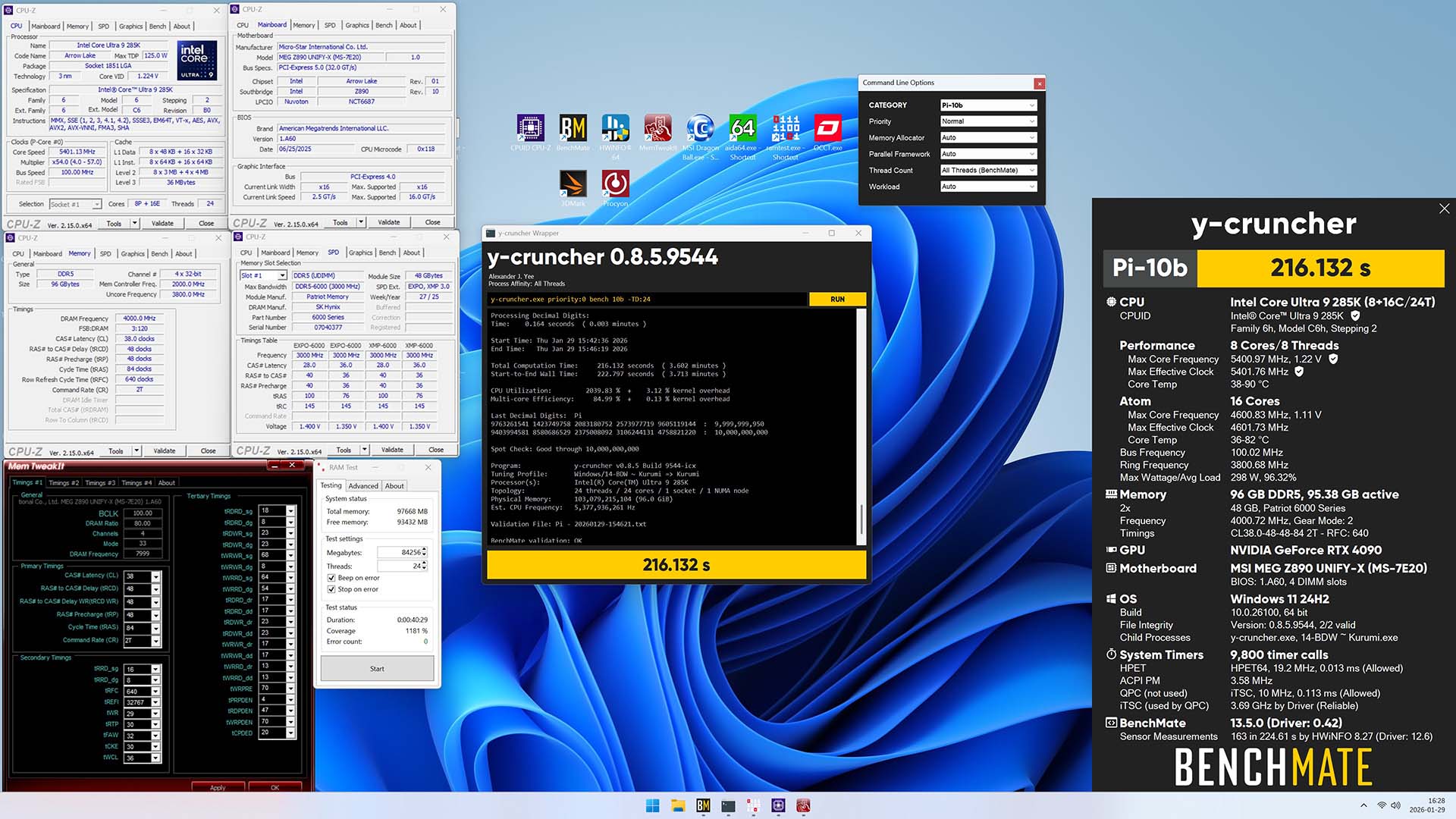
DDR5-8000 CL38 y-cruncher 10B HWBot Submission
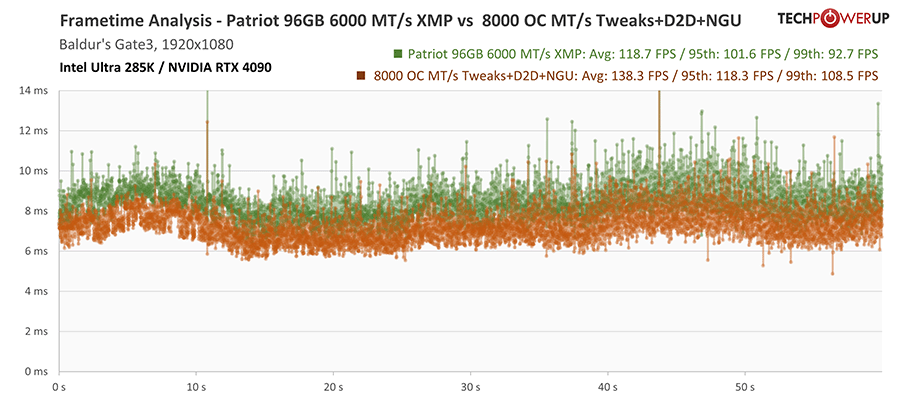
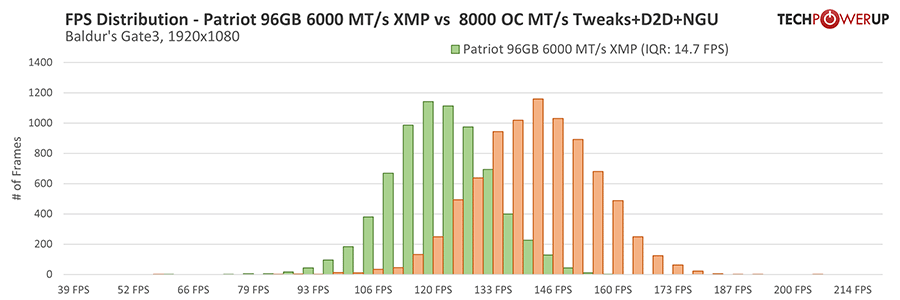
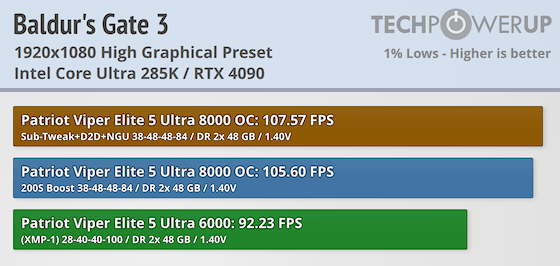
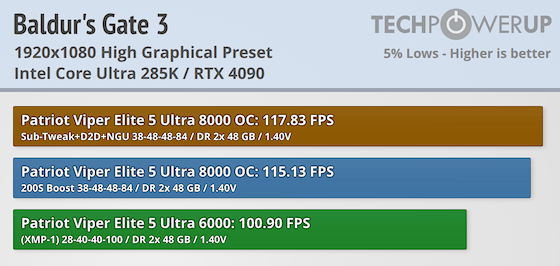
Baldur's Gate 3 Results

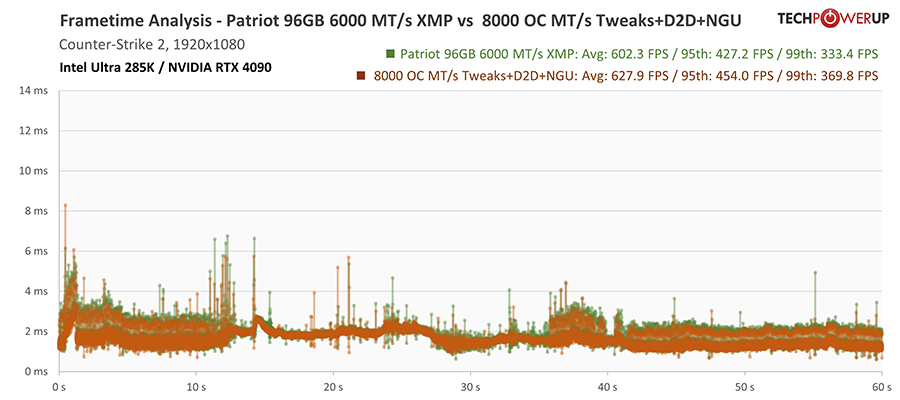
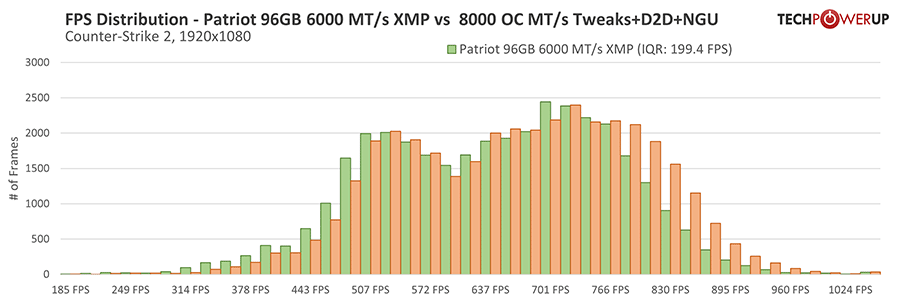
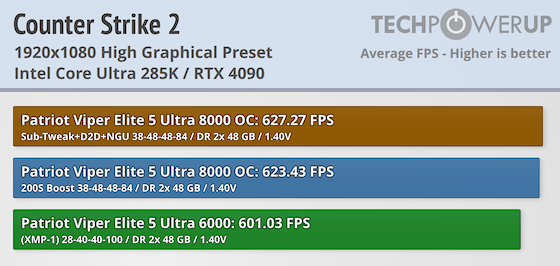
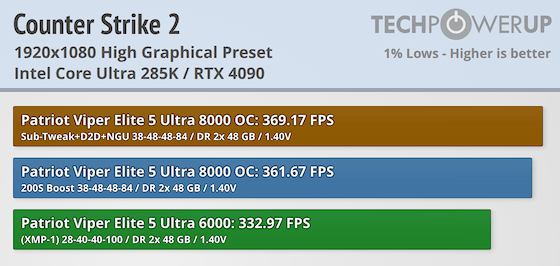
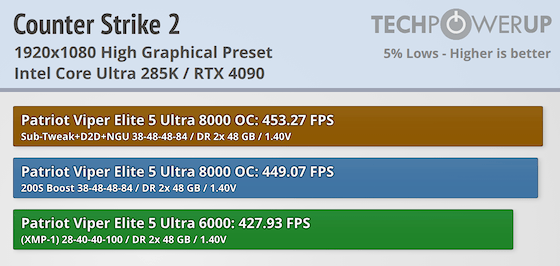
Counter-Strike 2 Results
Nov 20th, 2026 17:15 PST
change timezone
Latest GPU Drivers
New Forum Posts
- SATA drive 1.4 GBps with Intel X25-E on Windows 98! (36)
- DTS DCH Driver for Realtek HDA [DTS:X APO4 + DTS Interactive] (2816)
- Honestly, do you care about GTA VI? (214)
- Without Jensen, PC gaming will be (51)
- WarpCoreBench scores! (86)
- What's your latest tech Freebie? (80)
- Nvidia GPU undervolting via MVolt+? (0)
- How to prevent OLED burn damage due to PC freezes or power outtages? (49)
- RX 9000 series GPU Owners Club (2249)
- Logitech Headsets Modded Driver — Unlock Dolby in G HUB (23)
Popular Reviews
- Microsoft Surface Laptop Ultra Review - The Next-gen Arm Laptop
- Ugreen NASync DXP4800 GT Review
- Corsair RM1200e (Second Generation) Review
- Pulsar Office Tour & First Look at P1 Dual-Sensor Mouse
- Upcoming Hardware Launches 2027 (Updated Nov 2026)
- Acemagic Retro X3 Review
- Biwin Black Opal NV7400 2 TB Review
- AMD Ryzen 7 9800X3D Review - The Best Gaming Processor
- AMD Zen 6 Technical Deep Dive
- Chieftec Iceberg PRO 360 DARK Review
TPU on YouTube
Controversial News Posts
- NVIDIA Co-Founder and CEO Jensen Huang Officially Resigns (491)
- Report: Jensen Huang Eyes NVIDIA Comeback (256)
- Open Letter Asking NVIDIA to Reinstate Jensen Huang Passes 115,000 Signatures (184)
- OpenAI CEO Argues Home PCs Waste the World's Limited DRAM Supply (152)
- NVIDIA Launches Investigation Into Jensen Huang's Relationship With Suspected Chinese Spy (136)
- Intel "Raptor Lake Next" 16-Core and 20-Core CPUs Surface (130)
- Legendary Game Studio BioWare Shuts Down Following EA Layoffs (104)
- NVIDIA GeForce RTX 50-Series Scheduled for up to $500 Price Hike This Week (89)