 14
Patriot Viper Elite 5 Ultra RGB DDR5-8000 48 GB CL36 Review
(14 Comments) »Introduction

Dating back to 1985, Patriot was founded in the United States San Francisco Bay Area. It has since expanded, with distribution channels around the world offering consumers access to a wide range of different products. While the headquarters may still be located in the USA, all the company's products are assembled elsewhere, with facilities in Fremont, California, Taipei, and Taiwan.
Patriot currently offers multiple memory products, with both consumer and enterprise lines to fit a wide range of needs. The company first brought forward the well-established DDR4 Viper Venom brand, later the Extreme series, and with the addition of non-binary capacities came an updated Elite series, now available for DDR5. Patriot offers a diverse range of memory kit configurations, catering to a broad spectrum of PC users with their distinct product lines and frequencies from 5200 MT/s to 9600 MT/s, ensuring options for both casual users and performance enthusiasts. Whether you're looking for a strictly (2× 8 GB) budget gaming setup or a more substantial (2× 64 GB) workstation oriented configuration, Patriot has something to suit your needs.
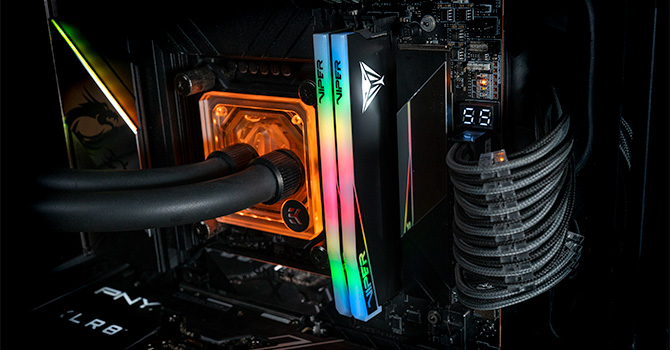
In this review, we will be taking a closer look at the Patriot Elite 5 Ultra RGB DDR5-8000 48 GB (2× 24 GB) memory kit. The Elite 5 Ultra series is specifically designed for data-heavy tasks such as large language models, generative AI, and supporting a general content creator's workflow. This particular kit stands out as the fastest available, focusing on Intel Arrow Lake CPUs with three XMP profiles, allowing users to enjoy peace of mind while focusing on maximizing their PC's performance.
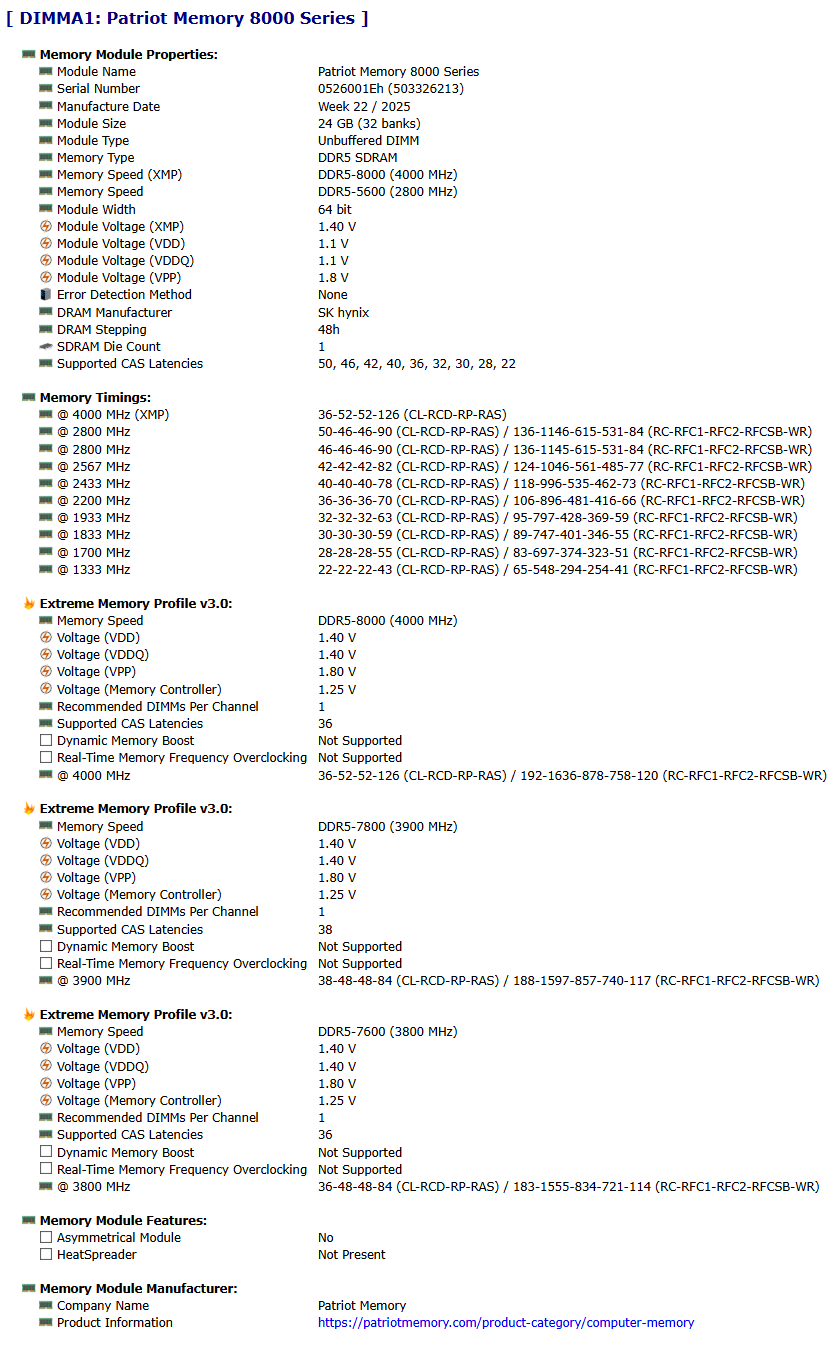
The Elite series continues to impress with its balance of performance and practicality. While the profile timings aren't as aggressive as the Xtreme 5 series, they are still more than sufficient for the majority of users. The primary 8000 MT/s profile showcased here comes with timings of 36-52-52-126 at 1.40 V, which should cater to most needs without pushing the limits too far. We'll be putting this memory kit through a comprehensive set of benchmarks to assess its performance against other contenders, beginning with a closer look at its specifications.
Specifications
| Specifications & SPD Profiles | |||||
|---|---|---|---|---|---|
| Manufacturer: | Patriot | ||||
| Series: | Viper Elite 5 Ultra | ||||
| Model: | VEUR548G8036K | ||||
| Tested Capacity: | 48 GB (2× 24 GB) | ||||
| Registered/Unbuffered: | Unbuffered | ||||
| CKD: | No | ||||
| Form Factor: | 288-pin UDIMM | ||||
| Dimensions (Z-Height): | 40.5 mm | ||||
| IC Manufacturer: | SK hynix | ||||
| Warranty: | Limited Lifetime | ||||
| Ranks: | Single-Rank | ||||
| XMP/EXPO Profile: | XMP-1 | XMP-2 | XMP-3 | JEDEC | |
| Speed Rating: | DDR5-8000 MT/s | DDR5-7800 MT/s | DDR5-7600 MT/s | Up to DDR5-5600 MT/s | |
| Rated Timings: | 36-52-52-126-192 | 38-48-48-84-188 | 36-48-48-84-183 | 46-46-46-90-136 | |
| Tested Voltage: | 1.40 V | 1.40 V | 1.40 V | 1.10 V | |
Packaging
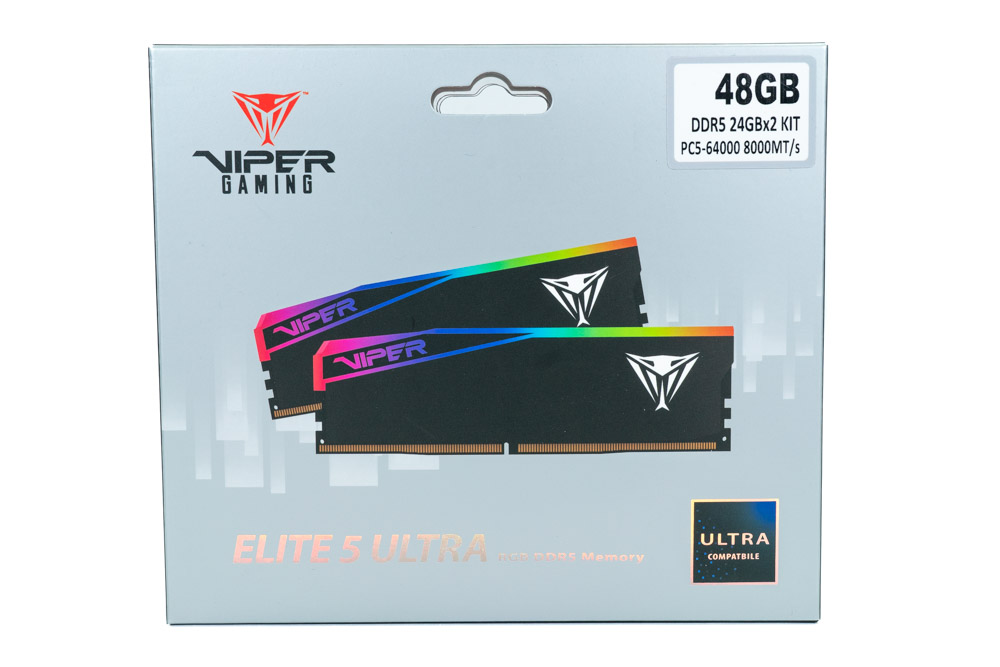

The packaging for the Patriot Elite 5 series has undergone a design update, but rest assured, all the essential details remain present. The information on the box is straightforward and easy to understand, with a sticker in the top right corner specifying the particular kit's bin. The bottom of the box prominently displays the Elite 5 Ultra branding. On the back, you'll find a QR code that directs you to the product page for more detailed information. Additionally, the box features badges for RGB compatibility, indicating support for ASUS Aura Sync, GIGABYTE RGB Fusion, MSI Mystic Light Sync, and ASRock Polychrome Sync motherboard RGB software. Lastly is the XMP/EXPO badges, which seem to be used on all the Elite 5 Ultra boxes regardless of actual presence, since this kit doesn't include EXPO.
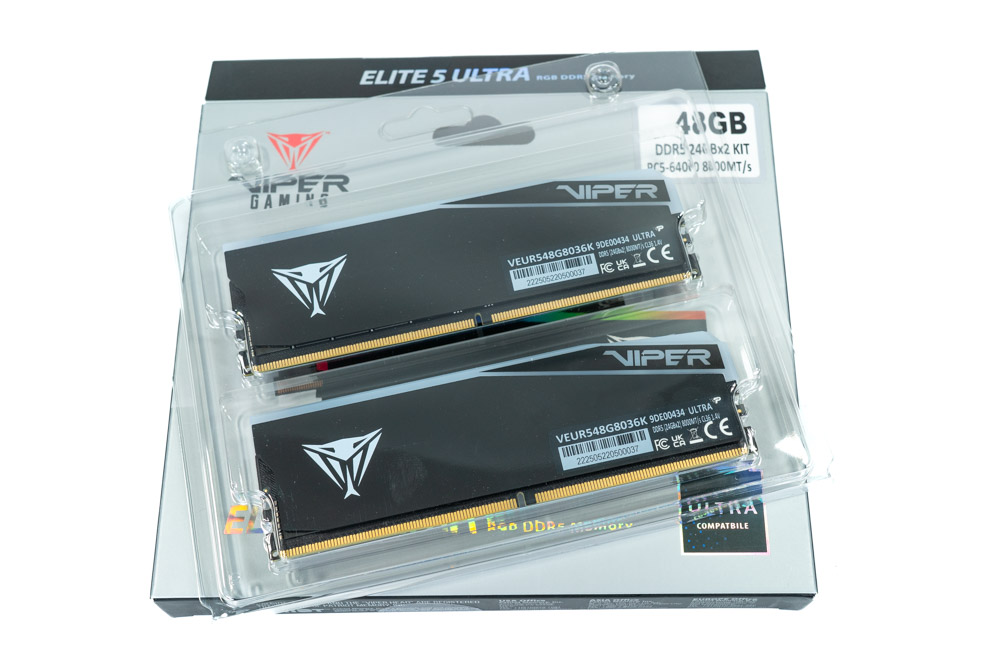
The box has some tape to prevent anything from falling out during shipping. Once cut and removed from the outer packaging, the memory sticks are secured and protected from minor damage with a clamshell inside the outer box.
A Closer Look

Patriot's Viper Gaming brand has established itself in the DDR5 memory market with a variety of series aimed at catering to different consumer needs and aesthetic preferences. The lineup includes the Viper Ultra 5, Viper Xtreme 5, Viper Venom, and Viper Elite 5, each offering distinct features. The Viper Xtreme 5 series stands out as the flagship, with speeds ranging from 7600 MT/s to 9600 MT/s, making it the ideal choice for users seeking top-tier performance in both CUDIMM and UDIMM configurations. In this review, we focus on the Viper Elite 5 Ultra series, a product designed for those who want the best that the Elite 5 has to offer without stepping into the "Xtreme" performance bracket. The Elite 5 Ultra kits come exclusively with black heat spreaders and offer non-RGB options for those who prefer a more subdued, office-friendly appearance without the distraction of flashy lights.

Similar to the rest of Patriot's lineup, each memory module has the Viper logo branding on both sides of each memory DIMM.
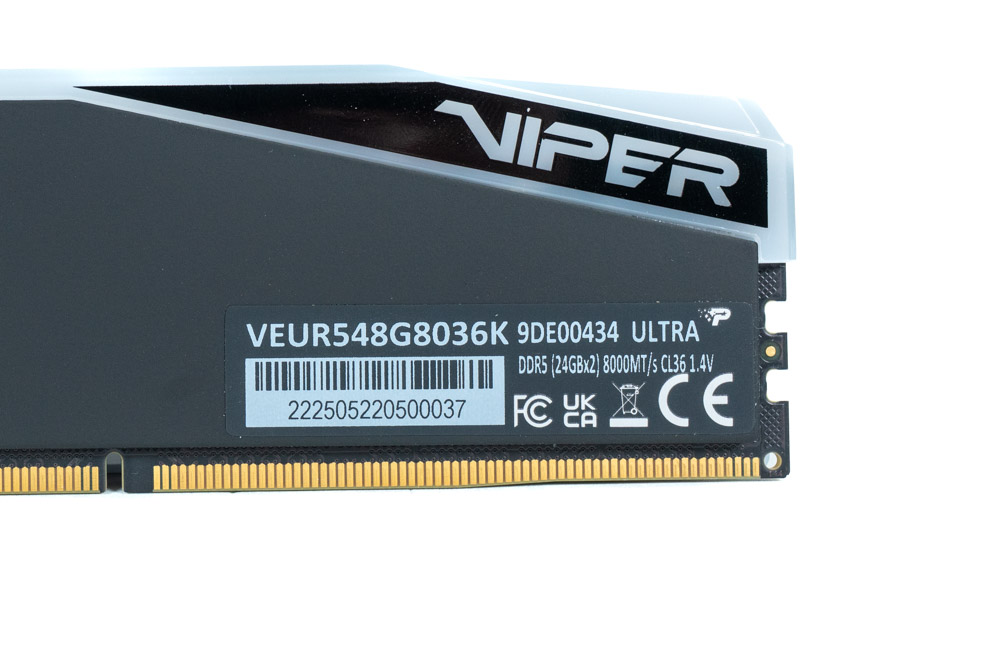
On one side of each DIMM module is an identification sticker listing the product number, size configuration, rated XMP/EXPO operating frequency, voltage, and primary CAS timing.


Laying the DIMMs on the side, you can see "VIPER" written in black on one corner. The entire plastic strip in the middle will be illuminated when the system is powered on, and lighting can be controlled with supported motherboard software. These LEDs are fairly spaced out and easy to see directly through the opaque plastic. The RGB lighting effects can be customized and controlled using popular motherboard software, including ASUS Aura Sync, GIGABYTE RGB Fusion, MSI Mystic Light Sync, and ASRock Polychrome Sync.
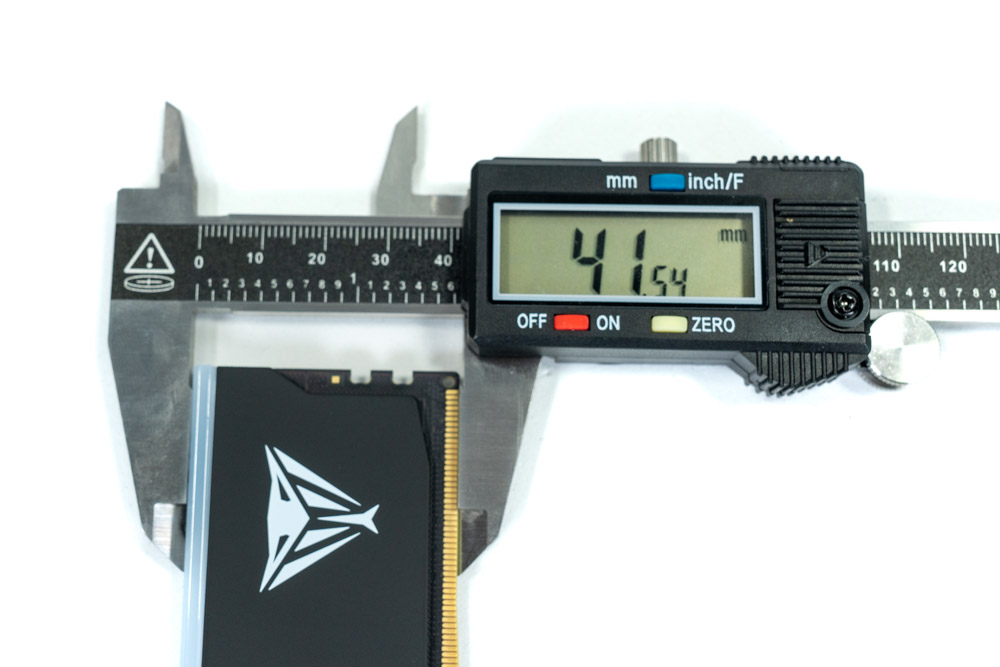
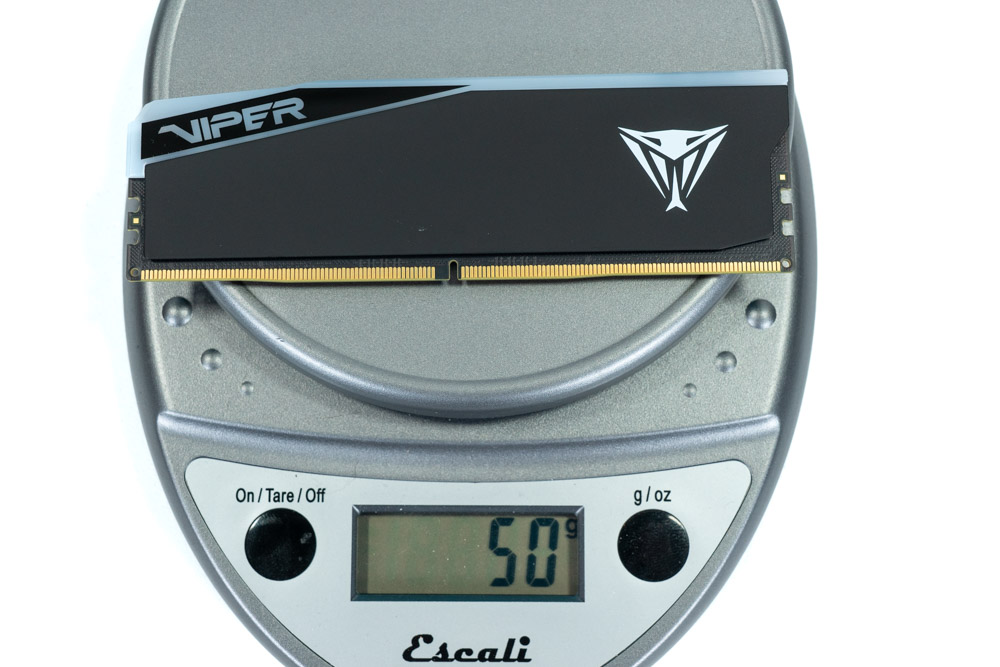
The Patriot Viper Elite 5 Ultra RGB DDR5-6000 Z-Height is 41.5 mm measuring with calipers, and weighs 50 grams on the scale.
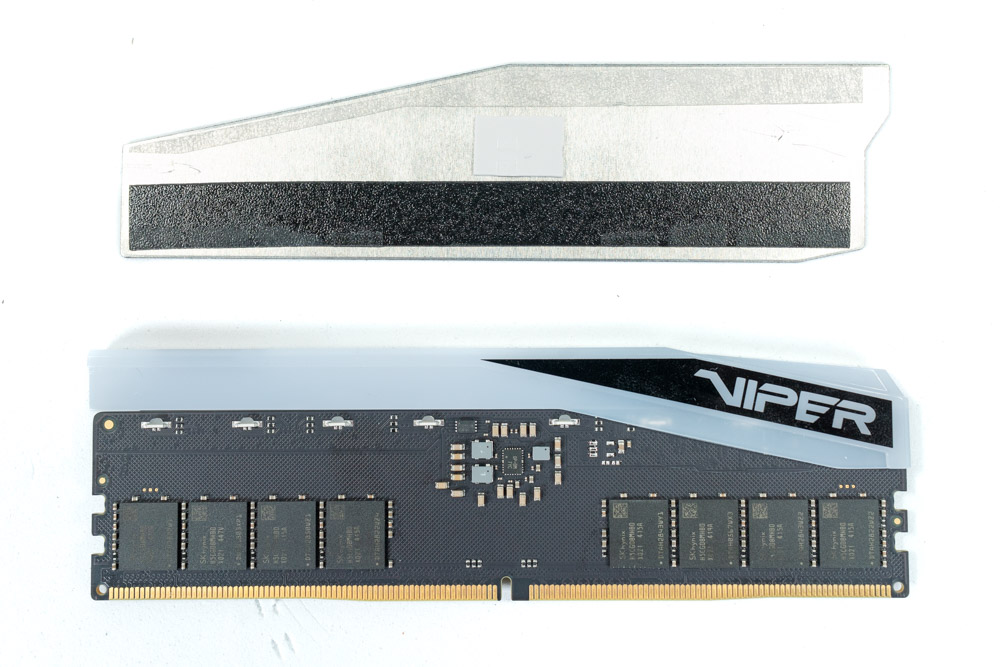
After taking the heat spreader off, we see that these are double-sided DIMMs with eight (24 Gbit) 3 GB ICs on each side. Included is the standard thermal pad that covers all the memory ICs. This particular kit does have coverage for the PMIC and surrounding components.
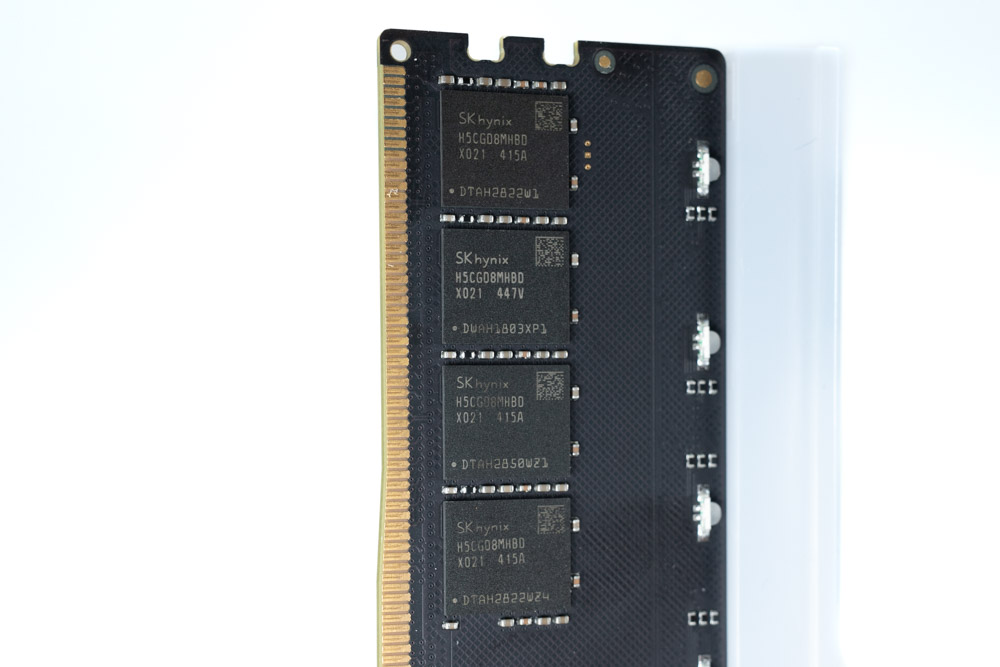
Currently, Micron, Samsung, and SK hynix are the three big suppliers of DDR5 ICs, with Nanya and CXMT holding 3% market share together. Non-binary 3 GB ICs generally "perform" worse than their 2 GB counterparts at the same frequency due to different tRFC values, at least in stock XMP/EXPO configuration. More on that later in the review.
A closer look at the ICs shows that these are SK hynix (H5CGD8MGBD-X021). Which can be abbreviated to SK hynix 3 GB M-Die, not to be confused with SK hynix's first DDR5 M-Die (2 GB) in 2021. Up until the release of (24 Gbit) 3 GB ICs, the previous world record crown was held by SK hynix A-Die (16 Gbit) 2 GB, which is still considered a good choice for high frequency overclocks paired with lower primary timings, only to be outdone by the SK hynix 3 GB variant for highest frequency.
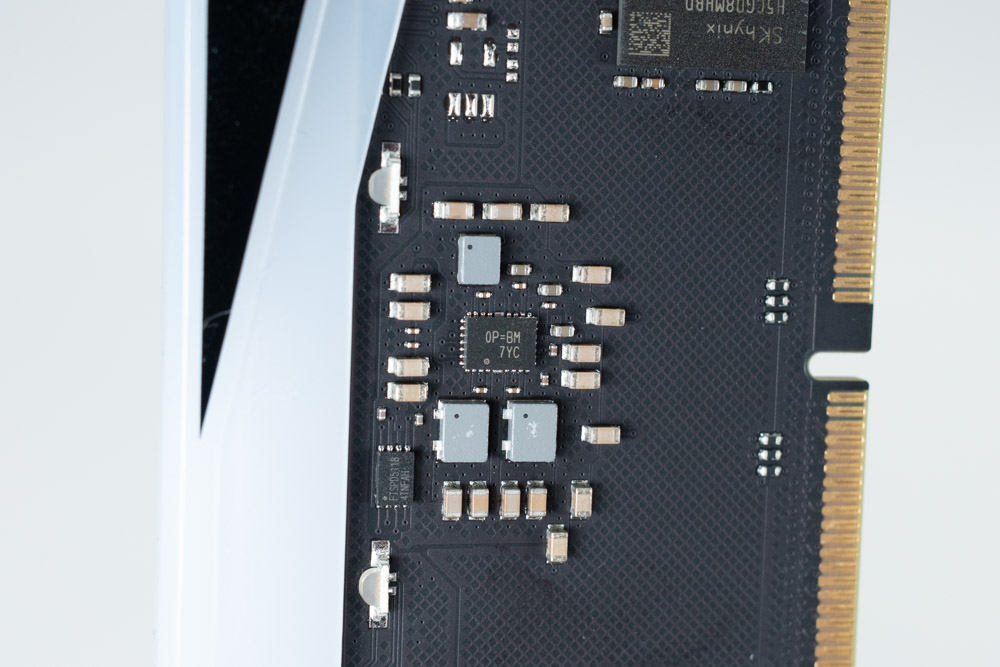
With DDR5, one of the major changes is how the motherboard directly provides 5 V to the memory module's PMIC, which is then stepped down and split accordingly. No longer is the motherboard responsible for regulating the voltages, as with DDR4. The PMIC has the part number "OD=BM 7YC," software reports this as Richtek being the manufacturer.
Test System
| Test System Memory 2026 | |
|---|---|
| Processor: (Intel) | Intel Core i9-13900K Raptor Lake, 8+16 cores/32 threads P-Core @ 5.5 GHz, E-Core @ 4.3 GHz (Locked) |
| Processor: (Intel) | Intel Core Ultra 9 285K Arrow Lake, 8+16 cores/24 threads P-Core @ 5.4 GHz, E-Core @ 4.6 GHz (Locked) |
| Processor: (AMD) | AMD Ryzen 9 9950X Zen 5, 16 cores/32 threads |
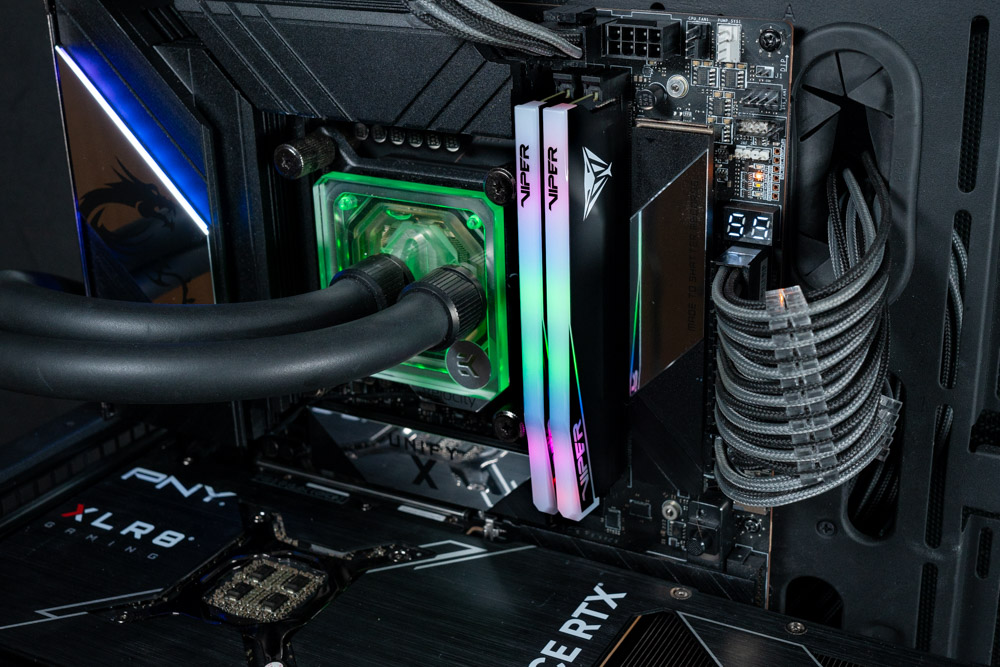
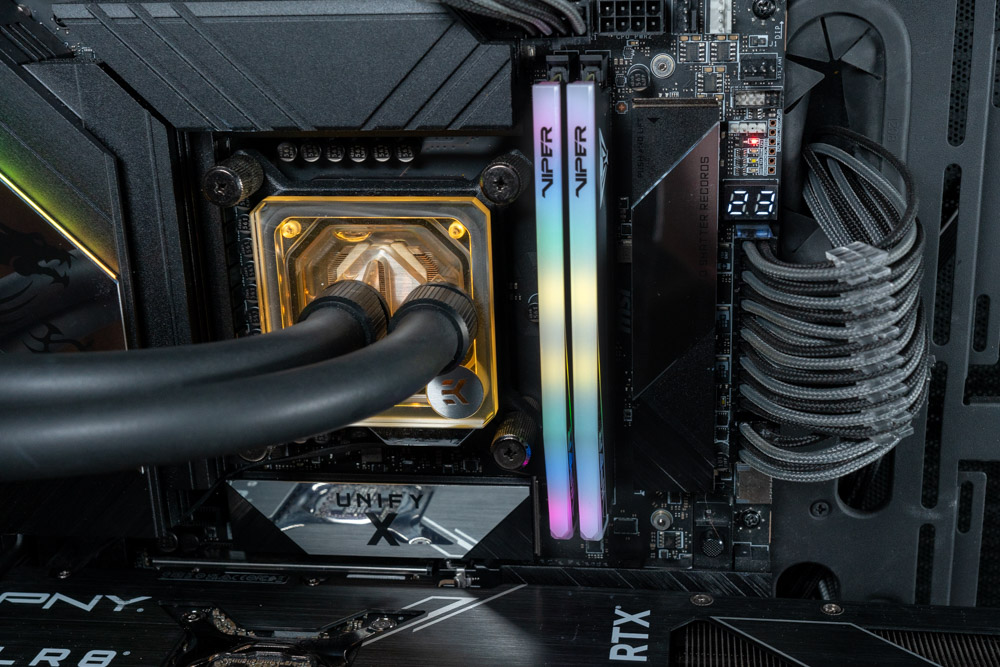
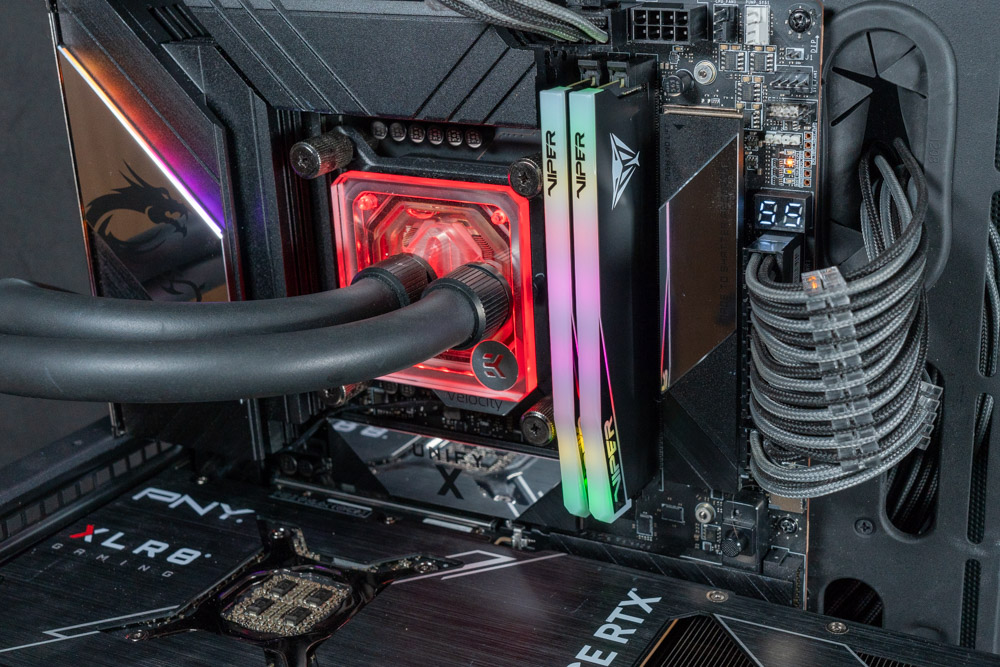
| Motherboard: | MEG Z890 UNIFY-X MEG X870E ACE MAX MSI MAG Z790 Tomahawk DDR4 |
| Graphics Card: | GeForce RTX 4090 |
| Cooling: | Custom Watercooling Loop |
| Harddisk: | 1 TB M.2 NVMe Gen 3 (OS) 1 TB M.2 NVMe Gen 4 (Data) |
| Power Supply: | FSP MEGA TI Titanium 1650 W |
| Case: | Primochill Praxis Wetbench |
| Software: | Windows 11 Professional 64-bit |
| Drivers: | (RTX 4090) NVIDIA GeForce 552.12 WHQL |
AIDA64 XMP Readout
Our Patreon Silver Supporters can read articles in single-page format.
Nov 22nd, 2026 18:11 CST
change timezone
Latest GPU Drivers
New Forum Posts
- Increasing Power Limit? (3)
- What are you playing? (26240)
- UPS what one to get? (48)
- Honestly, do you care about GTA VI? (265)
- Your PC ATM (36458)
- Gacha Games - Discussions, Pulls, Updates, etc. (1157)
- Last game you purchased? (1414)
- Making a game in Godot engine (19)
- Intel D270 (5)
- X870E AORUS ELITE WIFI7 thread with setting and OC (69)
Popular Reviews
- Microsoft Surface Laptop Ultra Review - The Next-gen Arm Laptop
- Corsair RM1200e (Second Generation) Review
- Upcoming Hardware Launches 2027 (Updated Nov 2026)
- Pulsar Office Tour & First Look at P1 Dual-Sensor Mouse
- Ugreen NASync DXP4800 GT Review
- AMD Ryzen 7 9800X3D Review - The Best Gaming Processor
- AMD Zen 6 Technical Deep Dive
- AMD Ryzen 7 5800X3D 10th Anniversary Review
- Phantom Blade Zero Performance Benchmark Review - 35 GPUs Tested
- Biwin Black Opal NV7400 2 TB Review
TPU on YouTube
Controversial News Posts
- NVIDIA Co-Founder and CEO Jensen Huang Officially Resigns (492)
- Report: Jensen Huang Eyes NVIDIA Comeback (266)
- Open Letter Asking NVIDIA to Reinstate Jensen Huang Passes 115,000 Signatures (184)
- OpenAI CEO Argues Home PCs Waste the World's Limited DRAM Supply (152)
- NVIDIA Launches Investigation Into Jensen Huang's Relationship With Suspected Chinese Spy (136)
- Intel "Raptor Lake Next" 16-Core and 20-Core CPUs Surface (130)
- NVIDIA GeForce RTX 50-Series Scheduled for up to $500 Price Hike This Week (89)
- Intel Razor Lake Gets a 12 P-Core bLLC Chip With No E-Cores, Per Leak (86)