 2
CPS PCCooler YT1200 Review
Value & Conclusion »Result Summary
| Test results (AC @ 230 V) - CPS PCCooler YT1200 | |||||||||
|---|---|---|---|---|---|---|---|---|---|
| All-rail load | 12 V | 5 V | 3.3 V | Power (DC/AC) | Efficiency | Fan Speed | Noise level | Power Factor | |
| 0 % | 0.00 A | 0.0 A | 0.0 A | 0.00 W | N/A | Fan Stop | 0.11 | ||
| 12.08 V | 5.36 V | 3.57 V | 3.30 W | ||||||
| 5 % | 5.00 A | 4.00 A | 6.06 A | 60.00 W | 78.55 % | Fan Stop | 0.74 | ||
| 12.18 V | 5.26 V | 3.43 V | 76.90 W | ||||||
| 10 % | 10.00 A | 4.00 A | 6.06 A | 120.00 W | 86.17 % | Fan Stop | 0.87 | ||
| 12.17 V | 5.25 V | 3.43 V | 140.30 W | ||||||
| 20 % | 20.00 A | 4.00 A | 6.06 A | 240.00 W | 90.51 % | Fan Stop | 0.93 | ||
| 12.16 V | 5.25 V | 3.42 V | 267.70 W | ||||||
| 30 % | 30.00 A | 4.00 A | 6.06 A | 360.00 W | 91.76 % | Fan Stop | 0.95 | ||
| 12.12 V | 5.24 V | 3.41 V | 397.00 W | ||||||
| 40 % | 40.00 A | 4.00 A | 6.06 A | 480.00 W | 92.05 % | Fan Stop | 0.95 | ||
| 12.09 V | 5.22 V | 3.39 V | 528.90 W | ||||||
| 50 % | 50.00 A | 4.00 A | 6.06 A | 600.05 W | 91.98 % | 589 RPM | 28.2 dBA | 0.96 | |
| 12.07 V | 5.20 V | 3.37 V | 663.30 W | ||||||
| 60 % | 60.00 A | 4.00 A | 6.06 A | 720.00 W | 91.75 % | 589 RPM | 28.2 dBA | 0.96 | |
| 12.04 V | 5.18 V | 3.36 V | 799.90 W | ||||||
| 70 % | 70.00 A | 4.00 A | 6.06 A | 840.00 W | 91.40 % | 1183 RPM | 40.3 dBA | 0.97 | |
| 12.00 V | 5.16 V | 3.34 V | 939.20 W | ||||||
| 80 % | 80.01 A | 4.00 A | 6.06 A | 960.10 W | 91.08 % | 1183 RPM | 40.3 dBA | 0.97 | |
| 11.98 V | 5.15 V | 3.33 V | 1080.00 W | ||||||
| 90 % | 90.01 A | 4.00 A | 6.06 A | 1080.10 W | 90.79 % | 1183 RPM | 40.3 dBA | 0.97 | |
| 11.95 V | 5.13 V | 3.31 V | 1222.00 W | ||||||
| 100 % | 100.01 A | 4.00 A | 6.06 A | 1200.10 W | 90.22 % | 1827 RPM | 49.1 dBA | 0.97 | |
| 11.92 V | 5.11 V | 3.30 V | 1370.00 W | ||||||
| 110 % | 110.01 A | 4.00 A | 6.06 A | 1320.10 W | 89.69 % | 1827 RPM | 49.1 dBA | 0.97 | |
| 11.90 V | 5.10 V | 3.28 V | 1520.00 W | ||||||
Efficiency
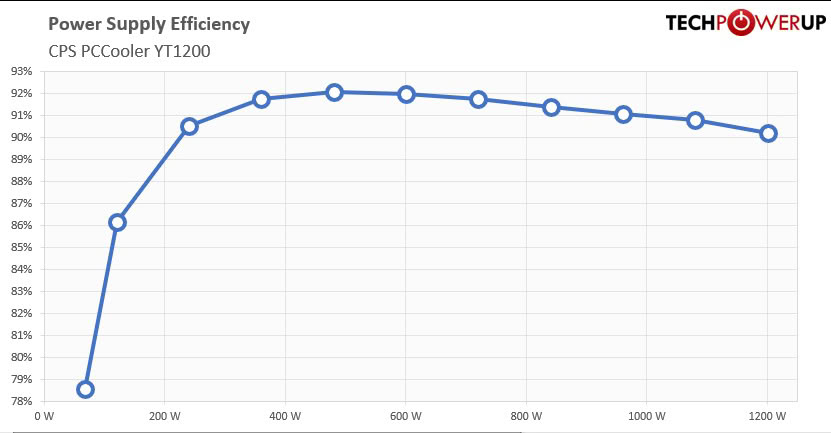
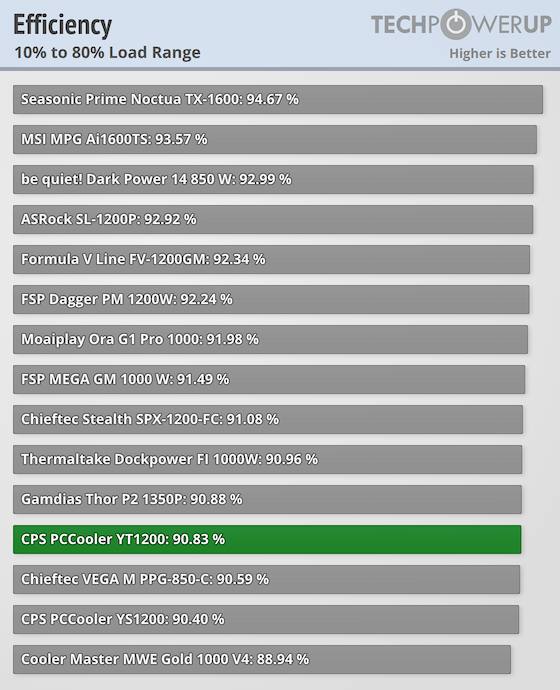
This supply is sufficiently efficient for its power density and price point, with no sudden drops or outliers.
| Rated Efficiency Validation (230 V) | ||||
|---|---|---|---|---|
| Certification: 80 Plus Titanium | ||||
| Test Load | Required | Measured | Margin | Status |
| 10% | 90.00 % | 89.84 % | -0.16 % | Borderline |
| 20% | 94.00 % | 92.78 % | -1.22 % | |
| 50% | 96.00 % | 93.57 % | -2.43 % | |
| 100% | 90.00 % | 91.85 % | +1.85 % | Pass |
PCCooler does not provide an official 80 Plus rating, but if we were to compare it to the Gold (230 V) rating, it practically meets the requirements, performing notably well at higher loads. It would likely not come close to a Platinum 80 Plus rating though, to match its Cybenetics score.
Fan Noise
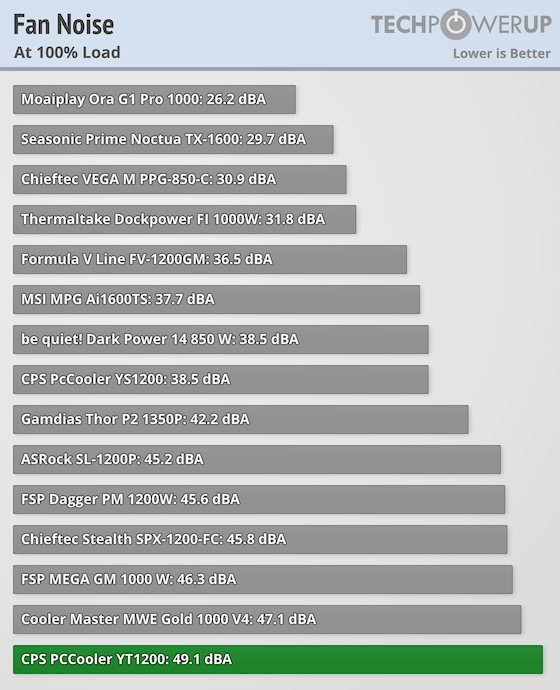
The most obvious thing we found when testing this unit was that the fan curve is not a smooth ramp with load or temperature. Rather, it has four fixed speeds: Off, Low, Medium and High. Under a 60% load you are unlikely to notice the fan above other system and room noise, but increase the load beyond this and it becomes very noticeable, absolutely screaming at 100% load. Aside from this, it is worth noting that if the PC presents a fluctuating load that constantly passes these fan speed thresholds, it may become annoying to hear it keep ramping up and down suddenly.
Voltage Regulation
All ATX PSUs have a voltage regulation feedback loop, which increases the PWM duty cycle for each rail to account for voltage drop when current is drawn. However, most PSUs only measure voltage at the PSU output, rather than at the end of the cable going to the load. This means any voltage drop across the cable is not automatically adjusted for. The ATX3.1 specification outlines a maximum allowed voltage drop at the load itself to ensure system stability,| Voltage Regulation & ATX 3.0 Compliance | |||||
|---|---|---|---|---|---|
| Test Load | Rail | Measured | ATX 3.0 Spec Limit | Margin | Status |
| Idle (0%) | +12V | 12.08 V | +5%/-8% | +0.67 % | Pass |
| +5V | 5.36 V | ±5% | +7.20 % | Fail | |
| +3.3V | 3.57 V | ±5% | +8.18 % | Fail | |
| 100% Load | +12V | 11.92 V | +5%/-8% | -0.67 % | Pass |
| +5V | 5.11 V | ±5% | +2.20 % | Pass | |
| +3.3V | 3.30 V | ±5% | 0.00 % | Pass | |
The idle floating voltage of this unit is quite high, actually failing ATX spec thresholds on the 5 V and 3.3 V rails. Usually this is done to account for voltage drop across the cables under load, and since the PSU will never be truly idle while powered up, this won't be an issue. You can see that by 100% load, the plan works well with rails either very near or dead on target.
Cable Quality
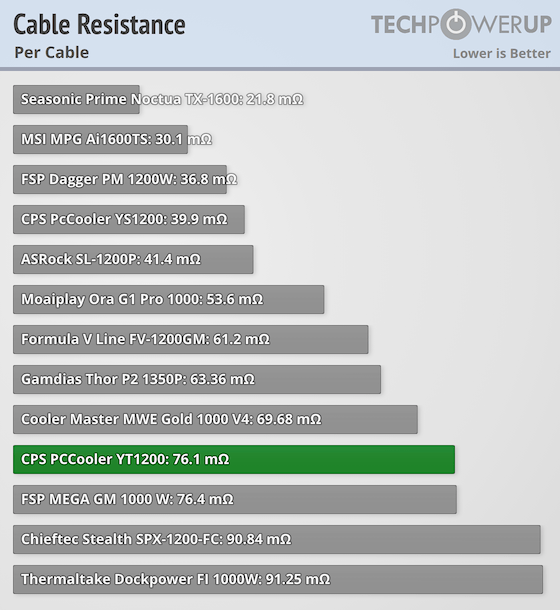
Although voltage regulation inside modern PSUs is extremely stable, voltage drop and thus power losses will occur across the cables as current is drawn through them. This results in a lower voltage available to the system components than what is actually measured at the PSU outputs. Thicker cables will cause less voltage drop and more power to the components. Any power lost across the cables is wasted as heat in the wire itself. By measuring the voltage drop at a known load, we can calculate the resistance of the cables.| Cable Losses at Full Load | |
|---|---|
| Applied 12 V Load | 98.56 A |
| Measured @ Supply | 12.17 V |
| Measured @ Load | 11.92 V |
| Power Lost in Cable | 24.64 W |
| Per-Cable Resistance | 76.1 mΩ |
| Cable Temperature | 40.4°C |
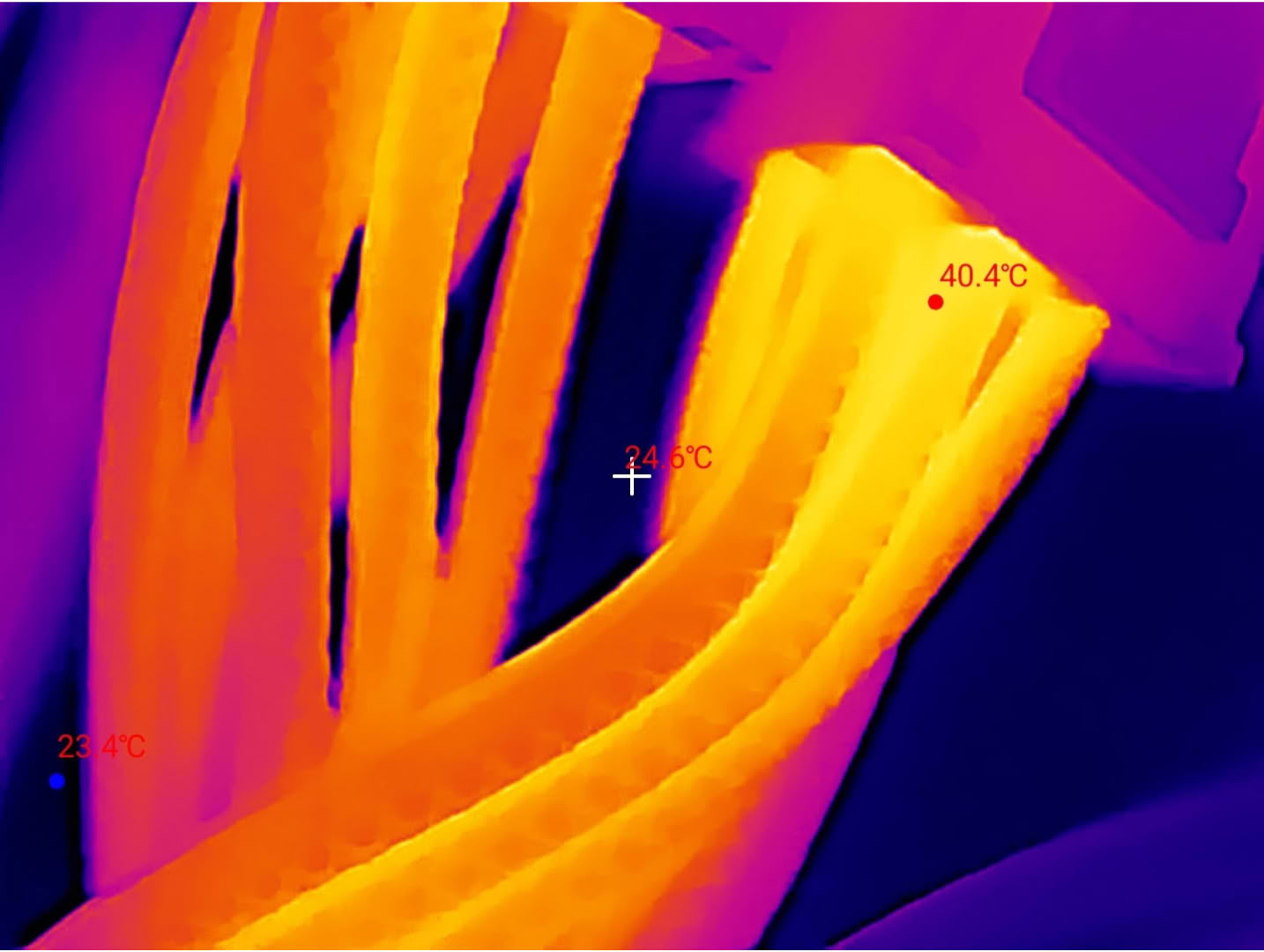
PCCooler are not using particularly thick cables here compared to other 1200 W rated models, but this is accounted for by the higher regulated voltage so that after losses the rails are still perfectly within spec.
Ripple
Ideally you want the DC voltage delivered by your power supply to be a completely flat line when looking through an oscilloscope. However, due to the switching nature of the ATX power supply and the less than ideal real world behavior of all the components involved, we get very small fluctuations in the voltage output, known as ripple and noise. The ATX spec allows a ripple of up to 120 mV for the +12 V rail and 50 mV for the minor rails.| Ripple (mV) | |||
|---|---|---|---|
| Test Load | 12 V | 5 V | 3.3 V |
| 5% | 16 mV | 9 mV | 10 mV |
| 10% | 12 mV | 9 mV | 11 mV |
| 20% | 12 mV | 10 mV | 11 mV |
| 30% | 13 mV | 9 mV | 12 mV |
| 40% | 15 mV | 11 mV | 12 mV |
| 50% | 13 mV | 10 mV | 14 mV |
| 60% | 13 mV | 11 mV | 14 mV |
| 70% | 12 mV | 11 mV | 15 mV |
| 80% | 14 mV | 12 mV | 16 mV |
| 90% | 13 mV | 11 mV | 17 mV |
| 100% | 16 mV | 12 mV | 19 mV |
| 110% | 18 mV | 12 mV | 21 mV |
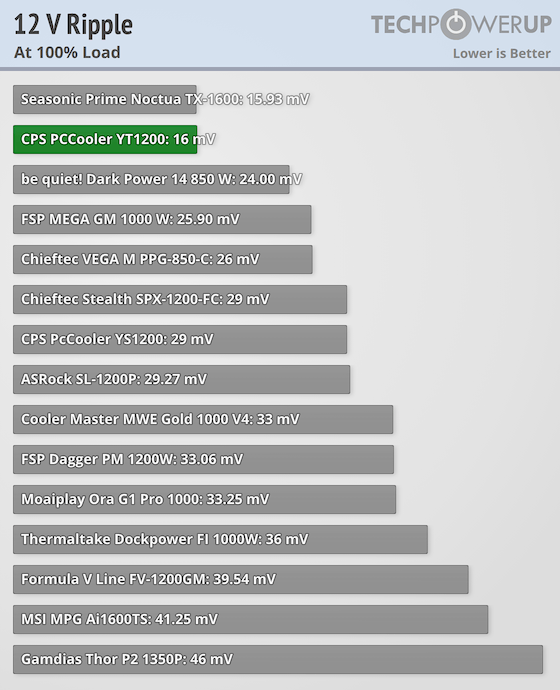
The ripple control outperforms its mid-tier price tag, keeping the critical +12 V rail locked below 20 mV across the entire load spectrum. It rivals much more expensive, premium units from brands like Corsair and Seasonic, achieving very clean power output without the need for in-cable capacitors, which make cable routing more difficult.
Short Circuit Protection
Short circuit protection is one of the most fundamental and important protections for a power supply. If a short circuit is detected on any rails, the PSU should turn off and prevent damage to itself and other components.| Short Circuit Protection | |
|---|---|
| +12 V rail | Operational |
| +5 V rail | Operational |
| +3.3 V rail | Operational |
SCP was working as expected with the unit.
Nov 25th, 2026 16:42 CST
change timezone
Latest GPU Drivers
New Forum Posts
- TPU's Nostalgic Hardware Club (22208)
- Which ryzen am5 cpu ? (217)
- UPS what one to get? (74)
- More Nova Lake specs (5)
- Share your CPUZ Benchmarks! (2680)
- X79 and/or rampage IV OC'ing thread for those of us still left.... (2457)
- Asus Rog Maximus Z890 Extreme. (Various questions). (38)
- Can you guess Which game it is? (362)
- Claude credits purchased on or after Dec. 7 now have an expiry date (13)
- Adventure: Running 8/9th gen Coffee Lake CPUs on Z170 motherboard (ASUS Maximus VIII Ranger) (393)
Popular Reviews
- ASRock X870E Challenger Wi-Fi White Review
- Microsoft Surface Laptop Ultra Review - The Next-gen Arm Laptop
- VZMORE AX9 Max Review
- Upcoming Hardware Launches 2027 (Updated Nov 2026)
- AMD Ryzen 7 9800X3D Review - The Best Gaming Processor
- AMD Zen 6 Technical Deep Dive
- Corsair RM1200e (Second Generation) Review
- Phantom Blade Zero Performance Benchmark Review - 35 GPUs Tested
- Pulsar Office Tour & First Look at P1 Dual-Sensor Mouse
- Ocypus lota P1000 Review
TPU on YouTube
Controversial News Posts
- Jensen Huang Reinstated as CEO of NVIDIA (570)
- NVIDIA Co-Founder and CEO Jensen Huang Officially Resigns (492)
- Report: Jensen Huang Eyes NVIDIA Comeback (281)
- Open Letter Asking NVIDIA to Reinstate Jensen Huang Passes 115,000 Signatures (184)
- OpenAI CEO Argues Home PCs Waste the World's Limited DRAM Supply (152)
- NVIDIA Launches Investigation Into Jensen Huang's Relationship With Suspected Chinese Spy (136)
- Intel "Raptor Lake Next" 16-Core and 20-Core CPUs Surface (130)
- Intel Razor Lake Gets a 12 P-Core bLLC Chip With No E-Cores, Per Leak (94)