 16
Philips Fidelio X3 Wired Open-Back Headphones Review
(16 Comments) »Introduction

Soon after my quick look at the Philips PH805 headphones was published, news came of the company releasing a successor to the wildly successful Fidelio X2/X2HR in the form of the new Fidelio X3. My local contact sought to make sure I covered the product here, and we all know what happened next. Months of limbo later, yours truly is settled in again for reviews, and it just so happened that the UK arm of Philips had the same idea. So here we are with our first full review of a Philips product on TechPowerUp, and thanks again to the company for loaning a review unit to TechPowerUp!

The Fidelio X2HR is one of my go-to headphones, so much so that I have actively been using it for listening to audio and quick changeovers to online meetings with an Antlion ModMic USB, which works so well with the magnetic mesh lining on the headphones that you don't need any sticky pads for permanent installation. It is one of the most comfortable and neutral-sounding headphones I have in my possession currently, and there is added warmth with some bass boost that I was not expecting either. It is not the most accurate set of cans, however, and when Philips mentioned that the Fidelio X3 was designed with accuracy in mind foremost my interest was piqued. Let's see how these sound as we begin the review with a look at the product specifications in the table below.
Specifications
| Philips Fidelio X3 Headphones | |
|---|---|
| Distortion: | <0.1% THD |
| Diaphragm: | LMC |
| Speaker Diameter: | 50 mm |
| Sensitivity: | 100 dB @ 1mW |
| Maximum Power Input: | 500 mW |
| Impedance: | 32 Ω |
| Frequency Response: | 5–40,000 Hz |
| Magnet Type: | Neodymium |
| Acoustic System: | Open |
| Type: | Dynamic |
| Dimensions: | 11 (L) x 19 (W) x 23 (H) mm |
| Weight: | 380 g / 0.84 lbs. |
| Cables: | Split 3.5 mm (L/R) to 3.5 mm TRS, split 3.5 mm (L/R) to balanced 2.5 mm TRRS, and 3.5 mm to 6.3 mm adapter plug |
| Cable Length: | 10 ft / 3 m |
| Warranty: | Two years |
Packaging and Accessories
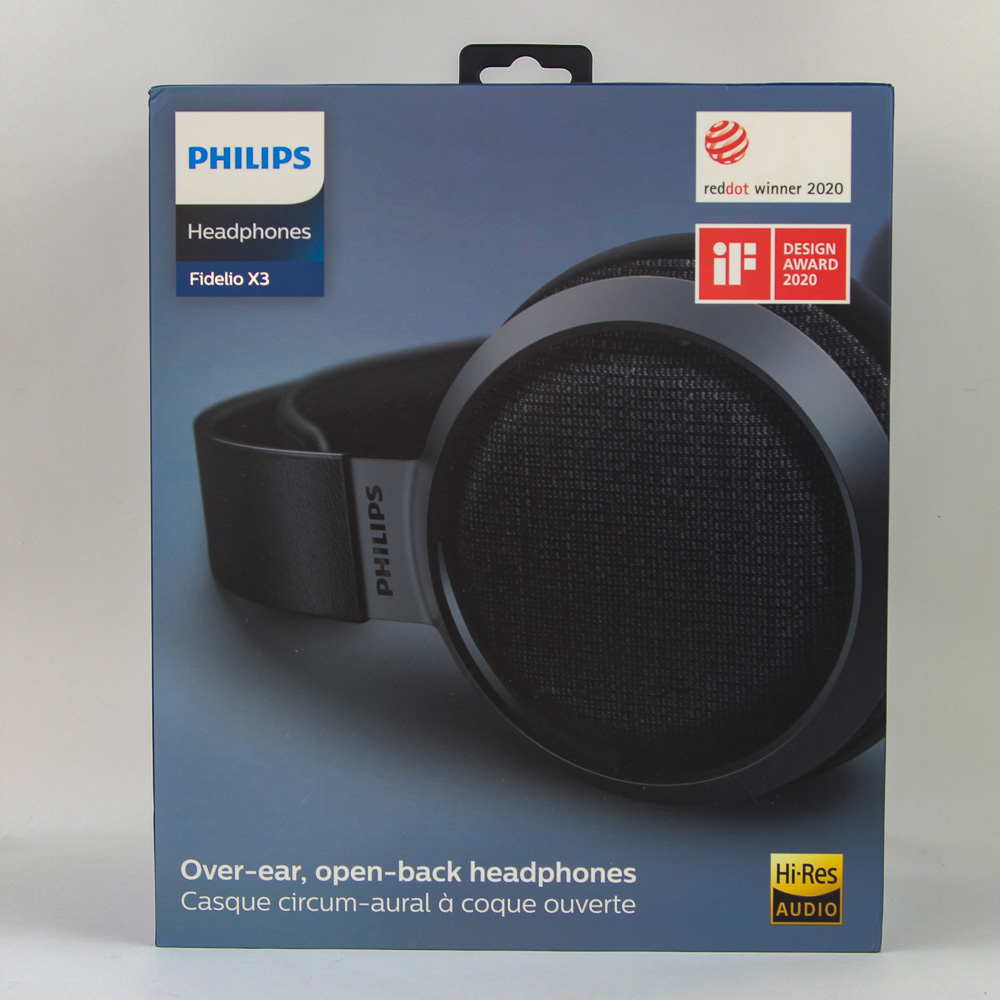


With a blue box that borrows colors from the company logo directly, packaging for the Philips Fidelio X3 is similar to that of the two other Philips headphones here, namely the TAPH805 and aforementioned Fidelio X2HR. On the front is the other company logo, as well as the product name, of course. This is paired with a large render of the Fidelio X3 resting on its side and a list of salient features which let you know that this is an over-ear, open-back pair of headphones. There is also the Hi-Res audio certification badge and a mention of two design awards won by the product last year. This continues on the back with another render, more features listed in multiple languages, and the specifications on the side with a look at the connectivity options. Plenty of seals keep the packaging together and the contents inside in place during transit.


Removing the seals on the bottom reveals Philips is using a two-piece packaging, again similar to my previous experiences, with an inner box inside the external sleeve. This box, again blue in color, houses the Philips name in the center in white. There are two more seals along the sides, although mine was clearly opened before and repacked owing to this potentially being a loaner unit even before it came my way. Cut off both seals, and the box opens up vertically akin to a fancy gift box. There is a thick foam lining on the underside of the top surface, which goes over the headphones themselves for added protection.


We see the headphones immediately inside a plastic blister packaging with cutouts to accommodate it snugly, and you just lift it up to get your hand on the Fidelio X3. Above it is a cardboard box that houses the accessories, and I also got a guide in the packaging that goes over the features of the headphones, which you can also find on the product page—baaed on some unboxings I have seen, it may not be included with the retail packaging. This might be part of the reason the seals were cut already. You may end up with the headphones inside the carry bag, so be aware that this may not reflect your own retail experience completely, though it is close enough for me not to lose any sleep over.
Inside the cardboard box, you will find the two cables Philips includes, which we will go over in more detail on the next page. There is a pamphlet about the Muirhead fine grain leather employed on the headphones and presumably headband, which is a big sign of Philips wanting to take the Fidelio X3 to a more upstream market than the X2/X2HR. A second piece of paperwork walks you through how best to use the included cables. More relevant to this section is the provided 3.5 mm to 6.3 mm adapter plug, all gold-coated and retaining the TRS (Tip-Ring-Sleeve) nature of the plug for when you want to use it with a source supporting 1/4" input (6.3 mm)—on, say, more professional equipment, such as the audio mixers or stereo amplifiers from yesteryear (or even today). Lastly, we see a Philips-branded cable clip that helps with managing the cable length. It has a wider opening on one end because both cables go from one wire to two as we will see soon, meaning the wider opening needs to host two wires.


Regardless of where the bag is in the retail packaging, we still get one. It is adequate, but so far everything has been fairly similar to the other two Philips headphones I have personally used. If anything, this cloth bag feels flimsy compared to the travel case that came with the TAPH805, and it is fairly soft cloth material in black that is stitched at the mating sections to prevent fraying. I would like to see something better here, especially if the Fidelio X3 is meant to be a more luxurious, higher-end offering from Philips.
Our Patreon Silver Supporters can read articles in single-page format.
Nov 18th, 2026 16:17 PST
change timezone
Latest GPU Drivers
New Forum Posts
- Got a new laptop! What should I do with it? (5)
- Honestly, do you care about GTA VI? (147)
- Dell Workstation Owners Club (3514)
- Making a game in Godot engine (2)
- [Poll] 12V-2x6 Connector Protection: What Are You Using? (WireView / Ampinel / Equalizer / Other / Nothing) (39)
- Last game you purchased? (1406)
- Time to upgrade CPU and MOBO (34)
- Can i play GTA 6 now? (Joke) (7)
- What are you playing? (26234)
- Very unusual two gaming-pc scenarios. (12)
Popular Reviews
- Acemagic Retro X3 Review
- Upcoming Hardware Launches 2027 (Updated Nov 2026)
- AMD Zen 6 Technical Deep Dive
- Ugreen NASync DXP4800 GT Review
- Biwin Black Opal NV7400 2 TB Review
- Pulsar Office Tour & First Look at P1 Dual-Sensor Mouse
- Chieftec Iceberg PRO 360 DARK Review
- Sapphire Radeon RX 7700 XT Pure Review
- ASUS ROG Strix B850-I Gaming Wi-Fi7 W Review
- Sapphire Radeon RX 7700 XT Pulse Review
TPU on YouTube
Controversial News Posts
- NVIDIA Co-Founder and CEO Jensen Huang Officially Resigns (478)
- Report: Jensen Huang Eyes NVIDIA Comeback (193)
- Open Letter Asking NVIDIA to Reinstate Jensen Huang Passes 115,000 Signatures (184)
- OpenAI CEO Argues Home PCs Waste the World's Limited DRAM Supply (152)
- NVIDIA Launches Investigation Into Jensen Huang's Relationship With Suspected Chinese Spy (136)
- Intel "Raptor Lake Next" 16-Core and 20-Core CPUs Surface (130)
- Legendary Game Studio BioWare Shuts Down Following EA Layoffs (104)
- Dell CEO Says the Memory Shortage Will Get Worse in 2027 (95)