 55
Phison E28 PCIe 5.0 SSD Engineering Sample Review - Efficiency Magic
Windows 11 Startup, Virtualization & File Compression »Thermal Throttling
Due to the compact form factor, M.2 drives lack the ability to actively cool themselves, usually having to rely on passive airflow instead. All vendors include some form of thermal throttling on their drives as a safeguard, which limits throughput once a certain temperature is exceeded.On this page, we will investigate whether the tested drive has such a mechanism, how high temperatures get, and what effect this has on performance. We will test the drive in a typical case, installed in the M.2 slot between the CPU and graphics card.
Each of the charts has time moving from left to right, showing transfer speeds in MB/s and also reporting the drive's temperature in degrees Celsius (measured using SMART).
Real-Life Temperatures
This new thermal testing approach simulates typical SSD workloads using PCMark10 storage traces, which replay real-world disk usage without executing the full applications. It helps us create consistent, realistic usage patterns, not just primitive synthetic "random read" or "random write" operations. We can also reduce idle gaps in the trace playback to make the SSD work harder, but not unrealistically so. The recorded activity comes from apps like Adobe and Office, as well as gaming and file transfers. We repeat the entire test sequence three times to extend the total workload duration, followed by a cool-down period to observe how the SSD dissipates heat.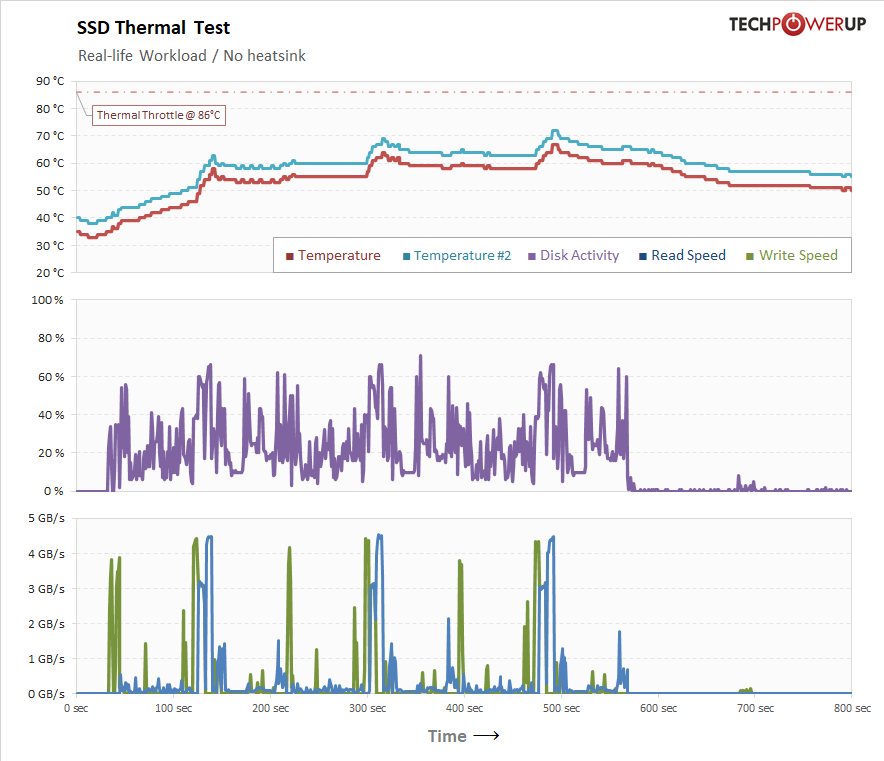
No thermal throttling.
Thermal Stress Test
In these tests, the SSD is hammered by nonstop incoming writes to simulate worst-case thermal stress under the heaviest possible load. The test also checks how the drive deals with thermal throttling and whether it continues to function normally.Bare Drive
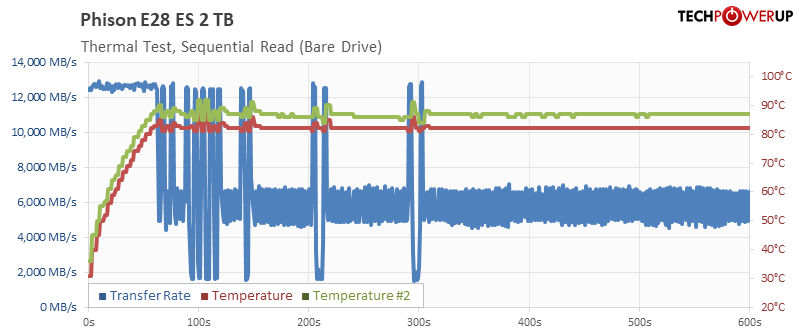
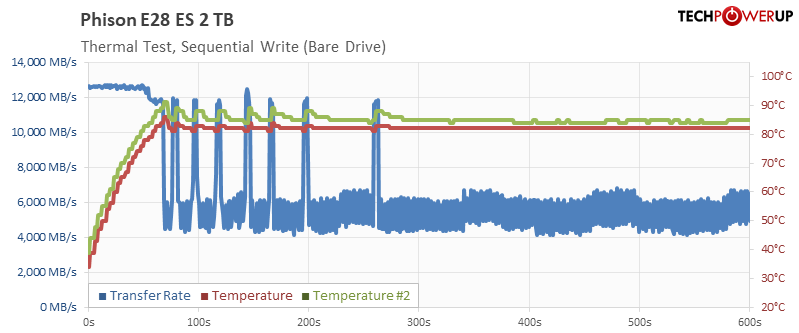
Without any sort of heatsink, despite the excellent energy efficiency, the drive will start throttling fairly quickly. The throttle behavior is very well-defined though and gradual, which ensures performance doesn't just fall off a cliff.
Drive with Thermalright Heatsink
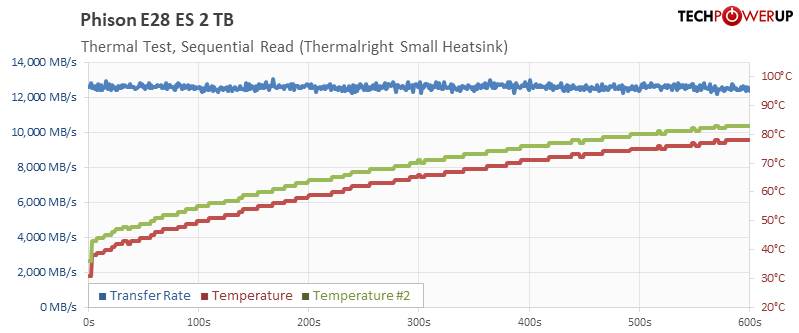
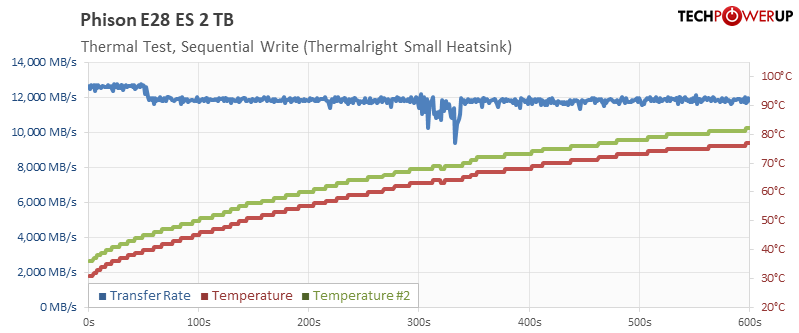
I installed a Thermalright TR-M2, which is a compact full-metal heatsink. Now there is no more throttling—very impressive for a Gen 5 SSD.
Drive with big Thermalright Heatsink
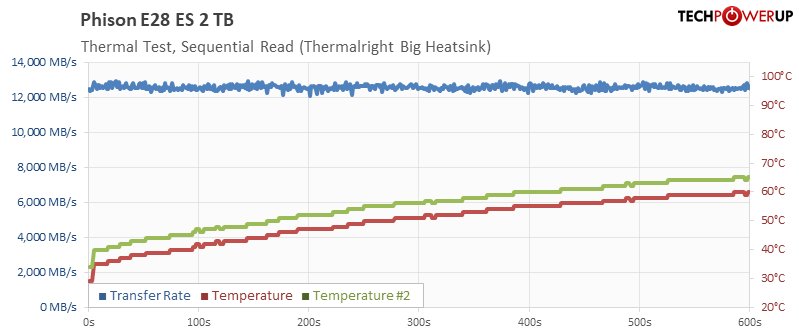
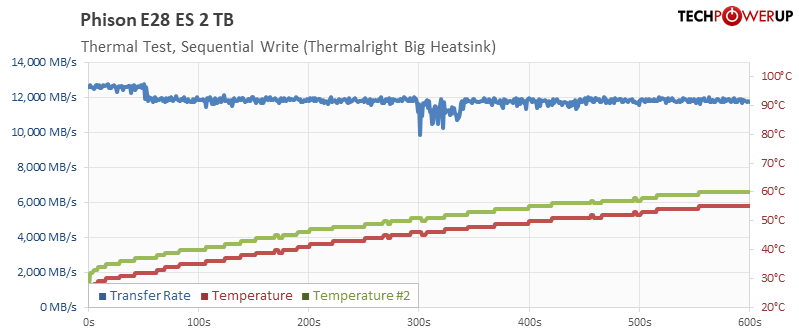
With the much bigger Thermalright HR-10, there is no more throttling as well, and temperatures are much lower.
Thermal Image & Hot Spot
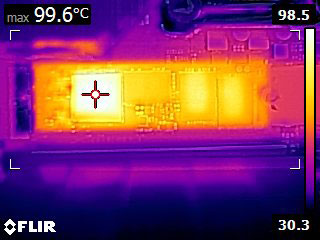
We recorded a thermal image of the running SSD as it was completing the thermal stress test. The surface temperature of the drive reached 110°C. This is a high but very reasonable maximum—the higher limit helps avoid thermal throttling. These chips are designed to run at even higher temperatures without issues.
Nov 22nd, 2026 18:22 CST
change timezone
Latest GPU Drivers
New Forum Posts
- Increasing Power Limit? (5)
- What are you playing? (26240)
- UPS what one to get? (48)
- Honestly, do you care about GTA VI? (265)
- Your PC ATM (36458)
- Gacha Games - Discussions, Pulls, Updates, etc. (1157)
- Last game you purchased? (1414)
- Making a game in Godot engine (19)
- Intel D270 (5)
- X870E AORUS ELITE WIFI7 thread with setting and OC (69)
Popular Reviews
- Microsoft Surface Laptop Ultra Review - The Next-gen Arm Laptop
- Corsair RM1200e (Second Generation) Review
- Upcoming Hardware Launches 2027 (Updated Nov 2026)
- Pulsar Office Tour & First Look at P1 Dual-Sensor Mouse
- Ugreen NASync DXP4800 GT Review
- AMD Ryzen 7 9800X3D Review - The Best Gaming Processor
- AMD Zen 6 Technical Deep Dive
- AMD Ryzen 7 5800X3D 10th Anniversary Review
- Phantom Blade Zero Performance Benchmark Review - 35 GPUs Tested
- Biwin Black Opal NV7400 2 TB Review
TPU on YouTube
Controversial News Posts
- NVIDIA Co-Founder and CEO Jensen Huang Officially Resigns (492)
- Report: Jensen Huang Eyes NVIDIA Comeback (266)
- Open Letter Asking NVIDIA to Reinstate Jensen Huang Passes 115,000 Signatures (184)
- OpenAI CEO Argues Home PCs Waste the World's Limited DRAM Supply (152)
- NVIDIA Launches Investigation Into Jensen Huang's Relationship With Suspected Chinese Spy (136)
- Intel "Raptor Lake Next" 16-Core and 20-Core CPUs Surface (130)
- NVIDIA GeForce RTX 50-Series Scheduled for up to $500 Price Hike This Week (89)
- Intel Razor Lake Gets a 12 P-Core bLLC Chip With No E-Cores, Per Leak (86)