 0
Phison PASCARI X201P 15.36 TB Review
(0 Comments) »Introduction

As one of the leading manufacturers of SSD controllers, re-drivers, and other related technologies, Phison stands out for its strong development role, being a pioneer particularly when it comes to next-generation controllers on the SSD market.

The Phison PASCARI X201 series represents the successor to the X200 lineup, which we reviewed last year. While the previous generation was introduced several years ago, Phison announced the new X201 series in November 2025, and the drives have now entered mass production. This new lineup builds upon the existing platform with several improvements, one of the most significant being the NAND upgrade, which we'll examine in greater detail in the teardown section. Phison has replaced the previous SK hynix 4D TLC V7 176-layer NAND with the newer SK hynix 4D TLC V9 321-layer NAND, which theoretically offers considerably higher performance and greater storage density. The Phison X2 controller remains unchanged, meaning the primary hardware difference between the two generations is the NAND flash itself. However, Phison has likely also implemented firmware optimizations to take better advantage of the newer NAND and further improve overall performance.
The new Phison X201 lineup is divided into two subcategories. The first is the X201E, a 3-DWPD PCIe 5.0 enterprise SSD designed for write-intensive workloads. In the U.2 form factor, it is available in capacities ranging from 1.6 TB to 25.6 TB, while the E3.S versions range from 3.2 TB to 25.6 TB. The drive we received for testing belongs to the X201P series, which offers a lower endurance rating of 1-DWPD, at a more affordable price point. The U.2 models are available in capacities ranging from 1.92 TB to 30.72 TB, while the E3.S variants start at 3.84 TB and also reach up to 30.72 TB. Depending on capacity, endurance ratings range from 1,752 TBW for the 1.92 TB model to 56,064 TBW for the 30.72 TB version.
Due to the current global supply situation for NAND flash and DRAM, obtaining reliable pricing for enterprise SSDs has become increasingly difficult. Prices fluctuate constantly and vary significantly depending on the supplier, region, and purchase volume, with larger orders generally resulting in lower per-unit costs. At the time of this review, the lowest prices we could find for the X201P were approximately $13,000, with some listings going considerably higher.
| Specifications: Phison PASCARI X201P 15.36 TB SSD | |
|---|---|
| Brand: | Phison |
| Model: | XP208H0815T3P3216T310 |
| Capacity: | 15360 GB (14304 GB usable) 7 % overprovisioning |
| Controller: | Phison X2 PS5302-X2 |
| Flash: | SK hynix 4D eTLC V9 1 Tb 321-Layers D-Die (H25GTD0) H2AVGA4AYP |
| DRAM: | 18 GB (9× 2 GB) DDR4-3200 CL-22 (D-Die) SK hynix H5AG48DXNDX116 |
| Sequential Read Speeds: | 14,800 MB/s |
| Sequential Write Speeds: | 11,800 MB/s |
| Random Read Speeds: | 3,250 K IOPS |
| Random Write Speeds: | 600 K IOPS |
| Endurance: | 28,032 TBW, 1.0 DWPD |
| MTBF: | 2.5 Million Hours |
| Form Factor: | U.2 15 mm |
| Interface: | PCIe Gen 5 x4, NVMe 2.0 |
| Firmware: | RH110017 |
| Warranty: | Five years |
| Price at Time of Review: | ~$13,170 |
Packaging


The SSD comes packaged in a very simple cardboard box with no markings. Once opened, the drive is secured inside a plastic blister to prevent damage during transport.
The Drive


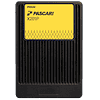
These SSDs are available in multiple form factors. The unit we received uses the U.2 15 mm format with the SFF-8639 connector, though it's also offered in the newer EDSFF E3.S form factor. On the front, there's only a yellow sticker displaying the brand and product line name, no capacity, model number, or other identifying information is shown. The back of the drive is completely blank, with no additional labels or markings.
In datacenter or server environments, having a clear label with details like the serial number, capacity, and firmware version is essential for asset management, inventory tracking, and identifying specific drives for maintenance or replacement. The lack of information on the drive itself can be a drawback in those use cases.

PCI-Express 5.0 x4 is used as the host interface to the rest of the system, alongside the NVMe 2.0 protocol.

The connector shown here is a proprietary diagnostic port that Phison uses for factory servicing and engineering purposes. According to Phison, it provides access to debugging functions and allows technicians to flash or update the SSD's firmware. Unlike standard interfaces such as USB or UART, this is a proprietary connection intended for internal development, diagnostics, and maintenance, rather than regular end-user operation.
Teardown
Upon opening the SSD, we see that it's secured with four Torx T1 screws. Once removed, the back side of the PCB is revealed, firmly attached to the metal housing via several thermal pads that help dissipate heat from key components.


After removing the four screws securing the SSD, we get our first look at the rear side of the PCB. Here, we find eight additional NAND flash pads, which are likely intended for higher-capacity models such as the 30.72 TB variant. There are also four additional DRAM cache packages and several VRM components. Once the PCB is removed from the metal enclosure, we can see the Phison X2 controller, along with five more DRAM cache packages, eight NAND flash packages, numerous additional power management ICs, and the Power Loss Protection (PLP) system.
Controller

The new Phison X2 "PS5302-X2-66" controller shares several characteristics with its predecessor, the "X1," previously known as the Phison E20 PS5020BB. Datacenter SSD controllers often have distinct features compared to consumer-grade models, and this case is no exception with its higher number of NAND channels, to name one example.
We believe the main processing cluster is based on a 32-bit Arm architecture, likely a triple-core Cortex-R5 operating at 1 GHz, which handles the primary tasks of the SSD. To assist with secondary and repetitive operations, Phison integrates an additional 32-core design using AndesCore N25F cores, based on the 32-bit RISC-V architecture.
That controller supports a 16-channel interface with the NAND Flash. While the exact controller interface speed remains unknown, we estimate it to be close to or above 1600 MT/s, considering it's a next-gen controller and the NAND chips themselves are rated up to 2400 MT/s. For comparison, newer consumer-grade controllers are already capable of handling NAND rated at 2400 MT/s or even higher, but of course these tend to use fewer channels.
The controller was manufactured using TSMC's well-known 12 nm FinFET process, a node that Phison frequently relies on. The main cores operate at frequencies of 1 GHz, while the secondary proprietary cores operate at a much lower frequency.
This article is not public yet. Patreon Gold Supporters can read it early.
Nov 27th, 2026 20:29 CST
change timezone
Latest GPU Drivers
New Forum Posts
- Exit Adobe - PDF reader, and PDF editor recommendations (11)
- CPU Database (302)
- -18C on GPU by moving it to the front of the case. (18)
- TPU's WCG/BOINC Team (34815)
- Anthrophics IPO (51)
- AAF Optimus Modded Driver For Windows 10 & 11 - Only for HDAUDIO Chips [WINDOWS 11 RECOMMENDED] (1156)
- What's your main Black Friday / Cyber Monday purchase? (41)
- The TPU UK Clubhouse (27308)
- Wireless Internet sharing between PC and router both-ways, is it possible? (34)
- Gigabyte RX 6800 XT Gaming OC and I would like to test the BIOS version 020.001.000.071.000000. (18)
Popular Reviews
- Upcoming Hardware Launches 2027 (Updated Nov 2026)
- AMD Ryzen 7 9800X3D Review - The Best Gaming Processor
- VZMORE AX9 Max Review
- Montech CyberFlow ARGB 360 Review
- ASRock X870E Challenger Wi-Fi White Review
- Moaiplay Ora Pro G1 850 Review
- AMD Zen 6 Technical Deep Dive
- ORICO Obook15 AI Review
- Microsoft Surface Laptop Ultra Review - The Next-gen Arm Laptop
- Phantom Blade Zero Performance Benchmark Review - 35 GPUs Tested
TPU on YouTube
Controversial News Posts
- Jensen Huang Reinstated as CEO of NVIDIA (623)
- NVIDIA Co-Founder and CEO Jensen Huang Officially Resigns (492)
- Report: Jensen Huang Eyes NVIDIA Comeback (281)
- Open Letter Asking NVIDIA to Reinstate Jensen Huang Passes 115,000 Signatures (184)
- OpenAI CEO Argues Home PCs Waste the World's Limited DRAM Supply (152)
- NVIDIA Launches Investigation Into Jensen Huang's Relationship With Suspected Chinese Spy (136)
- Intel Razor Lake Gets a 12 P-Core bLLC Chip With No E-Cores, Per Leak (94)
- NVIDIA GeForce RTX 50-Series Scheduled for up to $500 Price Hike This Week (89)