 34
PNY GeForce RTX 3070 XLR8 Revel Epic-X RGB Review
(34 Comments) »Introduction

We have with us the PNY GeForce RTX 3070 XLR8 Revel Epic-X RGB graphics card. The XLR8 (reads "accelerate") line of graphics cards by PNY targets the gaming and PC enthusiast community and comes with the trust creative professionals associate with the PNY brand. PNY is a major vendor of professional visualization graphics cards based on NVIDIA Quadro graphics processors, as well as a leading vendor of flash memory products used by photographers and cinematographers. Palit-Gainward has been PNY's manufacturing partner for these XLR8 graphics cards, and the RTX 3070 XLR8 Revel bears a striking resemblance to the Gainward RTX 3070 Phoenix GS.

The GeForce RTX 3070 is a fascinating performance-segment product that's dancing on the edge of the enthusiast segment. NVIDIA claims it's designed to perform better than the previous-generation flagship, the RTX 2080 Ti, but at half the price. This would mean the RTX 3070 has the same performance outlook as the RTX 2080 Ti—to enable maxed out gaming with RTX-on at 1440p resolution, 4K UHD gaming with RTX-off, or DLSS Quality enabled. It should also let e-sports gamers play at 1440p with high refresh rates.
At its heart, the RTX 3070 is based on the 8 nm "GA104" silicon, which it nearly maxes out. This is NVIDIA's second-largest GeForce "Ampere" silicon. The company used a conventional memory setup by giving it 8 GB of 14 Gbps GDDR6 memory across a 256-bit wide memory bus, same as the RTX 2070. For the full details on the RTX 3070 technology and architecture, refer to our RTX 3070 Founders Edition article.
The GeForce Ampere graphics architecture heralds the 2nd generation of NVIDIA's path-breaking RTX technology, which leverages real-time raytracing and AI deep-learning to dramatically uplift eye candy. It combines new Ampere CUDA cores capable of concurrent INT32+FP32 operations, 2nd gen RT cores that double the ray intersection performance over the 1st gen and add more hardware to accelerate newer kinds of raytraced effects, and 3rd gen Tensor cores that leverage the sparsity phenomenon to build and train AI deep-learning neural nets faster.
The PNY RTX 3070 XLR8 Revel Epic-X features a massive triple-slot product design with a triple-fan heatsink. The cooler is longer than the PCB underneath, so airflow from one of the fans flows right through because of vents on the backplate. The card also features a rugged industrial design, and a tastefully executed RGB LED illumination. Interestingly, our card sticks with NVIDIA-reference clock speeds, with its GPU Boost set to 1725 MHz and memory left untouched at 14 Gbps.
| Price | Shader Units | ROPs | Core Clock | Boost Clock | Memory Clock | GPU | Transistors | Memory | |
|---|---|---|---|---|---|---|---|---|---|
| RTX 2060 Super | $380 | 2176 | 64 | 1470 MHz | 1650 MHz | 1750 MHz | TU106 | 10800M | 8 GB, GDDR6, 256-bit |
| RX Vega 64 | $400 | 4096 | 64 | 1247 MHz | 1546 MHz | 953 MHz | Vega 10 | 12500M | 8 GB, HBM2, 2048-bit |
| GTX 1080 Ti | $650 | 3584 | 88 | 1481 MHz | 1582 MHz | 1376 MHz | GP102 | 12000M | 11 GB, GDDR5X, 352-bit |
| RX 5700 XT | $370 | 2560 | 64 | 1605 MHz | 1755 MHz | 1750 MHz | Navi 10 | 10300M | 8 GB, GDDR6, 256-bit |
| RTX 2070 | $340 | 2304 | 64 | 1410 MHz | 1620 MHz | 1750 MHz | TU106 | 10800M | 8 GB, GDDR6, 256-bit |
| RTX 3060 | $330 | 3584 | 48 | 1320 MHz | 1777 MHz | 1875 MHz | GA106 | 13250M | 12 GB, GDDR6, 192-bit |
| RTX 2070 Super | $450 | 2560 | 64 | 1605 MHz | 1770 MHz | 1750 MHz | TU104 | 13600M | 8 GB, GDDR6, 256-bit |
| Radeon VII | $680 | 3840 | 64 | 1802 MHz | N/A | 1000 MHz | Vega 20 | 13230M | 16 GB, HBM2, 4096-bit |
| RTX 2080 | $600 | 2944 | 64 | 1515 MHz | 1710 MHz | 1750 MHz | TU104 | 13600M | 8 GB, GDDR6, 256-bit |
| RTX 2080 Super | $690 | 3072 | 64 | 1650 MHz | 1815 MHz | 1940 MHz | TU104 | 13600M | 8 GB, GDDR6, 256-bit |
| RTX 3060 Ti | $700 | 4864 | 80 | 1410 MHz | 1665 MHz | 1750 MHz | GA104 | 17400M | 8 GB, GDDR6, 256-bit |
| RTX 2080 Ti | $1000 | 4352 | 88 | 1350 MHz | 1545 MHz | 1750 MHz | TU102 | 18600M | 11 GB, GDDR6, 352-bit |
| RTX 3070 | $750 | 5888 | 96 | 1500 MHz | 1725 MHz | 1750 MHz | GA104 | 17400M | 8 GB, GDDR6, 256-bit |
| PNY RTX 3070 XLR8 Revel Epic-X | Estimated: $770 MSRP: €500 | 5888 | 96 | 1500 MHz | 1725 MHz | 1750 MHz | GA104 | 17400M | 8 GB, GDDR6, 256-bit |
| RX 6800 | $850 | 3840 | 96 | 1815 MHz | 2105 MHz | 2000 MHz | Navi 21 | 26800M | 16 GB, GDDR6, 256-bit |
| RX 6800 XT | $1200 | 4608 | 128 | 2015 MHz | 2250 MHz | 2000 MHz | Navi 21 | 26800M | 16 GB, GDDR6, 256-bit |
| RTX 3080 | $1000 | 8704 | 96 | 1440 MHz | 1710 MHz | 1188 MHz | GA102 | 28000M | 10 GB, GDDR6X, 320-bit |
| RX 6900 XT | $1500 | 5120 | 128 | 2015 MHz | 2250 MHz | 2000 MHz | Navi 21 | 26800M | 16 GB, GDDR6, 256-bit |
| RTX 3090 | $1900 | 10496 | 112 | 1395 MHz | 1695 MHz | 1219 MHz | GA102 | 28000M | 24 GB, GDDR6X, 384-bit |
Packaging


The Card


PNY's design is very interesting. To keep cost down, the main cooler and backplate are both made out of plastic. On top of the fan assembly, a metal plate has been installed, which greatly improves the look and feel of the product because of the metal surface structure. However, a tiny bit of airflow is lost due to this design element.

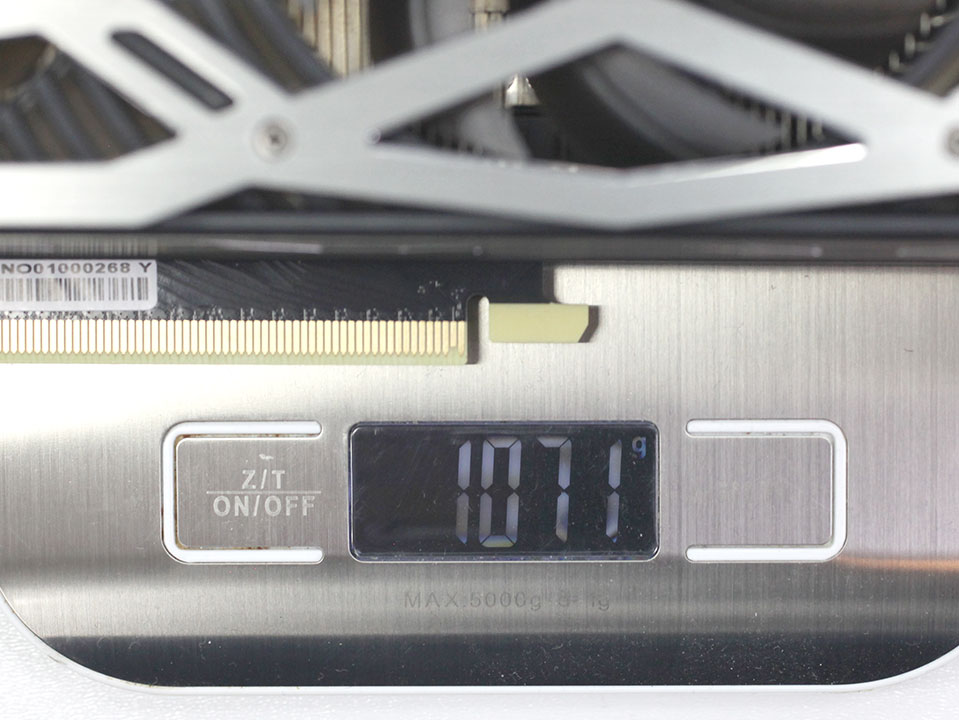
Dimensions of the card are 29.5 x 11.5 cm, and it weighs 1071 g.


Installation requires three slots in your system.

Display connectivity includes three standard DisplayPort 1.4 and one HDMI 2.1.
The DisplayPort 1.4a outputs support Display Stream Compression (DSC) 1.2a, which lets you connect 4K displays at 120 Hz and 8K displays at 60 Hz. Ampere can drive two 8K displays at 60 Hz with just one cable per display.
Ampere is the first GPU to support HDMI 2.1, which increases bandwidth to 48 Gbps to support higher resolutions, like 4K144 and 8K30, with a single cable. With DSC, this goes up to 4K240 and 8K120. NVIDIA's new NVENC/NVDEC video engine is optimized to handle video tasks with minimal CPU load. The highlight here is added support for AV1 decode. Just like on Turing, you may also decode MPEG-2, VC1, VP8, VP9, H.264, and H.265 natively, at up to 8K@12-bit.
The encoder is identical to Turing. It supports H.264, H.265, and lossless at up to 8K@10-bit.

The card has two 8-pin power inputs. This configuration is rated for up to 375 W of power draw.
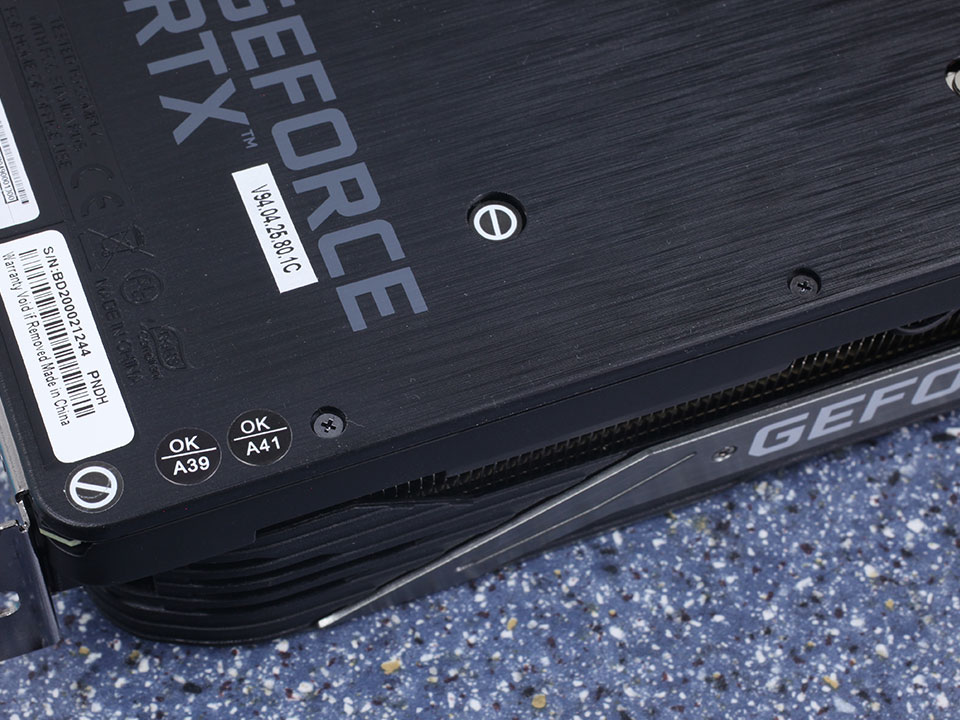
The GeForce RTX 3070 does not support SLI. Only the RTX 3090 has very limited SLI support.
Teardown

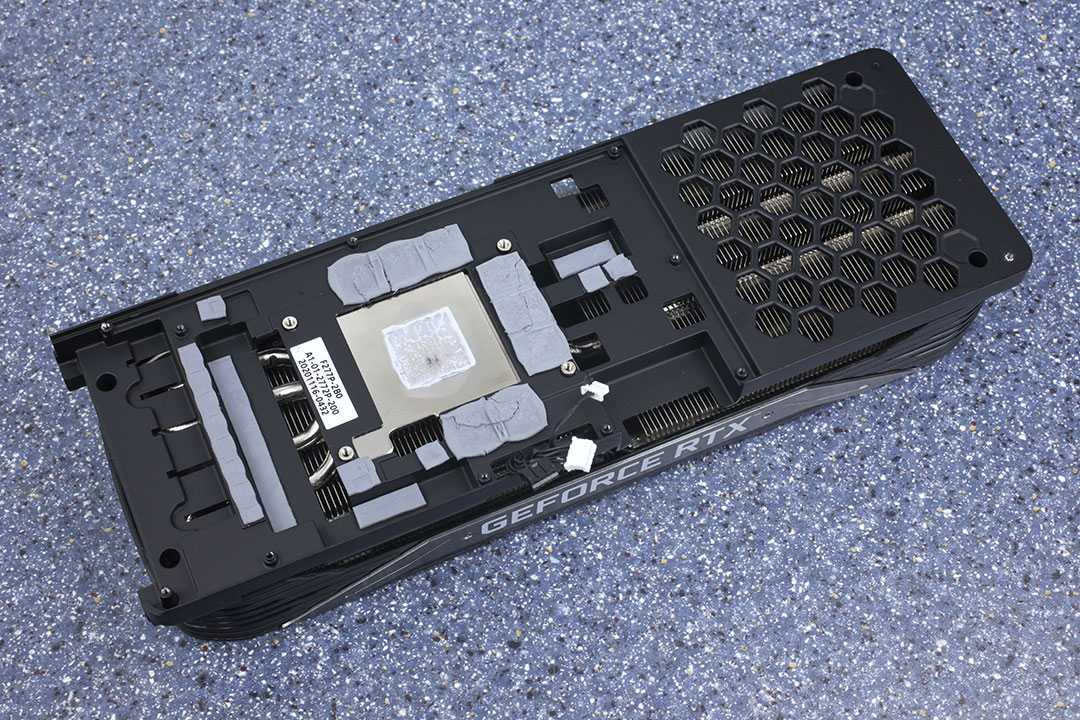

PNY's heatsink uses four heatpipes to keep the card cool. Note how the cooling assembly also has thermal pads to cool the voltage regulation circuitry and memory chips.

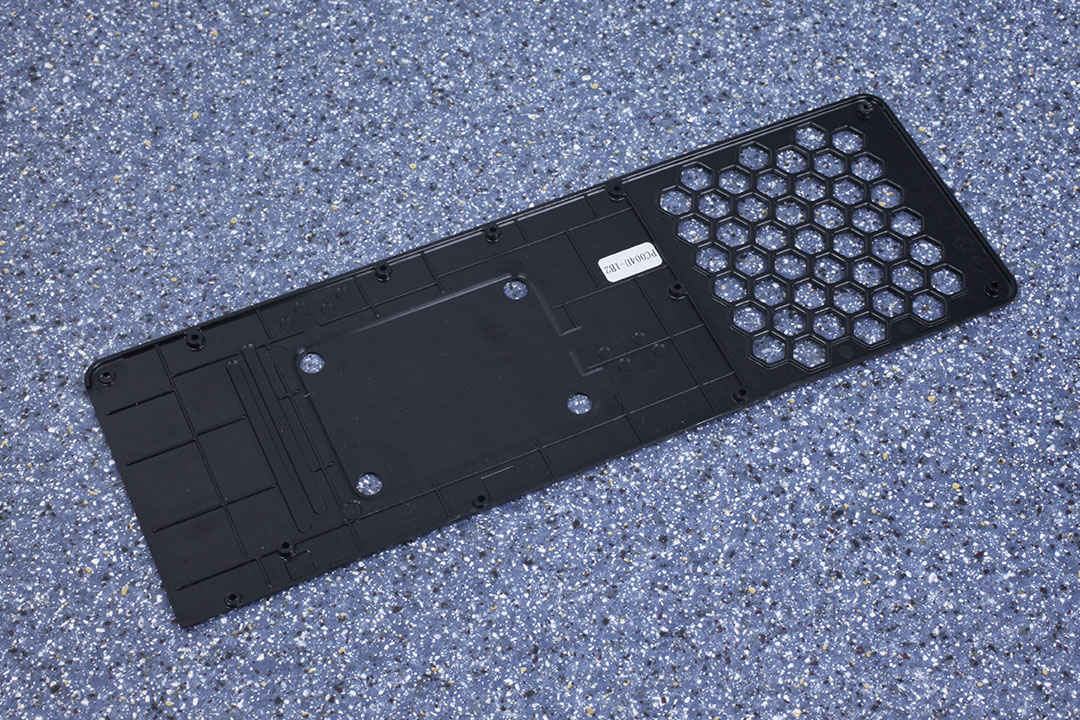
The backplate is made out of plastic and protects the card against damage during installation and handling.
High-resolution PCB Pictures
These pictures are for the convenience of volt modders and people who would like to see all the finer details on the PCB. Feel free to link back to us and use these in your articles or forum posts.

High-res versions are also available (front, back).
Our Patreon Silver Supporters can read articles in single-page format.
Nov 16th, 2026 10:27 CST
change timezone
Latest GPU Drivers
New Forum Posts
- Advice for my PC upgrade (7)
- Can you guess Which game it is? (328)
- Meeting point of those who broke their GPUs. Please share what GPUs you've burned, shattered, ionized or melted accidentally. (39)
- Without Jensen, PC gaming will be (6)
- I don’t know been building “by hand” for years and we at the point where “Server Quality” is mentioned, is this the future of it or will it continue? (39)
- Honestly, do you care about GTA VI? (63)
- Warning for Windows 10 and 11 users running newer AMD GPU drivers (61)
- What storage medium you lost the most data thus far from failure? HDD/SSD Flash, etc (54)
- How much does an RTX 5090 cost in your area? (64)
- need an ide to sata adapter that lets me burn cds on an ide cdrw drive (that doesn't power down while burning or copying) (55)
Popular Reviews
- ASUS ROG Strix B850-I Gaming Wi-Fi7 W Review
- Corsair HX1000i Shift Crystal Review
- AMD Zen 6 Technical Deep Dive
- Upcoming Hardware Launches 2027 (Updated Nov 2026)
- Acemagic Retro X3 Review
- Montech King 95 3D PRO Review
- NZXT C1200 Platinum Review
- Phantom Blade Zero Performance Benchmark Review - 35 GPUs Tested
- AMD Ryzen 7 9800X3D Review - The Best Gaming Processor
- NZXT H7 RGB+ Review
TPU on YouTube
Controversial News Posts
- NVIDIA Co-Founder and CEO Jensen Huang Officially Resigns (431)
- Open Letter Asking NVIDIA to Reinstate Jensen Huang Passes 115,000 Signatures (184)
- OpenAI CEO Argues Home PCs Waste the World's Limited DRAM Supply (152)
- NVIDIA Launches Investigation Into Jensen Huang's Relationship With Suspected Chinese Spy (136)
- Intel "Raptor Lake Next" 16-Core and 20-Core CPUs Surface (130)
- Legendary Game Studio BioWare Shuts Down Following EA Layoffs (104)
- Dell CEO Says the Memory Shortage Will Get Worse in 2027 (95)
- Report: Jensen Huang Eyes NVIDIA Comeback (89)