 23
PowerColor Radeon RX 5700 Red Dragon Review
(23 Comments) »Introduction

PowerColor's Radeon RX 5700 Red Dragon is the first Navi XL custom-design we're reviewing. The card is based on AMD's new 7 nm Radeon RX 5700 Series Navi graphics processor and promises a factory-overclocked experience with the shortcomings of the reference design fixed. Especially noise and temperatures should be much better. Out of the box, the card runs at 1565 MHz base clock, 1720 MHz game clock and 1750 MHz Boost. This is around 100 MHz higher than the AMD reference card, and the dual-slot, dual-fan cooler includes idle fan stop. PowerColor's Radeon RX 5700 Red Dragon is currently listed online for $359.

AMD had originally planned to launch the Radeon RX 5700 XT at $449 and the RX 5700 at $399, with the two cards beating the $499 NVIDIA RTX 2070 and $349 RTX 2060 respectively. This forced NVIDIA to refresh its lineup with the new RTX 2070 Super at $499 and the RTX 2060 Super at $399. The RTX 2060 Super in particular was carefully crafted not to cannibalize the RTX 2070. AMD seeped into this imbroglio of NVIDIA and slotted the RX 5700 XT at $399 and the RX 5700 at $349, at which prices they outclass the RTX 2060 Super and original RTX 2060 respectively. NVIDIA didn't adjust prices of its RTX 2060 Super or RTX 2070 Super any further, and we hence have a fair bit of headroom between the RTX 2060 Super and the RTX 2070 Super in which AMD's board partners can launch custom-design RX 5700 XT cards with factory-overclocked speeds and other goodies, such as quieter coolers.
At the heart of the Radeon RX 5700 is the 7 nm "Navi 10" silicon with an impressive 10.3 billion transistors crammed into a 251 mm² die. Unlike the "Vega 20", Navi is a more traditional GPU in that the package only has the GPU die and is surrounded by memory chips. AMD opted for cost-effective 256-bit GDDR6 memory over exotic design choices such as HBM2. At a memory frequency of 14 Gbps, Navi enjoys a healthy memory bandwidth of 448 GB/s. It also features the latest-generation PCI-Express gen 4.0 x16 host interface with full backwards compatibility for older generations of PCIe, so you can pair it with AMD's new Ryzen 3000 processors on an X570 chipset motherboard. The buzz-words "7 nm" and "PCIe gen 4.0" are extensively used in AMD's marketing, as if to suggest that Navi is a generation ahead of NVIDIA's Turing, which is built on 12 nm and has PCIe gen 3.0.
| Price | Shader Units | ROPs | Core Clock | Boost Clock | Memory Clock | GPU | Transistors | Memory | |
|---|---|---|---|---|---|---|---|---|---|
| GTX 1070 | $300 | 1920 | 64 | 1506 MHz | 1683 MHz | 2002 MHz | GP104 | 7200M | 8 GB, GDDR5, 256-bit |
| RX Vega 56 | $300 | 3584 | 64 | 1156 MHz | 1471 MHz | 800 MHz | Vega 10 | 12500M | 8 GB, HBM2, 2048-bit |
| GTX 1660 Ti | $280 | 1536 | 48 | 1500 MHz | 1770 MHz | 1500 MHz | TU116 | 6600M | 6 GB, GDDR6, 192-bit |
| GTX 1070 Ti | $450 | 2432 | 64 | 1607 MHz | 1683 MHz | 2000 MHz | GP104 | 7200M | 8 GB, GDDR5, 256-bit |
| RTX 2060 | $340 | 1920 | 48 | 1365 MHz | 1680 MHz | 1750 MHz | TU106 | 10800M | 6 GB, GDDR6, 192-bit |
| RX 5700 | $350 | 2304 | 64 | 1465 MHz | 1625 MHz | 1750 MHz | Navi 10 | 10300M | 8 GB, GDDR6, 256-bit |
| PowerColor RX 5700 Red Dragon | $359 | 2304 | 64 | 1565 MHz | 1750 MHz | 1750 MHz | Navi 10 | 10300M | 8 GB, GDDR6, 256-bit |
| GTX 1080 | $500 | 2560 | 64 | 1607 MHz | 1733 MHz | 1251 MHz | GP104 | 7200M | 8 GB, GDDR5X, 256-bit |
| RTX 2060 Super | $400 | 2176 | 64 | 1470 MHz | 1650 MHz | 1750 MHz | TU106 | 10800M | 8 GB, GDDR6, 256-bit |
| RX Vega 64 | $500 | 4096 | 64 | 1247 MHz | 1546 MHz | 953 MHz | Vega 10 | 12500M | 8 GB, HBM2, 2048-bit |
| GTX 1080 Ti | $700 | 3584 | 88 | 1481 MHz | 1582 MHz | 1376 MHz | GP102 | 12000M | 11 GB, GDDR5X, 352-bit |
| RX 5700 XT | $400 | 2560 | 64 | 1605 MHz | 1755 MHz | 1750 MHz | Navi 10 | 10300M | 8 GB, GDDR6, 256-bit |
| RTX 2070 | $480 | 2304 | 64 | 1410 MHz | 1620 MHz | 1750 MHz | TU106 | 10800M | 8 GB, GDDR6, 256-bit |
| RTX 2070 Super | $500 | 2560 | 64 | 1605 MHz | 1770 MHz | 1750 MHz | TU104 | 13600M | 8 GB, GDDR6, 256-bit |
| Radeon VII | $680 | 3840 | 64 | 1802 MHz | N/A | 1000 MHz | Vega 20 | 13230M | 16 GB, HBM2, 4096-bit |
| RTX 2080 | $700 | 2944 | 64 | 1515 MHz | 1710 MHz | 1750 MHz | TU104 | 13600M | 8 GB, GDDR6, 256-bit |
Packaging and Contents

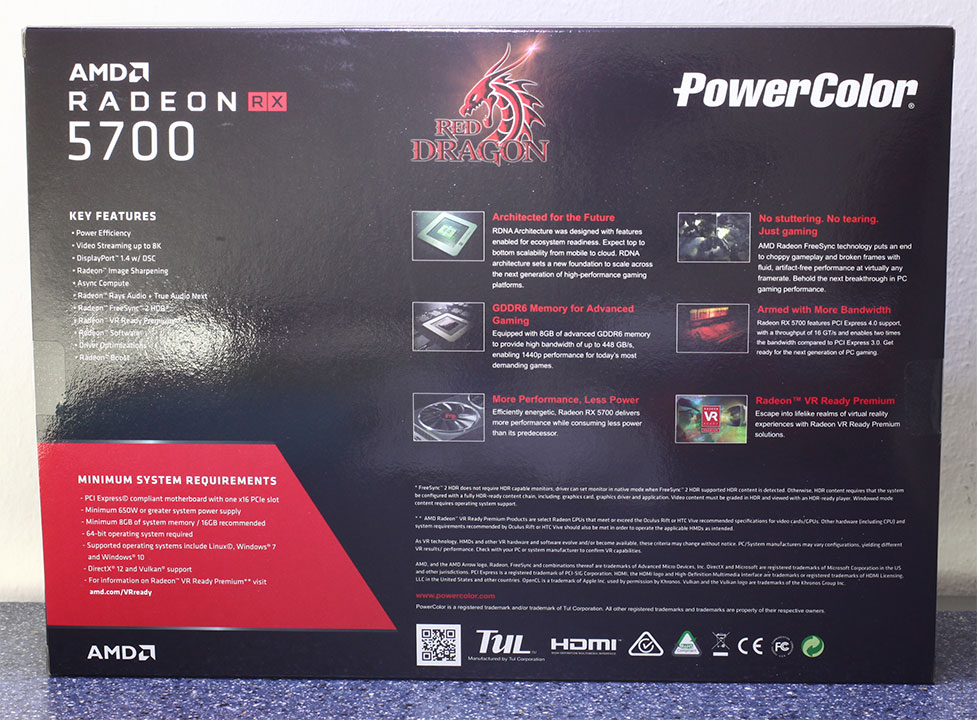

You will receive:
- Graphics card
- Driver disc
- Documentation
The Card


PowerColor's visual theme for the Red Dragon is almost completely devoid of "red". Rather, the company went for a classy black design with straight lines. On the back you'll find a high-quality metal backplate in a matching color theme. Dimensions of the card are 24.0 x 13.0 cm.


Installation requires two slots in your system.

Display connectivity options include three standard DisplayPort 1.4a and one HDMI 2.0b port.
AMD took the opportunity to update the display controllers handling these outputs by leveraging DSC 1.2a (display stream compression), which unlocks very high resolution and refresh-rate combinations over a single cable. Among the single-cable display modes supported are 8K 60 Hz (which took two DP 1.3 cables until now), 4K 240 Hz, and 1080p as high as 360 Hz. On top of these, the outputs support HDR and 30 bpc color-depth for better color accuracy in creative applications.

The board uses one 8-pin and one 6-pin power connector. This input configuration is specified for up to 300 watts of power draw.

AMD's Navi generation of GPUs no longer supports CrossFire. DirectX 12 does include its own set of multi-GPU capabilities, but implementation requires game developers to put serious development time into a feature only a tiny fraction of their customers might ever use.
PowerColor made good use of that area by positioning their BIOS switch feature here. The second BIOS runs at reduced fan speed for a quieter experience.
Disassembly


PowerColor is using five heatpipes and a copper base on their cooler. This piece of the cooler also provides cooling for the memory chips and VRM circuitry.


The backplate is made out of metal and protects the card against damage during installation and handling.
On the next page, we dive deep into the PCB layout and VRM configuration.
Our Patreon Silver Supporters can read articles in single-page format.
Nov 15th, 2026 16:56 CST
change timezone
Latest GPU Drivers
New Forum Posts
- WarpCoreBench scores! (53)
- What are you playing? (26223)
- Folding Pie and Milestones!! (10205)
- Asus Rog Maximus Z890 Extreme. (Various questions). (25)
- Power supply noise stops when I move the mouse (9)
- TPU's Nostalgic Hardware Club (22165)
- HP Office Jet 7740 Pro - Supply system problem with replacement cartridge (3)
- Recommendations Wanted - Affordable Enterprise SSD for Boot (9)
- What can the FX 8320 do today? Here is the answer. (59)
- How do you get games for PC? (59)
Popular Reviews
- AMD Zen 6 Technical Deep Dive
- ASUS ROG Strix B850-I Gaming Wi-Fi7 W Review
- Corsair HX1000i Shift Crystal Review
- Upcoming Hardware Launches 2027 (Updated Nov 2026)
- Montech King 95 3D PRO Review
- NZXT C1200 Platinum Review
- NZXT H7 RGB+ Review
- NZXT H5 Review
- Phantom Blade Zero Performance Benchmark Review - 35 GPUs Tested
- AMD Ryzen 7 9800X3D Review - The Best Gaming Processor
TPU on YouTube
Controversial News Posts
- NVIDIA Co-Founder and CEO Jensen Huang Officially Resigns (421)
- Open Letter Asking NVIDIA to Reinstate Jensen Huang Passes 115,000 Signatures (184)
- OpenAI CEO Argues Home PCs Waste the World's Limited DRAM Supply (152)
- NVIDIA Launches Investigation Into Jensen Huang's Relationship With Suspected Chinese Spy (136)
- Intel "Raptor Lake Next" 16-Core and 20-Core CPUs Surface (130)
- Legendary Game Studio BioWare Shuts Down Following EA Layoffs (104)
- Dell CEO Says the Memory Shortage Will Get Worse in 2027 (95)
- NVIDIA GeForce RTX 50-Series Scheduled for up to $500 Price Hike This Week (89)