 3
Pulsar Susanto-X Review
(3 Comments) »Value and Conclusion
- The Pulsar Susanto-X is available for $129.95.
- True 8000 Hz polling
- Good sensor performance
- Very low click latency
- High button quality
- Good scroll wheel
- Good choice of components
- Lightweight
- Nicely gliding mouse feet
- Full software customizability, either through web driver or application
- Set of replacement mouse feet included
- Pricey
- Polling instability in wireless operation
- Stiff charging cable
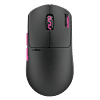
The Susanto-X is another addition to Pulsar's ever-growing Pro Series line of mice. The Susanto brothers are known for preferring claw grip, which is clearly reflected in the design of the Susanto-X. The rear is wider than usual to provide stability when using claw grip, though in contrast to other, similar designs, the hump remains centered on the Susanto-X. Of note is also the fact that the Susanto-X maintains a higher profile at the front, even though it isn't bulky overall. Accordingly, while not wholly novel, the Susanto-X does balance things a bit differently than other releases that may look similar at first glance. At a weight of 50 g, the Susanto-X isn't breaking any records, but still is light enough, and the build quality on my sample at least is nearly flawless: there is no rattle when shaking the mouse, no flexing and only minor creaking of the shell when applying lateral pressure, and actuating the side buttons by pressing below them cannot be done regardless of force applied. Internally, the Susanto-X utilizes a design similar to Pulsar's earlier ZywOo The Chosen Mouse, as all screw posts are metal-reinforced to facilitate repeatedly opening the mouse, and the main button switches aren't placed on the main PCB, but rather dedicated ones screwed directly into the top shell.
In terms of switch selection, the Susanto-X lands closer to the X2 Crazylight. The main button switches are Pulsar-branded 5-pin optical switches, though based on their sound and actuation characteristic, I strongly suspect them being FE switches, which had been used on the X2 Crazylight as well. Oddly, despite the switches being placed on separate PCBs, pre-travel is bordering on high on these, whereas post-travel is low, and lateral movement likewise is low even when provoked. Still, the switches themselves are snappy enough that actuation doesn't end up feeling mushy. The side buttons have been outfitted with 2-pin, low-profile switches from TTC (brown, blue plunger), which also are familiar from the X2 Crazylight. Pre- and post-travel are pleasantly low on the forward side button, whereas the back button fares a bit worse, as actuation isn't entirely even, and post-travel is moderate. The scroll wheel encoder is Pulsar-branded, but actually comes from F-Switch. When scrolling up in particular, this encoder tends to be quite noisy, and tactility is merely a bit above average, as the individual steps have quite good separation. The feet are the usual white-dyed pure PTFE fare and glide well, and much like on the ZywOo The Chosen Mouse, their footprint is extra large. Of note is that a set of UHMWPE dot skates is included in the box.
Whereas the ZywOo The Chosen Mouse utilized a different firmware solution, the Susanto-X comes with the same firmware and software package from CompX already familiar from the TenZ Signature Edition and X2 Crazylight. Much like on those mice, Pulsar's XS-1 sensor is combined with a Nordic nRF52840 MCU. On the latest firmware, performance is a distinctly mixed bag. There is negative CPI deviation of 2.5%, but given how the XS-1 permits CPI adjustment in increments of 10, this is rectified very easily and a complete non-issue. General tracking also shows no issues, regardless of whether MotionSync is enabled or not. Motion delay is good but not outstanding. In wireless operation, at 1000 Hz and without MotionSync, the Susanto-X roughly achieves parity with the Logitech G403 (control subject). This can be improved slightly by enabling the so-called "Turbo Mode," which sets sensor run mode to corded, provided it isn't already set (as is the case for polling rates above 1000 Hz) and sensor framerate to the maximum of 20,000, the latter of which improves motion delay in the range of microseconds, yet potentially worsens low-velocity accuracy while tanking battery life. At polling rates higher than 1000 Hz, the Susanto-X attains a lead of 0.5 ms over the G403 without MotionSync, which is good but lands below the top competitors, which have a 1.0 ms advantage. The larger issue concerns polling stability. Even at polling rates of 1000 Hz and under in wireless operation, there are irregular off-period polls. At 2000 Hz and above, these become much more frequent, and the instability is pronounced enough that even motion delay sometimes is affected, with the Susanto-X falling several ms behind the G403 in those cases. This instability had already been introduced on an earlier firmware version and persisted since. I don't consider it a dealbreaker, as 1000 Hz remains as a largely stable fallback, but it certainly isn't ideal, either. In terms of click latency, the Susanto-X fares better. At 8000 Hz, 0.4 ms are averaged when using the lowest debounce time, and there is no reason not to do so, as optical switches cannot develop double-clicking due to wear and tear, and a flawlessly implemented slam-click filter is also present. At 1000 Hz, 1.3 ms is averaged, which is still fine.
In terms of configuration, the Susanto-X leaves the choice to the user. One can freely pick from a regular software requiring installation or a web driver, which connects through WebHID and therefore is restricted to Chromium-based browsers. Interestingly, the latter even has a couple of features more, though both have all the relevant settings, don't exhibit any bugs, and the regular application is also pleasantly bug-free. An advantage of the packaged application is the presence of a percentage-based battery life indicator, which isn't particularly accurate or reliable, but at least good enough to roughly gauge expected battery life. At 8000 Hz with Turbo Mode enabled, the indicator went down by 20% for every 2.5 hours of continuous use, suggesting an expected battery life of 12 hours. For comparison, the X2 Crazylight only did 8 hours due to having a meager 200 mAh battery, whereas the Susanto-X packs a 300 mAh capacity battery. Accordingly, while battery life still is nothing to write home about, at a 50% higher battery capacity than the X2 Crazylight the Susanto-X indeed delivers a 50% higher battery life, which is rather substantial. Charging isn't particularly speedy on the Susanto-X, but fast enough to keep downtime limited, which is relevant considering that the charging cable is too stiff to allow playing while charging without feeling overly restricted.
Overall, the Susanto-X doesn't differ much from the X2 Crazylight or TenZ Signature Edition, and this applies to the price as well. At $129.95, the Susanto-X faces the same issue those other two did, in that they aren't bad mice, but are priced $60 higher than the SCYROX V6/V8, which are very similar mice on a technical level. Aside from the shape, there simply isn't much the Susanto-X does differently or better than those mice, and the polling instability of course doesn't help either, begging the question as to why one should pay that much of a premium. Accordingly, the Susanto-X misses our Recommended award, but remains a good pick nonetheless.
Nov 27th, 2026 04:06 CST
change timezone
Latest GPU Drivers
New Forum Posts
- Mouse Pad advice - Shidenkai out of production? (8)
- Using sodimm+adapter instead of full size dimm DDR5? (103)
- SABRENT AIC's (no bifurcation) Black Friday deals (0)
- What's your main Black Friday / Cyber Monday purchase? (27)
- Found Out Why My FygoOS Transfers Were Stuck at 11 MB/s (0)
- Wireless Internet sharing between PC and router both-ways, is it possible? (28)
- X79 and/or rampage IV OC'ing thread for those of us still left.... (2461)
- Will zen 6 mobos have anything extra vs current ones? (63)
- Dell Dimension E510 Retro Gaming PC Upgrade & Modification (3)
- Gacha Games - Discussions, Pulls, Updates, etc. (1166)
Popular Reviews
- VZMORE AX9 Max Review
- Upcoming Hardware Launches 2027 (Updated Nov 2026)
- ASRock X870E Challenger Wi-Fi White Review
- AMD Ryzen 7 9800X3D Review - The Best Gaming Processor
- Microsoft Surface Laptop Ultra Review - The Next-gen Arm Laptop
- AMD Zen 6 Technical Deep Dive
- Montech CyberFlow ARGB 360 Review
- Phantom Blade Zero Performance Benchmark Review - 35 GPUs Tested
- Corsair RM1200e (Second Generation) Review
- Pulsar Office Tour & First Look at P1 Dual-Sensor Mouse
TPU on YouTube
Controversial News Posts
- Jensen Huang Reinstated as CEO of NVIDIA (617)
- NVIDIA Co-Founder and CEO Jensen Huang Officially Resigns (492)
- Report: Jensen Huang Eyes NVIDIA Comeback (281)
- Open Letter Asking NVIDIA to Reinstate Jensen Huang Passes 115,000 Signatures (184)
- OpenAI CEO Argues Home PCs Waste the World's Limited DRAM Supply (152)
- NVIDIA Launches Investigation Into Jensen Huang's Relationship With Suspected Chinese Spy (136)
- Intel Razor Lake Gets a 12 P-Core bLLC Chip With No E-Cores, Per Leak (94)
- NVIDIA GeForce RTX 50-Series Scheduled for up to $500 Price Hike This Week (89)