 3
Razer Cobra Hyperspeed Review
(3 Comments) »Value and Conclusion
- The Razer Cobra Hyperspeed is available for $99.99.
- Very good sensor performance
- Very low click latency
- Very high button quality
- Excellent scroll wheel
- Good choice of components
- Lightweight
- Nicely gliding mouse feet
- Rich RGB lighting
- Full software customizability
- Wireless extender included
- Compatible with HyperPolling Wireless Dongle
- Compatible with Mouse Dock Pro and Hyperflux V2
- Polling instability in wireless operation
- Resource-heavy software
- Very short charging cable
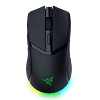
Back in 2020, the Viper Mini started out and gained recognition as a budget release, yet until now, Razer had not released a budget, wireless Viper Mini, and instead mostly catered to the enthusiast market with the Viper Mini Signature Edition and Cobra Pro. With the Cobra Hyperspeed, this finally changes. Following the template of the DeathAdder V3 Hyperspeed, the Cobra Hyperspeed has lower specifications than its Pro variant, yet in practice, is able to match and even beat the Cobra Pro. Most notably, at 62 g, the Cobra Hyperspeed is a good deal lighter than the Cobra Pro, whose 77 g weight was far removed from what people expected from a "wireless Viper Mini." The weight reduction is interesting in that the Cobra Hyperspeed omits some, but not all the bells and whistles of the Pro. RGB lighting is still present, albeit restricted to the logo and an LED stripe at the back, and the Cobra Hyperspeed can still be made compatible to the Mouse Dock Pro, same as the Cobra Pro. The Cobra Hyperspeed even comes with a 450 mAh battery in lieu of the 420 mAh battery found inside the Cobra Pro, and the shape likewise is unchanged. Accordingly, the bulk of the weight reduction comes from smarter engineering: the Hyperspeed places all of its switches right on the main PCB, and the switches are actuated through stems that are part of the top shell. Contrary to what one may expect, this works surprisingly well. Build quality is also in a pretty good spot: on my sample, there is no rattle when shaking the mouse, but when applying lateral pressure, some creaking yet no flexing of the shell can be provoked, though actuating the side buttons by pressing below them is not possible.
Since the Cobra Pro is two years old at this point, the Cobra Hyperspeed also benefits from getting some of Razer's latest technology, which debuted with the DeathAdder V4 Pro earlier this year. For the main buttons, Razer's Gen-4 optical switches are used, and they fare a bit better than they did on the DeathAdder V4 Pro. Actuation is almost perfectly uniform between these, and owing to low pre- and post-travel, along with low lateral button movement, button response is firm and snappy, though the loudness of the switches may not be to everyone's liking. Despite the unusual design of having the switches on the main PCB, the side buttons also score with low pre- and moderate post-travel, for which surface-mounted switches from CF are used. That said, feedback is notably dull, which could already be observed on the DeathAdder V4 Pro. For the scroll wheel, the same Razer-branded optical encoder seen on the DeathAdder V4 Pro is used, albeit in a different size, and it once again shines with rather low noise levels and excellent tactility, allowing for precise scrolling thanks to very well-separated steps. The feet are made of the usual non-dyed PTFE familiar from previous Razer releases, though they may appear slightly grayish due to a black backing being used.
Much like the DeathAdder V3 Hyperspeed, the Cobra Hyperspeed utilizes an 8-pin sensor going by the name "Focus X 26K," whose specifications eclipse the 3370 but do not match the 3395/3399 family of sensors. In practice, most would likely be hard-pressed to tell the difference, as performance is excellent. CPI deviation is minimal to nonexistent, and since CPI adjustment in increments of 50 is supported, correcting the little deviation there may be is made easy. When looking at tracking, the most immediately obvious difference to other Razer sensors is the lack of MotionSync, though considering that this merely concerns the consistency at which SPI reads happen, the lack thereof is hardly felt in practice. Somewhat peculiar is how differently wired and wireless operation behave. In wired mode, smoothing is either inactive or kept to a minimum, whereas wireless mode has significant levels of smoothing applied at higher CPI steps, and a different sensor run mode is enabled as well, leading to higher SPI timing jitter compared to wired. Thus, in order to keep motion delay at its lowest, staying below 5000 CPI is recommended for wireless usage. Remarkably, the Cobra Hyperspeed achieves parity with the Logitech G403 (control subject) in terms of motion delay, even beating the DeathAdder V4 Pro at the same polling rate of 1000 Hz. Click latency likewise is very close to Razer's top-tier offerings, averaging 0.7 ms at 1000 Hz in wireless operation. For those wanting even better numbers, the Cobra Hyperspeed is compatible with the HyperPolling Wireless Dongle, allowing polling rates of up to 8000 Hz in wireless operation, and bringing performance on par with the Cobra Pro when using the same dongle. The only flaw in terms of performance concerns polling stability: in wireless operation, periodic off-period polls emerge across all polling rates. These off-period polls aren't terribly frequent, but not having any would certainly be preferable, especially given how the DeathAdder v3 Hyperspeed suffered from no such issue.
Razer cites up to 110 hours of battery life using 2.4 GHz wireless at 1000 Hz and up to 170 hours using Bluetooth, presumably without illumination in both cases. While the software does include a percentage-based battery life indicator, the Cobra Hyperspeed lacks the fuel gauge IC found on pricier Razer mice, which is why the readings are less accurate. In my testing, the indicator only went down to 99% after more than four hours of continuous use with illumination at 1000 Hz, which is impossible of course, though based on experiences with previous Razer mice, I'd expect the battery life numbers cited by Razer to be fairly accurate. The Cobra Hyperspeed comes with the same stiff and, at 1.15 m, seriously short PVC cable as the DeathAdder V3 Hyperspeed, which is why playing while charging is off the table. Nominally, at around 0.2 A, charging speed is a bit higher on the Cobra Hyperspeed compared to the DeathAdder V3 Hyperspeed, though scaled in relation to the higher capacity, a full charge takes roughly the same time. In addition, the charging speed often drops momentarily to a meager 0.02 A, slowing things down even further. In short, keeping an eye on the battery life indicator is recommended on the Cobra Hyperspeed, as some downtime is unavoidable whenever charging time comes.
The Cobra Hyperspeed is exclusively supported in Synapse 4, which by now has left the beta stage and presents itself largely bug-free and stable. In terms of design and functionality, Synapse 4 doesn't differ much from Synapse 3, though much has changed under the hood. Given how Synapse 4 is largely built using Chromium, one could wonder why Razer doesn't go the next step and offer fully browser-based configuration through WebHID as an option. For now, at least, one has to do with Synapse 4, which still has a very pronounced appetite for RAM. The RAM footprint will typically go up and down depending on which page is open, but at around 450 MB on average, Synapse certainly isn't lightweight at any point. The good news is that there is no necessity to keep Synapse running all the time, and when not running, the remaining services occupy "only" around 80 MB of RAM, which is still plenty but not as all-consuming as the countless processes Synapse 3 left running even when fully terminated.
Overall, the Cobra Hyperspeed is very close to what people were wishing for when talk of a "wireless Viper Mini" first emerged. Wireless polling instability notwithstanding, performance is great, the weight still competitive, and the pricing much more manageable compared to the $299.99 Viper Mini Signature Edition and $129.99 Cobra Pro. The Cobra Hyperspeed is also more affordable than the Pwnage Trinity CF at $139.00, which is much lighter at 41 g, but has plenty of holes and a less solid build than the Cobra Hyperspeed. The Glorious Series 2 Pro likewise costs more at $129.99 without offering much in return, as performance isn't really better despite out of the box support for 8000 Hz polling. As a budget release, the RAWM SH01 Pro is more successful at $64.99, with the ability to hot-swap the main button switches standing out positively. To sum it up, despite being somewhat late to the party, the Cobra Hyperspeed still compares favorably to the many clones of this shape offered by the competition, and accordingly earns our Recommended award.

Since the Cobra Pro is two years old at this point, the Cobra Hyperspeed also benefits from getting some of Razer's latest technology, which debuted with the DeathAdder V4 Pro earlier this year. For the main buttons, Razer's Gen-4 optical switches are used, and they fare a bit better than they did on the DeathAdder V4 Pro. Actuation is almost perfectly uniform between these, and owing to low pre- and post-travel, along with low lateral button movement, button response is firm and snappy, though the loudness of the switches may not be to everyone's liking. Despite the unusual design of having the switches on the main PCB, the side buttons also score with low pre- and moderate post-travel, for which surface-mounted switches from CF are used. That said, feedback is notably dull, which could already be observed on the DeathAdder V4 Pro. For the scroll wheel, the same Razer-branded optical encoder seen on the DeathAdder V4 Pro is used, albeit in a different size, and it once again shines with rather low noise levels and excellent tactility, allowing for precise scrolling thanks to very well-separated steps. The feet are made of the usual non-dyed PTFE familiar from previous Razer releases, though they may appear slightly grayish due to a black backing being used.
Much like the DeathAdder V3 Hyperspeed, the Cobra Hyperspeed utilizes an 8-pin sensor going by the name "Focus X 26K," whose specifications eclipse the 3370 but do not match the 3395/3399 family of sensors. In practice, most would likely be hard-pressed to tell the difference, as performance is excellent. CPI deviation is minimal to nonexistent, and since CPI adjustment in increments of 50 is supported, correcting the little deviation there may be is made easy. When looking at tracking, the most immediately obvious difference to other Razer sensors is the lack of MotionSync, though considering that this merely concerns the consistency at which SPI reads happen, the lack thereof is hardly felt in practice. Somewhat peculiar is how differently wired and wireless operation behave. In wired mode, smoothing is either inactive or kept to a minimum, whereas wireless mode has significant levels of smoothing applied at higher CPI steps, and a different sensor run mode is enabled as well, leading to higher SPI timing jitter compared to wired. Thus, in order to keep motion delay at its lowest, staying below 5000 CPI is recommended for wireless usage. Remarkably, the Cobra Hyperspeed achieves parity with the Logitech G403 (control subject) in terms of motion delay, even beating the DeathAdder V4 Pro at the same polling rate of 1000 Hz. Click latency likewise is very close to Razer's top-tier offerings, averaging 0.7 ms at 1000 Hz in wireless operation. For those wanting even better numbers, the Cobra Hyperspeed is compatible with the HyperPolling Wireless Dongle, allowing polling rates of up to 8000 Hz in wireless operation, and bringing performance on par with the Cobra Pro when using the same dongle. The only flaw in terms of performance concerns polling stability: in wireless operation, periodic off-period polls emerge across all polling rates. These off-period polls aren't terribly frequent, but not having any would certainly be preferable, especially given how the DeathAdder v3 Hyperspeed suffered from no such issue.
Razer cites up to 110 hours of battery life using 2.4 GHz wireless at 1000 Hz and up to 170 hours using Bluetooth, presumably without illumination in both cases. While the software does include a percentage-based battery life indicator, the Cobra Hyperspeed lacks the fuel gauge IC found on pricier Razer mice, which is why the readings are less accurate. In my testing, the indicator only went down to 99% after more than four hours of continuous use with illumination at 1000 Hz, which is impossible of course, though based on experiences with previous Razer mice, I'd expect the battery life numbers cited by Razer to be fairly accurate. The Cobra Hyperspeed comes with the same stiff and, at 1.15 m, seriously short PVC cable as the DeathAdder V3 Hyperspeed, which is why playing while charging is off the table. Nominally, at around 0.2 A, charging speed is a bit higher on the Cobra Hyperspeed compared to the DeathAdder V3 Hyperspeed, though scaled in relation to the higher capacity, a full charge takes roughly the same time. In addition, the charging speed often drops momentarily to a meager 0.02 A, slowing things down even further. In short, keeping an eye on the battery life indicator is recommended on the Cobra Hyperspeed, as some downtime is unavoidable whenever charging time comes.
The Cobra Hyperspeed is exclusively supported in Synapse 4, which by now has left the beta stage and presents itself largely bug-free and stable. In terms of design and functionality, Synapse 4 doesn't differ much from Synapse 3, though much has changed under the hood. Given how Synapse 4 is largely built using Chromium, one could wonder why Razer doesn't go the next step and offer fully browser-based configuration through WebHID as an option. For now, at least, one has to do with Synapse 4, which still has a very pronounced appetite for RAM. The RAM footprint will typically go up and down depending on which page is open, but at around 450 MB on average, Synapse certainly isn't lightweight at any point. The good news is that there is no necessity to keep Synapse running all the time, and when not running, the remaining services occupy "only" around 80 MB of RAM, which is still plenty but not as all-consuming as the countless processes Synapse 3 left running even when fully terminated.
Overall, the Cobra Hyperspeed is very close to what people were wishing for when talk of a "wireless Viper Mini" first emerged. Wireless polling instability notwithstanding, performance is great, the weight still competitive, and the pricing much more manageable compared to the $299.99 Viper Mini Signature Edition and $129.99 Cobra Pro. The Cobra Hyperspeed is also more affordable than the Pwnage Trinity CF at $139.00, which is much lighter at 41 g, but has plenty of holes and a less solid build than the Cobra Hyperspeed. The Glorious Series 2 Pro likewise costs more at $129.99 without offering much in return, as performance isn't really better despite out of the box support for 8000 Hz polling. As a budget release, the RAWM SH01 Pro is more successful at $64.99, with the ability to hot-swap the main button switches standing out positively. To sum it up, despite being somewhat late to the party, the Cobra Hyperspeed still compares favorably to the many clones of this shape offered by the competition, and accordingly earns our Recommended award.
Nov 26th, 2026 10:33 CST
change timezone
Latest GPU Drivers
New Forum Posts
- Post your CrystalDiskMark speeds (659)
- What's your main Black Friday / Cyber Monday purchase? (18)
- Wireless Internet sharing between PC and router both-ways, is it possible? (24)
- Can you guess Which game it is? (366)
- Making a game in Godot engine (20)
- X79 and/or rampage IV OC'ing thread for those of us still left.... (2459)
- Exploring Local LLMs: Models, Hardware and Setup Experiences (4)
- Linpack Xtreme Released (513)
- Claude credits purchased on or after Dec. 7 now have an expiry date (20)
- Acer TravelMate P414-51 (i5-1135G7): CPU stuck at x4 / ~200 MHz effective under 100% load, no throttle flags. How to find who's clamping it? (1)
Popular Reviews
- ASRock X870E Challenger Wi-Fi White Review
- VZMORE AX9 Max Review
- Upcoming Hardware Launches 2027 (Updated Nov 2026)
- Microsoft Surface Laptop Ultra Review - The Next-gen Arm Laptop
- AMD Ryzen 7 9800X3D Review - The Best Gaming Processor
- AMD Zen 6 Technical Deep Dive
- Corsair RM1200e (Second Generation) Review
- Phantom Blade Zero Performance Benchmark Review - 35 GPUs Tested
- Montech CyberFlow ARGB 360 Review
- Pulsar Office Tour & First Look at P1 Dual-Sensor Mouse
TPU on YouTube
Controversial News Posts
- Jensen Huang Reinstated as CEO of NVIDIA (587)
- NVIDIA Co-Founder and CEO Jensen Huang Officially Resigns (492)
- Report: Jensen Huang Eyes NVIDIA Comeback (281)
- Open Letter Asking NVIDIA to Reinstate Jensen Huang Passes 115,000 Signatures (184)
- OpenAI CEO Argues Home PCs Waste the World's Limited DRAM Supply (152)
- NVIDIA Launches Investigation Into Jensen Huang's Relationship With Suspected Chinese Spy (136)
- Intel "Raptor Lake Next" 16-Core and 20-Core CPUs Surface (130)
- Intel Razor Lake Gets a 12 P-Core bLLC Chip With No E-Cores, Per Leak (94)