 4
Redragon K1NG Ultra Review
Value & Conclusion »Software


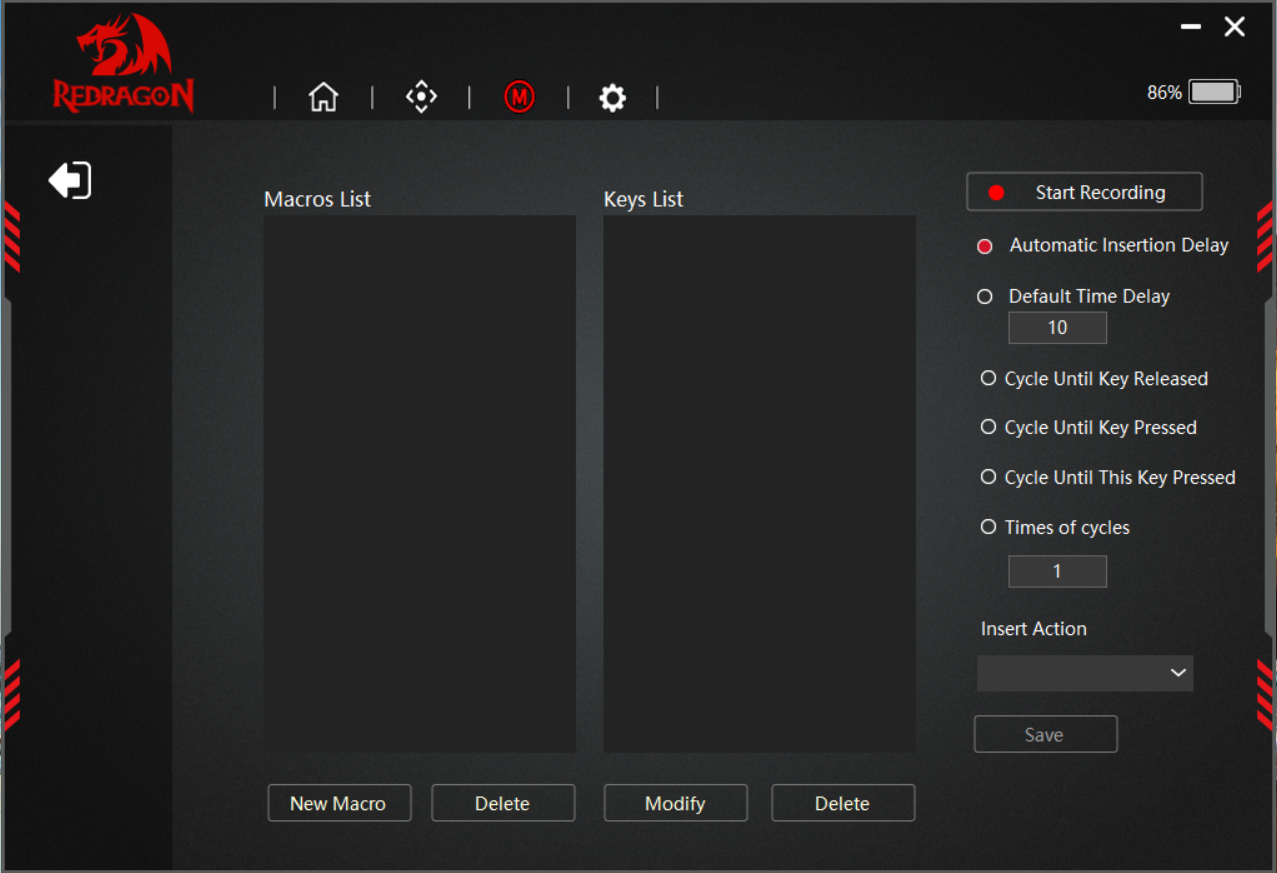
The K1NG Ultra comes with its own lightweight software. All options are accessible through three different tabs. The first page allows for button remapping to mouse, keyboard, media, and macro functions, along with the ability to adjust debounce time, which effectively controls click latency, at a range of 0 to 30 ms in increments of 1 ms. Profile management is present as well. The second page houses CPI adjustment settings for up to six color-coded levels, ranging from 50 to 30,000 CPI in increments of 50 CPI. Values cannot be put in directly, as this function appears to be bugged. Also included are polling rate (125, 250, 500, 1000, 2000, 4000, and 8000 Hz), LOD (0.7/1/2 mm), and angle snapping (on/off) adjustment options. "Ripple control" is disabled by default, but can be enabled to apply smoothing, which lessens jitter at higher CPI steps at the cost of increased motion delay. "MotionSync" can be turned on or off, which turning on synchronizes SPI reads with USB polls at the cost of a motion penalty of up to an entire interval. Furthermore, a setting that allows modifying the sensor mode is present. If plugged in, the sensor mode will default to "corded" with no way of changing it. In wireless mode, one can choose between "LP" (low power) and "HP" (high performance) modes, which determine the sensor run mode and therefore battery life, albeit only for polling rates of 1000 Hz and under. Lastly, "Peak Performance" defines after how much idle time sleep mode is entered. A macro editor can be found on the third page.
All setting changes are saved to the on-board memory, so the software does not need to be running (or even installed) all the time. On my system, the software had a RAM footprint of anywhere between 33 and 63 MB on average when running in the foreground, which changes depending on which page is open, and which doesn't change when minimized to the system tray, coupled with considerable CPU usage upon changing the page. Upon exiting the application, all processes are terminated, as they should be.
Battery Life
Redragon does not provide any battery life numbers. Though the software features a battery life indicator, it lacks any sort of percentage or segmentation within the gauge, so giving any sort of estimation is plain impossible. However, by changing the line "ShowBatteryValue=0" to "ShowBatteryValue=1" within the config.ini of the software folder, the software can be made to show a percentage, though it will be inaccurate. For the record, after applying this modification, the indicator went down by 10% for every two hours of continued usage at 8000 Hz. Assuming linear consumption, we'd therefore arrive at an expected battery life of around 20 hours at 8000 Hz, which should translate to around 80 hours at 1000 Hz.Sleep mode is entered after ten seconds of inactivity by default, but this can be adjusted within the software.
Using the included USB Type-A to Type-C charging cable, I measured the charging speed during the constant current stage, which sits at 0.289 A when lifted and 0.274 A when not lifted. The battery has a capacity of 400 mAh (3.7 V) and utilizes a 3-pin JST connector.
Nov 26th, 2026 10:33 CST
change timezone
Latest GPU Drivers
New Forum Posts
- Post your CrystalDiskMark speeds (659)
- What's your main Black Friday / Cyber Monday purchase? (18)
- Wireless Internet sharing between PC and router both-ways, is it possible? (24)
- Can you guess Which game it is? (366)
- Making a game in Godot engine (20)
- X79 and/or rampage IV OC'ing thread for those of us still left.... (2459)
- Exploring Local LLMs: Models, Hardware and Setup Experiences (4)
- Linpack Xtreme Released (513)
- Claude credits purchased on or after Dec. 7 now have an expiry date (20)
- Acer TravelMate P414-51 (i5-1135G7): CPU stuck at x4 / ~200 MHz effective under 100% load, no throttle flags. How to find who's clamping it? (1)
Popular Reviews
- ASRock X870E Challenger Wi-Fi White Review
- VZMORE AX9 Max Review
- Upcoming Hardware Launches 2027 (Updated Nov 2026)
- Microsoft Surface Laptop Ultra Review - The Next-gen Arm Laptop
- AMD Ryzen 7 9800X3D Review - The Best Gaming Processor
- AMD Zen 6 Technical Deep Dive
- Corsair RM1200e (Second Generation) Review
- Phantom Blade Zero Performance Benchmark Review - 35 GPUs Tested
- Montech CyberFlow ARGB 360 Review
- Pulsar Office Tour & First Look at P1 Dual-Sensor Mouse
TPU on YouTube
Controversial News Posts
- Jensen Huang Reinstated as CEO of NVIDIA (587)
- NVIDIA Co-Founder and CEO Jensen Huang Officially Resigns (492)
- Report: Jensen Huang Eyes NVIDIA Comeback (281)
- Open Letter Asking NVIDIA to Reinstate Jensen Huang Passes 115,000 Signatures (184)
- OpenAI CEO Argues Home PCs Waste the World's Limited DRAM Supply (152)
- NVIDIA Launches Investigation Into Jensen Huang's Relationship With Suspected Chinese Spy (136)
- Intel "Raptor Lake Next" 16-Core and 20-Core CPUs Surface (130)
- Intel Razor Lake Gets a 12 P-Core bLLC Chip With No E-Cores, Per Leak (94)