 32
Sapphire Radeon RX 9060 XT Pulse OC 16 GB Review - An Excellent Choice
(32 Comments) »Introduction

Sapphire Radeon RX 9060 XT 16 GB Pulse is the company's value custom-design graphics card based on AMD's interesting new performance-segment GPU. The Pulse series graphics cards from Sapphire are typically positioned below the company's NITRO+ and Pure series, but are uncompromising in terms of build quality, boasting a cooler design that prioritizes low noise. The Radeon RX 9060 XT is designed to offer maxed out gameplay at 1080p with ray tracing. It comes at a starting MSRP of $350 for the 16 GB variant being reviewed here. The Radeon RX 9060 XT is powered by the company's latest RDNA 4 graphics architecture, promising a generational leap in both raster and ray tracing performance over the previous RDNA 3-series cards.

Although the previous generation monolithic Radeon RX 7600 was powered by RDNA 3, unlike with the 5 nm/6 nm higher tier RDNA 3 GPUs, AMD built it on the much older 6 nm process node, even as NVIDIA had advanced to the 5 nm node with the RTX 4060. AMD corrected this by not just giving the RX 9060 XT the very latest RDNA 4 architecture, but building the monolithic Navi 44 chip on the 4 nm node—just like the higher tier RDNA 4 chips—with a doubling in transistor count over Navi 33. The new RDNA 4 compute unit provides a significant generational uplift in IPC, introduces new shader execution efficiencies, and a new out-of-order memory management system. The RDNA 4 RT accelerator—according to AMD—provides an over 100% gain in ray tracing performance over RDNA 3. The AI accelerator supports many new high-throughput data formats, providing hardware acceleration for FSR 4, which replaces the shader-based upscaler of FSR 2.2 with a new AI ML-based upscaler that provides significant uplifts in image quality at every performance preset. AMD is further updating FSR 4 with new features later this year under "Project Redstone," more on this later.
Radeon RX 9060 XT maxes out the 4 nm Navi 44 silicon it's based on, which has exactly half the CU count as the Navi 48 chip powering the RX 9070 XT. It comes with 32 CU (compute units), for 2,048 stream processors, 64 AI accelerators, 32 RT accelerators, 128 TMUs, and 64 ROPs. The card comes with 16 GB of GDDR6 memory across a 128-bit wide memory interface. Since AMD is using the older memory standard, this card offers 20 Gbps GDDR6 memory for 320 GB/s of memory bandwidth, a minor 11% increase, even as NVIDIA has moved on to the faster 28 Gbps GDDR7 for the competing RTX 5060/5060 Ti. AMD says that its architecture-level memory management advances more than make up for the modest gains in bandwidth. The Navi 44 chip comes with 32 MB of Infinity Cache memory. An interesting upgrade over the previous generation is AMD giving Navi 44 a full PCI-Express 5.0 x16 host interface, compared to the 8-lane PCIe Gen 4 interfaces it gave the RX 7600 and RX 6600 series, which makes for a quadrupling in host interface bandwidth. More importantly, it ensures the GPU has sufficient PCIe bandwidth on older systems/CPUs that only have PCIe Gen 3, such as the Ryzen 7 5700G "Cezanne" APU.
Sapphire RX 9060 XT 16 GB Pulse comes in a compact board design that should be highly compatible with all modern PC cases. It is 24 cm in length, and is exactly two slots thick. It uses a conventional 8-pin PCIe power input, which is sufficient for its 170 W typical board power. The card comes with factory overclocked speeds of 2700 MHz Game clocks, a generous uplift over the 2530 MHz AMD reference Game clock. Sapphire is pricing the RX 9060 XT Pulse at $365.
| Price | Cores | ROPs | Core Clock | Boost Clock | Memory Clock | GPU | Transistors | Memory | |
|---|---|---|---|---|---|---|---|---|---|
| RX 7600 XT | $400 | 2048 | 64 | 2470 MHz | 2755 MHz | 2250 MHz | Navi 33 | 13300M | 16 GB, GDDR6, 128-bit |
| RTX 4060 | $270 | 3072 | 48 | 1830 MHz | 2460 MHz | 2125 MHz | AD107 | 18900M | 8 GB, GDDR6, 128-bit |
| Arc A770 | $250 | 4096 | 128 | 2100 MHz | N/A | 2187 MHz | ACM-G10 | 21700M | 16 GB, GDDR6, 256-bit |
| Arc B580 | $250 | 2560 | 80 | 2670 MHz | N/A | 2375 MHz | BMG-G21 | 19600M | 12 GB, GDDR6, 192-bit |
| RTX 4060 Ti | $380 | 4352 | 48 | 2310 MHz | 2535 MHz | 2250 MHz | AD106 | 22900M | 8 GB, GDDR6, 128-bit |
| RTX 5060 | $300 | 3840 | 48 | 2280 MHz | 2497 MHz | 1750 MHz | GB206 | 21900M | 8 GB, GDDR7, 128-bit |
| RX 7700 XT | $450 | 3456 | 96 | 2171 MHz | 2544 MHz | 2250 MHz | Navi 32 | 26500M | 12 GB, GDDR6, 192-bit |
| RX 9060 XT | $350 | 2048 | 64 | 2530 MHz | 3130 MHz | 2518 MHz | Navi 44 | 29700M | 16 GB, GDDR6, 128-bit |
| Sapphire RX 9060 XT Pulse OC | $365 | 2048 | 64 | 2705 MHz | 3291 MHz | 2518 MHz | Navi 44 | 29700M | 16 GB, GDDR6, 128-bit |
| RTX 5060 Ti | $380 | 4608 | 48 | 2407 MHz | 2572 MHz | 1750 MHz | GB206 | 21900M | 8 GB, GDDR7, 128-bit |
| RTX 5060 Ti 16 GB | $430 | 4608 | 48 | 2407 MHz | 2572 MHz | 1750 MHz | GB206 | 21900M | 16 GB, GDDR7, 128-bit |
| RTX 4070 | $400 | 5888 | 64 | 1920 MHz | 2475 MHz | 1313 MHz | AD104 | 35800M | 12 GB, GDDR6X, 192-bit |
| RX 7800 XT | $540 | 3840 | 96 | 2124 MHz | 2430 MHz | 2425 MHz | Navi 32 | 28100M | 16 GB, GDDR6, 256-bit |
| RTX 4070 Super | $600 | 7168 | 80 | 1980 MHz | 2475 MHz | 1313 MHz | AD104 | 35800M | 12 GB, GDDR6X, 192-bit |
| RX 7900 GRE | $650 | 5120 | 160 | 1880 MHz | 2245 MHz | 2250 MHz | Navi 31 | 57700M | 16 GB, GDDR6, 256-bit |
| RTX 4070 Ti | $700 | 7680 | 80 | 2310 MHz | 2610 MHz | 1313 MHz | AD104 | 35800M | 12 GB, GDDR6X, 192-bit |
| RTX 5070 | $600 | 6144 | 80 | 2325 MHz | 2512 MHz | 1750 MHz | GB205 | 31100M | 12 GB, GDDR7, 192-bit |
| RTX 4070 Ti Super | $860 | 8448 | 96 | 2340 MHz | 2610 MHz | 1313 MHz | AD103 | 45900M | 16 GB, GDDR6X, 256-bit |
AMD RDNA 4 Architecture
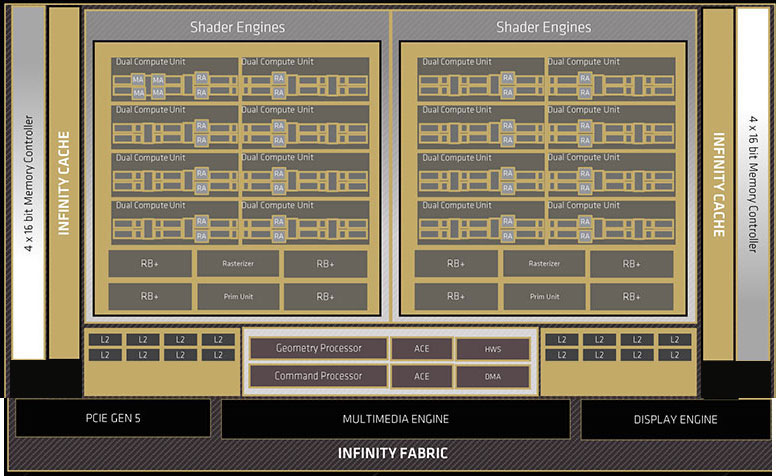

AMD didn't provide a block diagram for Navi 44, so we puzzled one together
The Radeon RX 9060 XT is powered by the new Navi 44, AMD's second gaming GPU silicon based on the RDNA 4 graphics architecture. This is a monolithic chip built on the 4 nm TSMC N4P foundry node, and packs 29.7 billion transistors across a die-area of 199 mm². On paper, this is half the chip as the Navi 48 powering the Radeon RX 9070-series, but with one key change that sets it apart from its predecessors, Navi 33 and Navi 23—the chip comes with a full PCI-Express 5.0 x16 host interface, just like Navi 48, and not a truncated PCI-Express 5.0 x8. This is also unlike the NVIDIA GB206 chip powering the RTX 5060 Ti, which still uses x8, like it's smaller brother the RTX 5060. This full x16-wide PCIe Gen 5 interface may help in certain cases, such as trying to use this GPU on older systems with Gen 3 x16 host interfaces. Given that AMD is still launching processors with PCIe Gen 3, such as the Ryzen 7 5700GT "Cezanne," the company might be onto something.
Navi 44 comes with 32 compute units across 2 shader engines, which each have 16 RDNA 4 Dual Compute Units. Each CU contains 64 stream processors, and hence the Navi 44 has 2,048 of them; 64 AI accelerators, 32 RT accelerators, 128 TMUs, and 64 ROPs. The chip also has 32 MB of Infinity Cache memory, all of which is enabled on the RX 9060 XT. The memory interface is 128-bit GDDR6, which drives either 16 GB or 8 GB of 20 Gbps GDDR6 memory for 320 GB/s of memory bandwidth. This might be low compared to the RTX 5060-series with its 28 Gbps GDDR7 yielding 448 GB/s of bandwidth, but AMD claims that it has made several memory management advances with RDNA 4, which should generationally improve memory performance akin to a significant bandwidth increase. Both the 16 GB and 8 GB variants of the RX 9060 XT max out the Navi 44 silicon. The 16 GB variant comes with a total board power value of 160 W.

At the heart of the RDNA 4 graphics architecture is the new dual compute unit, with a vastly improved memory sub-system, improvements made to the scalar units, a new technology called dynamic register allocation, and improvements to CU efficiency and engine clocks. Each CU has two scheduler blocks, driving a 192 KB general purpose register (GPR), an 8 KB scalar GPR, 32 FMA ALUs, and 32 FMA+INT ALUs. There are also 8 transcendental logic units. RDNA 4 introduces the concept of dual SIMD32 vector units, for even more parallelism. The Scalar Unit comes with support for newer Float32 ops. Schedulers are updated with accelerated spill/fill operations. Instruction prefetching is improved. The new generation AI Accelerator comes with two 16-bit and four 8-bit/4-bit dense matrix compute rates, support for 4:2 structured sparsity for doubling throughput, and matrix loads with transpose. AMD has incorporated many technologies from its CDNA 3 Instinct AI ML accelerators on the AI Accelerators of RDNA 4, including enhanced and power-optimized WMMA, improvements to the ops per CU, support for FP8, E4M3 and E5M2 formats, and 4:2 structured sparsity.

The new generation AI Accelerator comes with two 16-bit and four 8-bit/4-bit dense matrix compute rates, support for 4:2 structured sparsity for doubling throughput, and matrix loads with transpose. AMD has incorporated many technologies from its CDNA 3 Radeon Instinct AI ML accelerators on the AI Accelerators of RDNA 4, including enhanced and power-optimized WMMA, improvements to the ops per CU, support for FP8, E4M3 and E5M2 formats, and 4:2 structured sparsity.
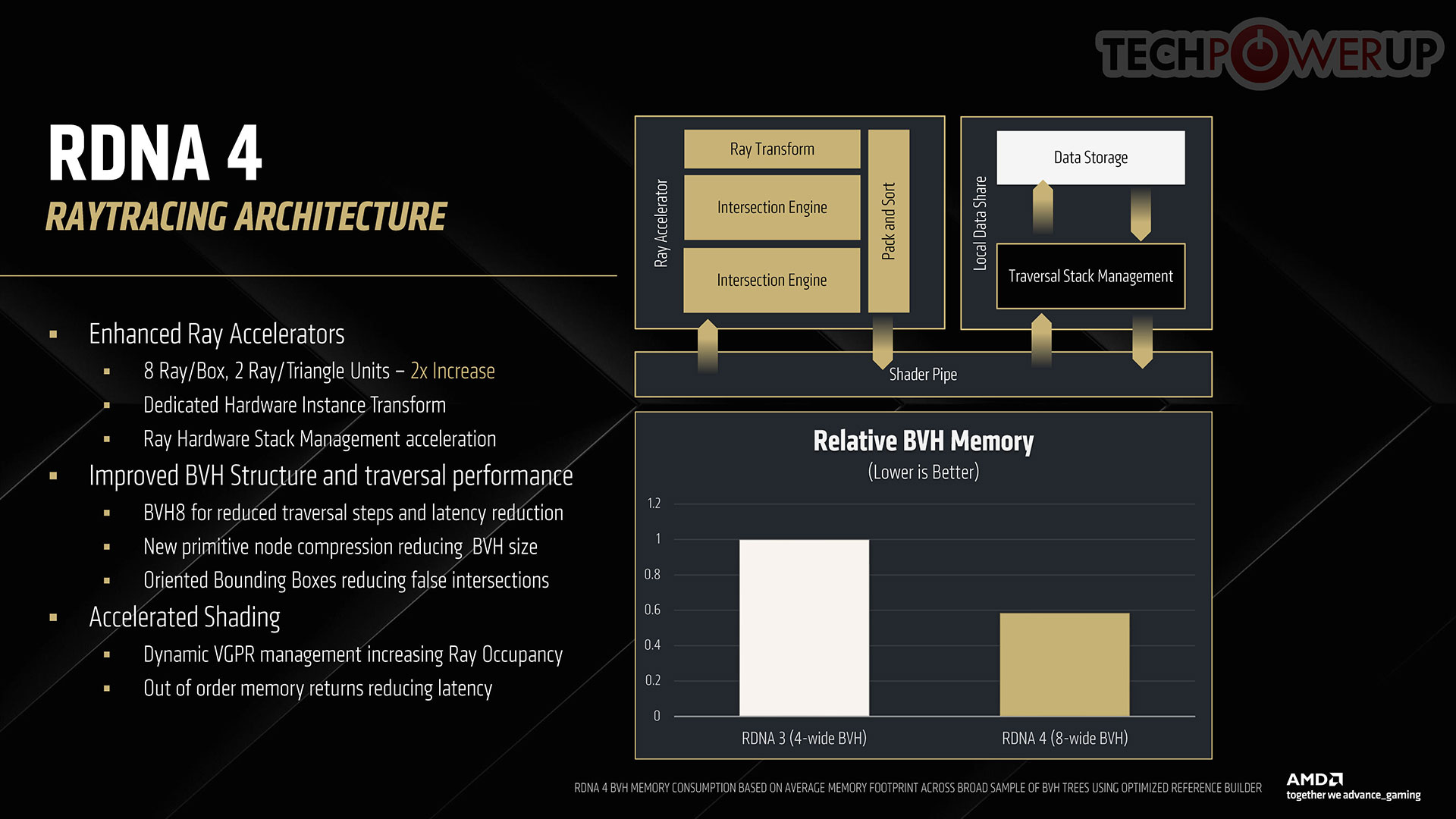
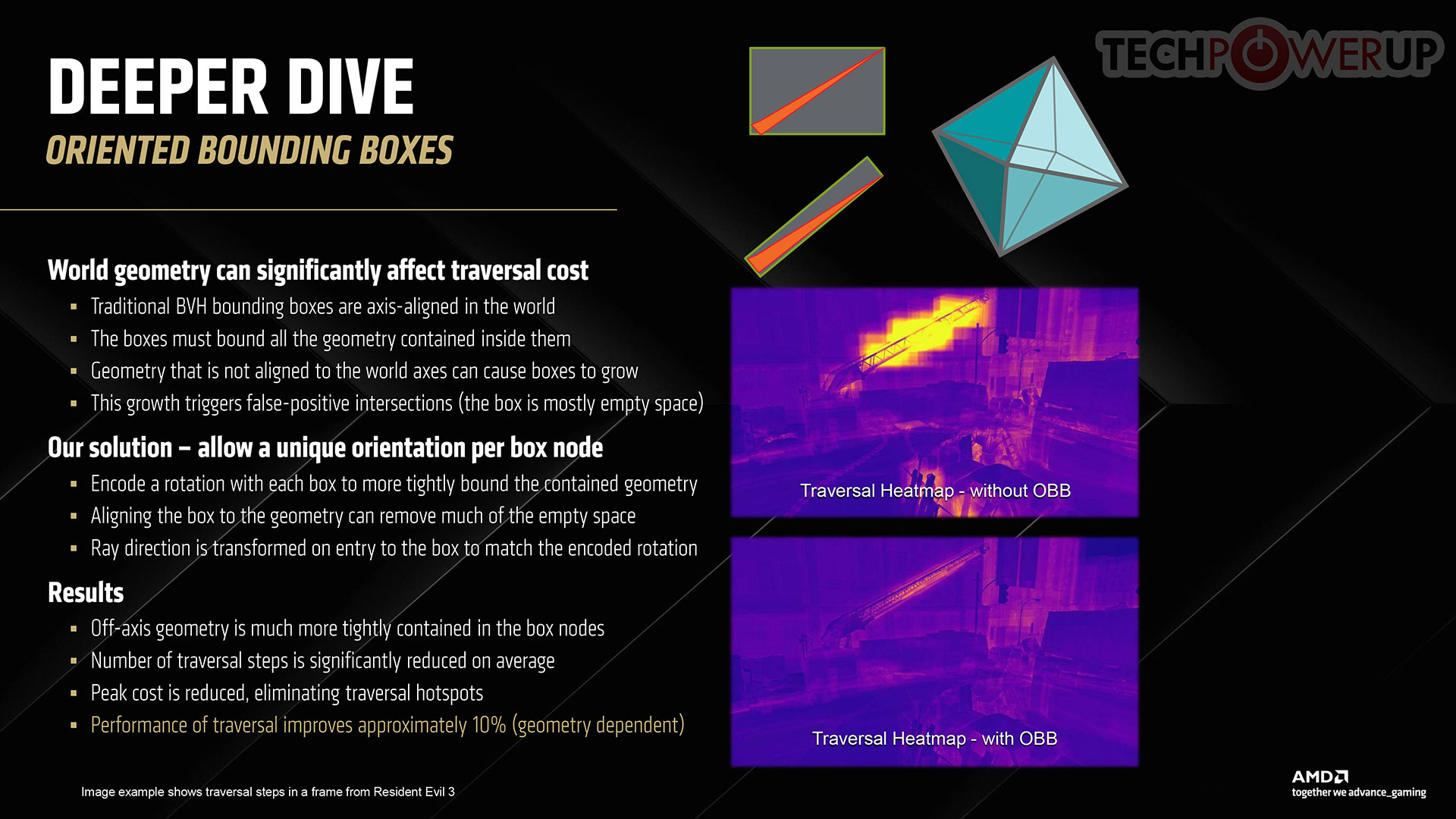
The new generation Ray Accelerator comes with double the box and triangle intersection resources as RDNA 3 RT accelerator, support for hardware instance transforms, improvements to the RT stack management, BVH8 node compression, and a revolutionary feature called oriented bounding boxes. To contain the number of rays really needed to be tested against an object, modern ray tracing technologies use something called a bounding box, which defines a region in which a geometry has to be tested against rays. Most of the time, the geometry is of a vastly different shape and smaller than the shape of a bounding box, which introduces false intersections, and wastes ray testing resources. AMD innovated a way to turn this bounding box into a 3D shape by giving it a Z-axis component, so the bounding box is oriented closer to the shape of the object to be tested, reducing the number of rays needed to be tested against it.
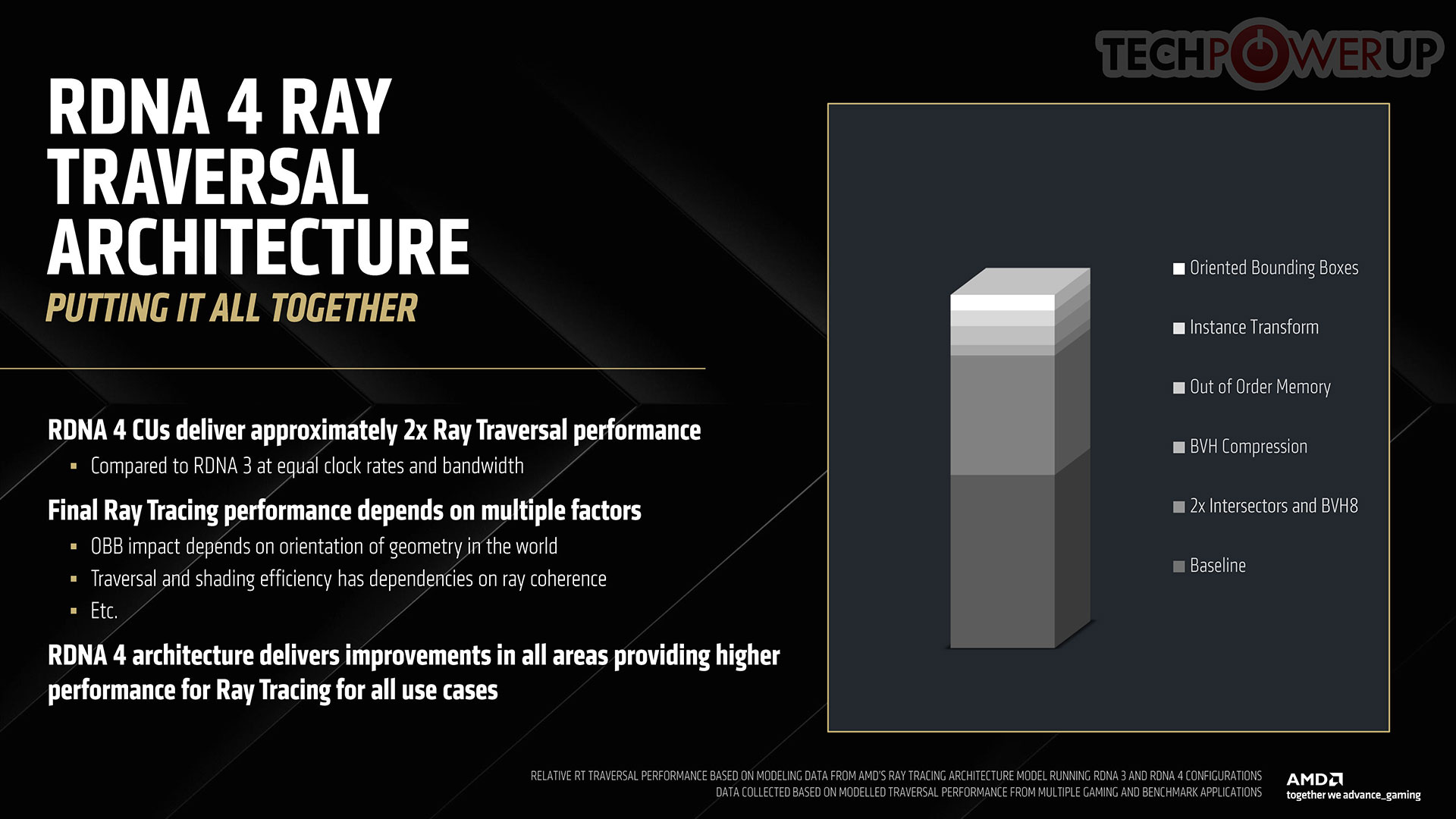
This graph highlights the contribution of various components toward the 100% generational ray traversal performance gain, allowing AMD to make do with a CU count of 64, with RDNA 3 being the baseline.
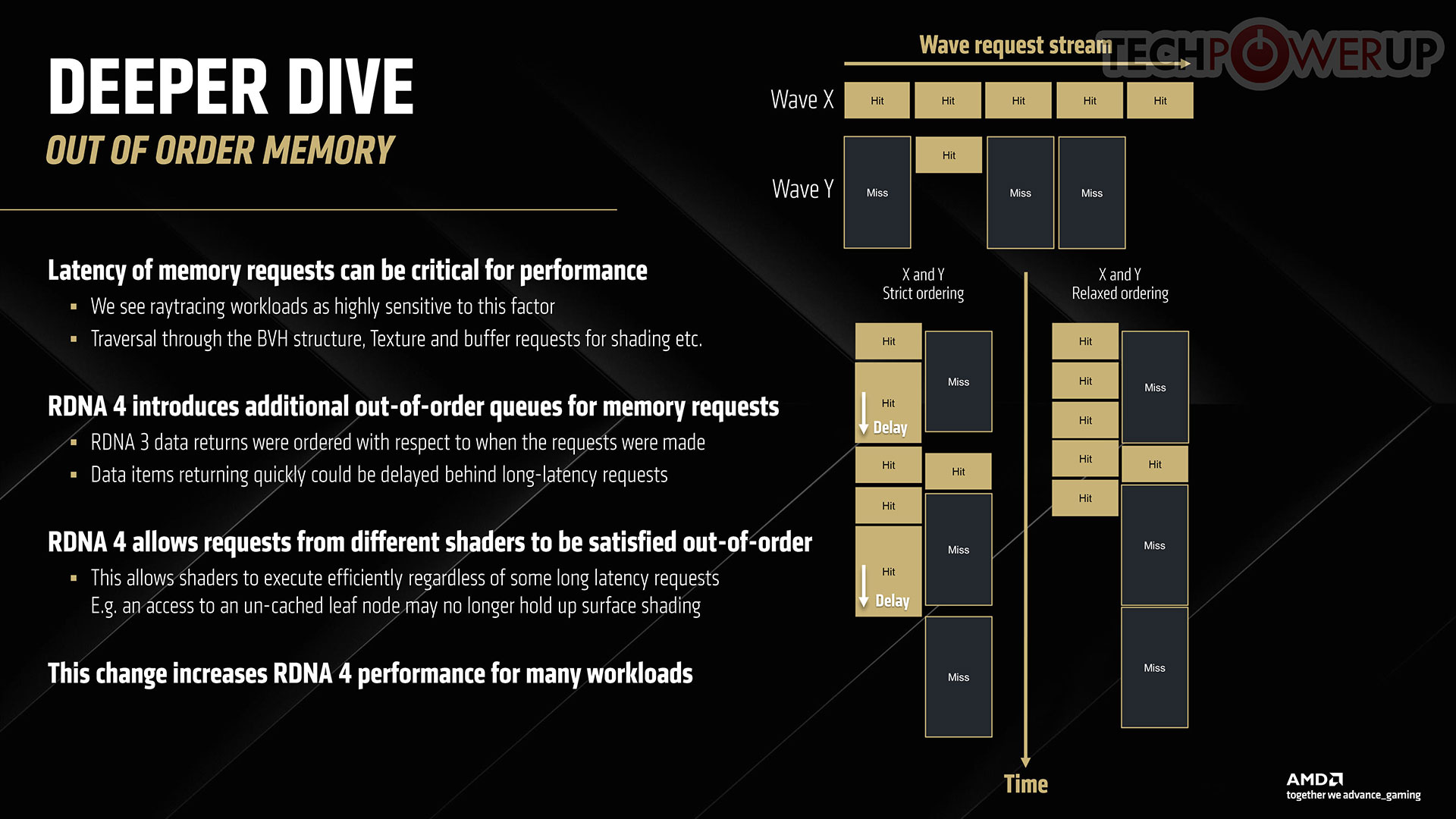
Both ray tracing and ML acceleration are memory sensitive applications, so AMD innovated a revolutionary change to its memory management system with the introduction of new out-of-order memory. All math is executed in waves on an RDNA GPU, and mutual dependencies between waves can cause memory request stream misses, as one wave's memory request queue waits for the other wave to complete its task. This is solved with a new out-of-order (relaxed ordering) memory management. This graph highlights the contribution of various components toward the 100% generational ray traversal performance gain, allowing AMD to make do with a CU count of 64, with RDNA 3 being the baseline.
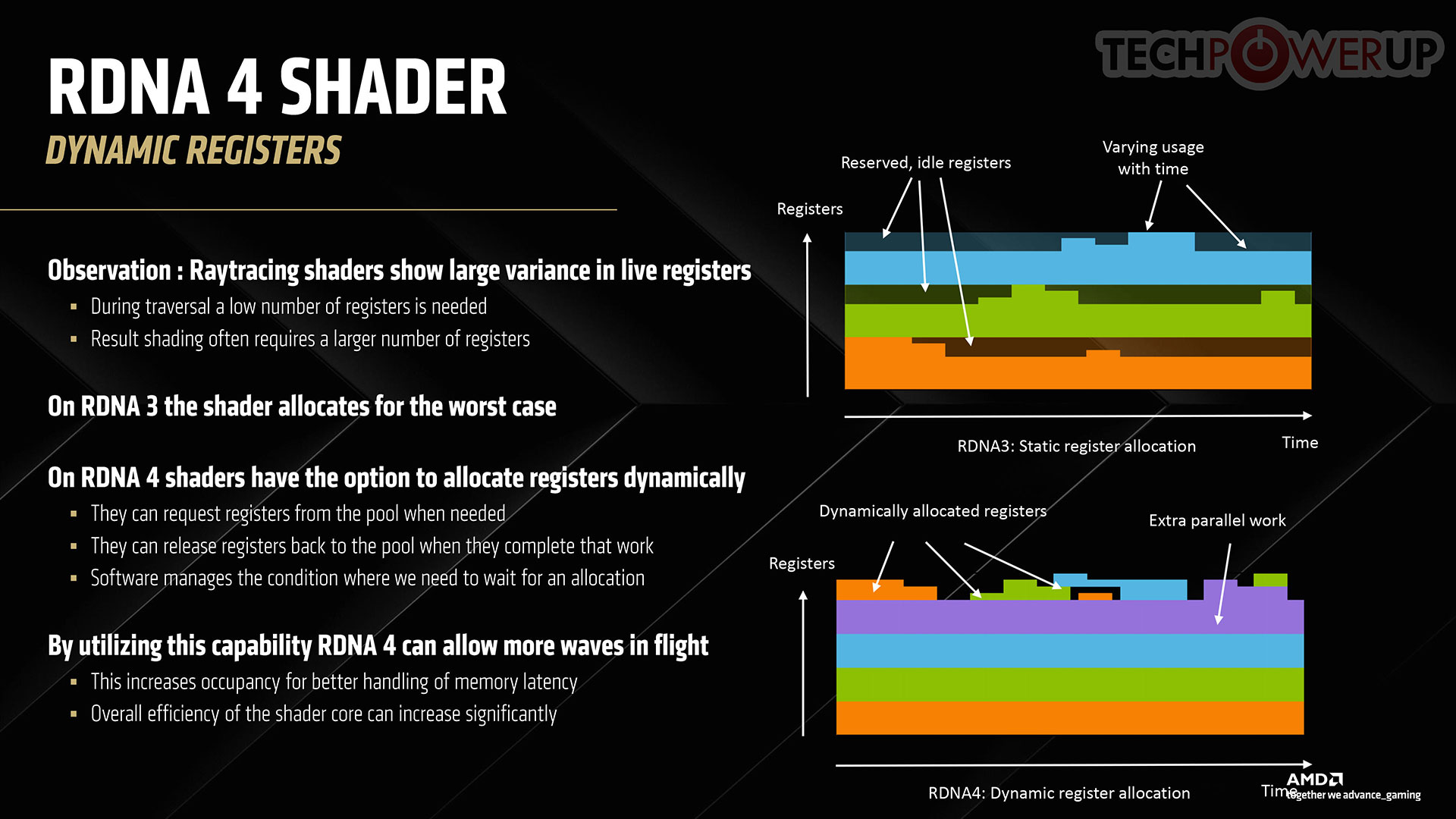
On AMD, a fairly big chunk of the ray tracing stack continues to be executed on shaders, but the company has made advances to ensure the cost of ray tracing on the shader resources of the GPU is minimal, with the introduction of Dynamic Registers to improve parallelism.
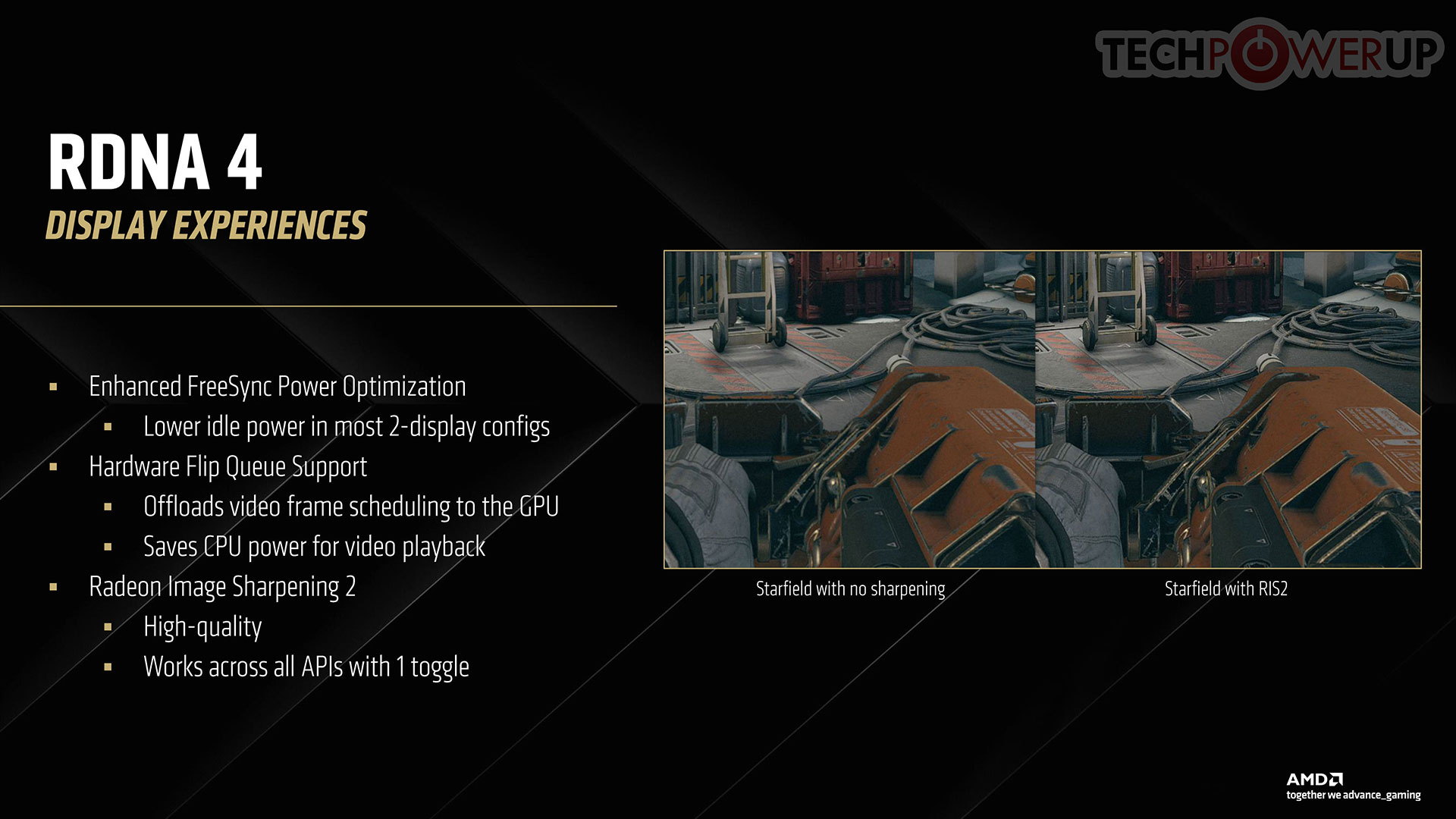
The new Radiance 2 Display Engine comes with major hardware updates that reduce GPU idle power draw in multi-monitor setups. The engine also comes with hardware flip-metering support (something NVIDIA also introduced with Blackwell, and which enables Multi-Frame Gen on the RTX 50-series). Flip-metering improves video frame pacing to the GPU and reduces CPU overhead for video playback. There is also a display engine level hardware image sharpening component that drives Radeon Image Sharpening. As for I/O, you get contemporary DisplayPort 2.1a and HDMI 2.1b, the maximum bitrate is UHBR 13.5.
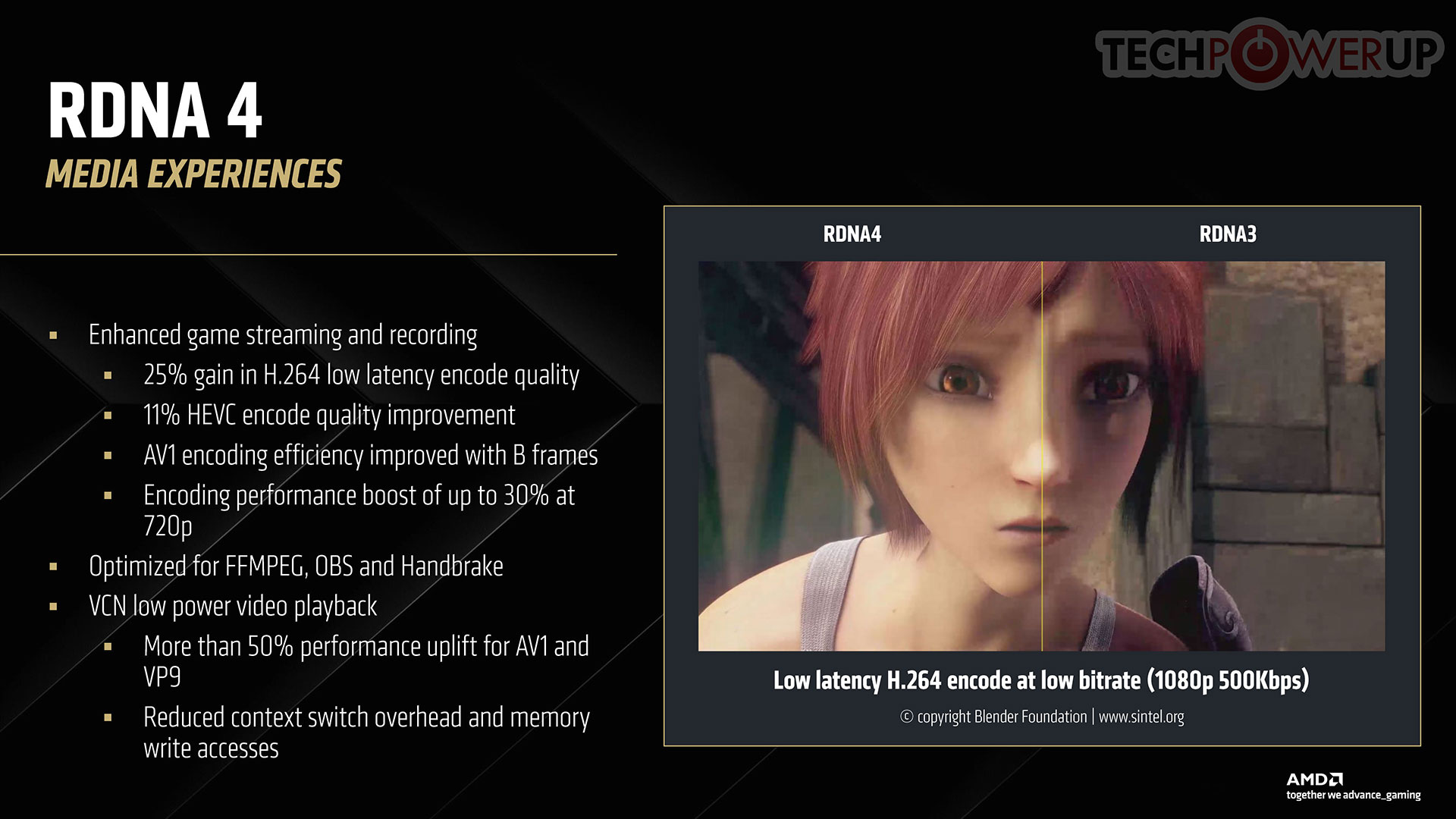
Navi 44 comes with an updated media engine which can perform concurrent encoding and decoding. The new generation media engine offers a 25% increase in H.264 low-bitrate encode image quality, and an 11% improvement in HEVC encode quality. AV1 encode and decode get B-frames support, vastly improving bitrates. The media engine posts a 50% generational performance uplift (measured in encoder/decoder frame rates), with reductions in memory overhead.
AMD FSR 4 and New AMD Software Features
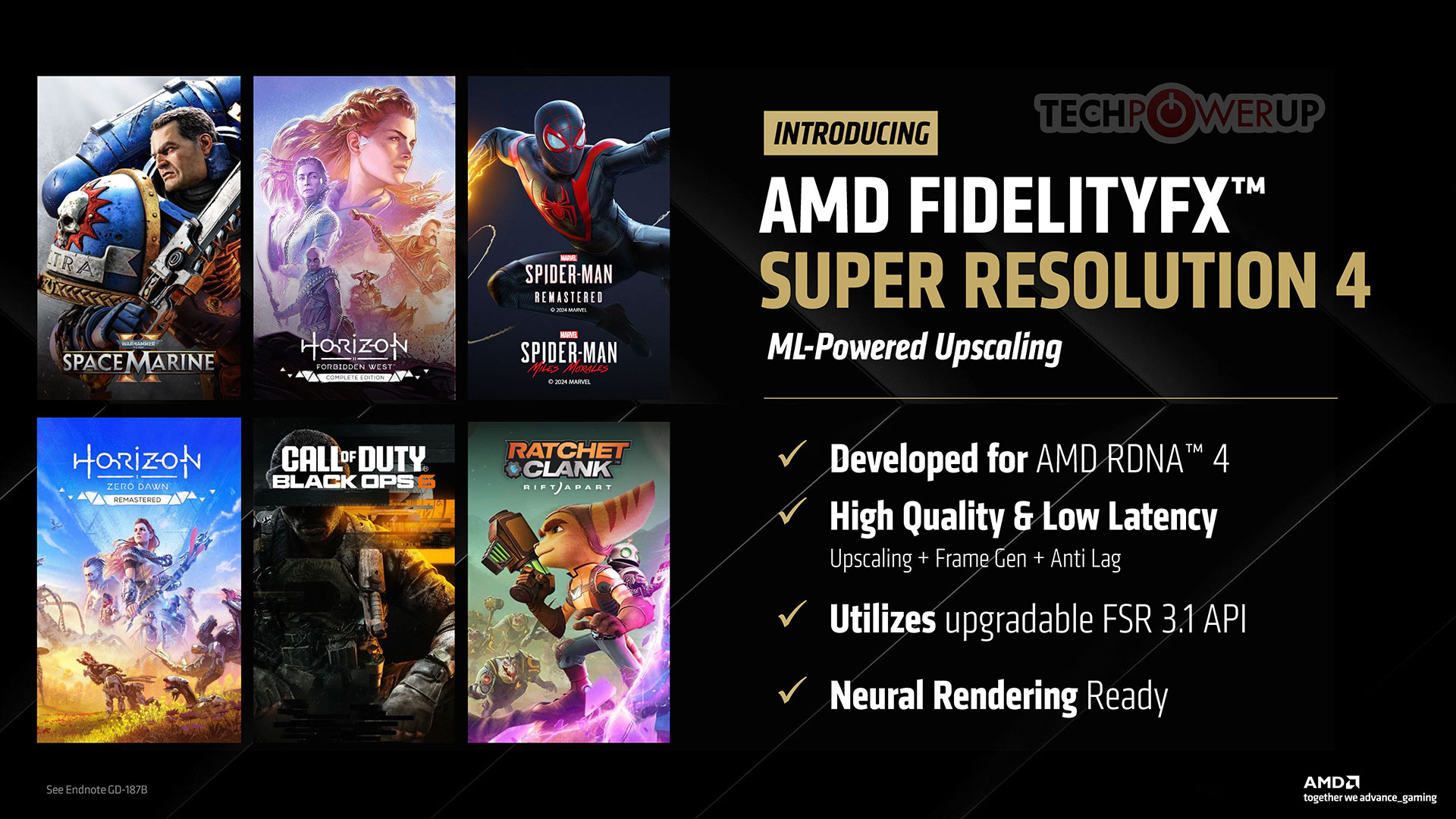
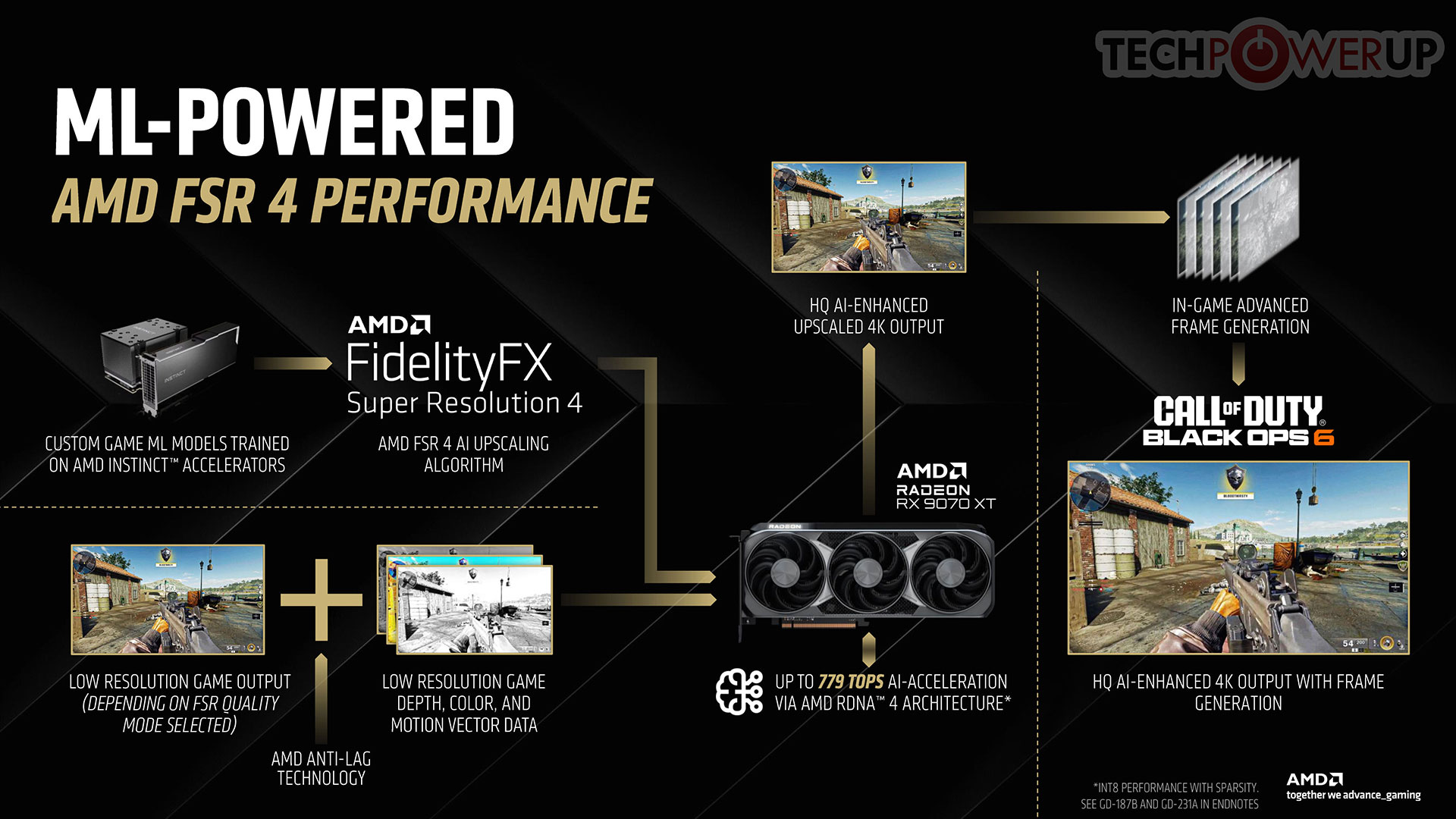
With the Radeon RX 9000-series, AMD is debuting FSR 4, the latest version of its performance enhancement suite. FSR 4 introduces the biggest tech update since FSR 2, which also makes it exclusive to the RX 9000-series (and presumably next-gen cards yet to come), breaking the FSR tradition of being able to be used with almost any modern graphics card, regardless of vendor. With the RDNA 4 generation of GPUs offering significantly higher ML compute throughput, AMD designed a new ML-based upscaler to reconstruct details of the upscaled frame. In that sense, FSR 4 is technologically close to DLSS. RDNA 4 GPUs also leverage AI DNNs to denoise ray tracing and path tracing, unburdening the shaders.
An AI ML based upscaler requires ground truth data, and just as NVIDIA goes through the painstaking task of training game-specific ML models that can later be shipped to end-users through game developers and as driver updates; AMD has set up a large FSR 4 data-center of its own, powered by Instinct MI300-series AI GPUs. On the client side, the ML-based upscaler needs the dedicated AI acceleration hardware from the RDNA 4 family. The frame generation technology appears to be carried over from FSR 3 Frame Generation, and is essentially a smart frame interpolation technology.
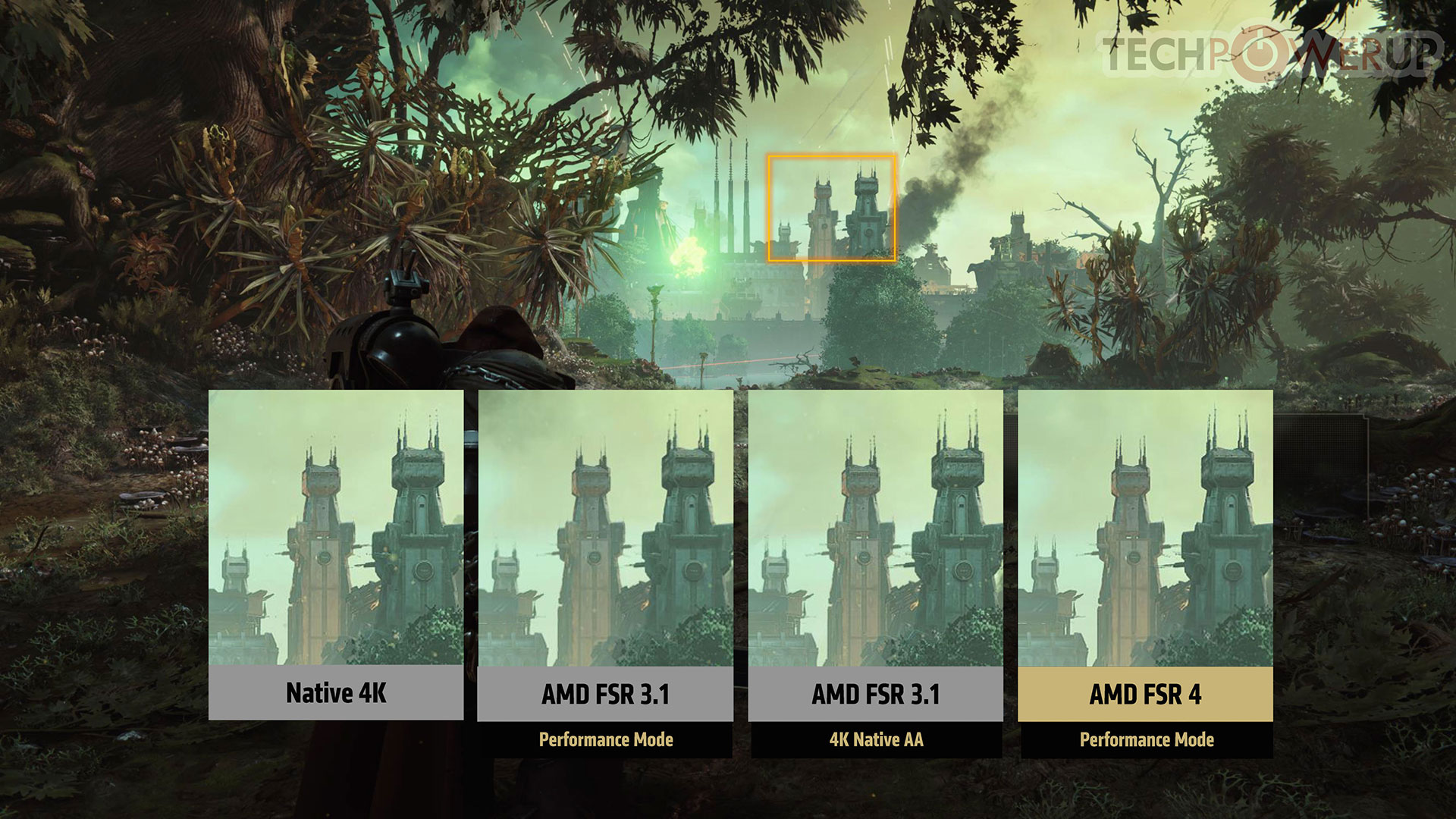
AMD in its presentation provided examples of image quality for FSR 4, claiming that in some cases, FSR 4 presents geometry more accurately than even native resolution. While AMD didn't detail it, FSR 4 comes with preparation for neural rendering. Given that Microsoft has now standardized neural shaders, and the ability for applications to directly address AI acceleration hardware on the GPU via the DirectX API, AMD could in the near future implement neural rendering, however, the company hasn't detailed a timeline. FSR 4 is ready for neural rendered objects.
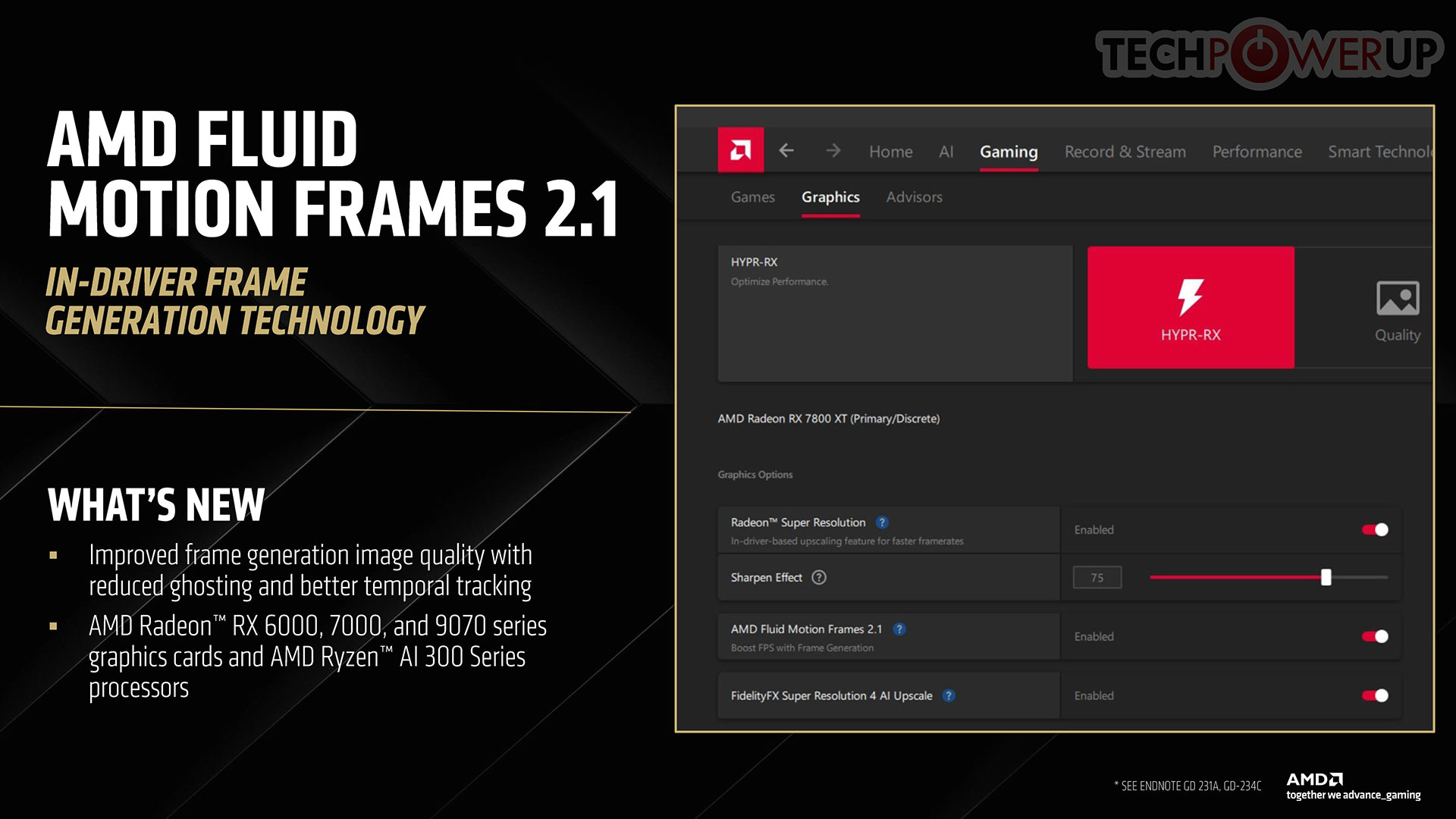
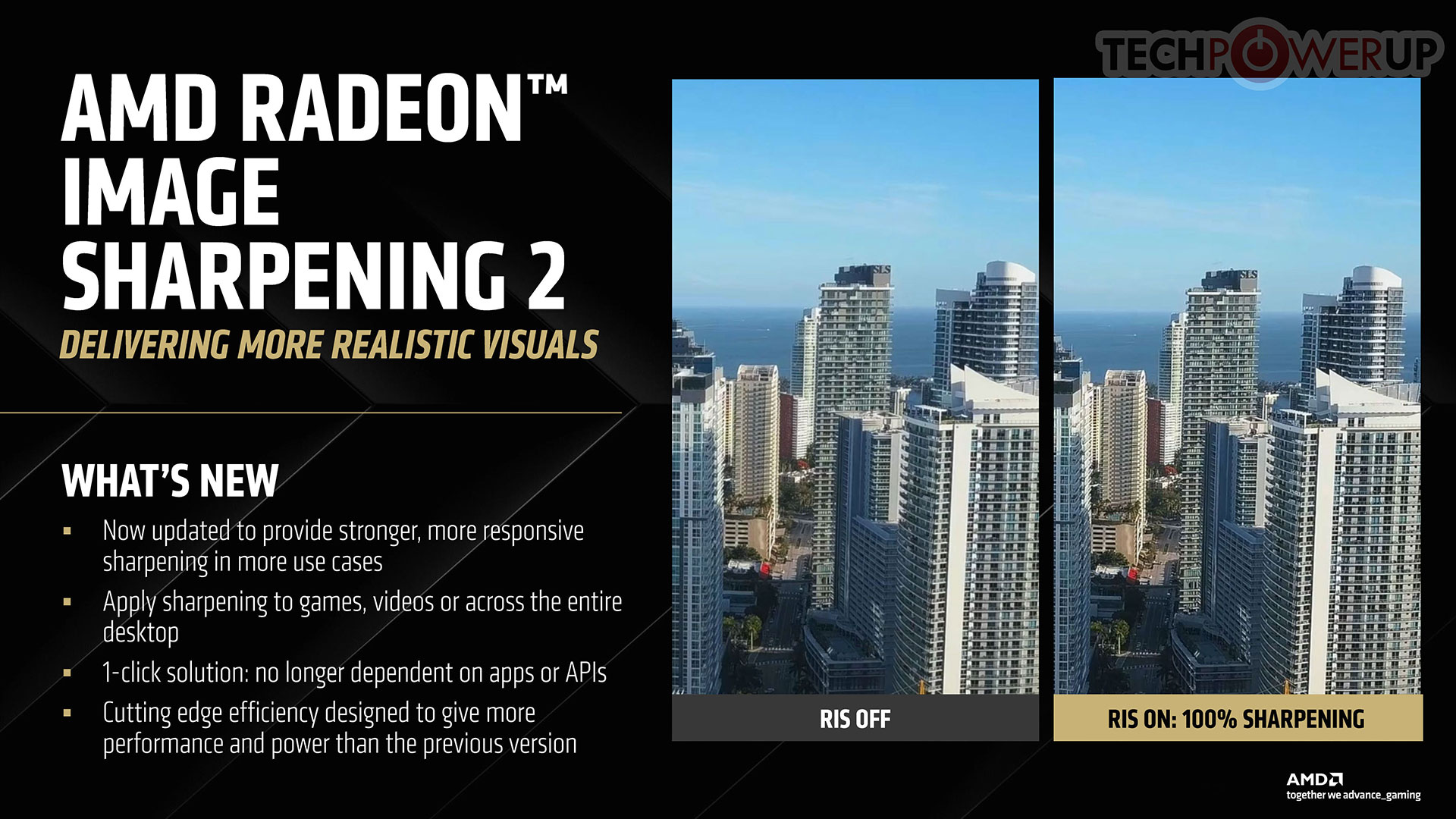
Fluid Motion Frames gets an update with FMF 2.1, with improved image quality, reduced ghosting, and improved temporal tracking. The company also updated its API-agnostic image sharpening tool, with the introduction of Radeon Image Sharpening 2 (RIS 2).
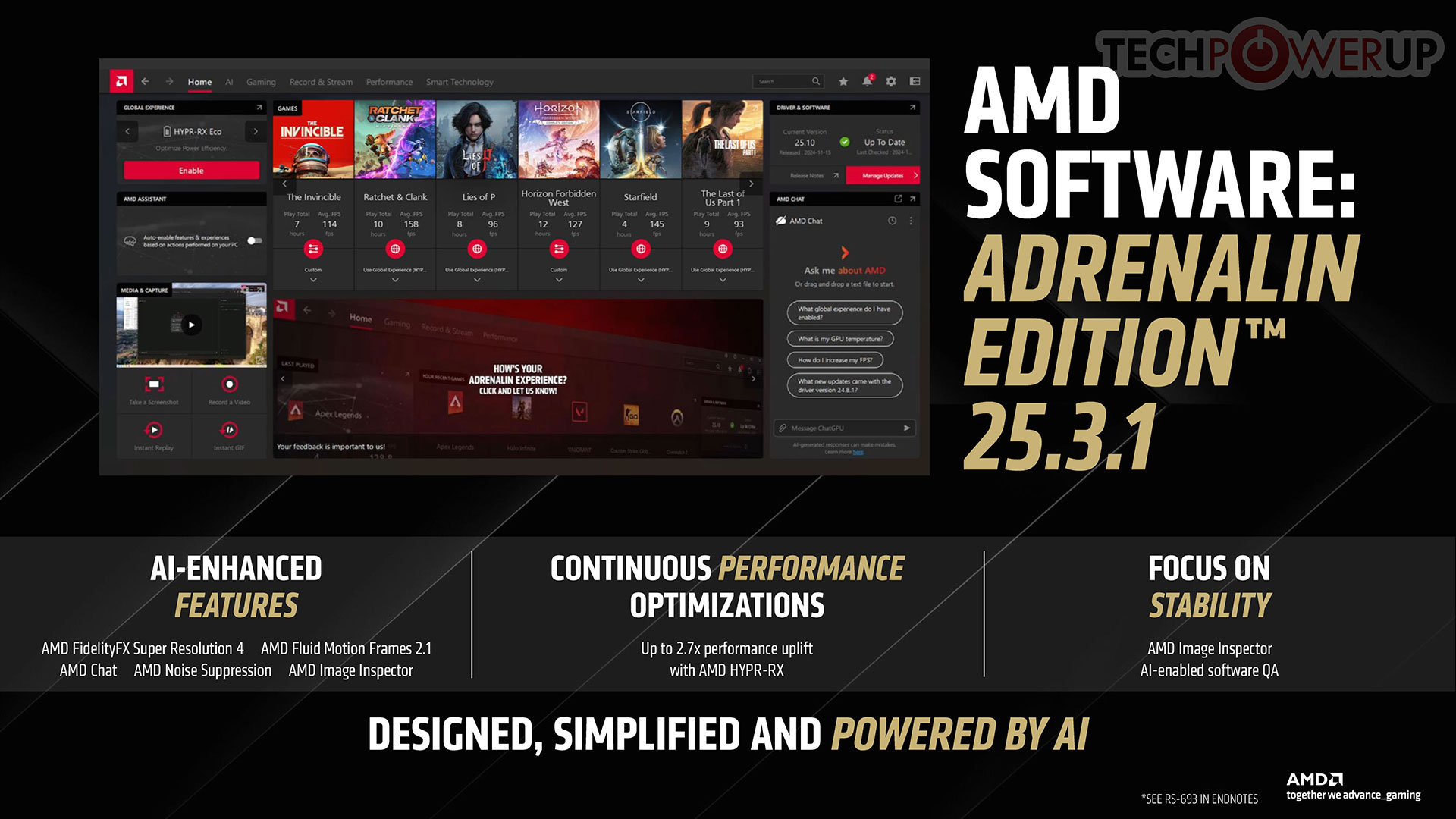
AMD provides a slick driver frontend application called simply "AMD Software." AMD improved the way in which users can report bugs, artifacts, or corruption in games, through a voluntary (opt-in) feature called AMD Image Inspector.
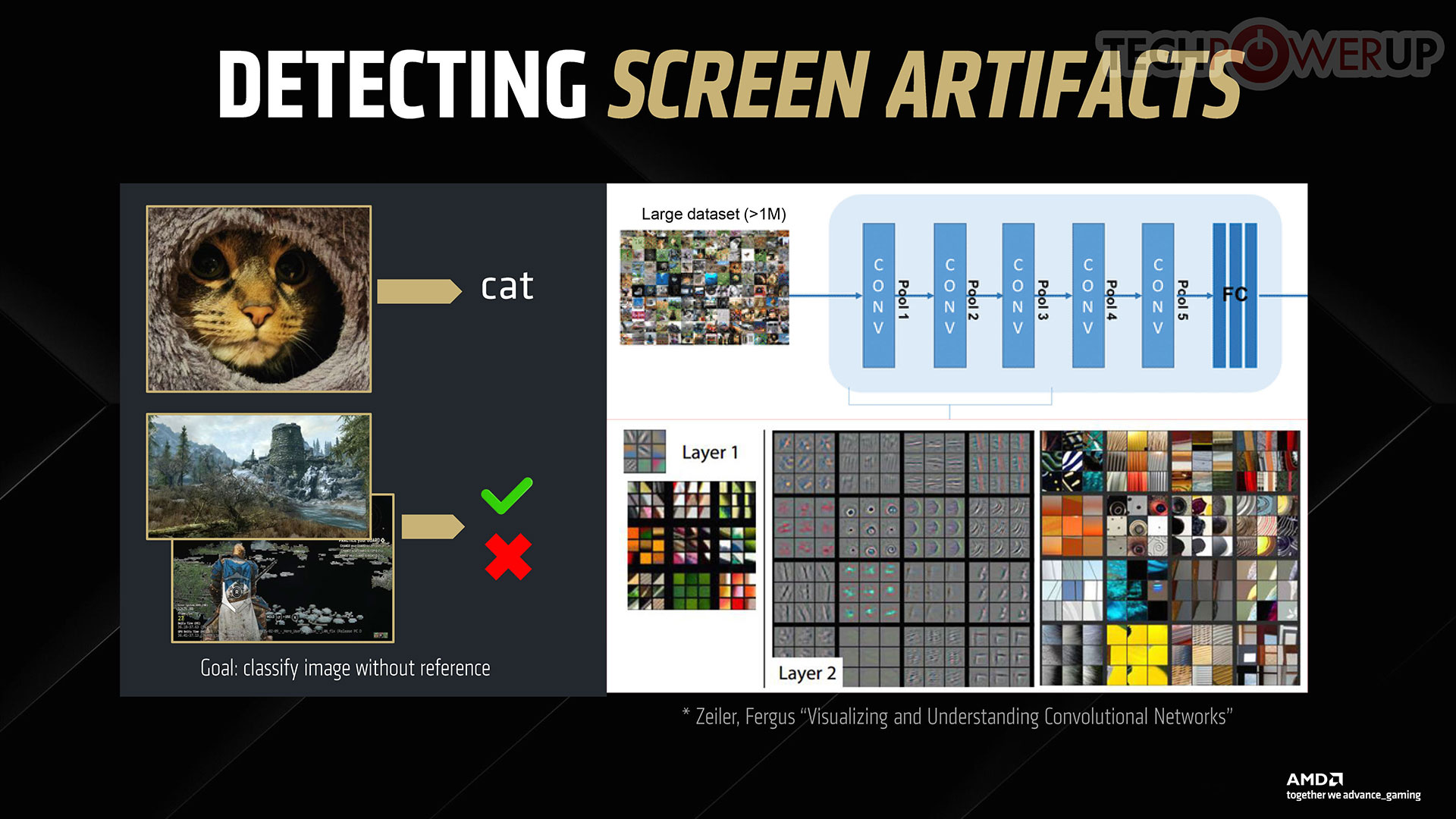

As you submit a screenshot or video sequence to AMD, the company uses an AI model to identify rendering bugs, or corruption in the display. The entire driver-level game optimization, testing, and bug fixing process has been revamped with AI doing the heavy lifting.
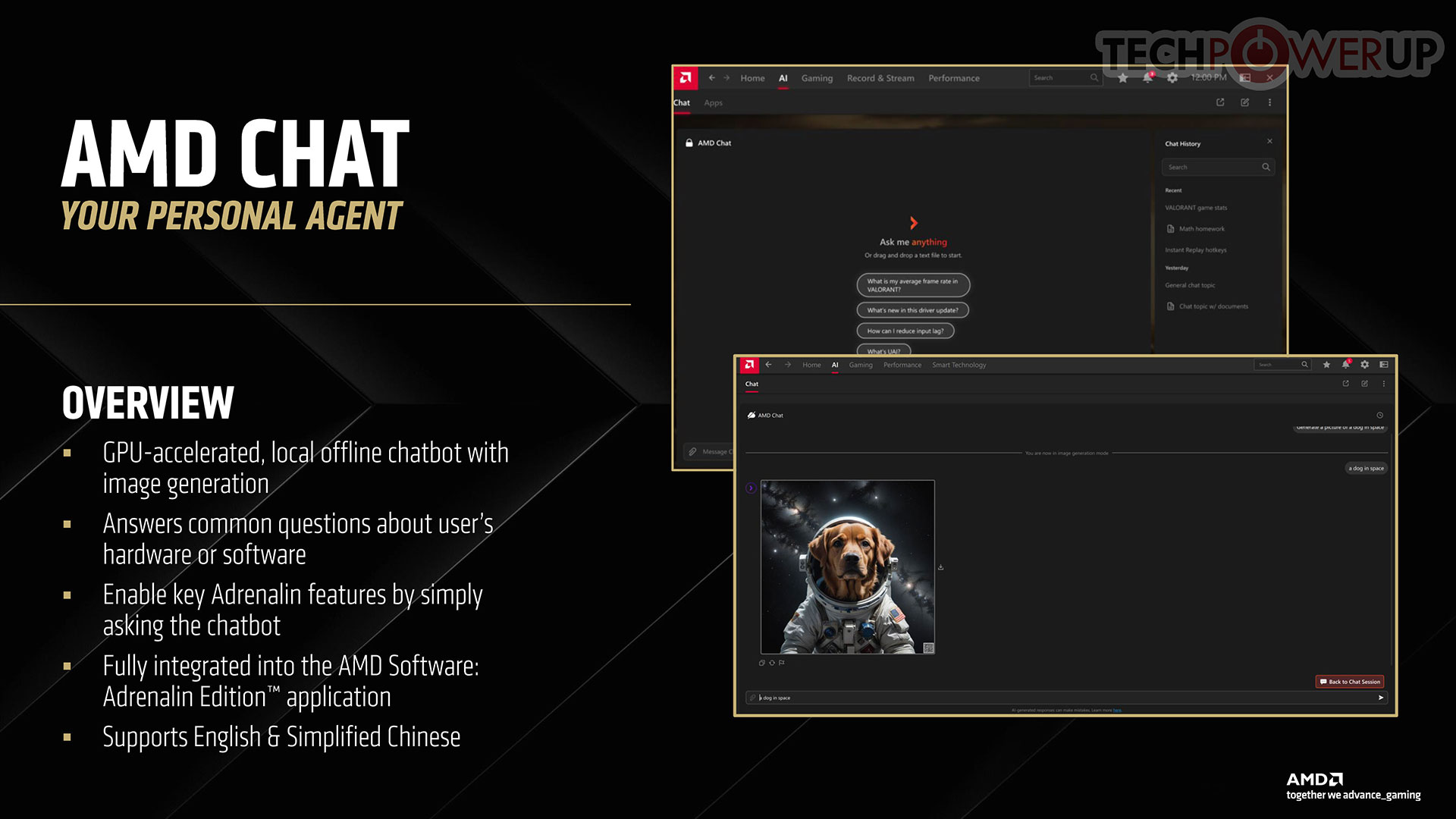
The company also introduced AMD Chat, which is an AI chatbot that runs locally, and is accelerated by the GPU. You can make plain language queries on configuring AMD Software features and settings; and also chat with it on AMD technologies. This is essentially AMD's answer to NVIDIA's ChatRTX, but we don't know if the utility can be trained with custom datasets.
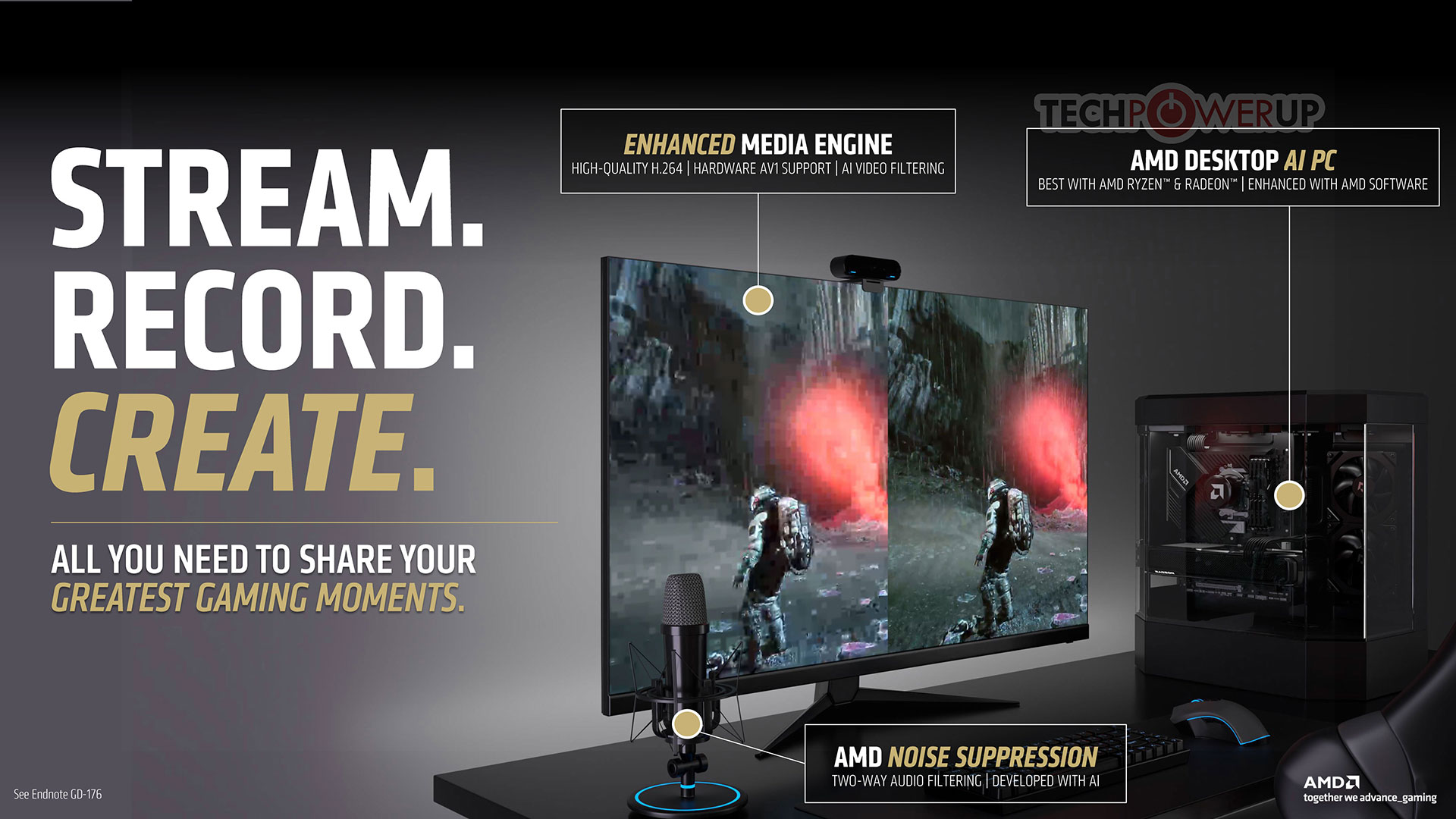
For streamers, AMD Software simplifies connecting their gameplay with their social media and streaming accounts. You can then take advantage of the new dual media engine of RDNA 4 that improves H.264 and HEVC image quality, and use other utilities such as AMD Noise Suppression, which is a 2-way AI-based audio filter.
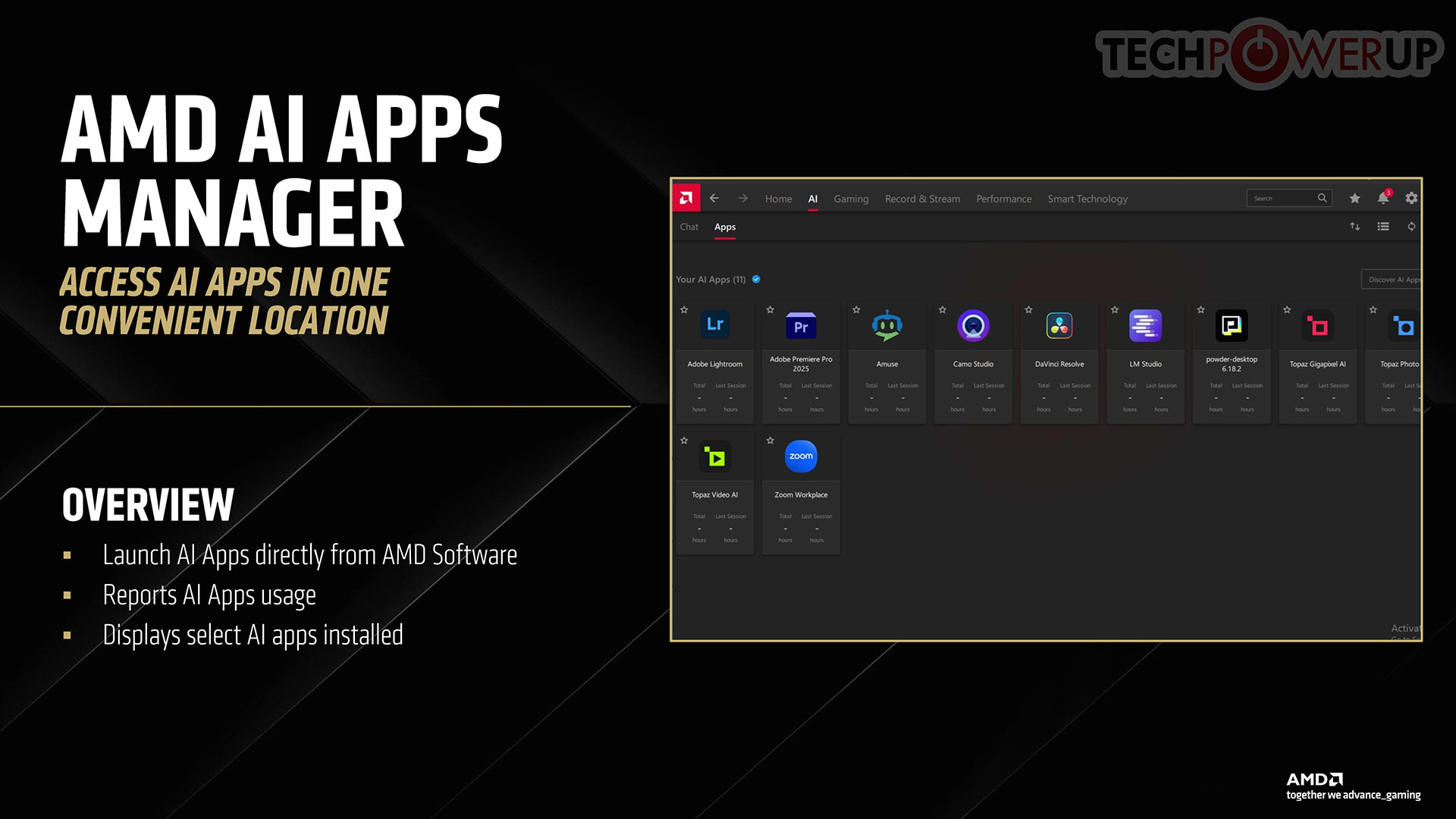
AMD AI Apps Manager consolidates all your AI applications into a simple launcher-like interface resembling a game launcher.
AMD FSR "Project Redstone"

In the second half of 2025, AMD is planning to introduce a major update to FSR 4, which is designed to bring it technologically up to par with NVIDIA. AMD has given this update the working title "Project Redstone." The FSR 4 implementation that launched with the Radeon RX 9070-series comes with an AI ML-based upscaler, which only covers the super resolution-based performance enhancement of the FSR suite. As of June 5, 2025, AMD claims that over 60 titles will have implemented FSR 4 super resolution. "Project Redstone" is a significant step up from this.
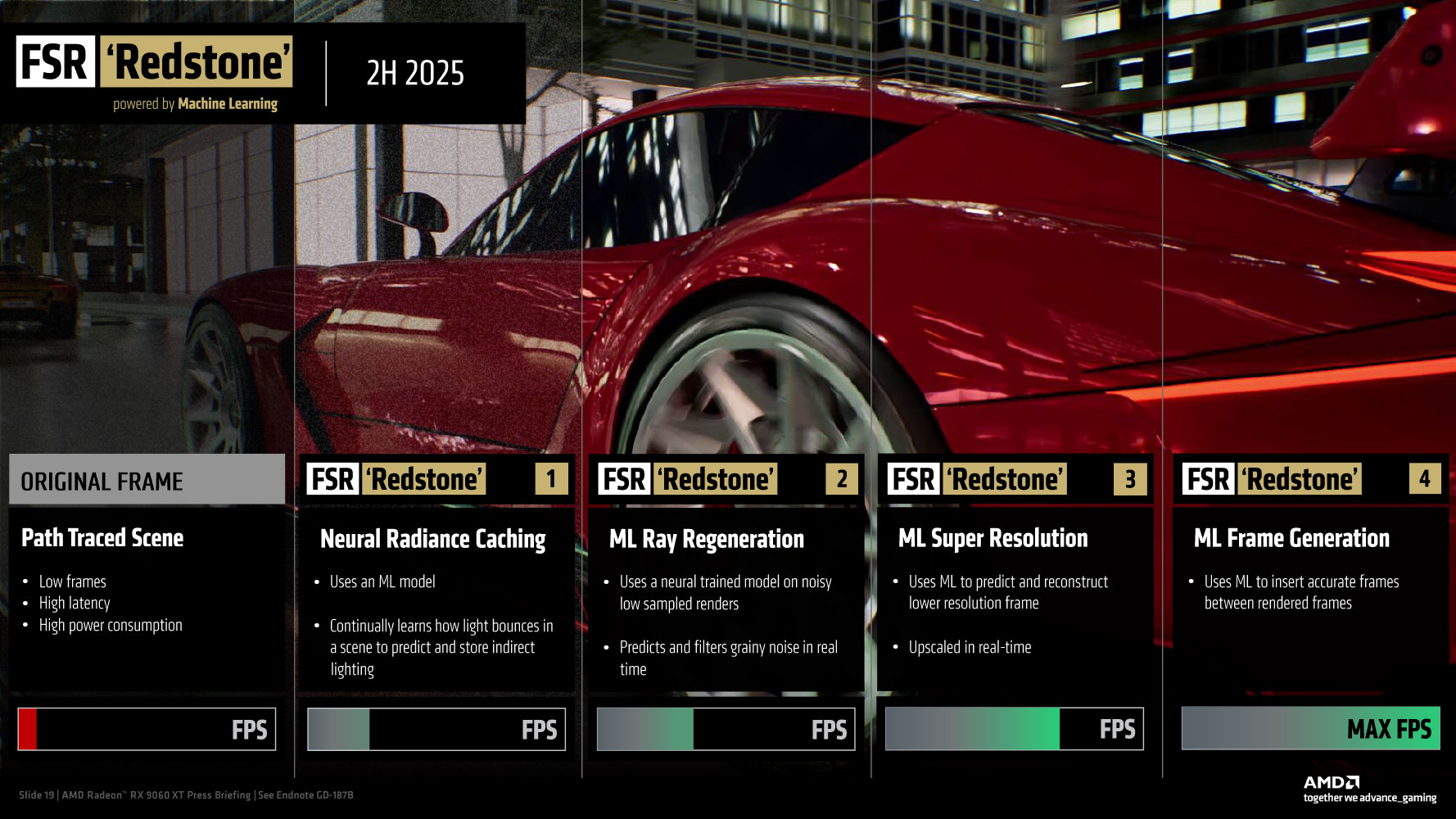
FSR "Project Redstone" introduces four new components besides the AI ML-based upscaler for super resolution AMD introduced earlier this year. The first component is an AI-ML model for Neural Radiance Caching, a method with which the GPU continuously learns how light interacts with ray traced objects in a scene, so it could store indirect lighting data to conserve performance cost of ray tracing. The second key feature is an AI ML-based model for ray regeneration. This should enhance image quality for high sparsity (noisy) low-sampled renders. It predicts and filters grainy noise in real time, and contributes to reduction of the cost of ray tracing.
The third of course is AI ML-based super resolution, which has been rolled out since the RX 9070 series, and significantly uplifts image quality at all performance presets of FSR compared to the previous FSR 2.2. Lastly, AI ML-based Frame Generation. This is a classic single frame generation akin to FSR 3, but with a new ML model that more accurately determines what an intermediate frame to two conventionally-rendered ones could look like, for more visual accuracy and reduced ghosting associated with frame generation tech.
AMD's main aim with FSR 4 and "Redstone" isn't just to improve performance across the board, but make Radeon RX 9000 series GPUs capable of games with path tracing within their recommended resolution and use-cases.
Packaging


The Card


The RX 9060 XT Pulse follows the color theme of earlier Pulse GPUs—black and red are the primary colors. You now get a metal "Sapphire" logo near the top edge and some additional detail has been added in that area, too. The metal backplate has a cutout for air to flow through.

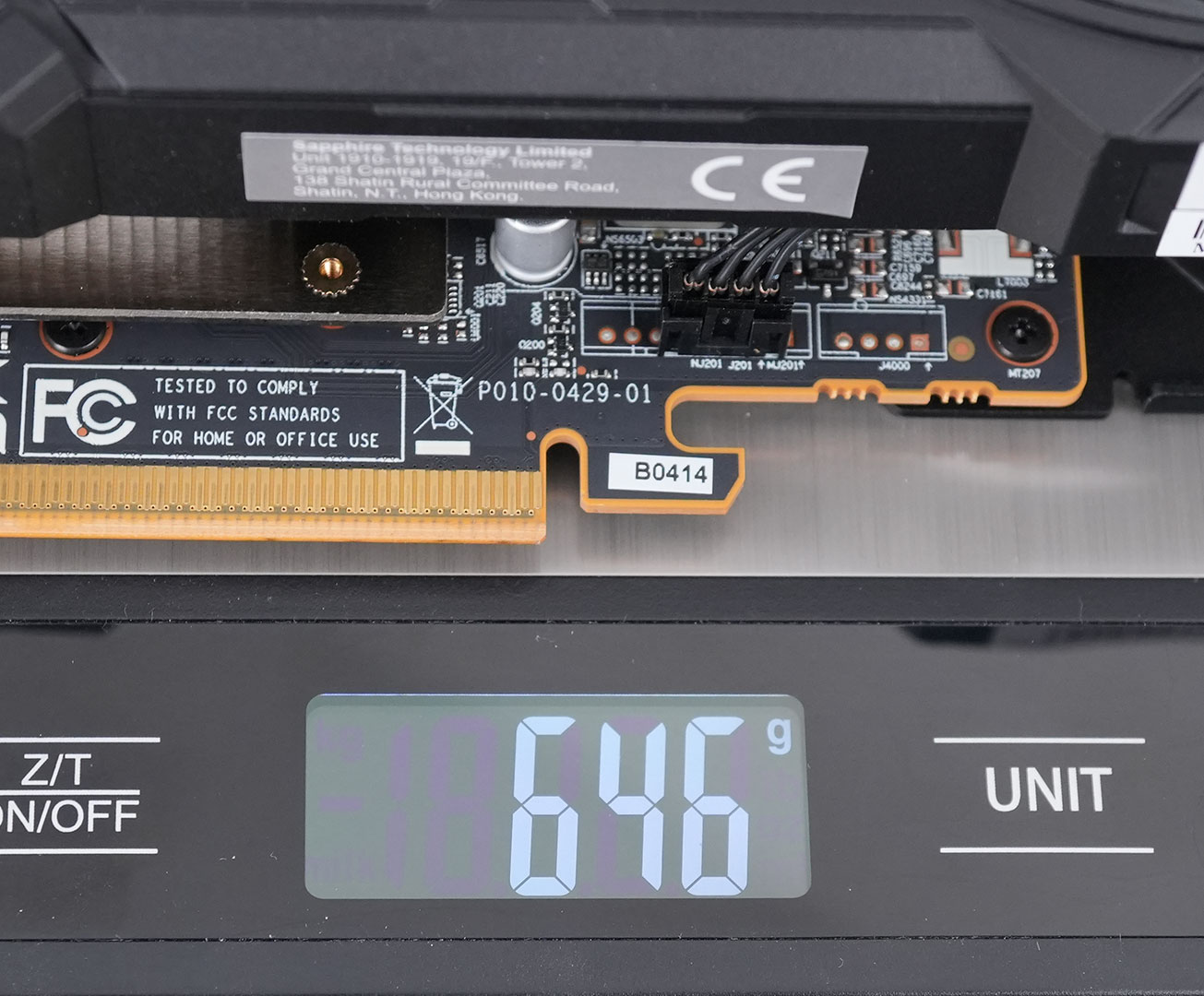
Dimensions of the card are 24.5 x 12.5 cm, and it weighs 646 g.
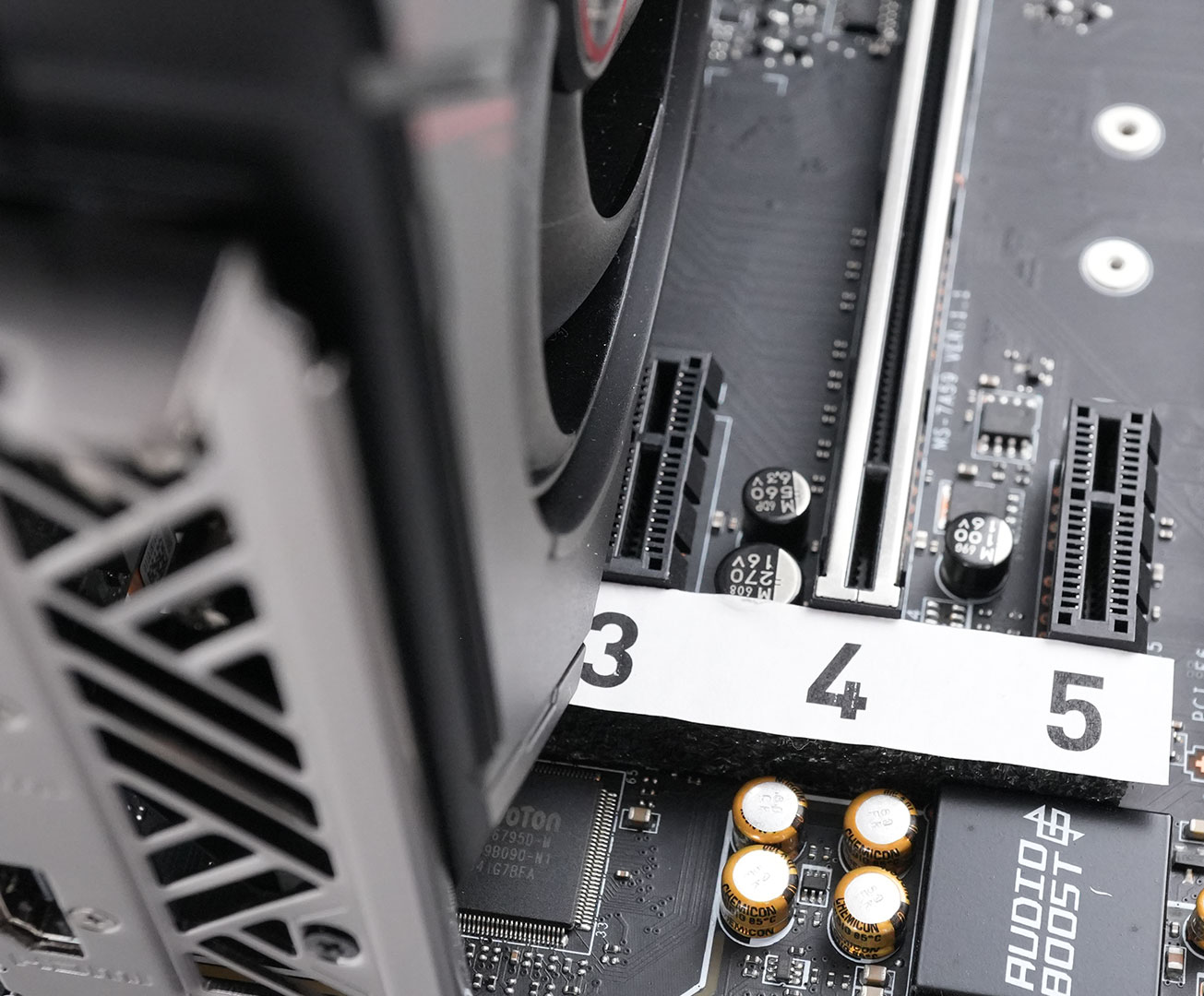
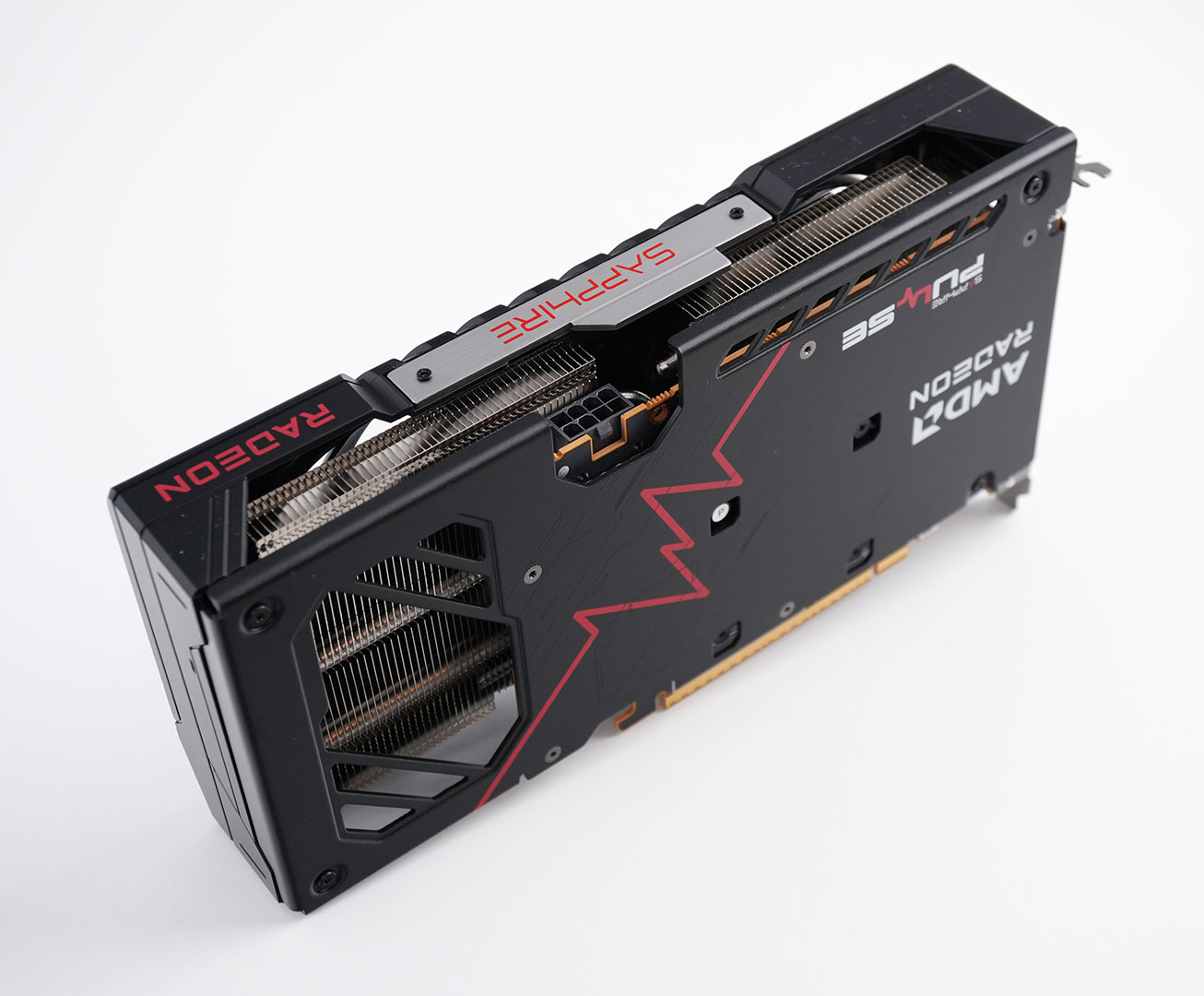
Installation requires two slots in your system. We measured the card's width to be 46 mm.
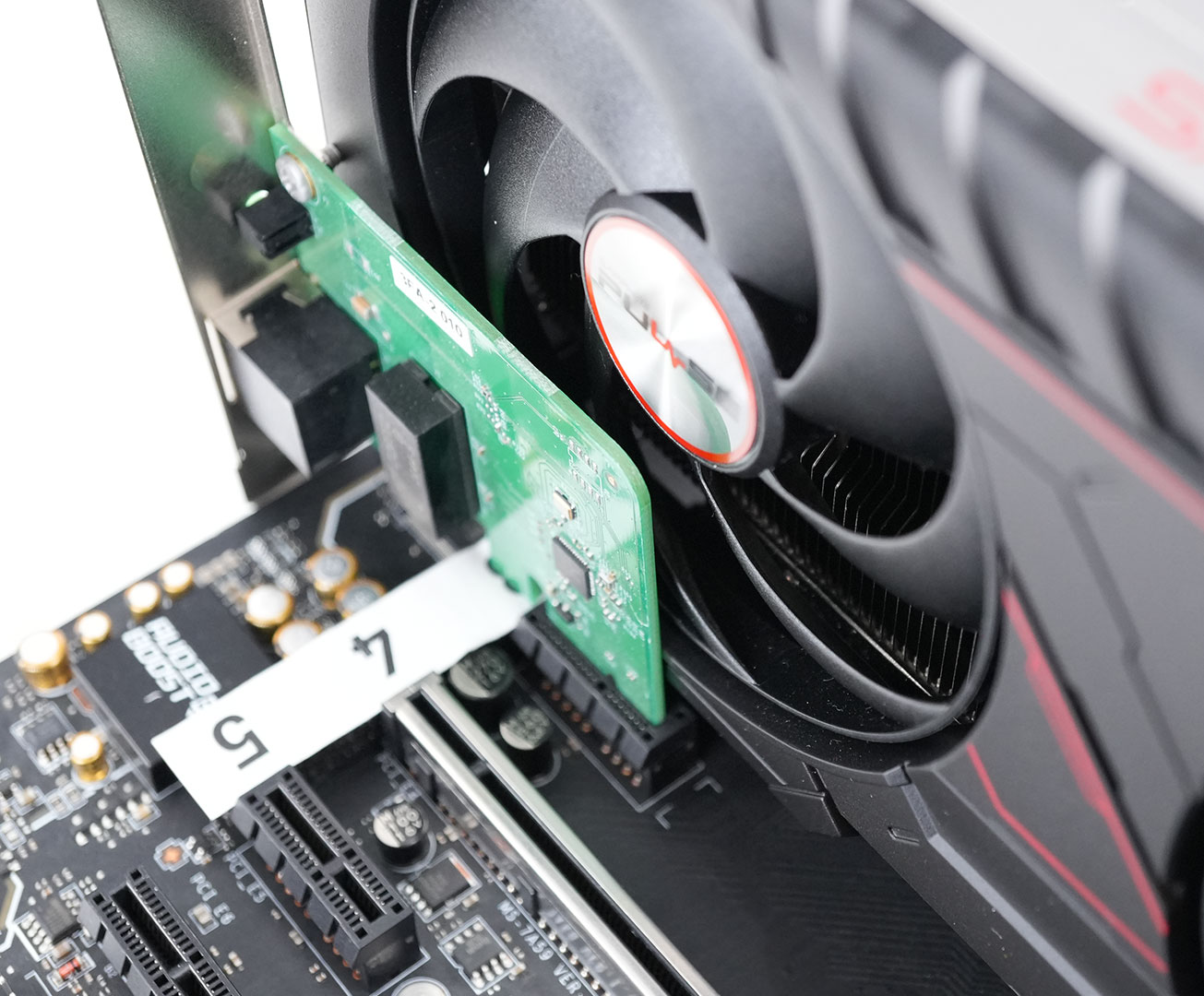
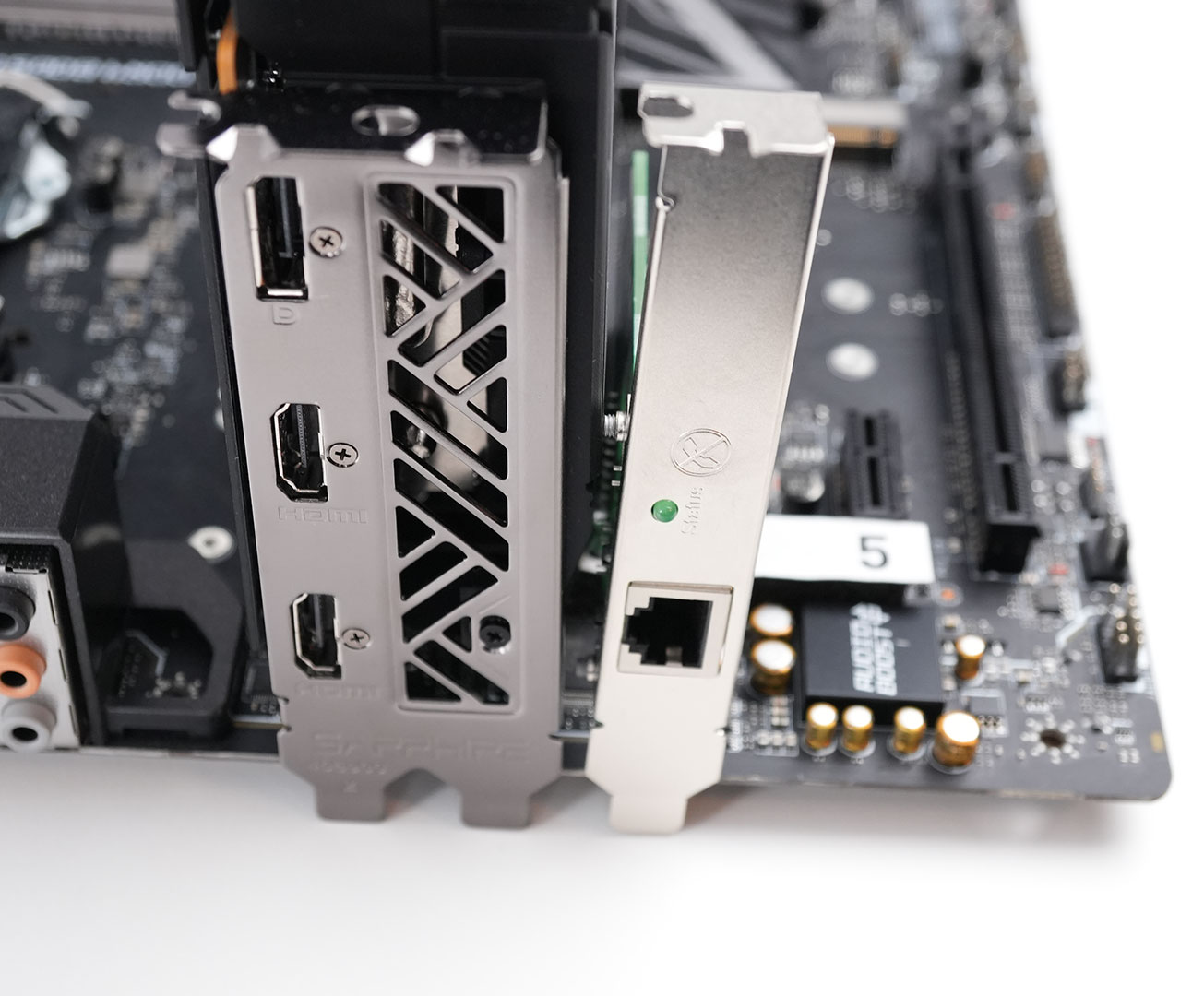
The card is a little bit too wide to be exactly two slots, note how the networking card does fit in the slot, but it will not sit straight. Not sure why Sapphire designed their card to be a bit too wide, consider it a 2.5 slot card in practice.

Display connectivity includes one standard DisplayPort 2.1b and two HDMI 2.1b.
AMD put in some extra work for creative professionals, particularly those into video editing, by giving Navi 44 its latest video engine. The video engine supports concurrent hardware-accelerated encode and decode for AV1, HEVC, and H.264 video codecs. With RDNA 4, AMD has improved the image quality of H.264 encoding at lower bitrates, which should make AMD appeal to content creators. The AV1 encoder and decoder support B-frames, a technology with which there can be a significant reduction in bitrates without a loss in image quality.

The card uses a single 8-pin connector, which allows a maximum power draw of 150 W, plus 75 W from the slot, but the actual board power limit is set much lower of course.
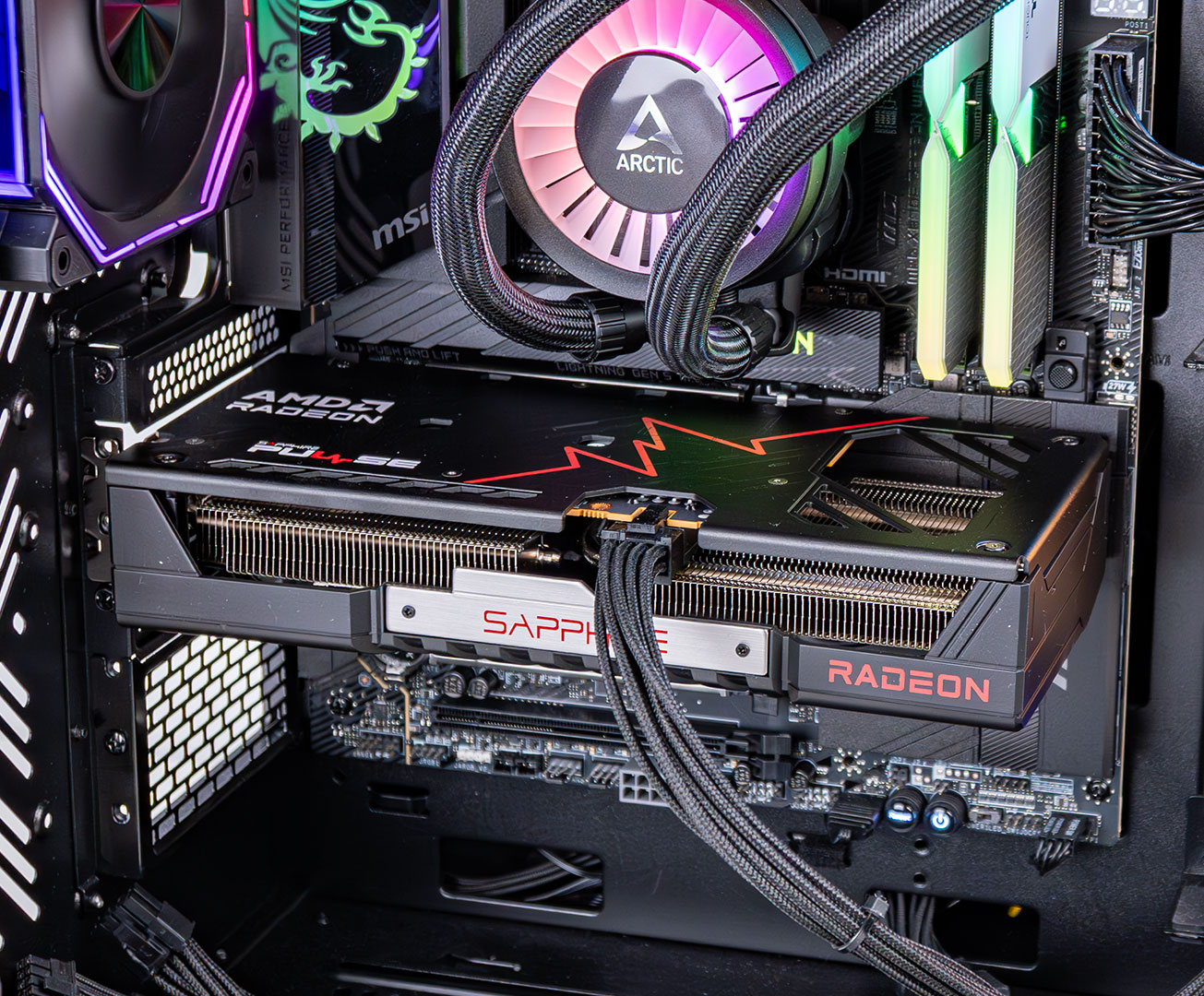
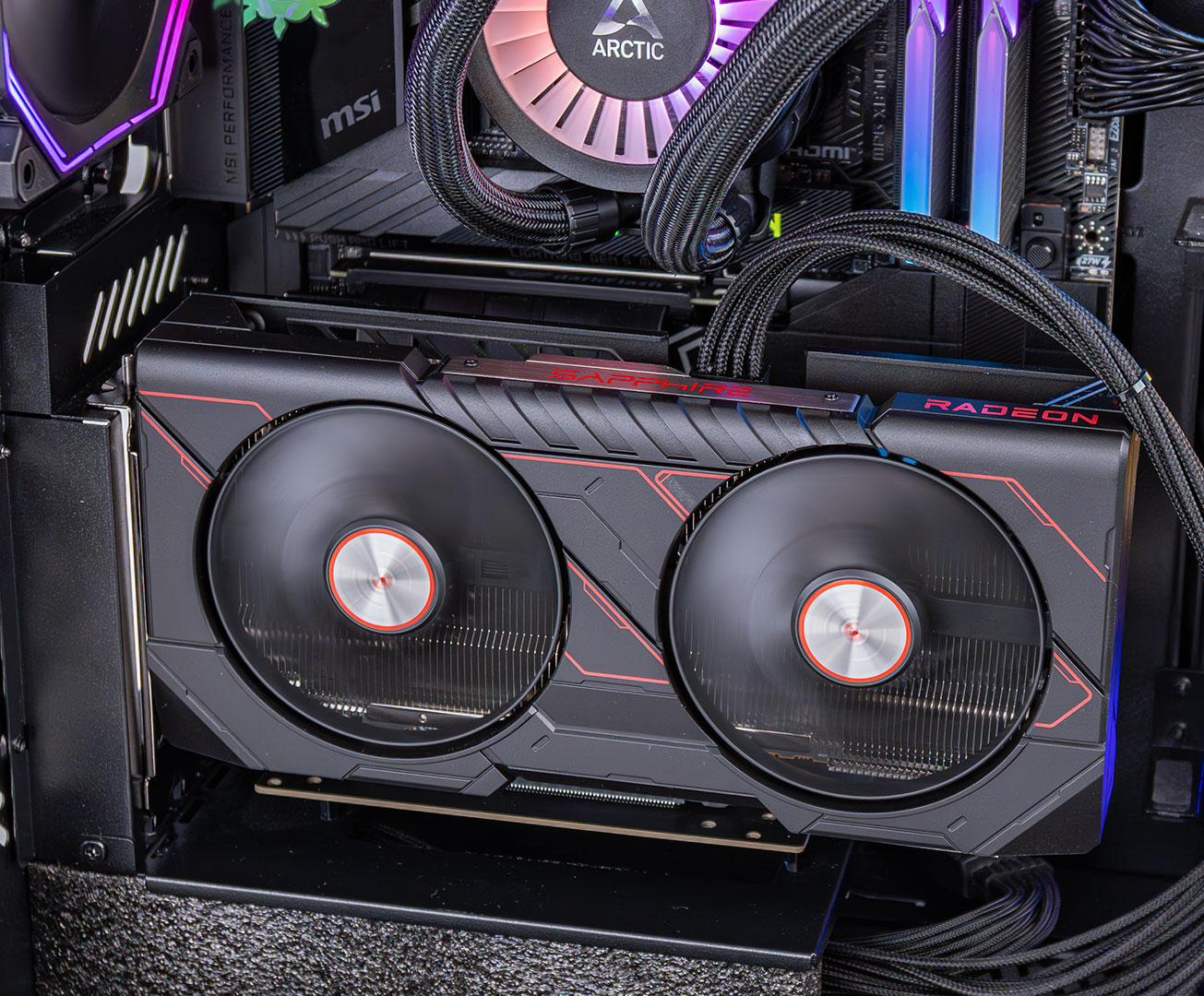
The Sapphire Pulse does not come equipped with any lighting features.
Teardown


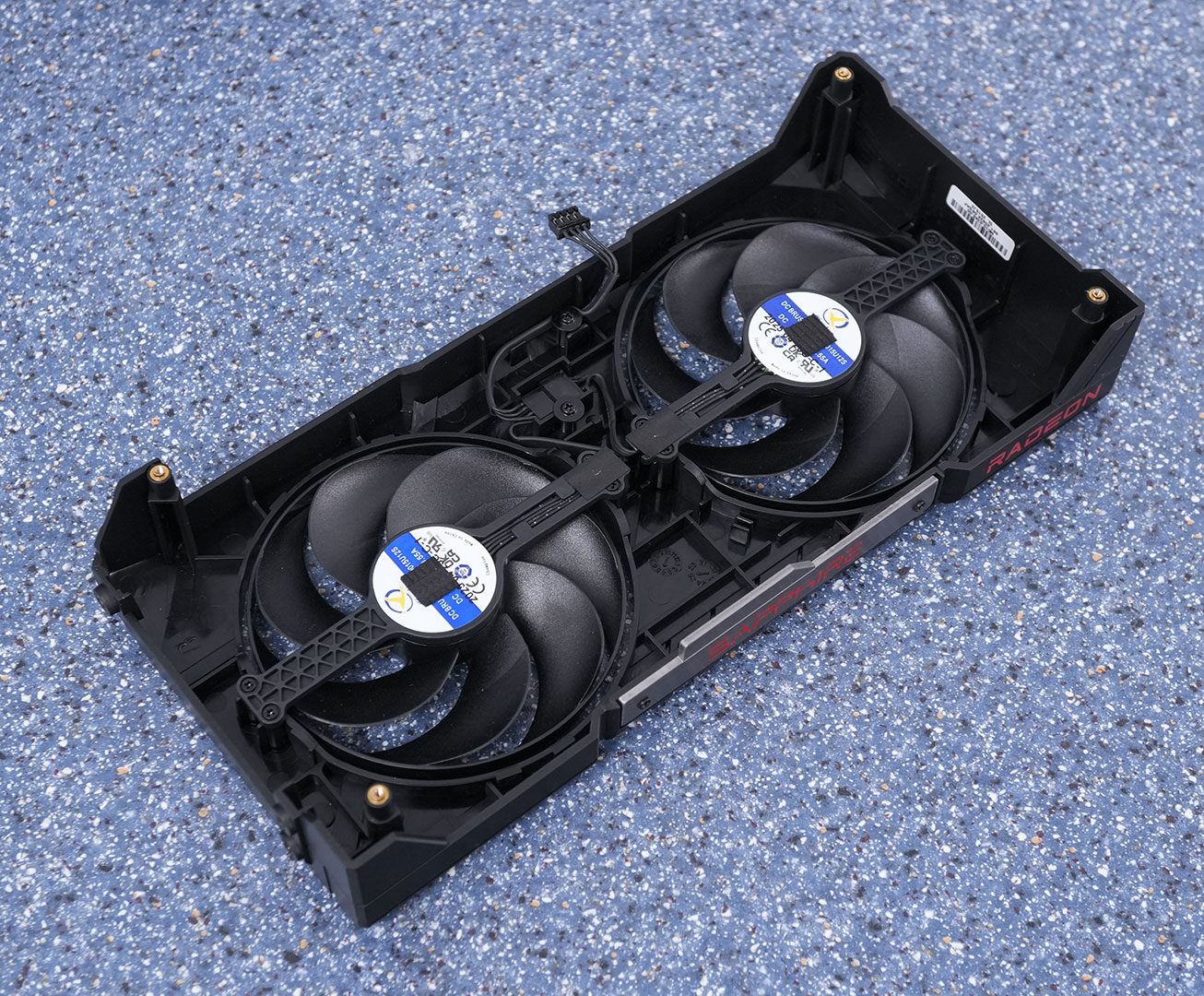
The fan assembly can be removed easily, which makes it easy to replace a broken fan in a couple of years—no need to touch the thermal paste of the card.
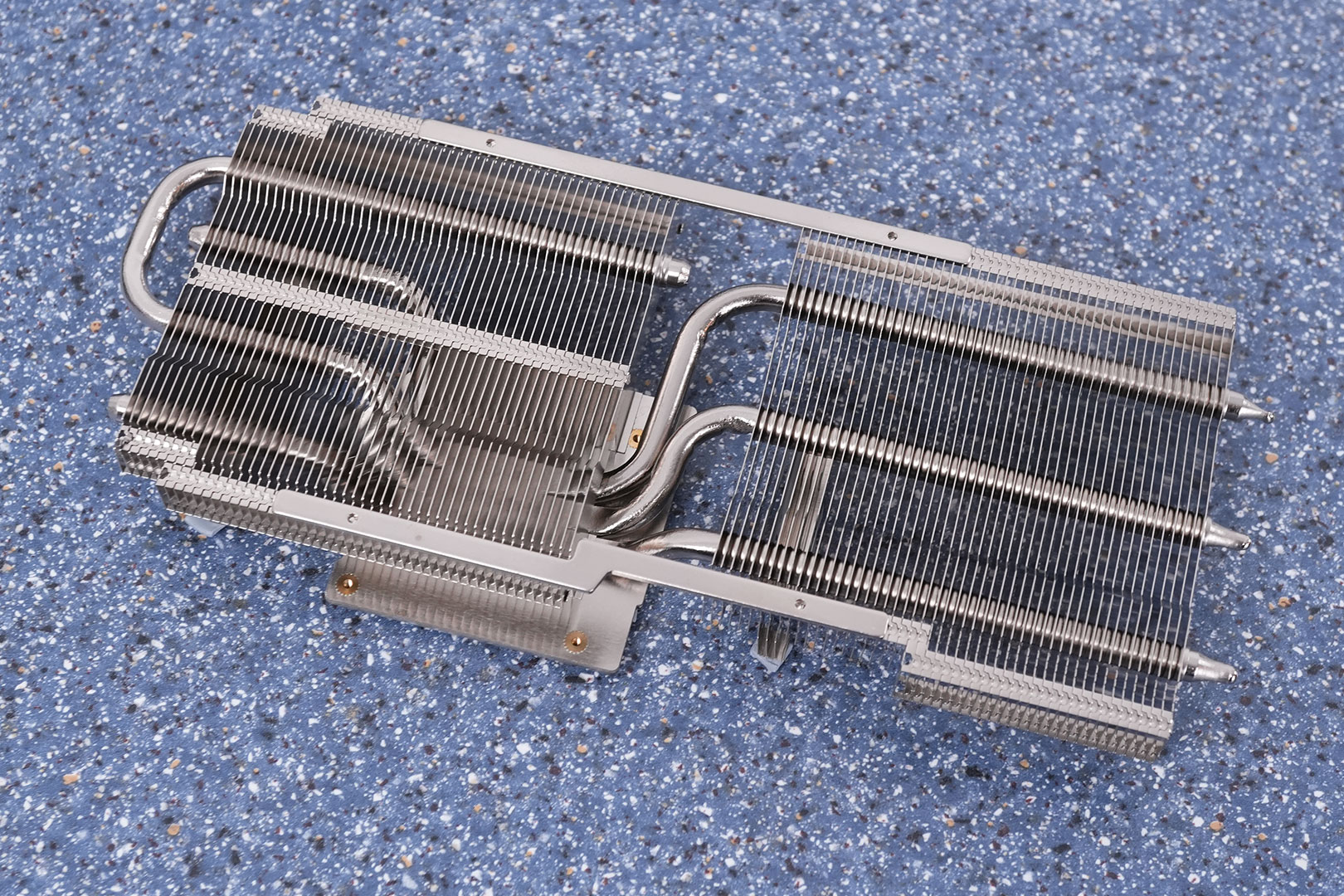
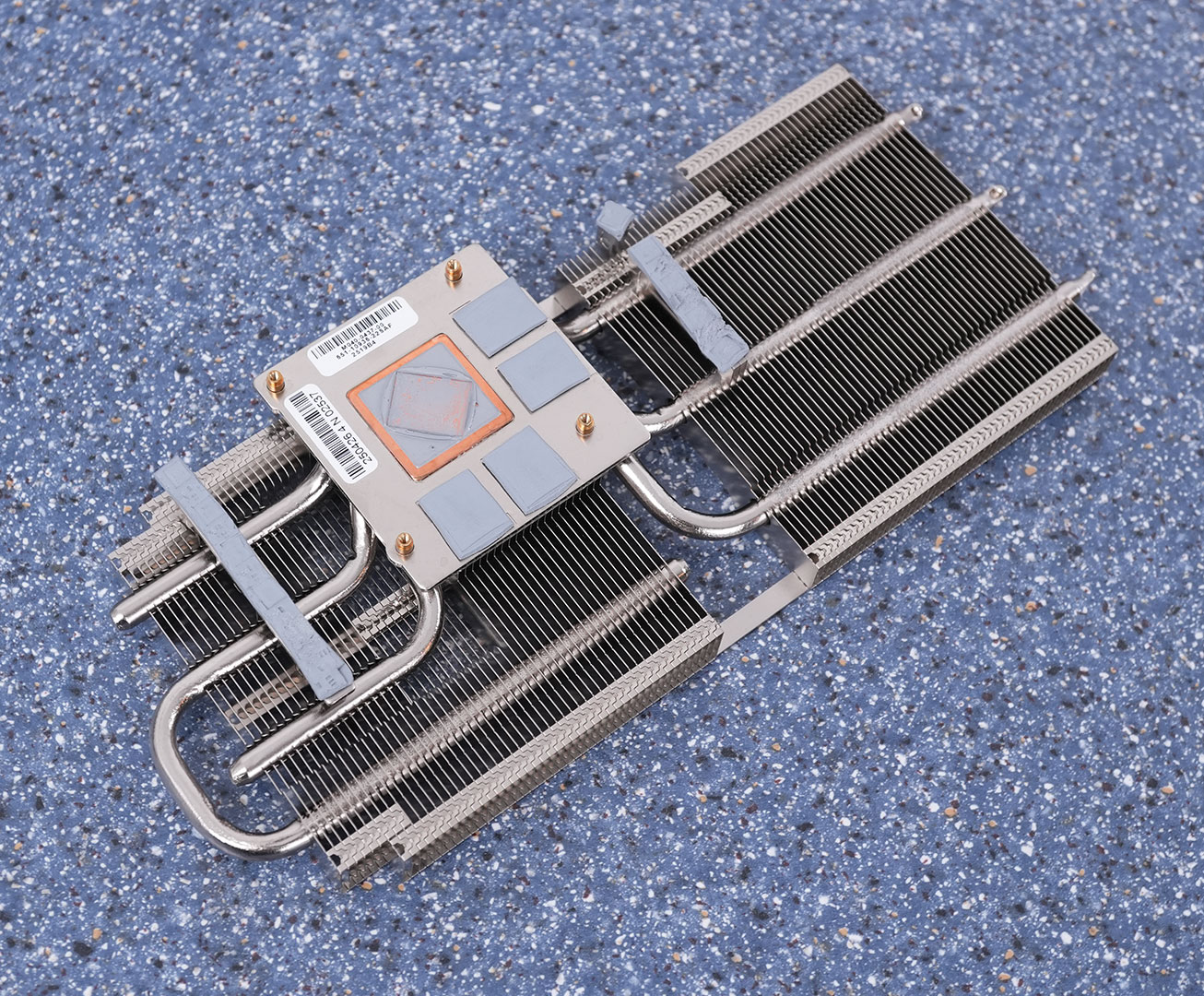
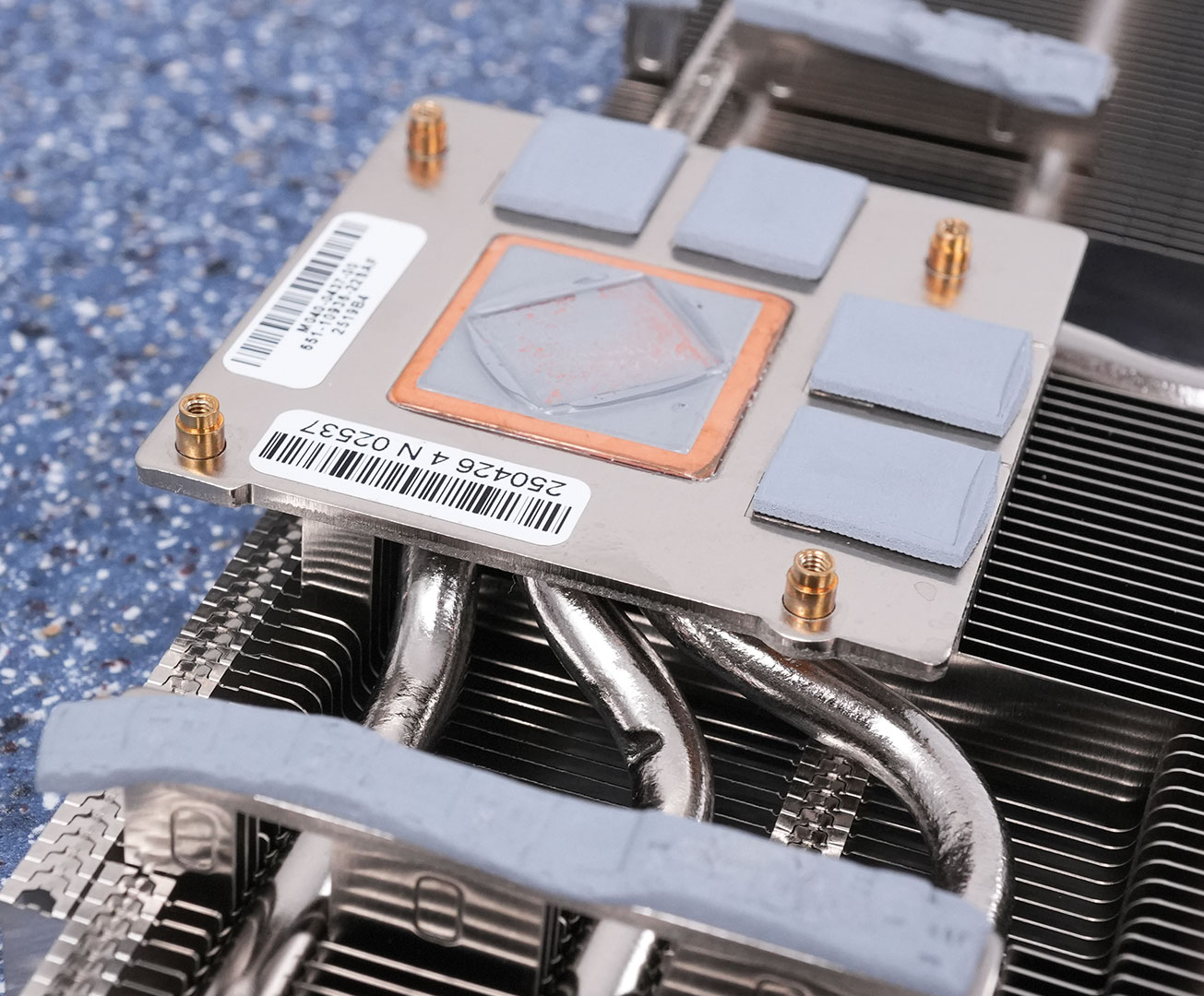
Sapphire has installed three heatpipes on their thermal solution, the main heatsink also provides cooling for the memory chips and VRM circuitry.
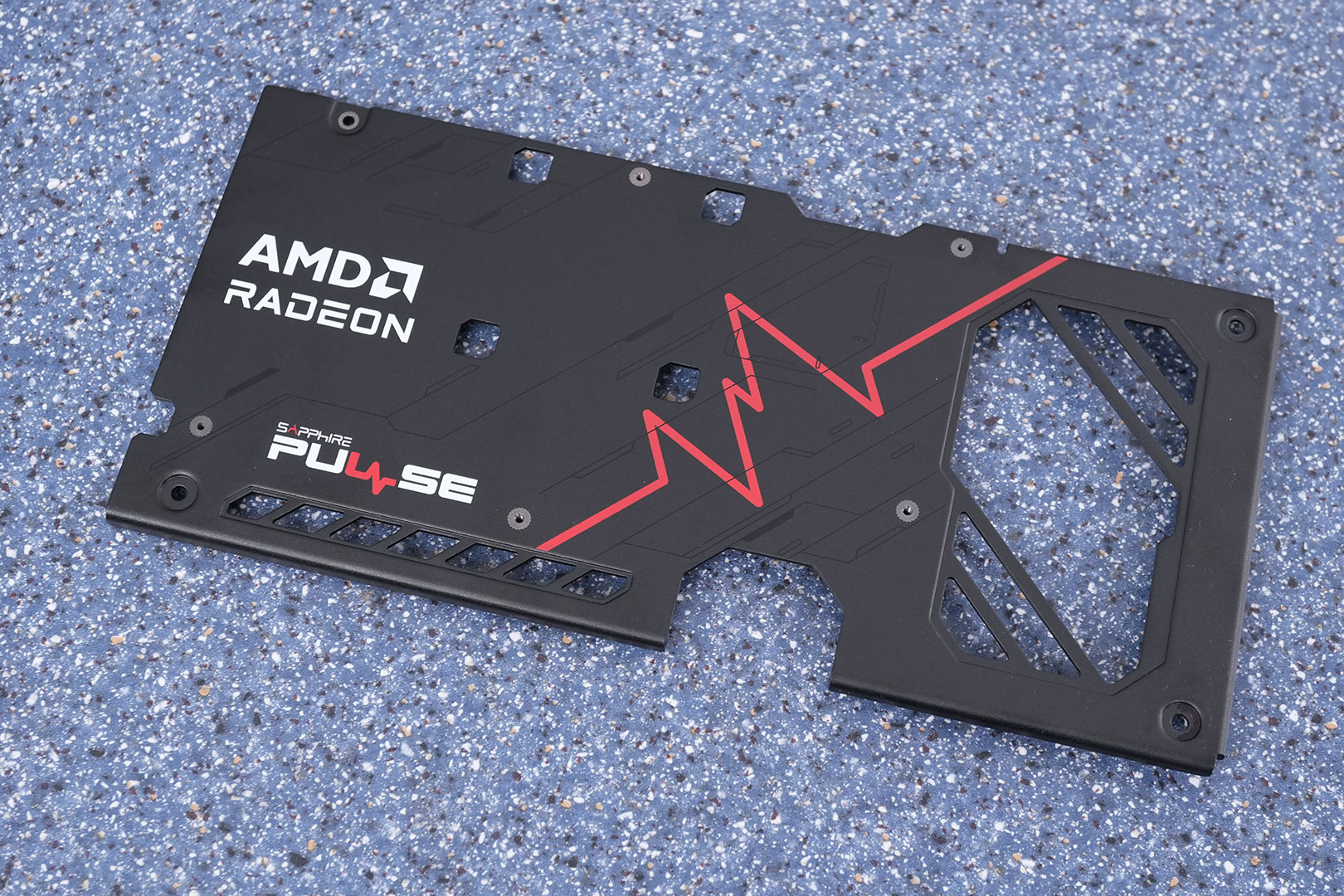
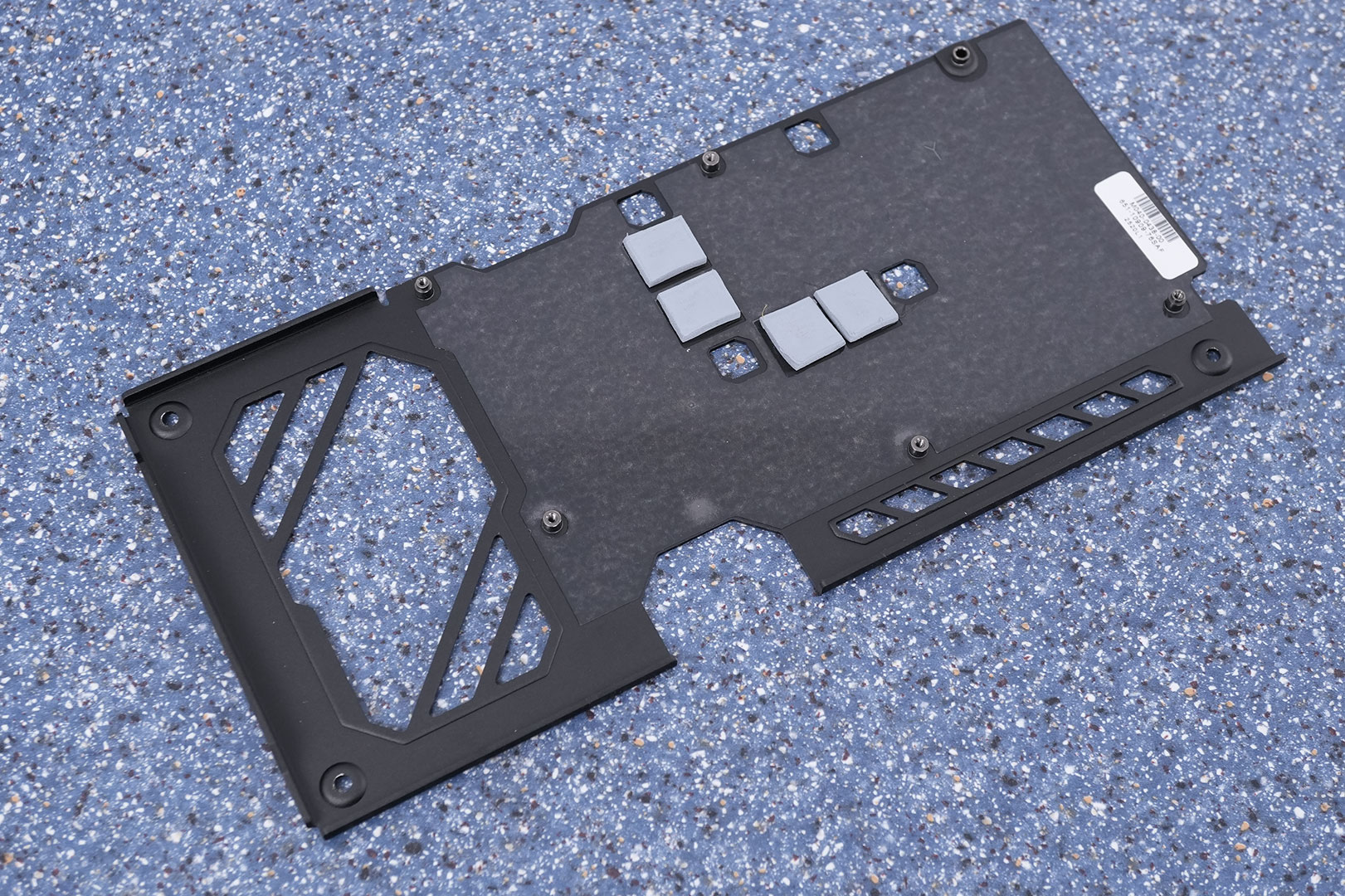
The backplate protects the card against damage during installation and handling. Note the thermal pads, which provide cooling for the memory chips on the back-side of the PCB.
Our Patreon Silver Supporters can read articles in single-page format.
Nov 13th, 2026 22:12 CST
change timezone
Latest GPU Drivers
New Forum Posts
- What are you playing? (26214)
- Tell me about your favourite graphics card (30)
- no "PhysX" workable (8)
- AI generated images... (224)
- Crimson Desert (31)
- RenoDX HDR - how to view the differnce Before&After in game? (0)
- Displayport DP80 3M (10ft) cable that can achieve 80gbps stable? (5)
- I'll flash a ASUS ROG Strix RX480 O8G in Cause of Code 43, as a Newbie (1)
- Opinion on Monitor Replacement (6)
- TMOG - post your benchmark results here (16)
Popular Reviews
- AMD Zen 6 Technical Deep Dive
- Corsair HX1000i Shift Crystal Review
- NZXT C1200 Platinum Review
- Upcoming Hardware Launches 2027 (Updated Nov 2026)
- ASUS ROG Strix B850-I Gaming Wi-Fi7 W Review
- Montech King 95 3D PRO Review
- NZXT H7 RGB+ Review
- NZXT H5 Review
- Phantom Blade Zero Performance Benchmark Review - 35 GPUs Tested
- XPG NIMBUS PLUS Review - Mid-range Chair With Strong Competitors
TPU on YouTube
Controversial News Posts
- NVIDIA Co-Founder and CEO Jensen Huang Officially Resigns (379)
- OpenAI CEO Argues Home PCs Waste the World's Limited DRAM Supply (152)
- NVIDIA Launches Investigation Into Jensen Huang's Relationship With Suspected Chinese Spy (136)
- Intel "Raptor Lake Next" 16-Core and 20-Core CPUs Surface (130)
- Legendary Game Studio BioWare Shuts Down Following EA Layoffs (104)
- Dell CEO Says the Memory Shortage Will Get Worse in 2027 (95)
- NVIDIA GeForce RTX 50-Series Scheduled for up to $500 Price Hike This Week (89)
- Modder Fits RTX 5090 With Four 8-Pin Connectors, Halving Current per Wire (80)