 7
Sharkoon Skiller SGH40W Review - No-Frills Wireless
Value & Conclusion »Microphone Performance
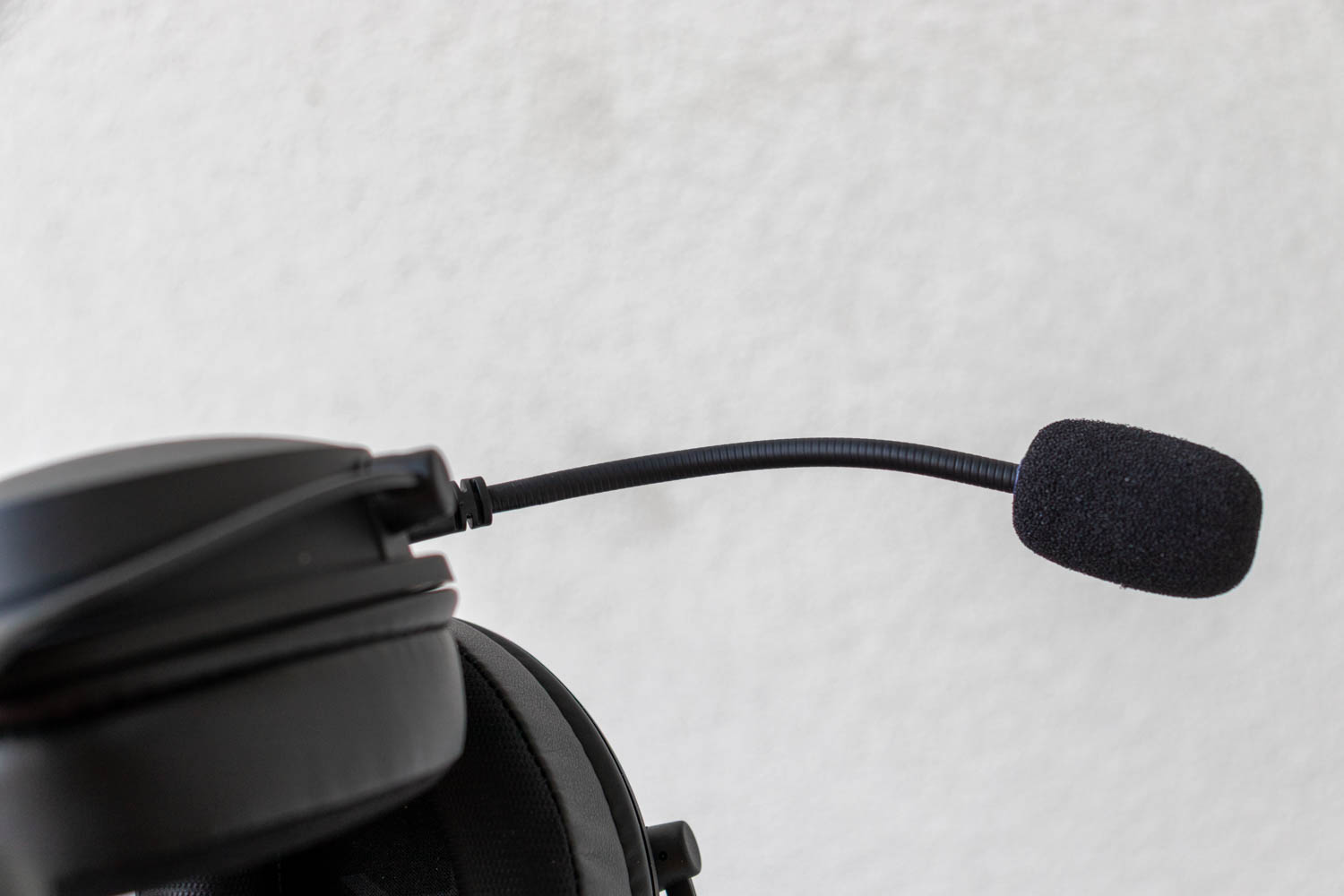
I tested the detachable omnidirectional microphone of the Sharkoon Skiller SGH40W in wireless mode. To review the microphone's sound and to compare it to other similar headsets, I used the Adam A7X speakers and Shure SRH840 headphones, both being studio monitors, connected to the powerful Topping DX5 II DAC/amp. The testing was done in Discord and Audacity, and I also used Audacity to record sound from the microphone. The sound was recorded with microphone sensitivity set to 100% and was not post-processed or edited in any way.
For reference, this voice recording was made with the Rode NT-USB, a high-quality studio microphone:
This is the sound recorded by using the omnidirectional microphone supplied with the Sharkoon Skiller SGH40W.
For a €70 wireless gaming headset, the Sharkoon Skiller SGH40W's microphone delivers acceptable quality. The ENC (environmental noise cancellation) does a reasonable job of suppressing steady-state background noise, such as keyboard clatter or a running fan, but it can struggle with more complex or dynamic noise sources. Voices come through clearly enough for Discord and in-game voice chat, though there's a noticeable compression to the sound that strips away some depth and naturalness. It's the kind of microphone quality you'd describe as "it gets the job done" - perfectly fine for team communication, but not something you'd want to use for streaming, podcasting, or any scenario where voice quality is a priority.
A word of advice: keep the microphone gain below 60% in your operating system or application settings. Above that threshold, the capsule becomes overly sensitive and starts clipping, which introduces harsh distortion into your voice. You'll also want to avoid positioning the microphone too close to your mouth, as the combination of its omnidirectional pattern and high sensitivity makes it prone to picking up plosives and breathing at close range. The flexible gooseneck arm holds its position adequately, so finding a good distance shouldn't be a problem. The foam pop filter helps reduce plosive distortion, though it doesn't eliminate it entirely.
Nov 20th, 2026 14:13 PST
change timezone
Latest GPU Drivers
New Forum Posts
- 1 - 5 person file storage server equivalent accasible from anywhere + general VM server. (0)
- WarpCoreBench scores! (81)
- How to prevent OLED burn damage due to PC freezes or power outtages? (48)
- Honestly, do you care about GTA VI? (208)
- When you could finally run Crysis maxed out? (63)
- GTA VI (20)
- Anthrophics IPO (25)
- GeekMagic Ultra Smart WiFi Weather Station (8)
- Very unusual two gaming-pc scenarios. (35)
- Can i play GTA 6 now? (Joke) (14)
Popular Reviews
- AMD Zen 6 Technical Deep Dive
- Ugreen NASync DXP4800 GT Review
- Microsoft Surface Laptop Ultra Review - The Next-gen Arm Laptop
- Corsair RM1200e (Second Generation) Review
- Acemagic Retro X3 Review
- Upcoming Hardware Launches 2027 (Updated Nov 2026)
- Pulsar Office Tour & First Look at P1 Dual-Sensor Mouse
- Biwin Black Opal NV7400 2 TB Review
- AMD Ryzen 7 9800X3D Memory Performance Scaling
- AMD Ryzen 7 9800X3D Review - The Best Gaming Processor
TPU on YouTube
Controversial News Posts
- NVIDIA Co-Founder and CEO Jensen Huang Officially Resigns (490)
- Report: Jensen Huang Eyes NVIDIA Comeback (255)
- Open Letter Asking NVIDIA to Reinstate Jensen Huang Passes 115,000 Signatures (184)
- OpenAI CEO Argues Home PCs Waste the World's Limited DRAM Supply (152)
- NVIDIA Launches Investigation Into Jensen Huang's Relationship With Suspected Chinese Spy (136)
- Intel "Raptor Lake Next" 16-Core and 20-Core CPUs Surface (130)
- Legendary Game Studio BioWare Shuts Down Following EA Layoffs (104)
- Dell CEO Says the Memory Shortage Will Get Worse in 2027 (95)