 2
Sharkoon SKILLER SGM70W Review
(2 Comments) »Value and Conclusion
- The Sharkoon SKILLER SGM70W is available for $39.99.
- True 8000 Hz wireless polling
- Good sensor performance
- Decent button quality
- Decent scroll wheel
- Good choice of components
- Lightweight
- Flexible charging cable
- Nicely gliding glass mouse feet
- Set of replacement feet included
- Speedy charging
- Very high click latency
- MotionSync permanently enabled
- Noisy scroll wheel
- Minor polling instability
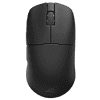
At first glance, one might mistake the SKILLER SGM70W for an ambidextrous design. While most features of its shape would definitely warrant such a classification, the sides are different from each other to where the SKILLER SGM70W indeed crosses over into right-handed ergonomic territory. Whereas the right side remains largely flat, the left one curves inwards to a significant degree, creating a thumb groove of sorts, and resulting in a grip width that is below average considering the other dimensions. These items aside, the shape of the SKILLER SGM70W is closest to that of the Razer Viper Mini and, by extension, Hitscan Hyperlight. At 49 g and sporting a fully solid shell, the SKILLER SGM70W manages to be lightweight for its size, albeit not as lightweight as the aforementioned Hyperlight at 40 g. In terms of build quality, there is little to complain about: there is no rattle when shaking the mouse, the side buttons cannot be actuated by pressing below them, and when applying lateral pressure, there is only minor creaking but no flexing of the shell.
Given its budget stature, the switch selection on the SKILLER SGM70W is highly respectable. For the main buttons, a set of Huano switches of the green transparent shell, white plunger variety are used. Unfortunately, the button design is subpar, squandering much of the snappiness these switches otherwise would be able to afford: pre-travel is high and post-travel moderate, and lateral button movement can be provoked to a moderate to high degree, though I didn't notice any movement during actual use. In addition, there is a quiet grinding noise when tapping the left button in particular, which furthermore points towards improper fitting of the buttons. By comparison, the side buttons fare much better: pre-travel is very low and post-travel moderate, and the actuation point is even across the entirety of these. The latter part is noteworthy given that only small 2-pin, low-profile switches from TTC are used for these. The scroll wheel encoder likewise comes from TTC and is of the near-ubiquitous "Gold" (blue, yellow core) variety. In my experience, these suffer from higher than average unit-to-unit-variance, and it appears that the one found in my sample belongs to the lower end. Tactility is quite good, with the individual steps having decent separation, but noise levels when scrolling up in particular are irritatingly high, to where a low-quality impression altogether is conveyed. The exact opposite could be said of the stock feet: instead of the usual PTFE, these are made of glass. In terms of durability, glass feet are clearly superior, though their glide properties may end up worse after the initial coating has worn off, and they tend to be noisier. Still, glass stock feet are a rare sight in general, and doubly so on a budget mouse. A set of black-dyed PTFE replacement feet is also included in the box, in case one can't quite warm up to the glass skates.
The SKILLER SGM70W does without any software. Five pre-defined CPI steps may be cycled through, and wireless mode permits switching between 1000, 4000, or 8000 Hz, but that is it. CPI adjustment isn't missed too much, as CPI deviation is very low at -1.3% and correction therefore not needed, but the ability to disable MotionSync would have been welcome, as the motion delay penalty of up to an entire interval is felt at 1000 Hz in particular, where the SKILLER SGM70W loses close to 1 ms worth of motion delay to MotionSync. At 4000 and 8000 Hz, intervals are smaller, and the motion delay penalty incurred by MotionSync accordingly is smaller too, but those polling rates come with their own set of issues. Whereas polling is mostly stable at 1000 Hz save for instances of elevated noise, 4000 and 8000 Hz show relatively frequent off-period polls, and 8000 Hz also suffers from iffy tracking, as SPI timing jitter is elevated, and there are frequent null reports. With that in mind, the target interval is averaged throughout at least. At 1000 Hz in wireless operation, the SKILLER SGM70W achieves parity in terms of motion delay with the Logitech G403 (control subject), whereas 4000 and 8000 Hz attain an advantage of 0.6 and 0.7 ms, respectively. In short, sensor performance is quite good, but where the SKILLER SGM70W truly falters is click latency. At 8000 Hz, 9.8 ms are averaged, and lower polling rates post even worse results. It is fair to assume that a defer-type debounce delay of roughly 9 ms is applied, and since the SKILLER SGM70W does not permit adjusting this value, there is absolutely nothing one can do to lower the click latency. However, I've been informed by Sharkoon that a firmware update is in the works, so with any luck some improvement might be in store down the line.
Sharkoon cites up to 70 hours of battery life at 1000 Hz and up to 23 hours of battery life. While there is no way to check battery charge status directly, the battery had already entered the constant current stage after three hours of mixed usage at 4000 and 8000 Hz, which at least has me doubting the 23 hours figure. Since a 500 mAh capacity battery is used, I would expect 15 hours at a minimum, however. The good thing is that charging speed is high at more than 0.4 A and the charging cable flexible, such that playing while charging is possible without feeling overly restricted.
At $39.99, the SKILLER SGM70W is reasonably priced. At the same time, $44.99 already get one the Redragon K1NG 4K Pro, which is superior on virtually every level, and both the MCHOSE L7 Pro at $52.00 and A7 V2 Ultra at $56.00 aren't that much pricier, either, and are running circles around the SKILLER SGM70W. In terms of switch selection and feet, the SKILLER SGM70W does have its strengths, but everything else is available elsewhere at a much higher level for almost the same money.
Nov 22nd, 2026 19:17 CST
change timezone
Latest GPU Drivers
New Forum Posts
- Increasing Power Limit? (6)
- What are you playing? (26240)
- UPS what one to get? (48)
- Honestly, do you care about GTA VI? (265)
- Your PC ATM (36458)
- Gacha Games - Discussions, Pulls, Updates, etc. (1157)
- Last game you purchased? (1414)
- Making a game in Godot engine (19)
- Intel D270 (5)
- X870E AORUS ELITE WIFI7 thread with setting and OC (69)
Popular Reviews
- Microsoft Surface Laptop Ultra Review - The Next-gen Arm Laptop
- Corsair RM1200e (Second Generation) Review
- Upcoming Hardware Launches 2027 (Updated Nov 2026)
- Pulsar Office Tour & First Look at P1 Dual-Sensor Mouse
- Ugreen NASync DXP4800 GT Review
- AMD Ryzen 7 9800X3D Review - The Best Gaming Processor
- AMD Zen 6 Technical Deep Dive
- AMD Ryzen 7 5800X3D 10th Anniversary Review
- Phantom Blade Zero Performance Benchmark Review - 35 GPUs Tested
- Biwin Black Opal NV7400 2 TB Review
TPU on YouTube
Controversial News Posts
- NVIDIA Co-Founder and CEO Jensen Huang Officially Resigns (492)
- Report: Jensen Huang Eyes NVIDIA Comeback (266)
- Open Letter Asking NVIDIA to Reinstate Jensen Huang Passes 115,000 Signatures (184)
- OpenAI CEO Argues Home PCs Waste the World's Limited DRAM Supply (152)
- NVIDIA Launches Investigation Into Jensen Huang's Relationship With Suspected Chinese Spy (136)
- Intel "Raptor Lake Next" 16-Core and 20-Core CPUs Surface (130)
- NVIDIA GeForce RTX 50-Series Scheduled for up to $500 Price Hike This Week (89)
- Intel Razor Lake Gets a 12 P-Core bLLC Chip With No E-Cores, Per Leak (86)