 49
SK Hynix P51 Platinum 2 TB Review - Impressive Performance
Windows 11 Startup, Virtualization & File Compression »Thermal Throttling
Due to the compact form factor, M.2 drives lack the ability to actively cool themselves, usually having to rely on passive airflow instead. All vendors include some form of thermal throttling on their drives as a safeguard, which limits throughput once a certain temperature is exceeded.On this page, we will investigate whether the tested drive has such a mechanism, how high temperatures get, and what effect this has on performance. We will test the drive in a typical case, installed in the M.2 slot between the CPU and graphics card.
Each of the charts has time moving from left to right, showing transfer speeds in MB/s and also reporting the drive's temperature in degrees Celsius (measured using SMART).
Real-Life Temperatures
This new thermal testing approach simulates typical SSD workloads using PCMark10 storage traces, which replay real-world disk usage without executing the full applications. It helps us create consistent, realistic usage patterns, not just primitive synthetic "random read" or "random write" operations. We can also reduce idle gaps in the trace playback to make the SSD work harder, but not unrealistically so. The recorded activity comes from apps like Adobe and Office, as well as gaming and file transfers. We repeat the entire test sequence three times to extend the total workload duration, followed by a cool-down period to observe how the SSD dissipates heat.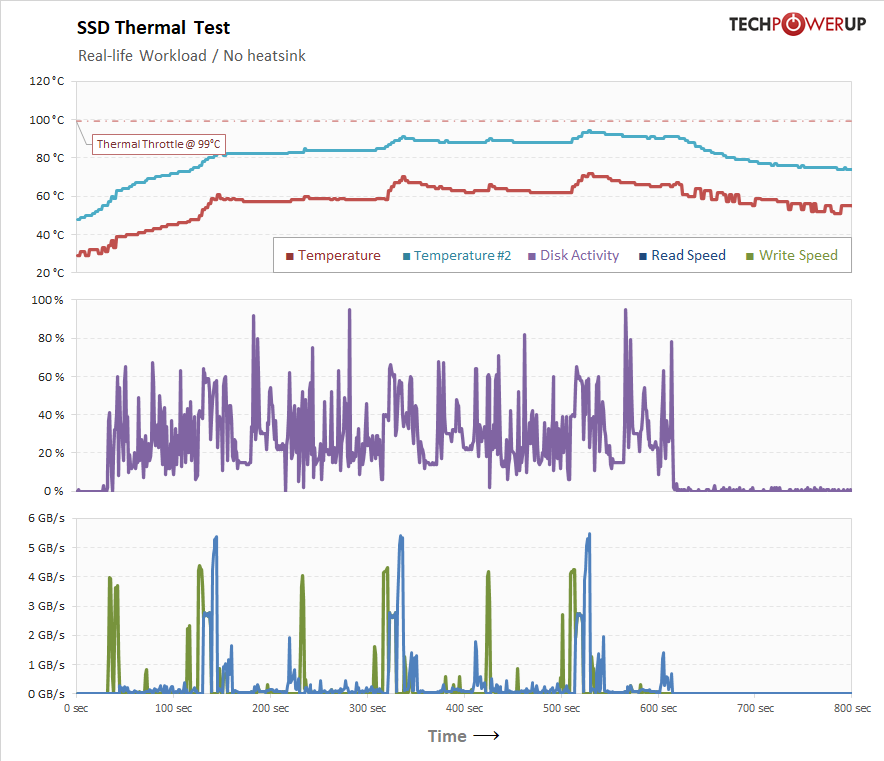
No thermal throttling.
Thermal Stress Test
In these tests, the SSD is hammered by nonstop incoming writes to simulate worst-case thermal stress under the heaviest possible load. The test also checks how the drive deals with thermal throttling and whether it continues to function normally.Bare Drive
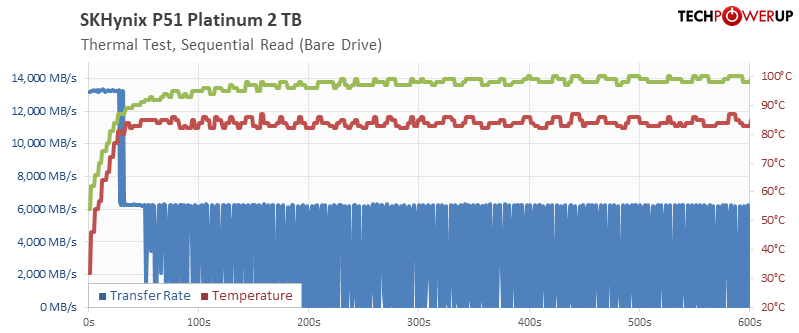
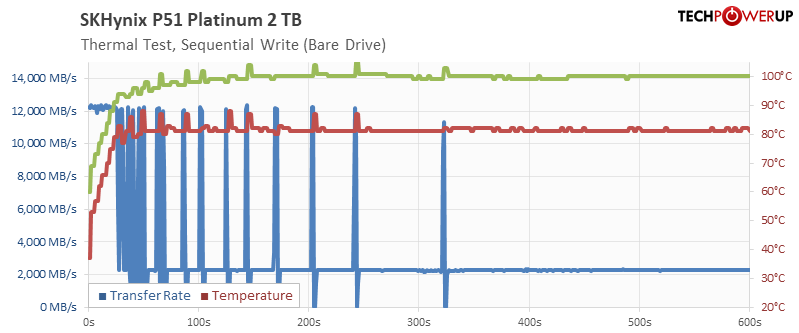
SK Hynix ships their drive without a heatsink or heat spreader. While our real-life thermal testing shows that there is no throttling, the thermal stress test throttles after less than a minute, which is usually enough for light workloads, but not for sustained highly demanding disk activity.
Drive with Thermalright Heatsink
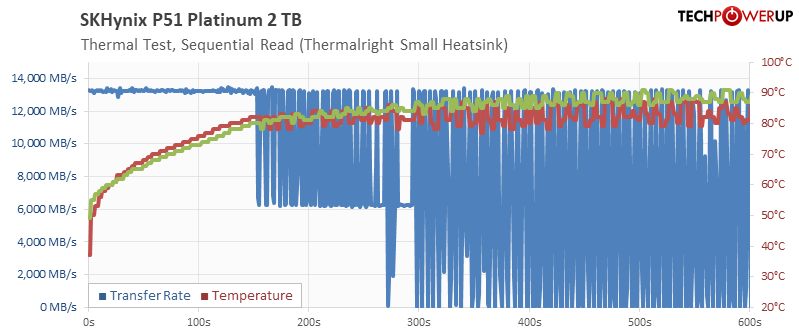
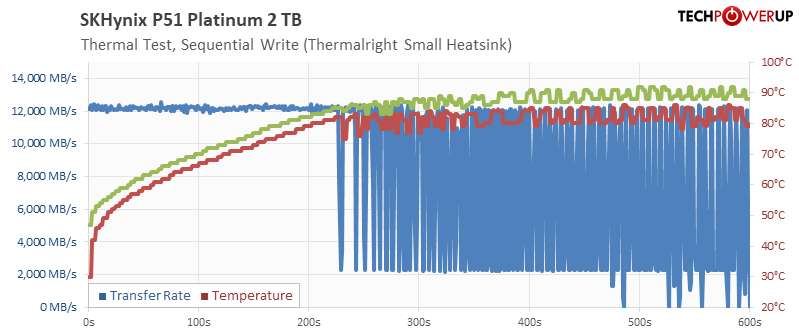
I installed a Thermalright TR-M2, which is a compact full-metal heatsink. The point of throttling is prolonged by a huge amount, but not eliminated completely.
Drive with big Thermalright Heatsink
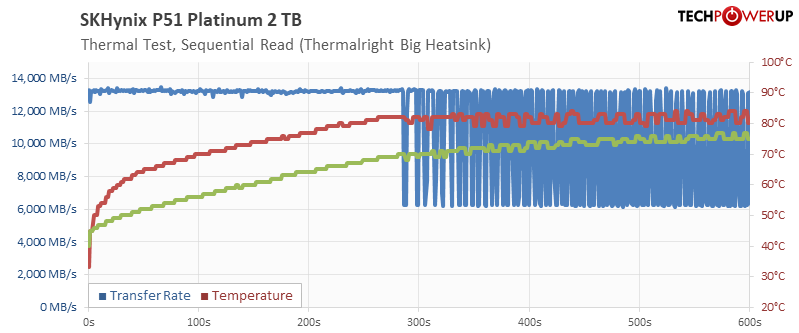
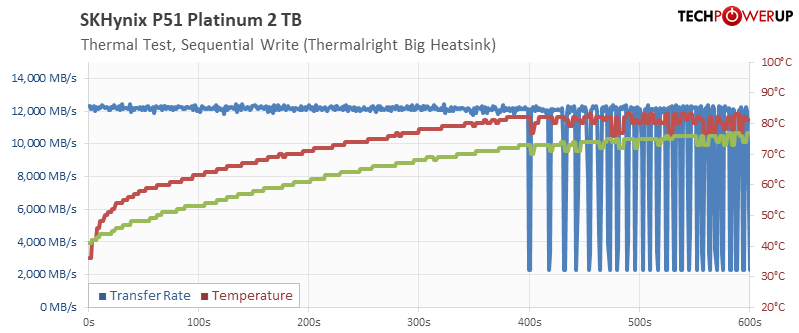
With the much bigger Thermalright HR-10, throttling is still happening.
Drive with Sticker Removed
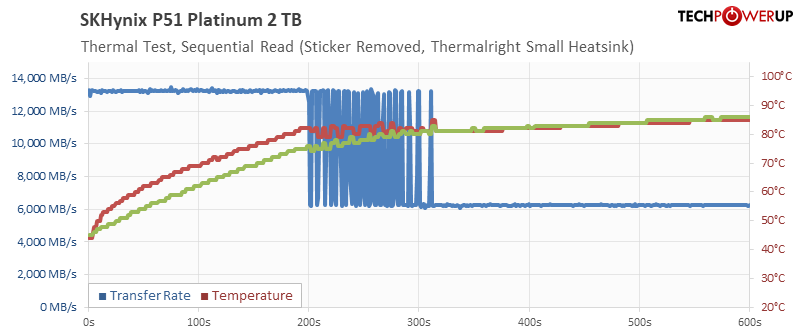
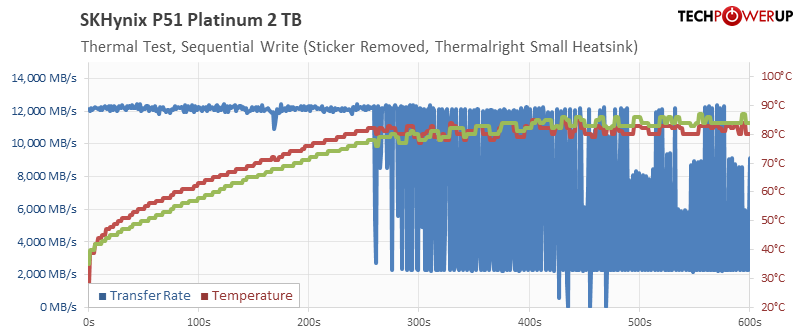
I suspected that the sticker is adding some thermal resistance, so I tested the drive without it, but there wasn't a huge difference.
Thermal Image & Hot Spot
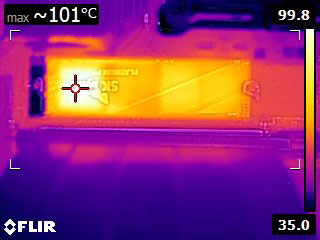
We recorded a thermal image of the running SSD as it was completing the thermal stress test. The surface temperature of the drive reached 100°C. This is a high but very reasonable maximum—the higher limit helps avoid thermal throttling. These chips are designed to run at even higher temperatures without issues.
Nov 25th, 2026 16:36 CST
change timezone
Latest GPU Drivers
New Forum Posts
- TPU's Nostalgic Hardware Club (22208)
- Which ryzen am5 cpu ? (217)
- UPS what one to get? (74)
- More Nova Lake specs (5)
- Share your CPUZ Benchmarks! (2680)
- X79 and/or rampage IV OC'ing thread for those of us still left.... (2457)
- Asus Rog Maximus Z890 Extreme. (Various questions). (38)
- Can you guess Which game it is? (362)
- Claude credits purchased on or after Dec. 7 now have an expiry date (13)
- Adventure: Running 8/9th gen Coffee Lake CPUs on Z170 motherboard (ASUS Maximus VIII Ranger) (393)
Popular Reviews
- ASRock X870E Challenger Wi-Fi White Review
- Microsoft Surface Laptop Ultra Review - The Next-gen Arm Laptop
- VZMORE AX9 Max Review
- Upcoming Hardware Launches 2027 (Updated Nov 2026)
- AMD Ryzen 7 9800X3D Review - The Best Gaming Processor
- AMD Zen 6 Technical Deep Dive
- Corsair RM1200e (Second Generation) Review
- Phantom Blade Zero Performance Benchmark Review - 35 GPUs Tested
- Pulsar Office Tour & First Look at P1 Dual-Sensor Mouse
- Ocypus lota P1000 Review
TPU on YouTube
Controversial News Posts
- Jensen Huang Reinstated as CEO of NVIDIA (570)
- NVIDIA Co-Founder and CEO Jensen Huang Officially Resigns (492)
- Report: Jensen Huang Eyes NVIDIA Comeback (281)
- Open Letter Asking NVIDIA to Reinstate Jensen Huang Passes 115,000 Signatures (184)
- OpenAI CEO Argues Home PCs Waste the World's Limited DRAM Supply (152)
- NVIDIA Launches Investigation Into Jensen Huang's Relationship With Suspected Chinese Spy (136)
- Intel "Raptor Lake Next" 16-Core and 20-Core CPUs Surface (130)
- Intel Razor Lake Gets a 12 P-Core bLLC Chip With No E-Cores, Per Leak (94)