 12
Thermaltake Dockpower FI 1000W Review
Value & Conclusion »Result Summary
| Full-Range Load Testing (230 V) | |||||||||
|---|---|---|---|---|---|---|---|---|---|
| All-rail Load | 12 V | 5 V | 3.3 V | Power (DC/AC) | Efficiency | Fan Speed | Noise Level | Power Factor | |
| 0 % | 0.00 A | 0.00 A | 0.00 A | 0.00 W | N/A | 651 RPM | 26.2 dBA | 0.18 | |
| 12.14 V | 5.14 V | 3.32 V | 8.00 W | ||||||
| 5 % | 4.17 A | 4.00 A | 6.06 A | 50.00 W | 78.05 % | 660 RPM | 26.3 dBA | 0.67 | |
| 12.12 V | 5.08 V | 3.31 V | 64.50 W | ||||||
| 10 % | 8.33 A | 4.00 A | 6.06 A | 100.00 W | 85.60 % | 660 RPM | 26.3 dBA | 0.83 | |
| 12.09 V | 5.07 V | 3.31 V | 117.70 W | ||||||
| 20 % | 16.67 A | 4.00 A | 6.06 A | 200.00 W | 90.15 % | 660 RPM | 26.3 dBA | 0.91 | |
| 12.07 V | 5.06 V | 3.30 V | 224.00 W | ||||||
| 30 % | 25.00 A | 4.00 A | 6.06 A | 300.00 W | 91.96 % | 668 RPM | 26.4 dBA | 0.94 | |
| 12.04 V | 5.05 V | 3.30 V | 330.10 W | ||||||
| 40 % | 33.33 A | 4.00 A | 6.06 A | 400.00 W | 92.19 % | 668 RPM | 26.4 dBA | 0.96 | |
| 12.01 V | 5.04 V | 3.29 V | 440.10 W | ||||||
| 50 % | 41.67 A | 4.00 A | 6.06 A | 500.00 W | 92.29 % | 668 RPM | 26.4 dBA | 0.97 | |
| 11.98 V | 5.03 V | 3.29 V | 550.80 W | ||||||
| 60 % | 50.00 A | 4.00 A | 6.06 A | 600.00 W | 92.42 % | 668 RPM | 26.4 dBA | 0.97 | |
| 11.96 V | 5.02 V | 3.28 V | 661.70 W | ||||||
| 70 % | 58.33 A | 4.00 A | 6.06 A | 700.00 W | 91.78 % | 668 RPM | 26.4 dBA | 0.98 | |
| 11.94 V | 5.01 V | 3.28 V | 779.30 W | ||||||
| 80 % | 66.67 A | 4.00 A | 6.06 A | 800.00 W | 91.28 % | 1191 RPM | 29.1 dBA | 0.98 | |
| 11.91 V | 5.00 V | 3.27 V | 897.90 W | ||||||
| 90 % | 75.00 A | 4.00 A | 6.06 A | 900.00 W | 90.98 % | 1191 RPM | 29.1 dBA | 0.98 | |
| 11.88 V | 4.99 V | 3.27 V | 1016.00 W | ||||||
| 100 % | 83.33 A | 4.00 A | 6.06 A | 1000.00 W | 90.73 % | 1200 RPM | 31.8 dBA | 0.98 | |
| 11.85 V | 4.98 V | 3.26 V | 1135.00 W | ||||||
| 110 % | 91.67 A | 4.00 A | 6.06 A | 1100.00 W | 90.42 % | 1208 RPM | 31.8 dBA | 0.98 | |
| 11.82 V | 4.98 V | 3.26 V | 1256.00 W | ||||||
Efficiency
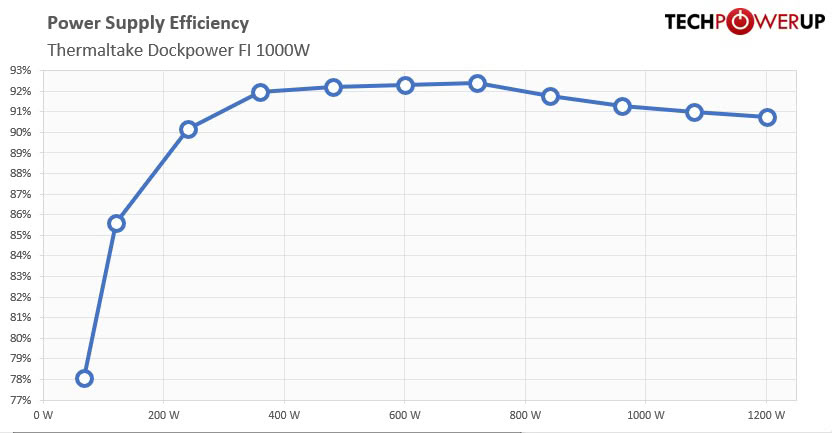
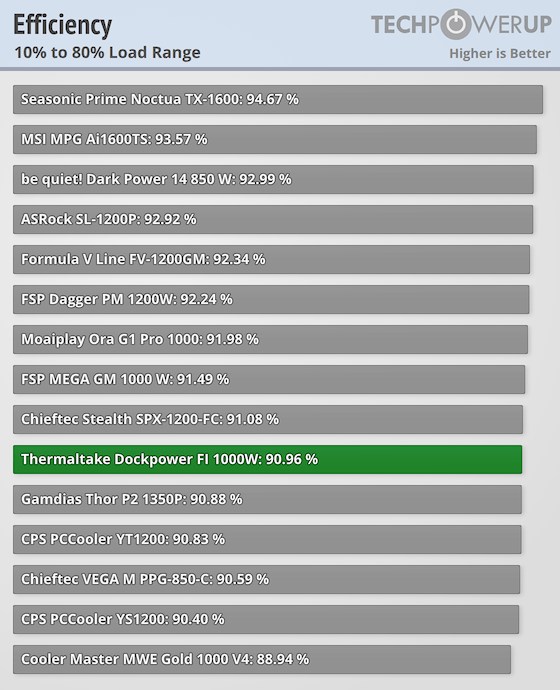
The efficiency of this unit is great, performing strongly up to around 700 W. It could perform even better with some thicker cables, and without the dock connection.
This supply is rated as 80 Plus Gold; however, this will be based on the 115 V measurements. Thermaltake does not provide an 80 Plus rating at 230 V, so we will compare the measurements to the 80 Plus Gold (230 V) standard.
| Rated Efficiency Validation (230 V) | ||||
|---|---|---|---|---|
| Certification: 80 Plus Gold | ||||
| Test Load | Required | Measured | Margin | Status |
| 20% | 90.00 % | 90.15 % | +0.15 % | Pass |
| 50% | 92.00 % | 92.29 % | +0.29 % | Pass |
| 100% | 89.00 % | 90.73 % | +1.73 % | Pass |
This model clears the efficiency requirements for an 80 Plus Gold rating at 230 V very comfortably.
Fan Noise
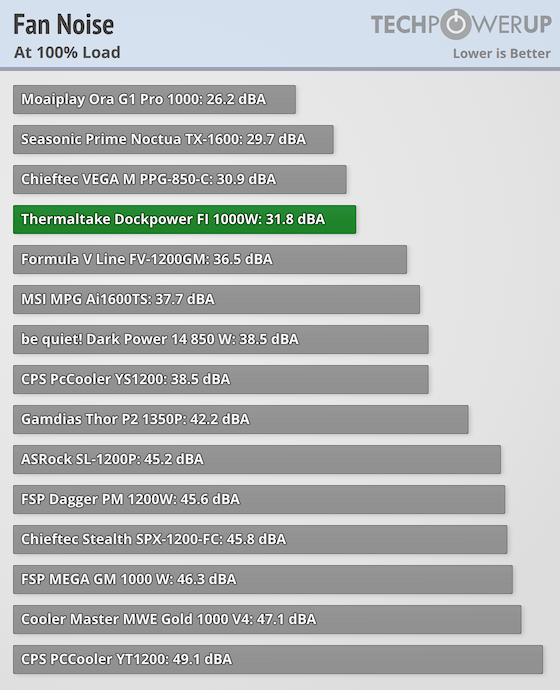
The fan curve progresses in steps rather than a smooth ramp, and even on the highest step the fan is kept at a reasonable speed and is not particularly loud as a result. The noise profile is a low hum without harsh higher harmonics or mechanical sounds. It will easily vanish when built into a case in a typical quiet room even at high loads.
Voltage Regulation
All ATX PSUs have a voltage regulation feedback loop, which increases the PWM duty cycle for each rail to account for voltage drop when current is drawn. However, most PSUs only measure voltage at the PSU output, rather than at the end of the cable going to the load. This means any voltage drop across the cable is not automatically adjusted for. The ATX 3.1 specification outlines a maximum allowed voltage drop at the load itself to ensure system stability.| Voltage Regulation & ATX 3.0 Compliance | |||||
|---|---|---|---|---|---|
| Test Load | Rail | Measured | ATX 3.0 Spec Limit | Margin | Status |
| Idle (0%) | +12V | 12.14 V | +5% / -8% | +1.17 % | Pass |
| +5V | 5.14 V | ±5% | +2.80 % | Pass | |
| +3.3V | 3.32 V | ±5% | +0.61 % | Pass | |
| 100% Load | +12V | 11.85 V | +5% / -8% | -1.25 % | Pass |
| +5V | 4.98 V | ±5% | -0.40 % | Pass | |
| +3.3V | 3.26 V | ±5% | -1.21 % | Pass | |
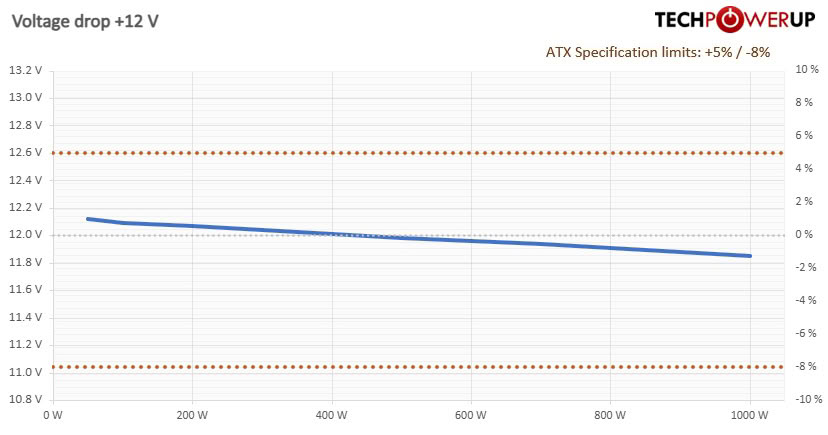
The Dockpower FI 1000W performs great, with voltages well within specification both at idle and under full load.
Cable Quality
Although voltage regulation inside modern PSUs is extremely stable, voltage drop and thus power losses will occur across the cables as current is drawn through them. This results in a lower voltage available to the system components than is actually measured at the PSU outputs. Thicker cables will cause less voltage drop and more power to the components. Any power lost across the cables is wasted as heat in the wire itself. By measuring the voltage drop at a known load, we can calculate the resistance of the cables.| Cable Losses at Full Load | |
|---|---|
| Applied 12 V Load | 81.92 A |
| Measured @ Supply | 12.10 V |
| Measured @ Load | 11.85 V |
| Power Lost in Cable | 20.48 W |
| Per-Cable Resistance | 91.55 mΩ |
| Cable Temperature | 40.9 °C |
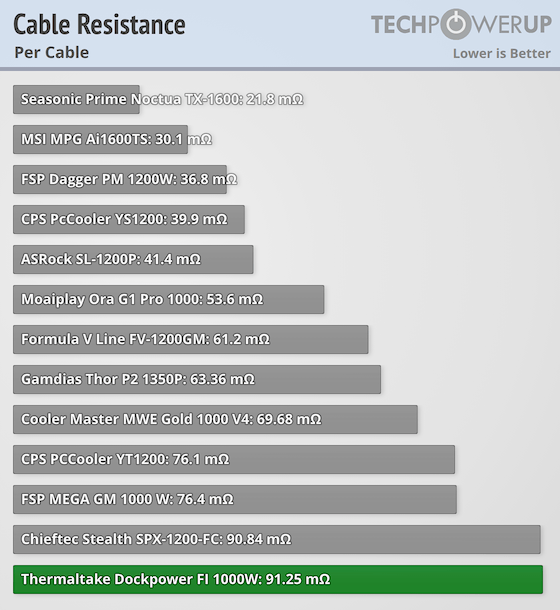
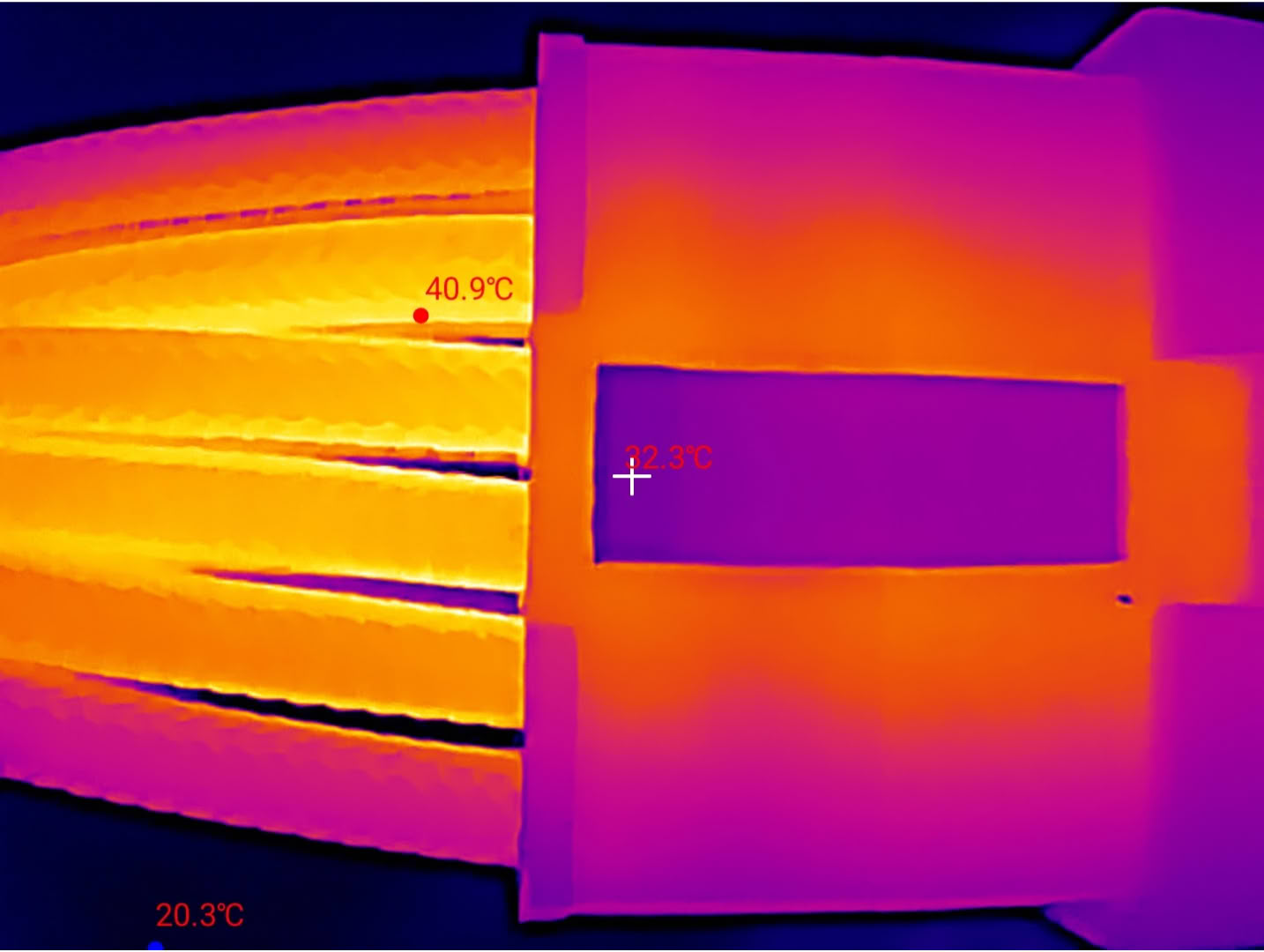
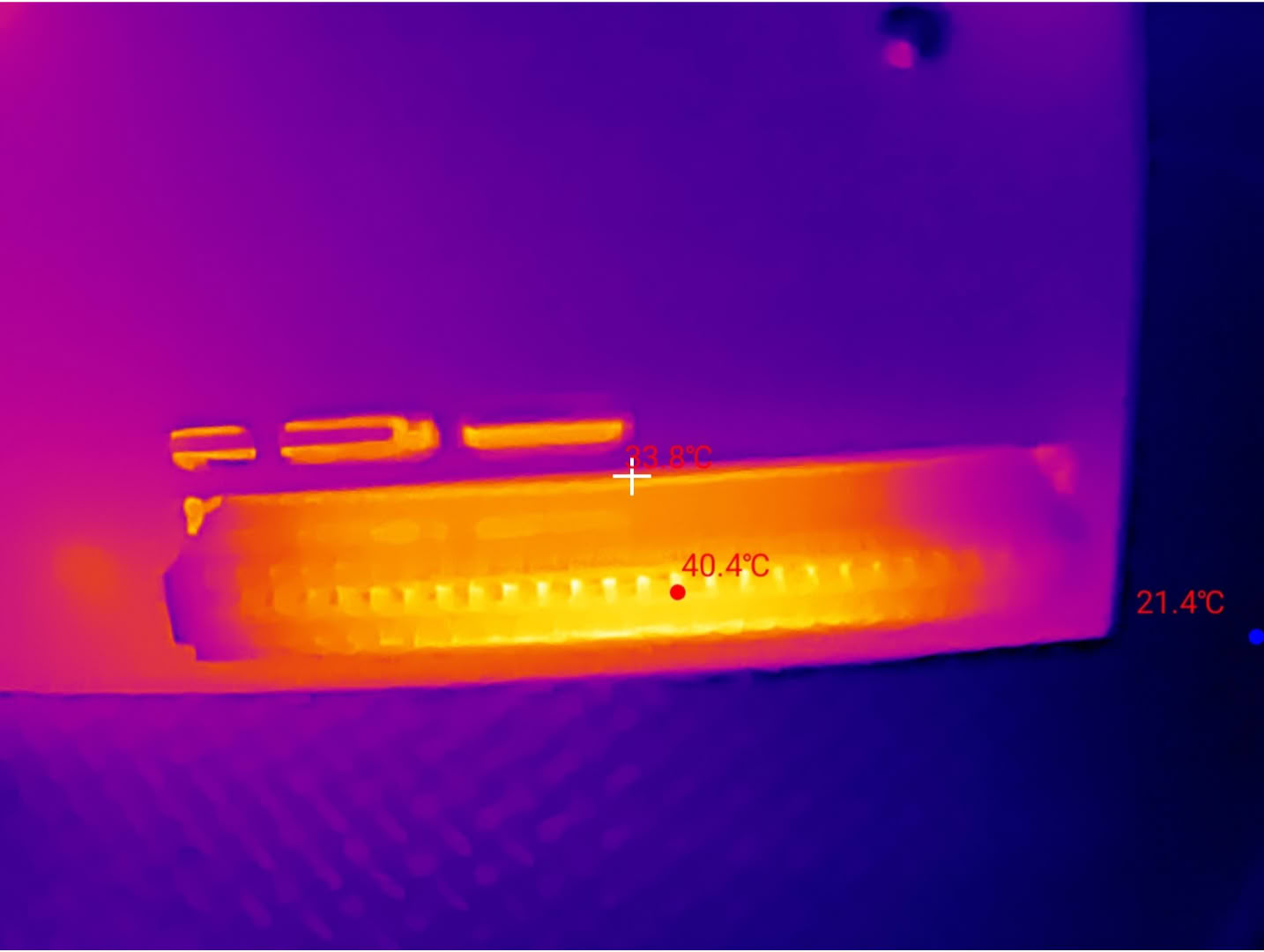
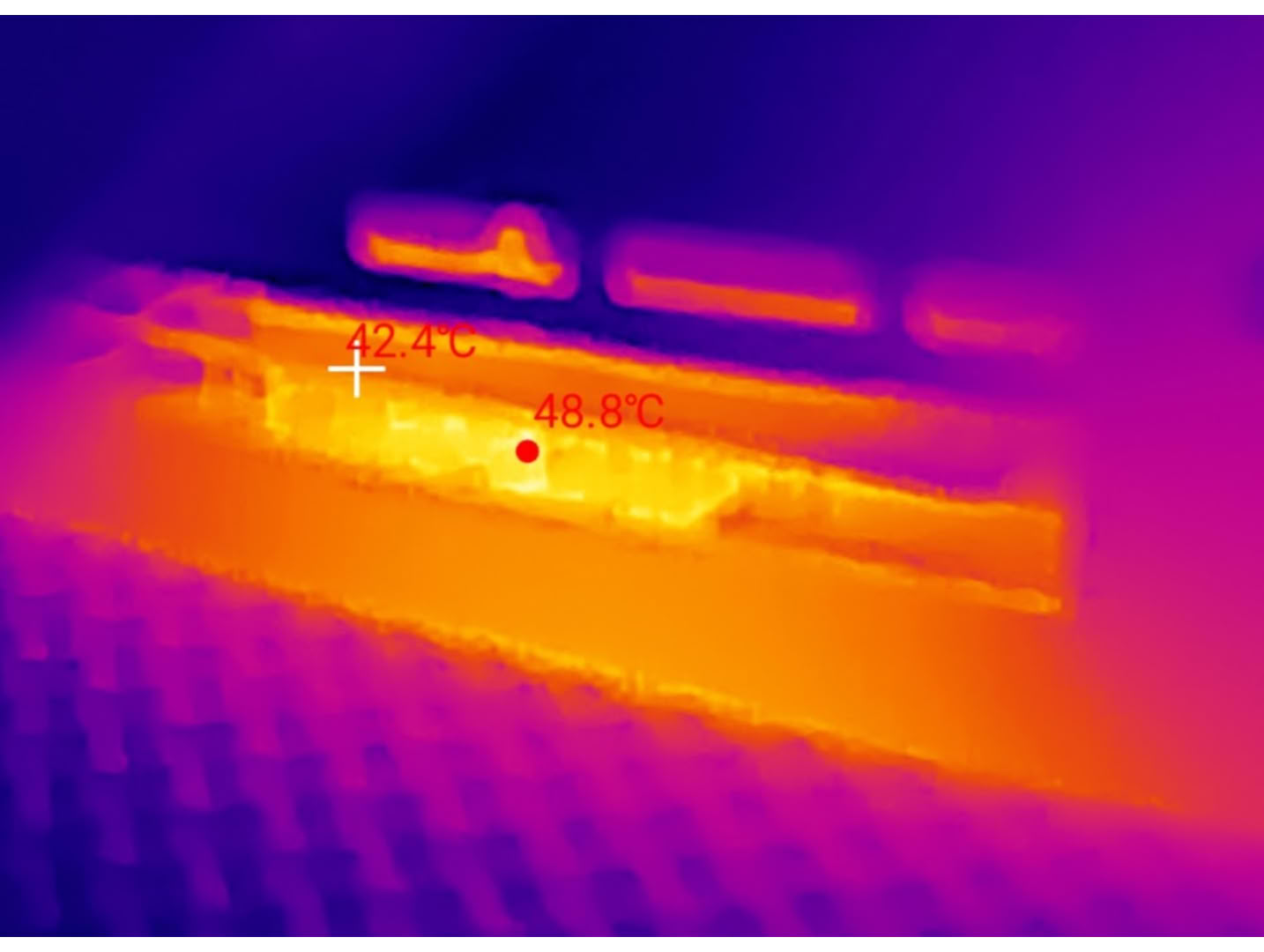
The included cables have quite a high resistance and run hotter than most units we have tested, but they are not approaching any risk of melting or causing damage. The tab and connector do also generate some heat at heavy load, but again it is not causing significant power loss or voltage drop, and will generally not be a concern.
Ripple
Ideally you want the DC voltage delivered by your power supply to be a completely flat line when looking through an oscilloscope. However, due to the switching nature of the ATX power supply and the less than ideal real world behavior of all the components involved, we get very small fluctuations in the voltage output, known as ripple and noise. The ATX spec allows a ripple of up to 120 mV for the +12 V rail and 50 mV for the minor rails (measured in mV P-P).| Ripple (mV P-P) | ||||
|---|---|---|---|---|
| Test Load | 12 V | 5 V | 3.3 V | Status |
| 10% | 24.24 mV | 15.90 mV | 15.02 mV | Pass |
| 20% | 27.15 mV | 16.08 mV | 15.16 mV | Pass |
| 30% | 28.11 mV | 17.55 mV | 16.44 mV | Pass |
| 40% | 29.11 mV | 18.82 mV | 17.07 mV | Pass |
| 50% | 30.25 mV | 19.38 mV | 17.91 mV | Pass |
| 60% | 31.90 mV | 19.97 mV | 18.68 mV | Pass |
| 70% | 33.38 mV | 21.26 mV | 19.56 mV | Pass |
| 80% | 35.11 mV | 22.70 mV | 21.89 mV | Pass |
| 90% | 35.53 mV | 23.93 mV | 22.79 mV | Pass |
| 100% | 36.39 mV | 24.51 mV | 23.52 mV | Pass |
| 110% | 37.79 mV | 25.84 mV | 24.65 mV | Pass |
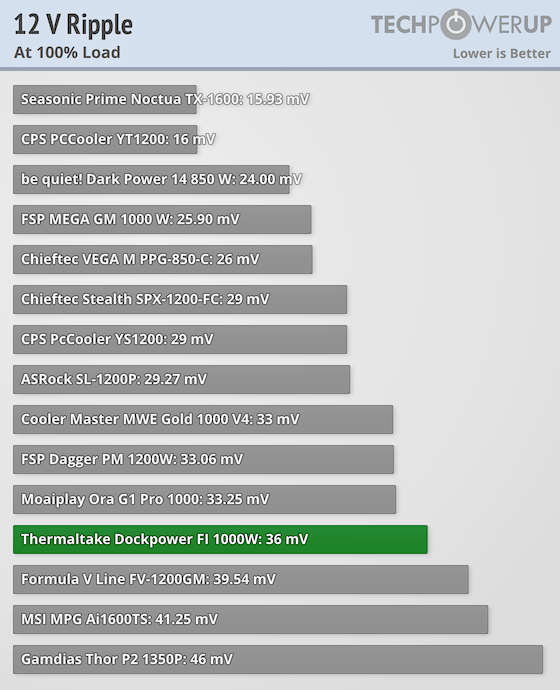
The ripple results are very similar to the MOIPLAY and Formula V models which is understandable as the PCB designs are almost the same. Ripple is controlled well and results are nicely within ATX specification, although the performance is not outstanding.
Short Circuit Protection
Short circuit protection is one of the most fundamental and important protections for a power supply. If a short circuit is detected on any rails, the PSU should turn off and prevent damage to itself and other components.| Short Circuit Protection | |
|---|---|
| +12 V rail | Operational |
| +5 V rail | Operational |
| +3.3 V rail | Operational |
SCP was working as expected with the unit.
Nov 19th, 2026 15:56 CST
change timezone
Latest GPU Drivers
New Forum Posts
- Honestly, do you care about GTA VI? (163)
- Windows 11 General Discussion (7736)
- Current Sales, Bundles, Giveaways (10448)
- Last game you purchased? (1409)
- WarpCoreBench scores! (76)
- Got the EOL 32GB TridentZ 6000 CL26 1.4V (12)
- Dell Workstation Owners Club (3516)
- Making a game in Godot engine (4)
- DTS DCH Driver for Realtek HDA [DTS:X APO4 + DTS Interactive] (2815)
- Security Apps (2)
Popular Reviews
- Acemagic Retro X3 Review
- Ugreen NASync DXP4800 GT Review
- Upcoming Hardware Launches 2027 (Updated Nov 2026)
- Pulsar Office Tour & First Look at P1 Dual-Sensor Mouse
- AMD Zen 6 Technical Deep Dive
- Biwin Black Opal NV7400 2 TB Review
- Sapphire Radeon RX 7700 XT Pure Review
- Sapphire Radeon RX 7700 XT Pulse Review
- AMD Ryzen 7 9800X3D Review - The Best Gaming Processor
- Chieftec Iceberg PRO 360 DARK Review
TPU on YouTube
Controversial News Posts
- NVIDIA Co-Founder and CEO Jensen Huang Officially Resigns (488)
- Report: Jensen Huang Eyes NVIDIA Comeback (223)
- Open Letter Asking NVIDIA to Reinstate Jensen Huang Passes 115,000 Signatures (184)
- OpenAI CEO Argues Home PCs Waste the World's Limited DRAM Supply (152)
- NVIDIA Launches Investigation Into Jensen Huang's Relationship With Suspected Chinese Spy (136)
- Intel "Raptor Lake Next" 16-Core and 20-Core CPUs Surface (130)
- Legendary Game Studio BioWare Shuts Down Following EA Layoffs (104)
- Dell CEO Says the Memory Shortage Will Get Worse in 2027 (95)