 5
UPERFECT UColor O2 Review - A Panel Worth Packing
Value & Conclusion »Gaming Performance
The UPERFECT UColor O2 sports a 120 Hz refresh rate OLED panel with no adaptive synchronization support. At native resolution, the panel can reach 120 Hz refresh rate only when USB-C input is used. HDMI connectivity is capped at 100 Hz, unless you're willing to use a lower resolution.Response Time and Overdrive
I tested the response time with the Open Source Response Time Tool Pro (OSRTT Pro), developed by Andrew McDonald of TechTeamGB. It's a nifty tool that, combined with the OSRTT Launcher app, measures panel response times and presents them through detailed graphs and easy-to-read heatmaps. You can find everything you might want to know about the OSRTT in its technical documentation and on the official website, where you can order your unit, too. The OSRTT Launcher gives us three interesting heat maps to observe.Perceived Response Time tells us how much time the panel took to transition from one color to another. This measurement is expressed in milliseconds and includes overshoot. In other words, if the panel exceeded the target value, the perceived response time also includes the time it took for the transition to recover from overshoot and stabilize on the target value. I'm running my tests with recommended settings, so with a fixed RGB 5 tolerance level and with gamma-corrected RGB values.
RGB Overshoot tells us how much a specific transition missed the target value. For example, if the panel was transitioning from RGB 51 to RGB 204, and it initially landed on RGB 212, the overshoot RGB value is 8. Overshoot can be both positive and negative, and it commonly occurs at extreme overdrive settings when pixels are driven by high voltage. In practice, an overshoot manifests as an afterimage or a halo around a moving object. It can be easily spotted even when doing something as basic as scrolling through a webpage.
Visual Response Rating is the most abstract heatmap generated by the OSRTT Launcher; in essence, it's an ever-evolving scoring system. To quote OSRTT's technical documentation, it is a finite score rather than a direct measurement. The calculation is pretty simple; it's: "100 – (Initial Response Time + Perceived Response Time)." Since both metrics use the same tolerance level, if a display doesn't overshoot, both times will be identical. This essentially rewards displays that are fast with a small amount of overshoot over displays that aren't as fast even if they don't overshoot at all—while still overall preferring ultra-fast, accurate monitors.
Here's how the UPERFECT UColor O2 fares in the pixel response time test at a 120 Hz refresh rate.
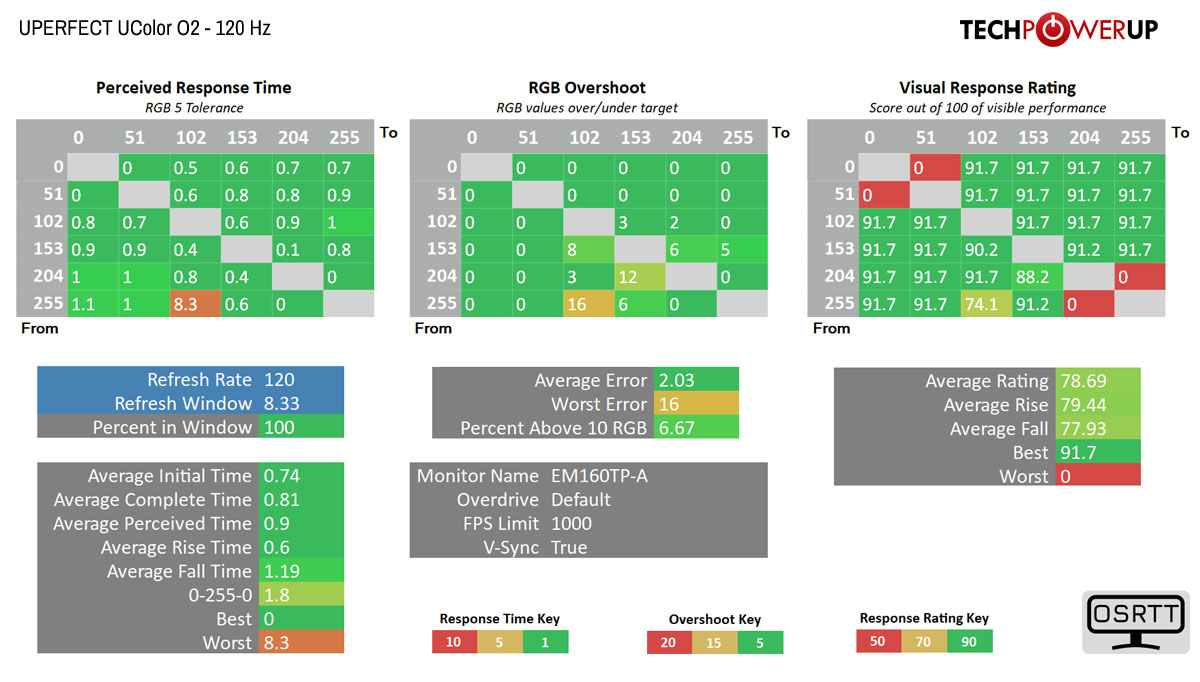
With the average perceived pixel response time measuring as low as 0.9 ms, the UColor O2 delivers a responsive and fluid experience with virtually no motion blur, even without dedicated overdrive settings. This makes the UColor O2 suitable for gaming or video consumption, and anything else where the presence of motion blur could be an issue.
Input Lag
To measure the input lag of a monitor, I switched from using the LDAT V2 (Latency Display Analysis Tool), which I've covered extensively in my NVIDIA Reflex review, to the OSRTT Pro Tool. The OSRTT Pro Tool and the accompanying software include a DirectX code developed by Andrew McDonald of TechTeamGB, which allows the OSRTT Launcher to track the events and capture the frame time, making it possible to isolate the monitor latency from other factors that come into play when using the click-to-photon testing methodology, namely the USB polling rate and game render time. For a deeper insight, I suggest you watch an excellent overview video made by Andy himself. Thanks to Andy for his tireless work on the OSRTT Tool and the OSRTT Launcher software!Here's how the UPERFECT UColor O2 holds up in terms of input lag after doing 100 iterations of the input lag test.
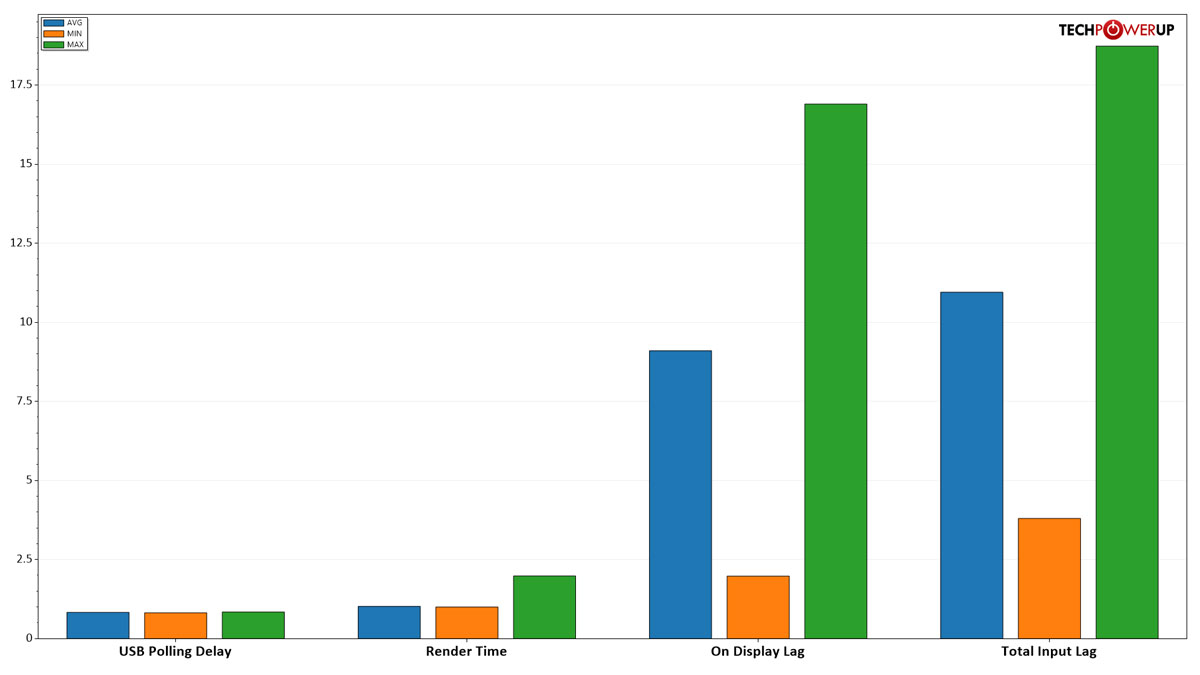
The measured input lag of the UPERFECT UColor O2 averages around 9 milliseconds, which is relatively high for a 120 Hz OLED panel and noticeably more than what is typically expected from a display of this type. While this won't pose a problem for general use or media consumption, it can be a limiting factor for latency-sensitive applications like competitive gaming. In casual or productivity scenarios, the delay is unlikely to be perceptible, but the result does put the UColor O2 behind faster desktop OLEDs and even many gaming-grade portable IPS alternatives in terms of responsiveness.
Nov 26th, 2026 07:08 CST
change timezone
Latest GPU Drivers
New Forum Posts
- Wireless Internet sharing between PC and router both-ways, is it possible? (21)
- GTA VI (51)
- Current Sales, Bundles, Giveaways (10451)
- Without Jensen, PC gaming will be (61)
- WarpCoreBench scores! (105)
- Which ryzen am5 cpu ? (220)
- Exploring Local LLMs: Models, Hardware and Setup Experiences (2)
- Radeon driver death (2)
- Claude credits purchased on or after Dec. 7 now have an expiry date (19)
- Smokin Hot Lappy (14)
Popular Reviews
- ASRock X870E Challenger Wi-Fi White Review
- VZMORE AX9 Max Review
- Upcoming Hardware Launches 2027 (Updated Nov 2026)
- Microsoft Surface Laptop Ultra Review - The Next-gen Arm Laptop
- AMD Ryzen 7 9800X3D Review - The Best Gaming Processor
- AMD Zen 6 Technical Deep Dive
- Corsair RM1200e (Second Generation) Review
- Phantom Blade Zero Performance Benchmark Review - 35 GPUs Tested
- Pulsar Office Tour & First Look at P1 Dual-Sensor Mouse
- Montech CyberFlow ARGB 360 Review
TPU on YouTube
Controversial News Posts
- Jensen Huang Reinstated as CEO of NVIDIA (583)
- NVIDIA Co-Founder and CEO Jensen Huang Officially Resigns (492)
- Report: Jensen Huang Eyes NVIDIA Comeback (281)
- Open Letter Asking NVIDIA to Reinstate Jensen Huang Passes 115,000 Signatures (184)
- OpenAI CEO Argues Home PCs Waste the World's Limited DRAM Supply (152)
- NVIDIA Launches Investigation Into Jensen Huang's Relationship With Suspected Chinese Spy (136)
- Intel "Raptor Lake Next" 16-Core and 20-Core CPUs Surface (130)
- Intel Razor Lake Gets a 12 P-Core bLLC Chip With No E-Cores, Per Leak (94)