 116
XFX Radeon RX 9070 XT Mercury OC Magnetic Air Review
(116 Comments) »Introduction

We have with us the XFX Radeon RX 9070 XT Mercury OC Magnetic Air. This is the company's most premium custom-design rendition of AMD's new performance-segment GPU that's making waves for restoring competition. The XFX Mercury OC comes with the company's heaviest and most capable cooling solution with an innovative and tool-free fan removal design. It also comes with a powerful VRM solution and a triple 8-pin power connector setup to ensure adequate overclocking headroom, given that the RX 9070 XT will be the top graphics card in the RX 9000 series.
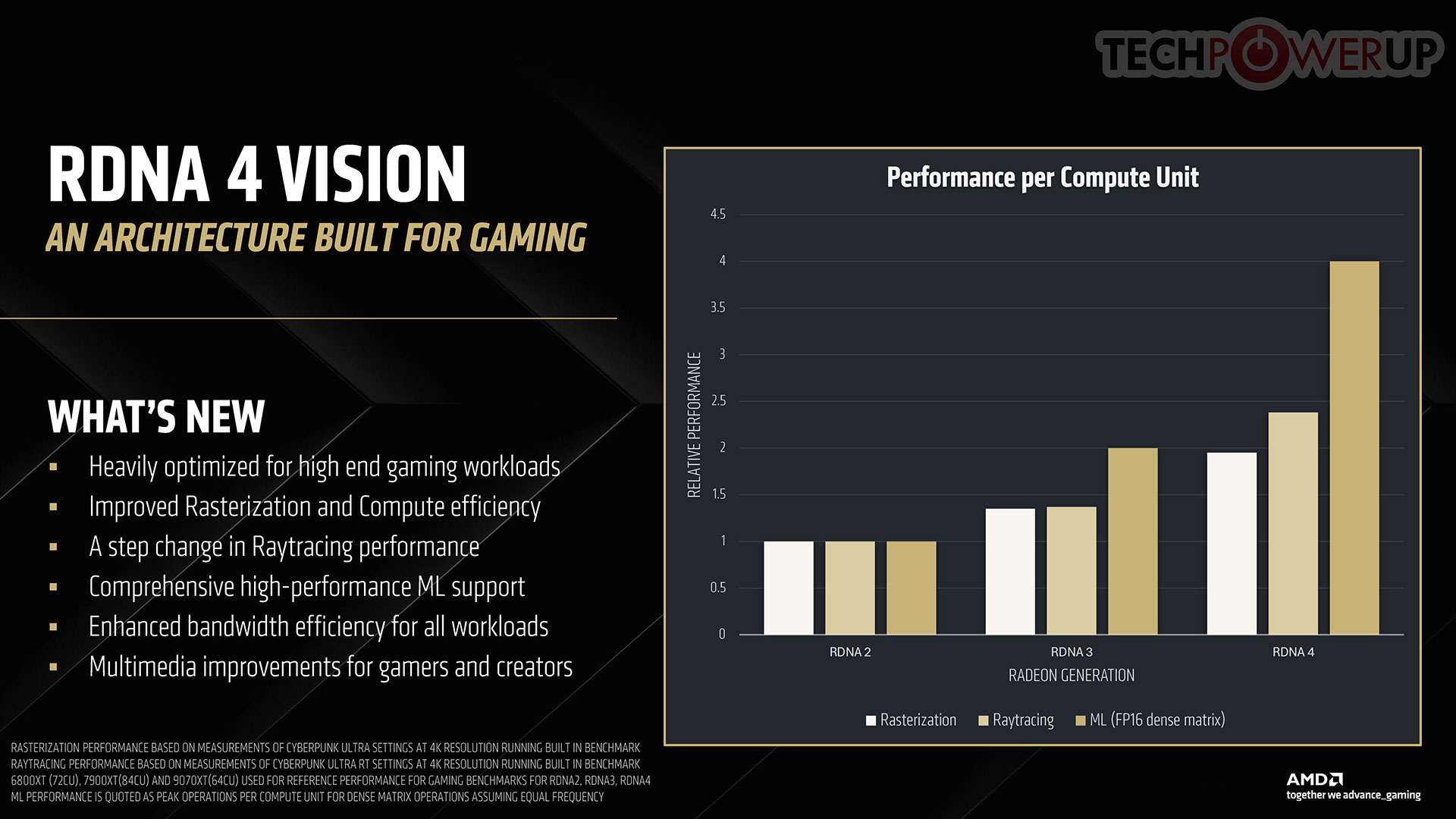
The new AMD Radeon RX 9070 XT is designed to offer maxed out gaming experiences at 1440p, including with ray tracing, as well as 4K Ultra HD gaming at acceptable performance levels. The GPU is based on AMD's latest RDNA 4 graphics architecture that offers a generational leap in performance per compute unit (CU) over the previous RDNA 3, allowing AMD to create a lean GPU that can remain competitive even as prices drop over time. The biggest strides AMD has taken are in the areas of ray tracing performance and AI acceleration.

The new RDNA 4 RT engine offers a 100% gain in ray tracing performance, lowering the cost of enabling it in games. Advances made in AI acceleration throughput paved the way for AMD to innovate FSR 4, the biggest update to its performance enhancement technology suite so far. FSR 4 uses an AI ML-based upscaling algorithm to reconstruct details in upscaled frames. This offers significant improvements to image quality at every performance preset over FSR 3.
The Radeon RX 9070 XT is based on the 4 nm Navi 48 silicon, which it maxes out. The company built this generation of GPUs on the TSMC N4P foundry node, which improves efficiency over the TSMC N5 node that the previous generation Navi 31 and Navi 32 chips used for their compute dies. Navi 48 is a traditional monolithic chip, and not a chiplet-based one, and so all components, including the memory controllers and Infinity Cache, are built on the newer node, resulting in a significantly smaller chip than Navi 31, but at comparable transistor counts.
The RX 9070 XT gets all 64 RDNA 4 compute units (CUs) present on the Navi 48, resulting in 4,096 stream processors, 128 AI accelerators, and 64 ray accelerators. Other key specs include 256 TMUs, and 128 ROPs. The RX 9070 XT comes with 16 GB of memory across a 256-bit memory bus, but this is the older generation GDDR6, running at 20 Gbps, and yielding 640 GB/s of memory bandwidth. AMD probably chose the older GDDR6 to give itself better headroom to wage price-wars against its competition, by relying on architecture-level innovations to overcome comparatively lower bandwidth when compared to the competition, namely the RTX 5070 Ti.
The XFX Radeon RX 9070 XT Mercury OC Magnetic Air offers the company's highest factory overclock, with a 2570 MHz Game clock compared to 2400 MHz reference. It features a unique set of axial airflow fans that are held in place with a magnetic interlock. The back of the fan hub and the base of the fan frame come with circular grooves that are magnetized. These grooves have the fan's electrical traces running through them. You pull the fans out of the cooler manually, but without needing any tools. This allows you to keep the fans and portions of the heatsink underneath clean. The cooler also comes with a tastefully executed RGB lighting setup along the top-edge. There are enthusiast features such as dual-BIOS and ARGB headers to sync your rig's lighting to that of the card. XFX is pricing the RX 9070 XT Mercury OC Magnetic Air at $800, a whopping 33% premium over the $600 baseline price.
| Price | Cores | ROPs | Core Clock | Boost Clock | Memory Clock | GPU | Transistors | Memory | |
|---|---|---|---|---|---|---|---|---|---|
| RTX 3080 | $420 | 8704 | 96 | 1440 MHz | 1710 MHz | 1188 MHz | GA102 | 28000M | 10 GB, GDDR6X, 320-bit |
| RTX 4070 | $490 | 5888 | 64 | 1920 MHz | 2475 MHz | 1313 MHz | AD104 | 35800M | 12 GB, GDDR6X, 192-bit |
| RX 7800 XT | $440 | 3840 | 96 | 2124 MHz | 2430 MHz | 2425 MHz | Navi 32 | 28100M | 16 GB, GDDR6, 256-bit |
| RX 6900 XT | $450 | 5120 | 128 | 2015 MHz | 2250 MHz | 2000 MHz | Navi 21 | 26800M | 16 GB, GDDR6, 256-bit |
| RX 6950 XT | $630 | 5120 | 128 | 2100 MHz | 2310 MHz | 2250 MHz | Navi 21 | 26800M | 16 GB, GDDR6, 256-bit |
| RTX 3090 | $900 | 10496 | 112 | 1395 MHz | 1695 MHz | 1219 MHz | GA102 | 28000M | 24 GB, GDDR6X, 384-bit |
| RTX 4070 Super | $590 | 7168 | 80 | 1980 MHz | 2475 MHz | 1313 MHz | AD104 | 35800M | 12 GB, GDDR6X, 192-bit |
| RX 7900 GRE | $530 | 5120 | 160 | 1880 MHz | 2245 MHz | 2250 MHz | Navi 31 | 57700M | 16 GB, GDDR6, 256-bit |
| RTX 4070 Ti | $700 | 7680 | 80 | 2310 MHz | 2610 MHz | 1313 MHz | AD104 | 35800M | 12 GB, GDDR6X, 192-bit |
| RTX 5070 | $550 | 6144 | 80 | 2325 MHz | 2512 MHz | 1750 MHz | GB205 | 31100M | 12 GB, GDDR7, 192-bit |
| RTX 4070 Ti Super | $750 | 8448 | 96 | 2340 MHz | 2610 MHz | 1313 MHz | AD103 | 45900M | 16 GB, GDDR6X, 256-bit |
| RX 7900 XT | $620 | 5376 | 192 | 2000 MHz | 2400 MHz | 2500 MHz | Navi 31 | 57700M | 20 GB, GDDR6, 320-bit |
| RX 9070 | $550 | 3584 | 128 | 2070 MHz | 2520 MHz | 2518 MHz | Navi 48 | 53900M | 16 GB, GDDR6, 256-bit |
| RX 9070 XT | $600 | 4096 | 128 | 2400 MHz | 2970 MHz | 2518 MHz | Navi 48 | 53900M | 16 GB, GDDR6, 256-bit |
| XFX RX 9070 XT Mercury OC | $800 | 4096 | 128 | 2570 MHz | 3100 MHz | 2518 MHz | Navi 48 | 53900M | 16 GB, GDDR6, 256-bit |
| RTX 3090 Ti | $1000 | 10752 | 112 | 1560 MHz | 1950 MHz | 1313 MHz | GA102 | 28000M | 24 GB, GDDR6X, 384-bit |
| RTX 5070 Ti | $750 | 8960 | 96 | 2295 MHz | 2452 MHz | 1750 MHz | GB203 | 45600M | 16 GB, GDDR7, 256-bit |
| RX 7900 XTX | $820 | 6144 | 192 | 2300 MHz | 2500 MHz | 2500 MHz | Navi 31 | 57700M | 24 GB, GDDR6, 384-bit |
| RTX 4080 | $940 | 9728 | 112 | 2205 MHz | 2505 MHz | 1400 MHz | AD103 | 45900M | 16 GB, GDDR6X, 256-bit |
| RTX 4080 Super | $990 | 10240 | 112 | 2295 MHz | 2550 MHz | 1438 MHz | AD103 | 45900M | 16 GB, GDDR6X, 256-bit |
| RTX 5080 | $1000 | 10752 | 112 | 2295 MHz | 2617 MHz | 1875 MHz | GB203 | 45600M | 16 GB, GDDR7, 256-bit |
| RTX 4090 | $2400 | 16384 | 176 | 2235 MHz | 2520 MHz | 1313 MHz | AD102 | 76300M | 24 GB, GDDR6X, 384-bit |
| RTX 5090 | $2000 | 21760 | 176 | 2017 MHz | 2407 MHz | 1750 MHz | GB202 | 92200M | 32 GB, GDDR7, 512-bit |
AMD RDNA 4 Architecture
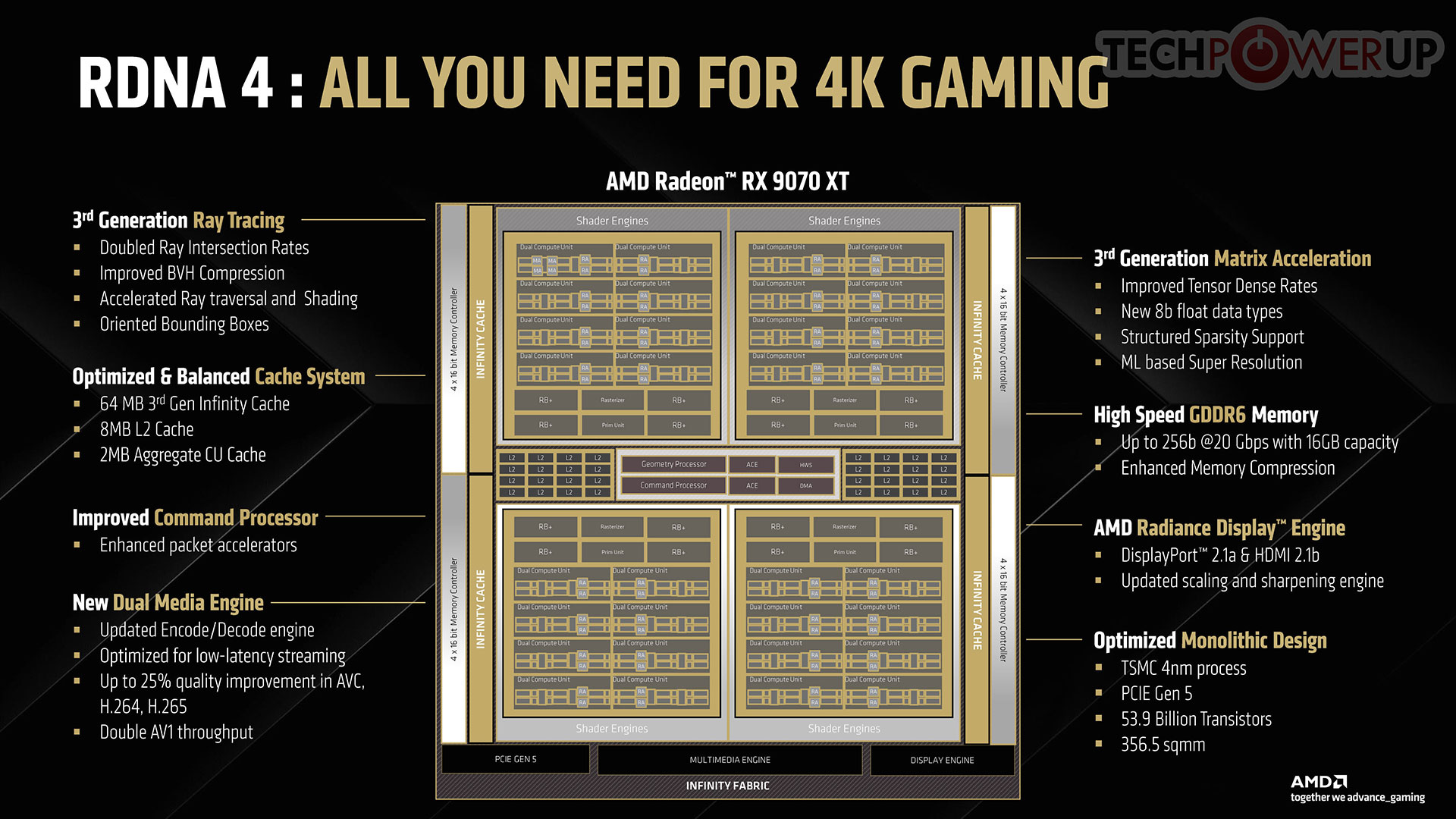
The new Radeon RX 9070 XT and RX 9070 are powered by the 4 nm Navi 48 silicon. Unlike the Navi 31 and Navi 32 before it, this is a traditional monolithic die built entirely on the TSMC N4P (4 nm EUV) process node. It has an area of 356.5 mm², but with an impressive transistor count of 53.9 billion. To put this number into context, the previous "big Navi" GPU, the Navi 31 powering the RX 7900 XTX, has 57.8 billion transistors (just 8% more), despite having 96 CU, a larger Infinity Cache, and a wider 384-bit memory bus. Navi 31 has a die area of 529 mm² (304 mm² for the 5 nm GCD, with the rest being 6 nm MCDs), so you can see the kind of strides AMD made with die-area. At the top-level, the Navi 48 features a PCI-Express 5.0 x16 host interface and a 256-bit wide GDDR6 memory bus. With 20 Gbps GDDR6 memory chips, the RX 9070 XT gets 640 GB/s of memory bandwidth. This is made up for with a faster 64 MB Infinity Cache, and a critical improvement AMD made to its memory management system, called Out-of-Order Memory Queuing.
The Navi 48 silicon physically has 64 CU spread across 4 shader engines. With each CU containing 64 stream processors, the chip has a total of 4,096 stream processors. All 64 CU are enabled on the RX 9070 XT, while the RX 9070 has 56 out of 64 of them enabled. The maxed-out Navi 48 contains 4,096 stream processors, 128 AI accelerators, 64 RT accelerators, 256 TMUs, and 128 ROPs. The chip also features 64 MB of 3rd Gen Infinity Cache, and a 256-bit wide GDDR6 memory interface, driving 16 GB of 20 Gbps memory on both the RX 9070 XT and RX 9070. With 56 CU enabled on the RX 9070, it has 3,584 stream processors, 112 AI accelerators, 56 RT accelerators, 224 TMUs, and an untouched ROP count of 128, besides the exact same memory configuration as the RX 9070 XT.
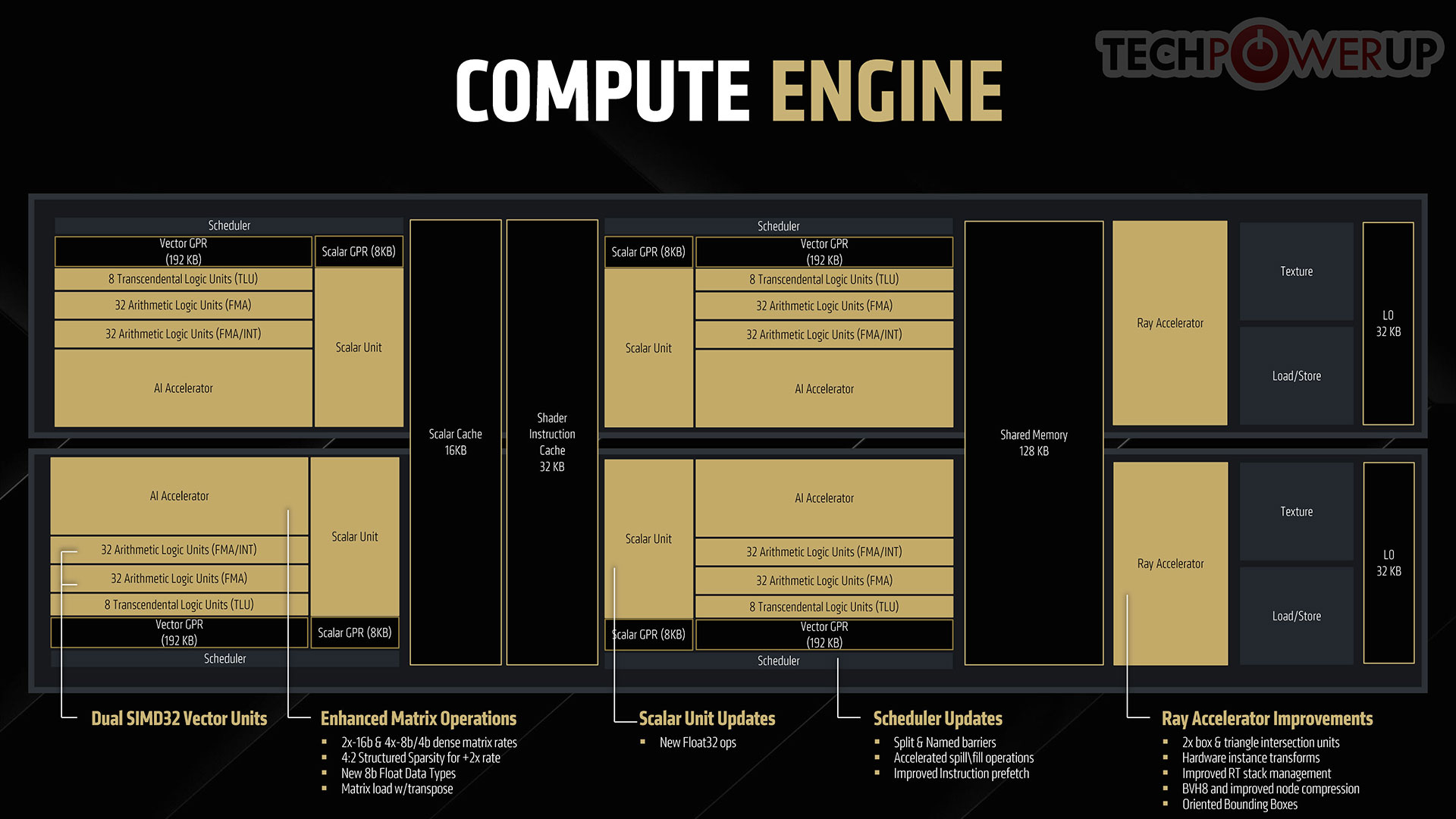
At the heart of the RDNA 4 graphics architecture is the new dual compute unit, with a vastly improved memory sub-system, improvements made to the scalar units, a new technology called dynamic register allocation, and improvements to CU efficiency and engine clocks. Each CU has two scheduler blocks, driving a 192 KB general purpose register (GPR), an 8 KB scalar GPR, 32 FMA ALUs, and 32 FMA+INT ALUs. There are also 8 transcendental logic units. RDNA 4 introduces the concept of dual SIMD32 vector units, for even more parallelism. The Scalar Unit comes with support for newer Float32 ops. Schedulers are updated with accelerated spill/fill operations. Instruction prefetching is improved. The new generation AI Accelerator comes with two 16-bit and four 8-bit/4-bit dense matrix compute rates, support for 4:2 structured sparsity for doubling throughput, and matrix loads with transpose. AMD has incorporated many technologies from its CDNA 3 Instinct AI ML accelerators on the AI Accelerators of RDNA 4, including enhanced and power-optimized WMMA, improvements to the ops per CU, support for FP8, E4M3 and E5M2 formats, and 4:2 structured sparsity.
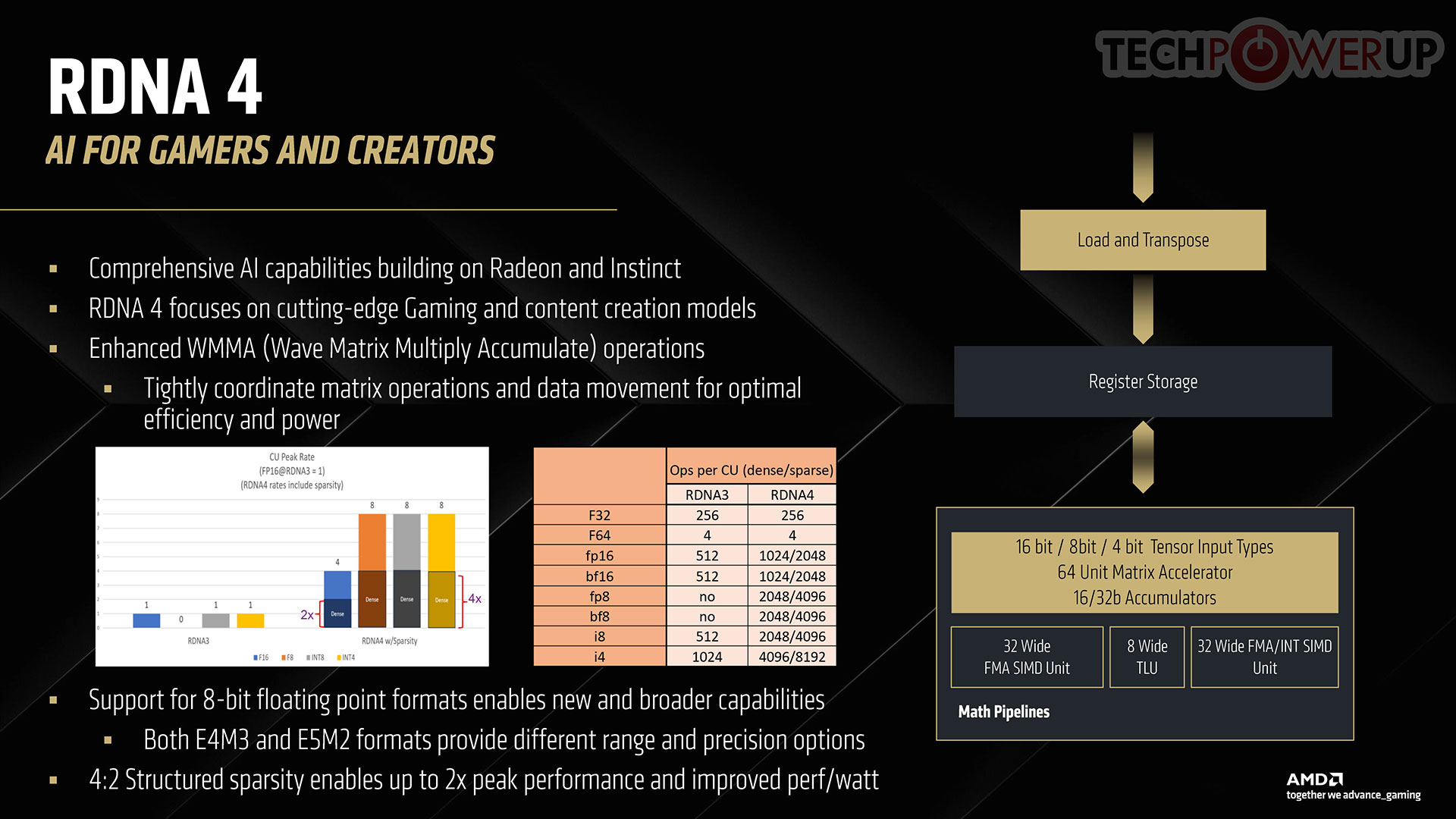
The new generation AI Accelerator comes with two 16-bit and four 8-bit/4-bit dense matrix compute rates, support for 4:2 structured sparsity for doubling throughput, and matrix loads with transpose. AMD has incorporated many technologies from its CDNA 3 Radeon Instinct AI ML accelerators on the AI Accelerators of RDNA 4, including enhanced and power-optimized WMMA, improvements to the ops per CU, support for FP8, E4M3 and E5M2 formats, and 4:2 structured sparsity.

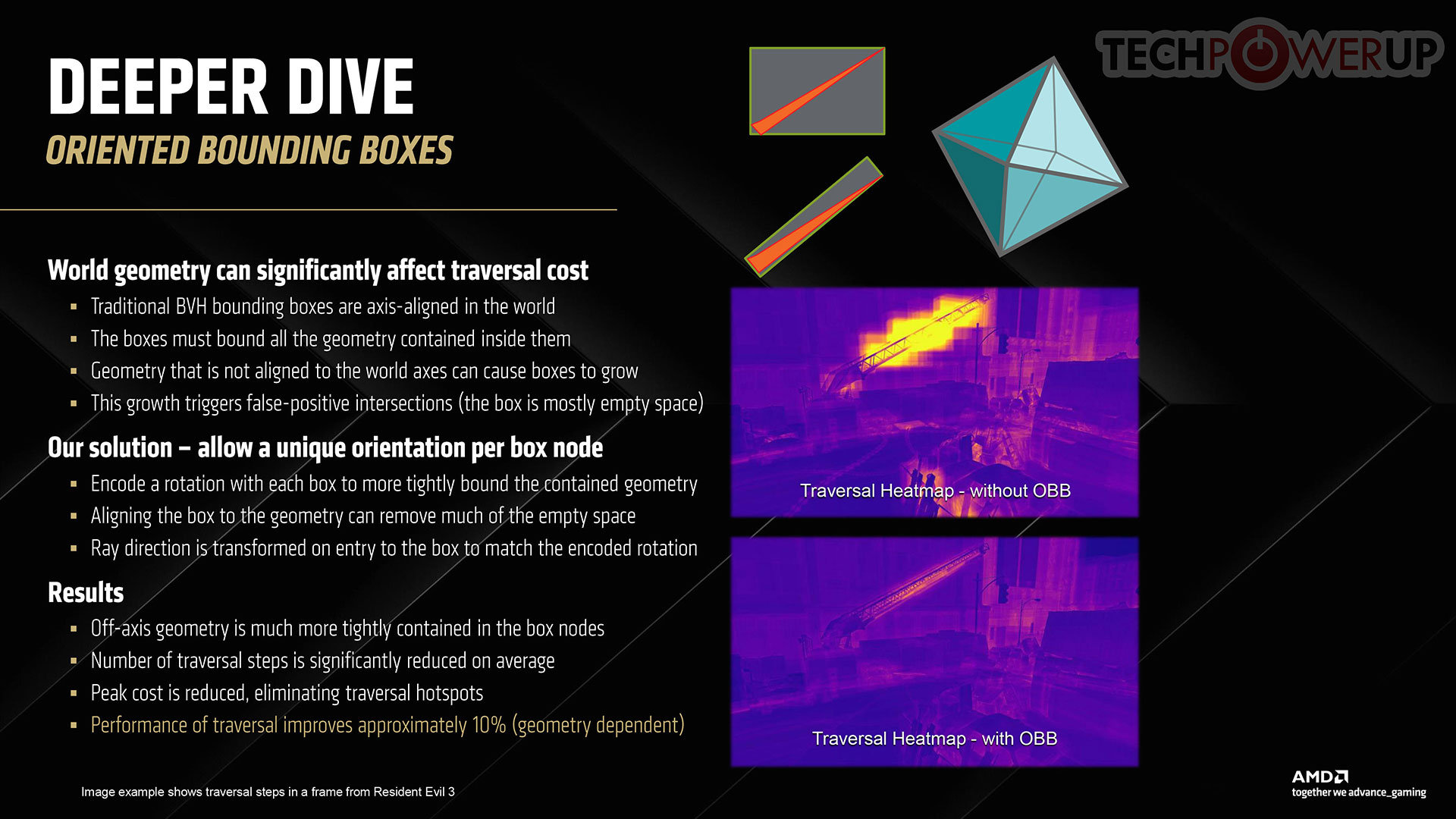
The new generation Ray Accelerator comes with double the box and triangle intersection resources as RDNA 3 RT accelerator, support for hardware instance transforms, improvements to the RT stack management, BVH8 node compression, and a revolutionary feature called oriented bounding boxes. To contain the number of rays really needed to be tested against an object, modern ray tracing technologies use something called a bounding box, which defines a region in which a geometry has to be tested against rays. Most of the time, the geometry is of a vastly different shape and smaller than the shape of a bounding box, which introduces false intersections, and wastes ray testing resources. AMD innovated a way to turn this bounding box into a 3D shape by giving it a Z-axis component, so the bounding box is oriented closer to the shape of the object to be tested, reducing the number of rays needed to be tested against it.
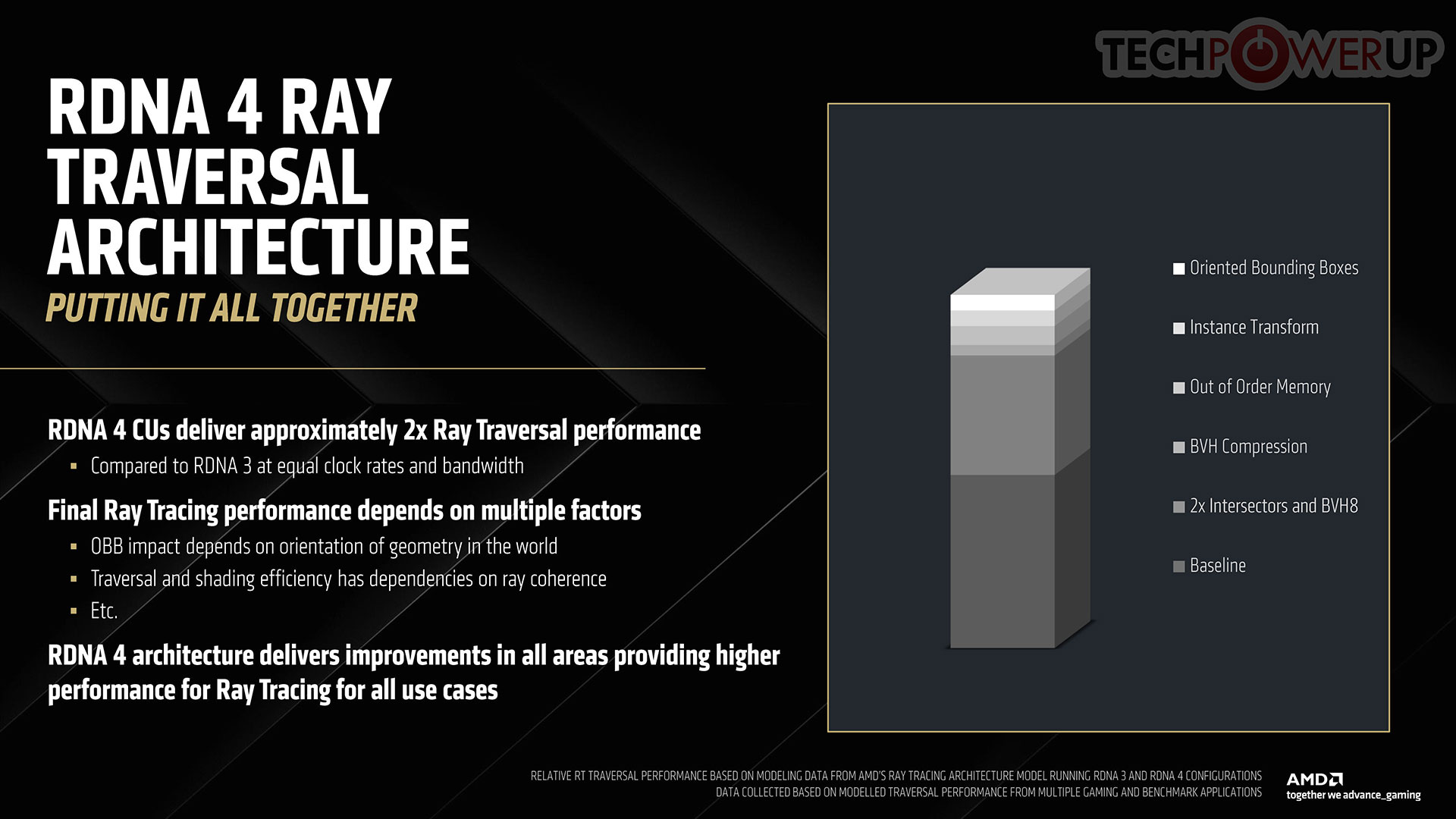
This graph highlights the contribution of various components toward the 100% generational ray traversal performance gain, allowing AMD to make do with a CU count of 64, with RDNA 3 being the baseline.
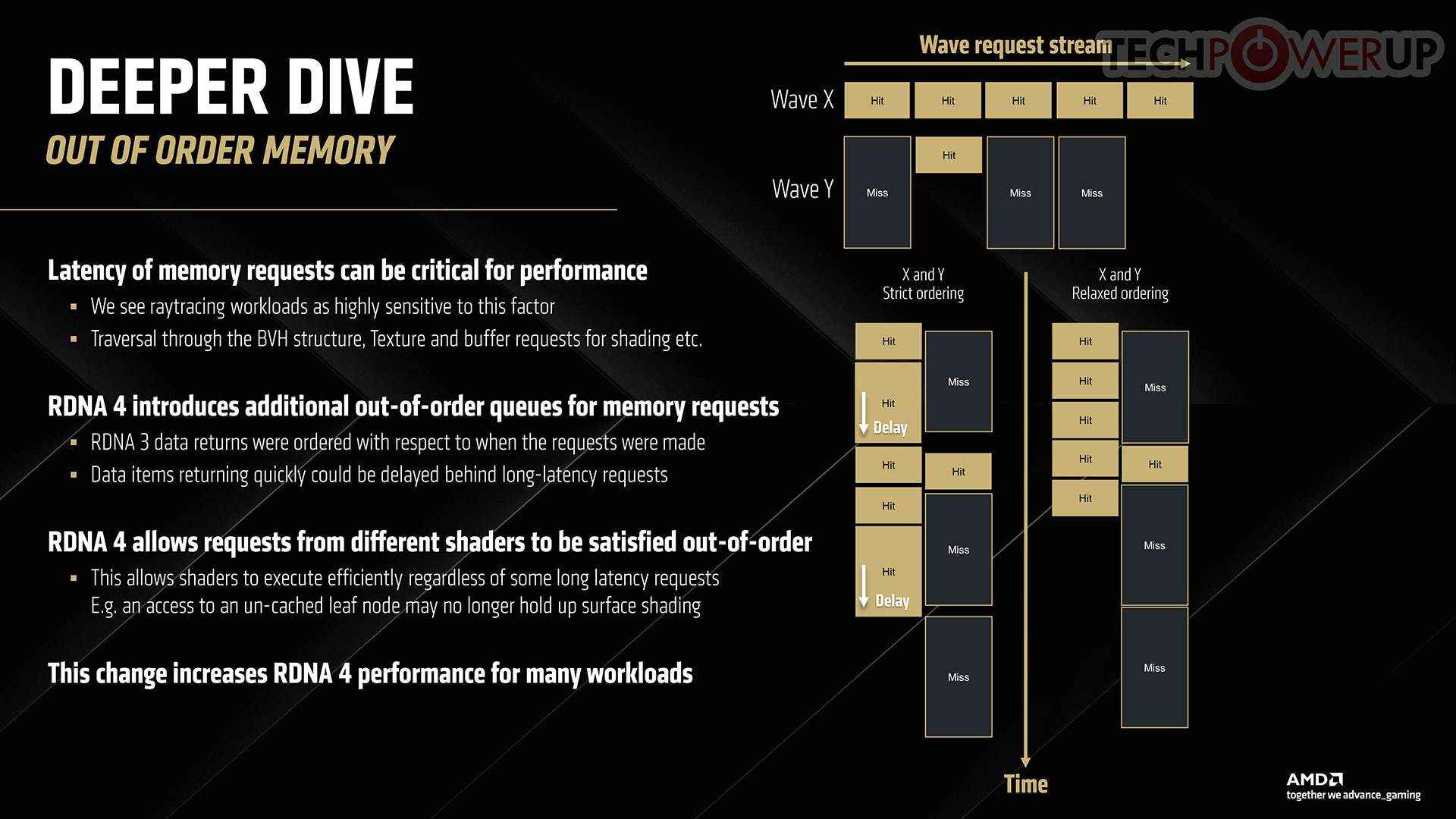
Both ray tracing and ML acceleration are memory sensitive applications, so AMD innovated a revolutionary change to its memory management system with the introduction of new out-of-order memory. All math is executed in waves on an RDNA GPU, and mutual dependencies between waves can cause memory request stream misses, as one wave's memory request queue waits for the other wave to complete its task. This is solved with a new out-of-order (relaxed ordering) memory management. This graph highlights the contribution of various components toward the 100% generational ray traversal performance gain, allowing AMD to make do with a CU count of 64, with RDNA 3 being the baseline.
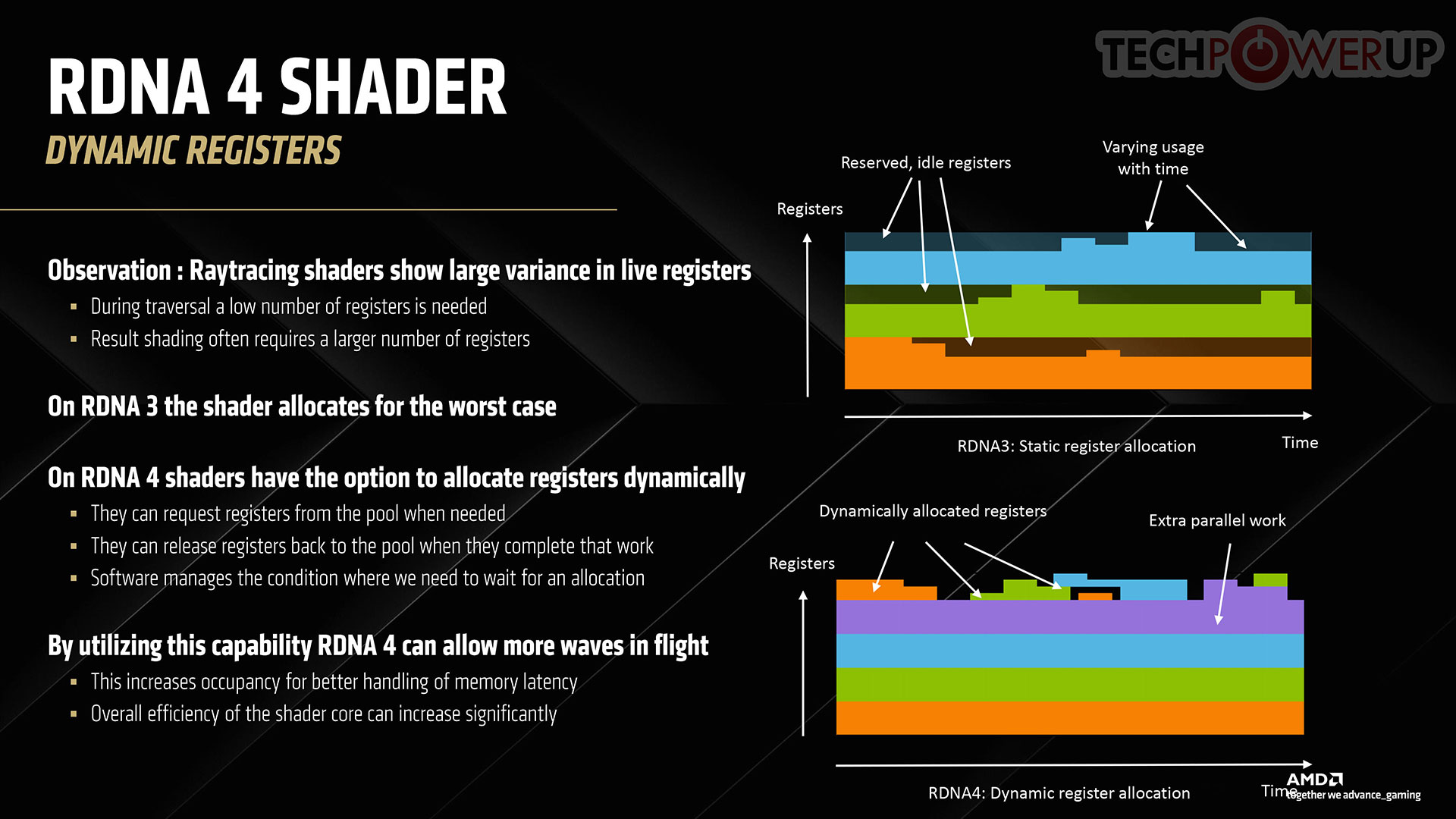
On AMD, a fairly big chunk of the ray tracing stack continues to be executed on shaders, but the company has made advances to ensure the cost of ray tracing on the shader resources of the GPU is minimal, with the introduction of Dynamic Registers to improve parallelism.

The new Radiance 2 Display Engine comes with major hardware updates that reduce GPU idle power draw in multi-monitor setups. The engine also comes with hardware flip-metering support (something NVIDIA also introduced with Blackwell, and which enables Multi-Frame Gen on the RTX 50-series). Flip-metering improves video frame pacing to the GPU and reduces CPU overhead for video playback. There is also a display engine level hardware image sharpening component that drives Radeon Image Sharpening. As for I/O, you get contemporary DisplayPort 2.1a and HDMI 2.1b, the maximum bitrate is UHBR 13.5.
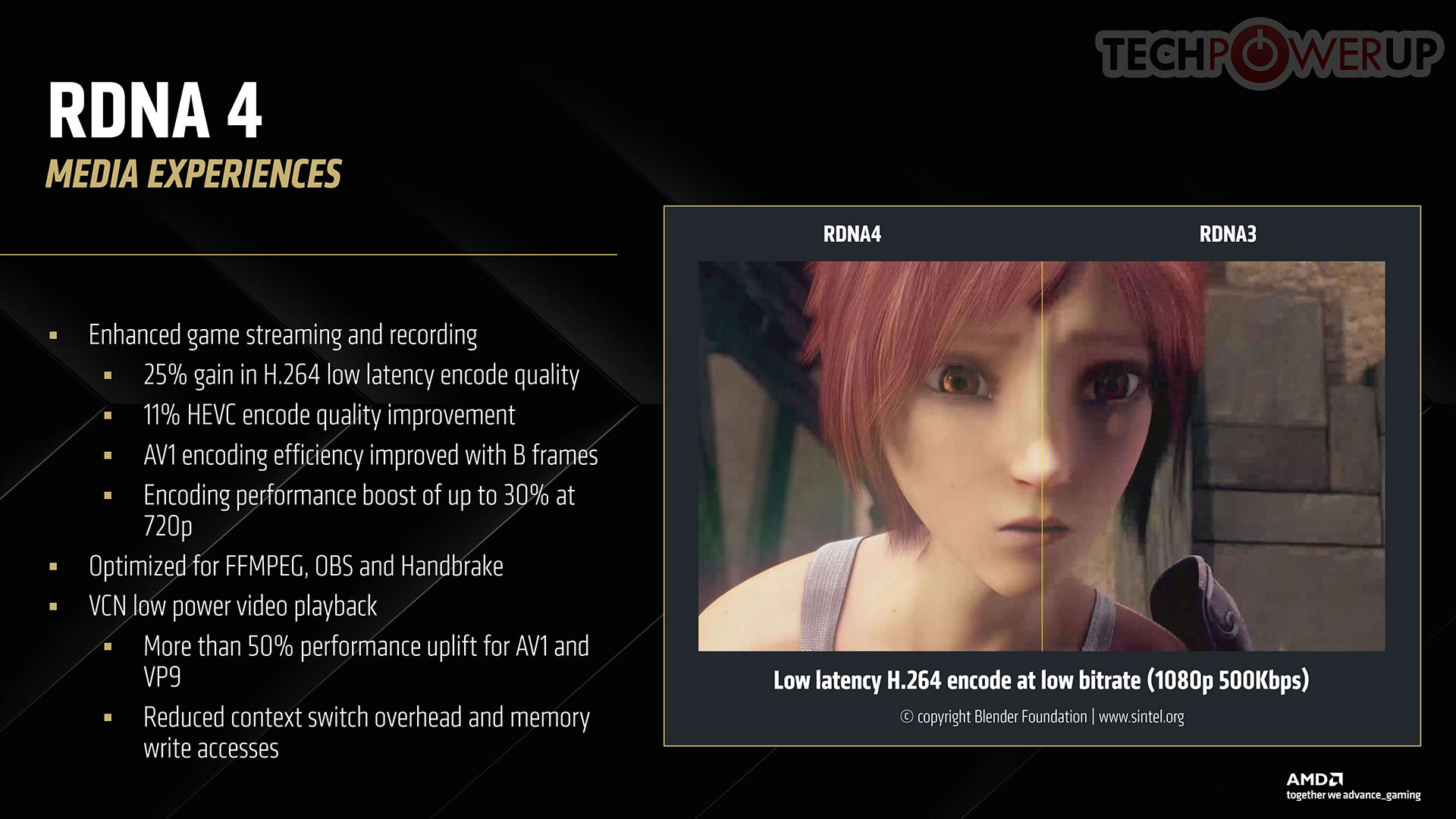
Navi 48 comes with a dual media engine, each of the two can perform concurrent encoding and decoding, and so the implementation resembles an NVIDIA GPU having two each of NVENC and NVDEC units. The new generation media engine offers a 25% increase in H.264 low-latency encode quality, and an 11% improvement in HEVC encode quality. AV1 encode and decode get B-frames support, vastly improving bitrates. The media engine posts a 50% generational performance uplift (measured in encoder/decoder frame rates), with reductions in memory overhead.
AMD FSR 4 and New AMD Software Features
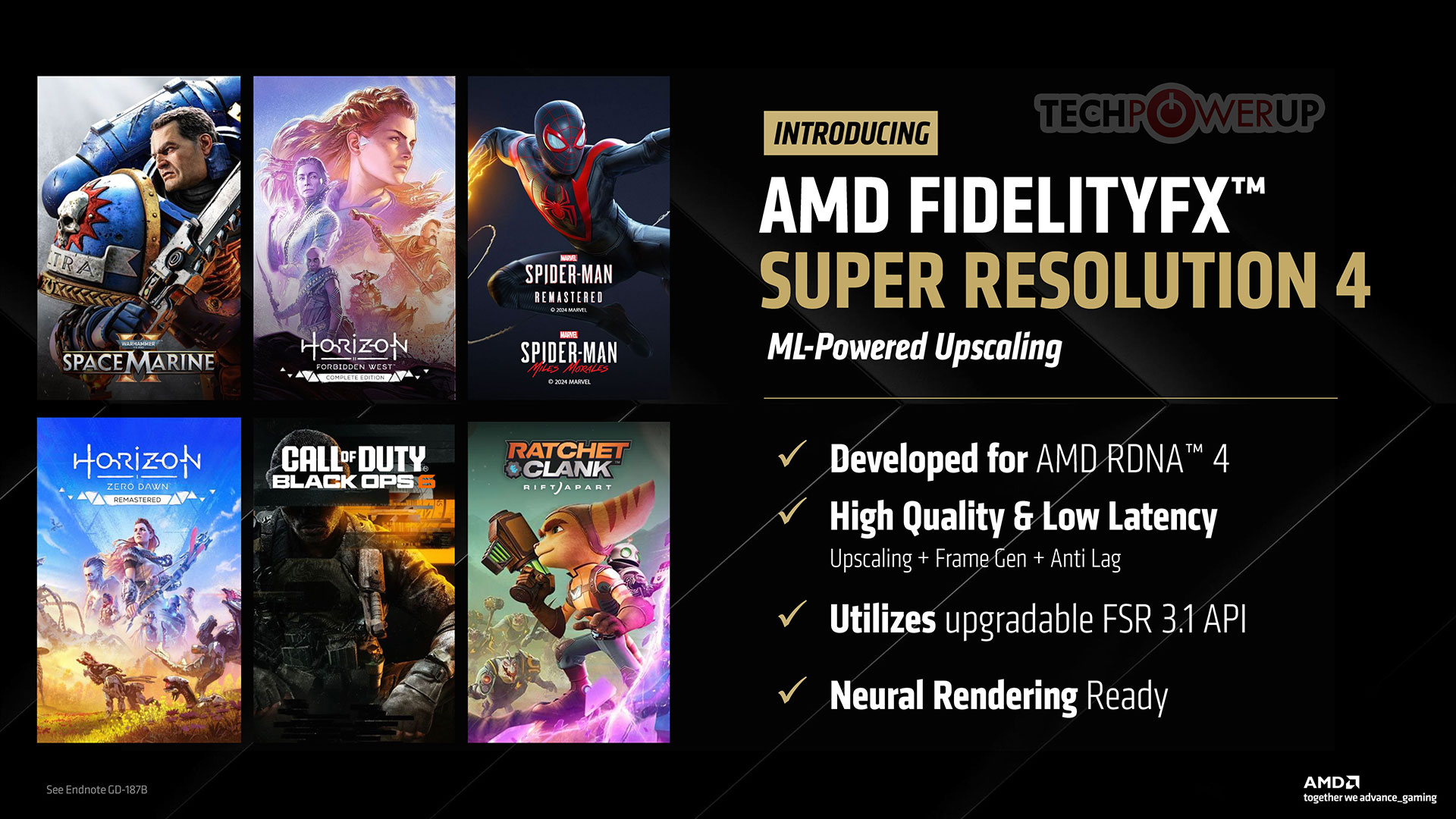

With the Radeon RX 9000 series, AMD is debuting FSR 4, the latest version of its performance enhancement suite. FSR 4 introduces the biggest tech update since FSR 2, which also makes it exclusive to the RX 9000 series. With the RDNA 4 generation of GPUs offering significantly higher ML compute throughput, AMD designed a new ML-based upscaler to reconstruct details of the upscaled frame. In that sense, FSR 4 is technologically close to DLSS. RDNA 4 GPUs also leverage AI DNNs to de-noise ray tracing and path tracing, unburdening the shaders.
An AI ML based upscaler requires ground truth data, and just as NVIDIA goes through the painstaking task of training game-specific ML models that can later be shipped to end-users through game developers and as driver updates; AMD has set up a large FSR 4 data-center of its own, powered by Radeon Instinct MI300-series AI GPUs for the task. On the client side, the ML-based upscaler needs the dedicated AI acceleration hardware from the RDNA 4 family. The frame generation technology appears to be carried over from FSR 3 Frame Generation, and is essentially a smart frame interpolation technology.
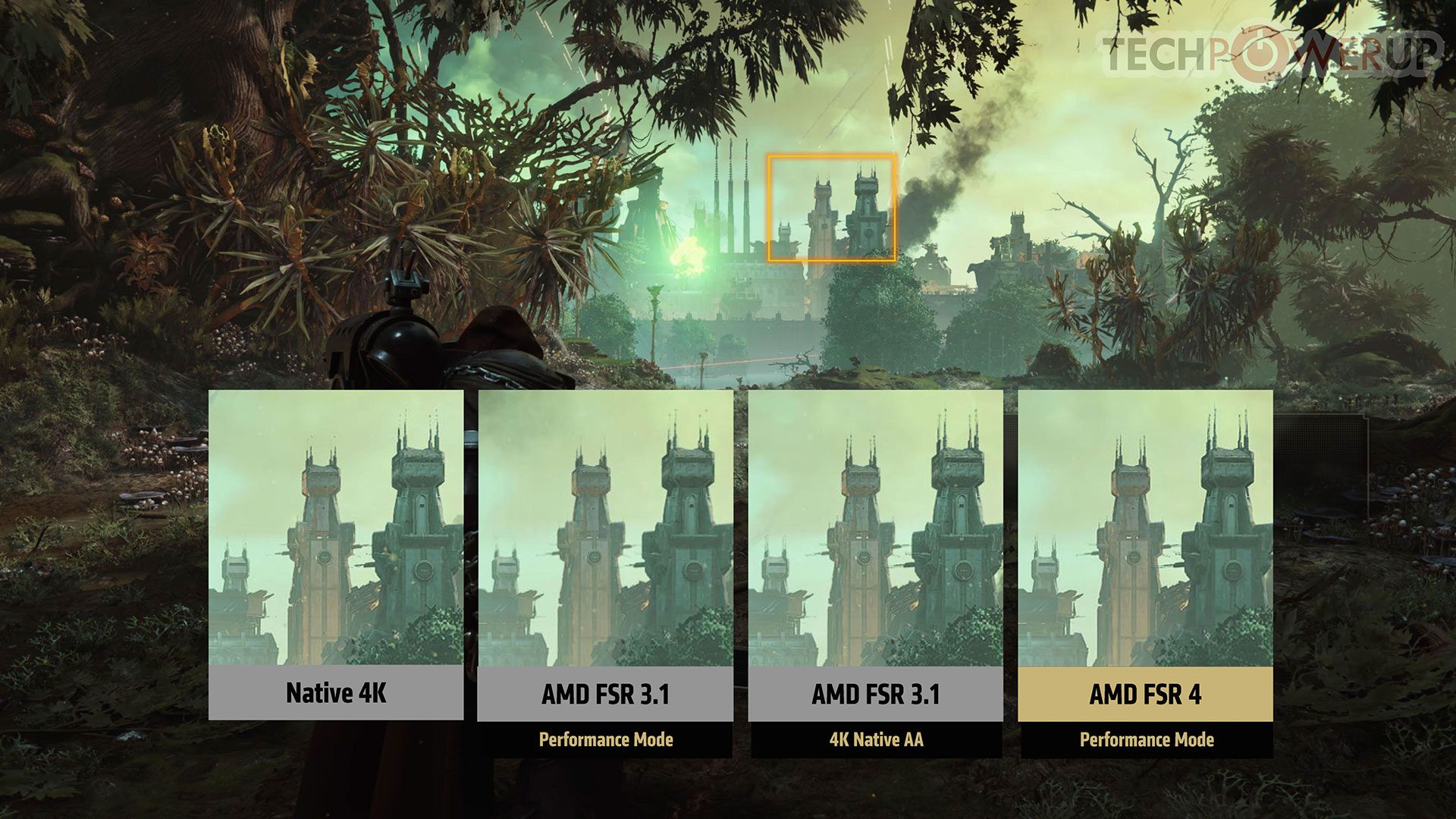
AMD in its presentation provided examples of image quality for FSR 4, claiming that in some cases, FSR 4 presents geometry more accurately than even native resolution. While AMD didn't detail it, FSR 4 comes with preparation for neural rendering. Given that Microsoft has now standardized neural shaders, and the ability for applications to directly address AI acceleration hardware on the GPU via the DirectX API, AMD could in the near future implement neural rendering, however, the company hasn't detailed a timeline. FSR 4 is ready for neural rendered objects.
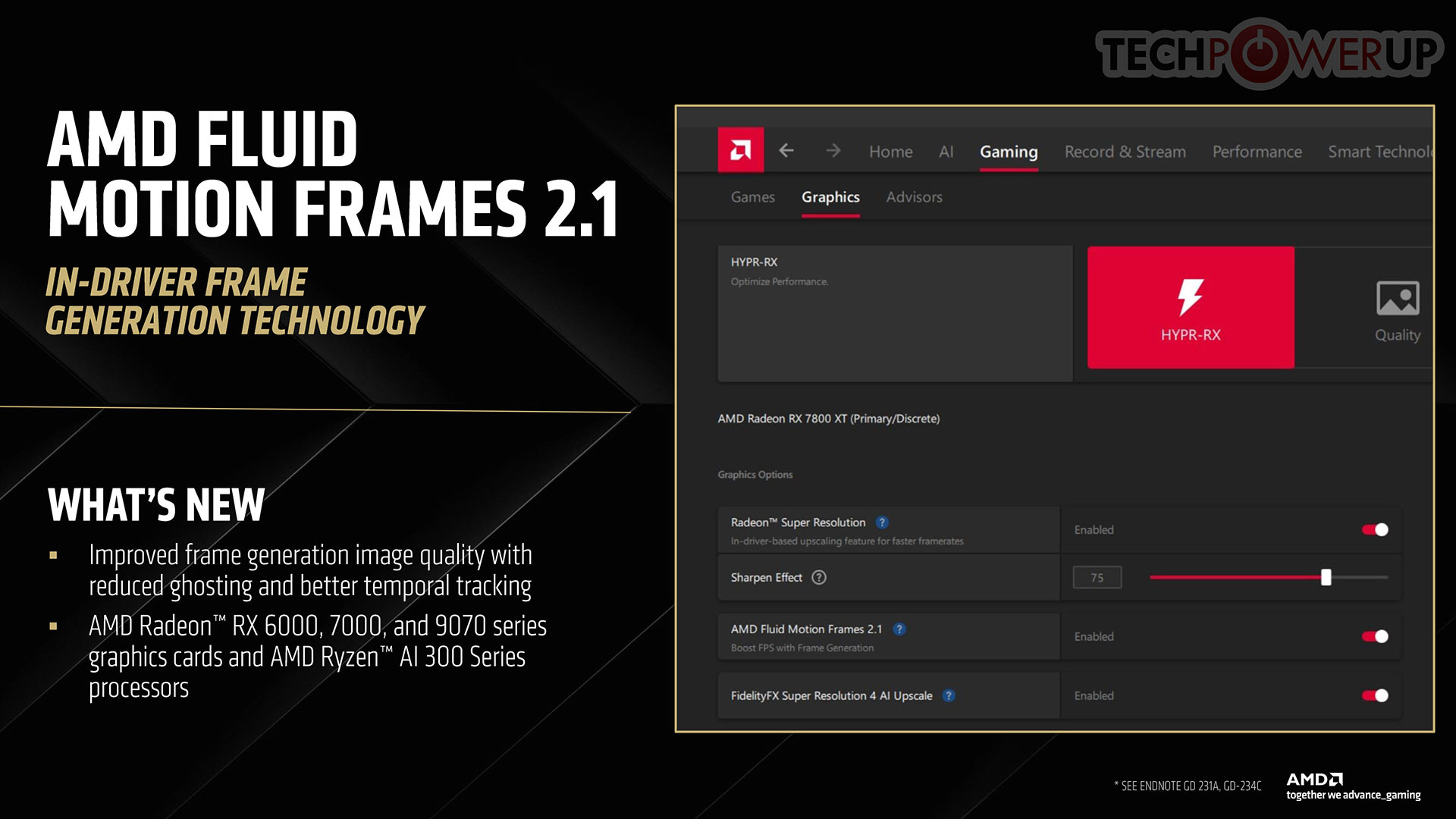
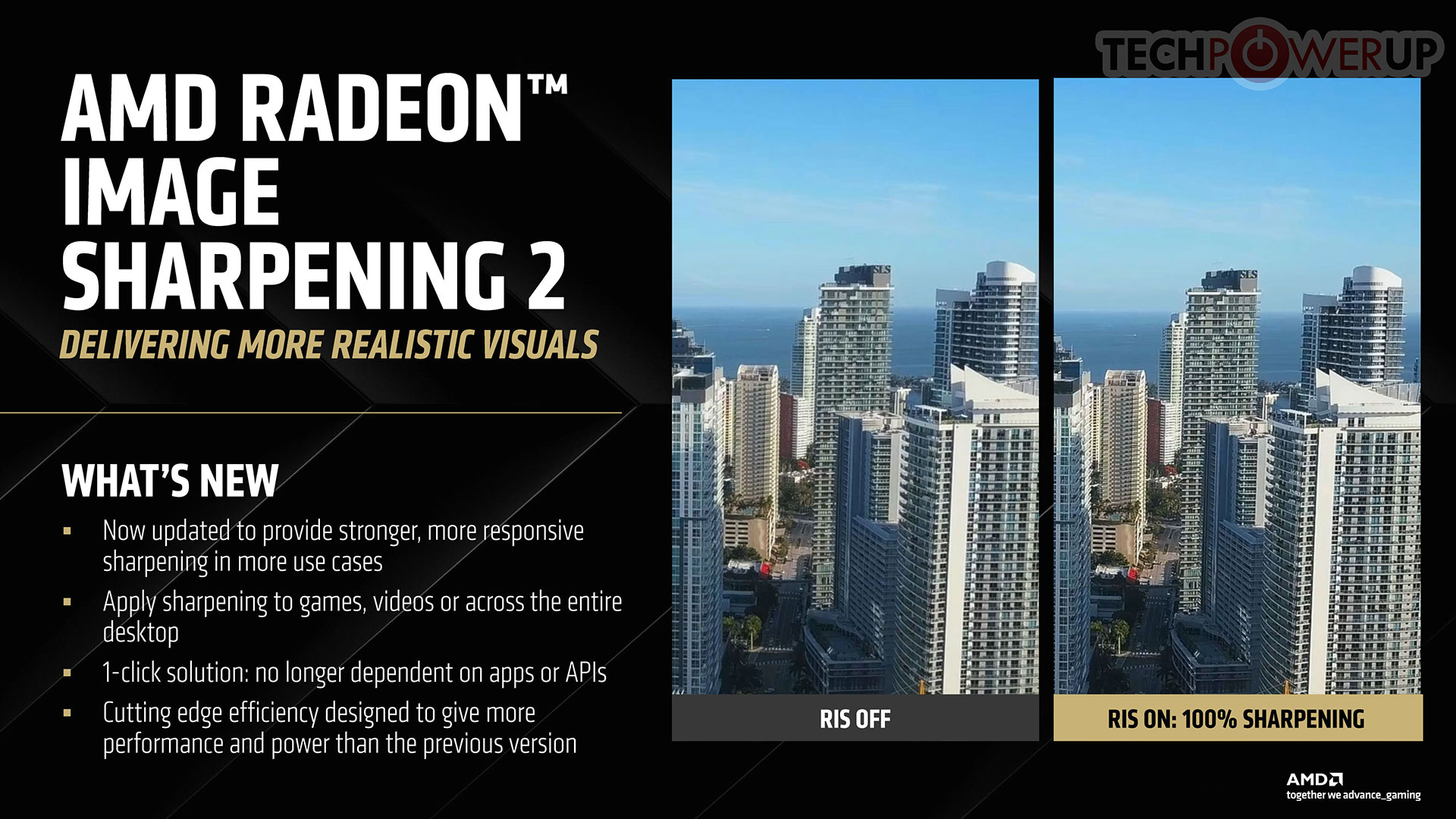
Fluid Motion Frames gets an update with FMF 2.1, with improved image quality, reduced ghosting, and improved temporal tracking. The company also updated its API-agnostic image sharpening tool, with the introduction of Radeon Image Sharpening 2 (RIS 2).
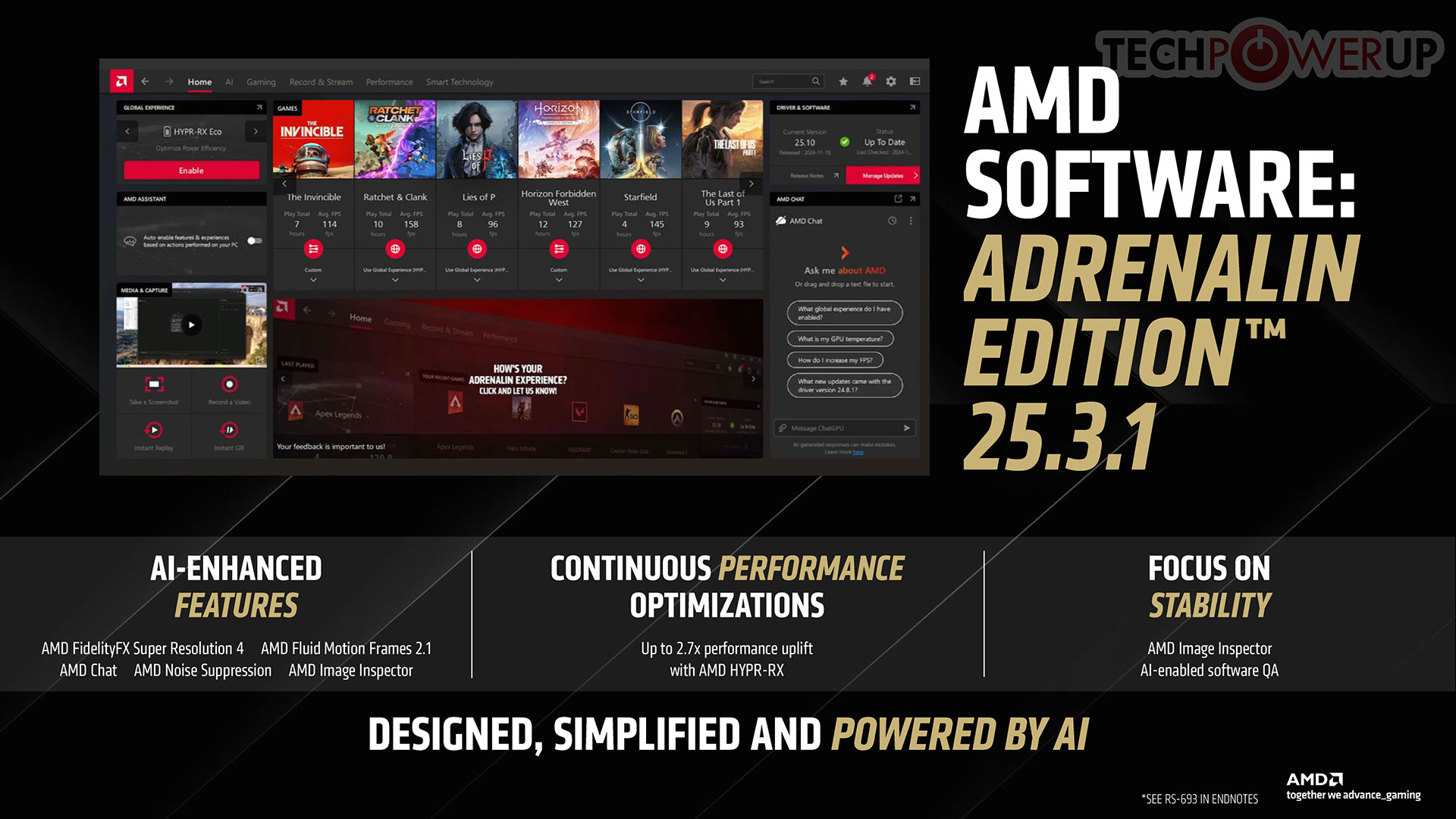
AMD provides a slick driver frontend application called simply "AMD Software." AMD improved the way in which users can report bugs, artifacts, or corruption in games, through a voluntary (opt-in) feature called AMD Image Inspector.
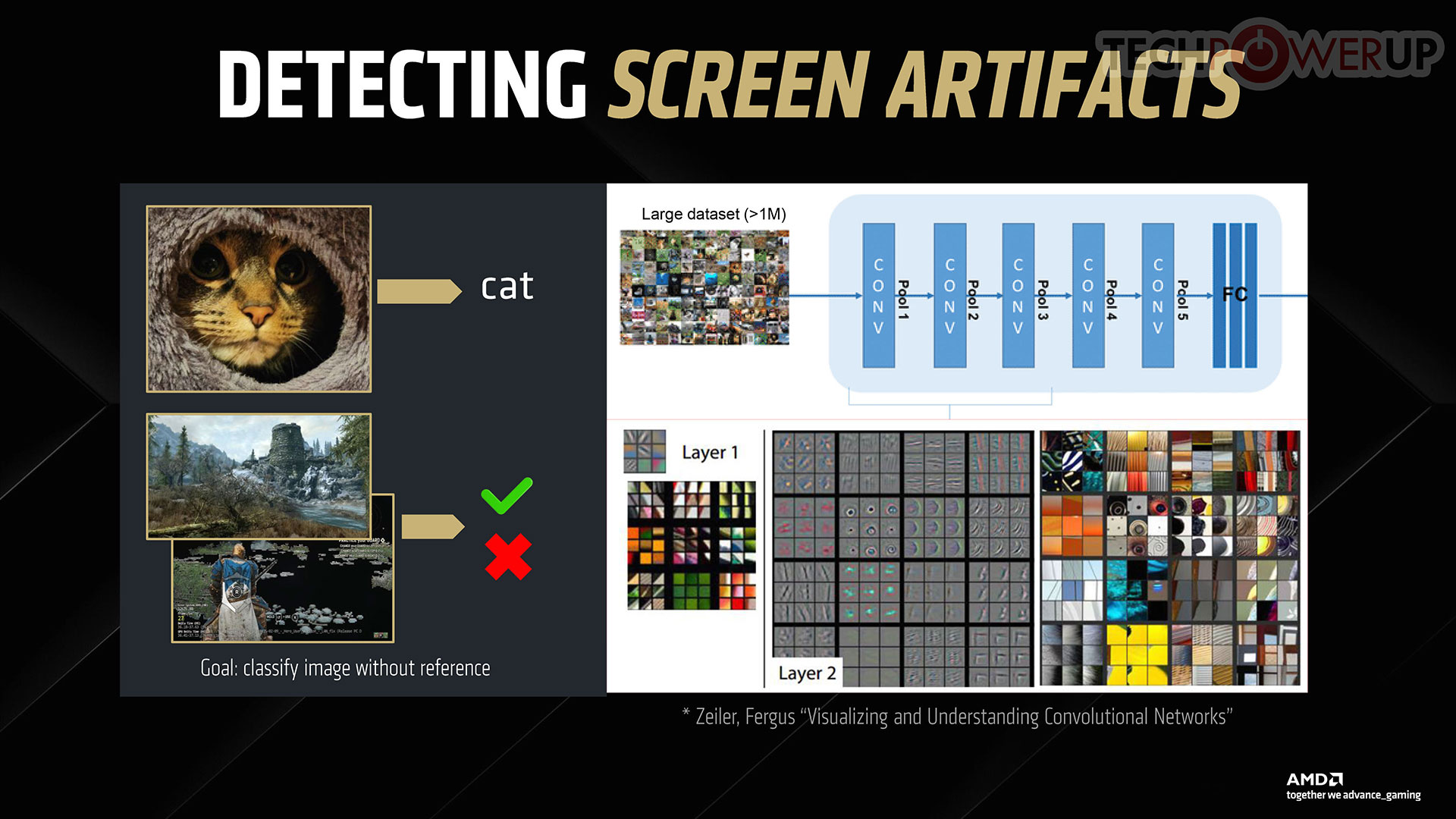
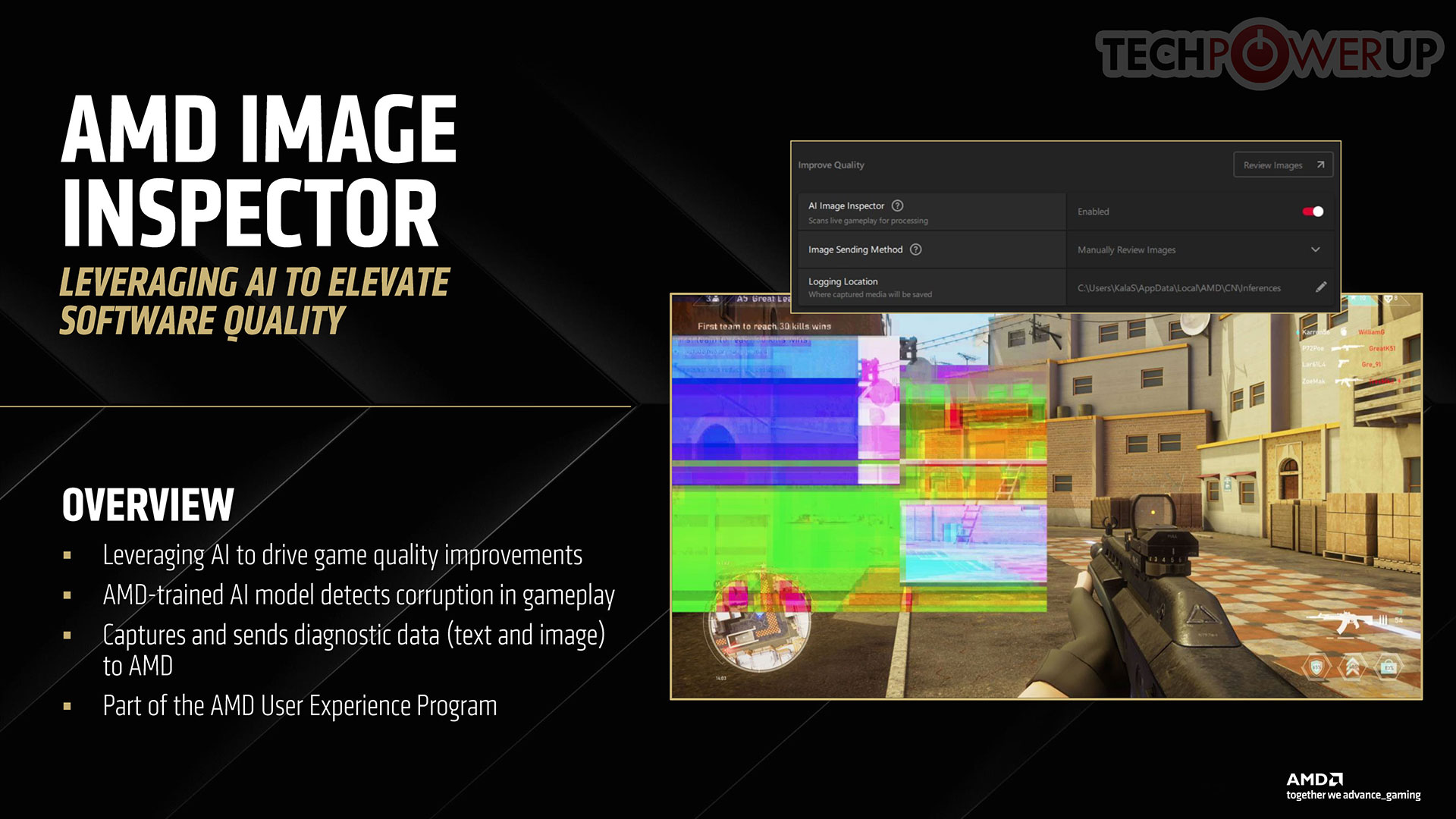
As you submit a screenshot or video sequence to AMD, the company uses an AI model to identify rendering bugs, or corruption in the display. The entire driver-level game optimization, testing, and bug fixing process has been revamped with AI doing the heavy lifting.
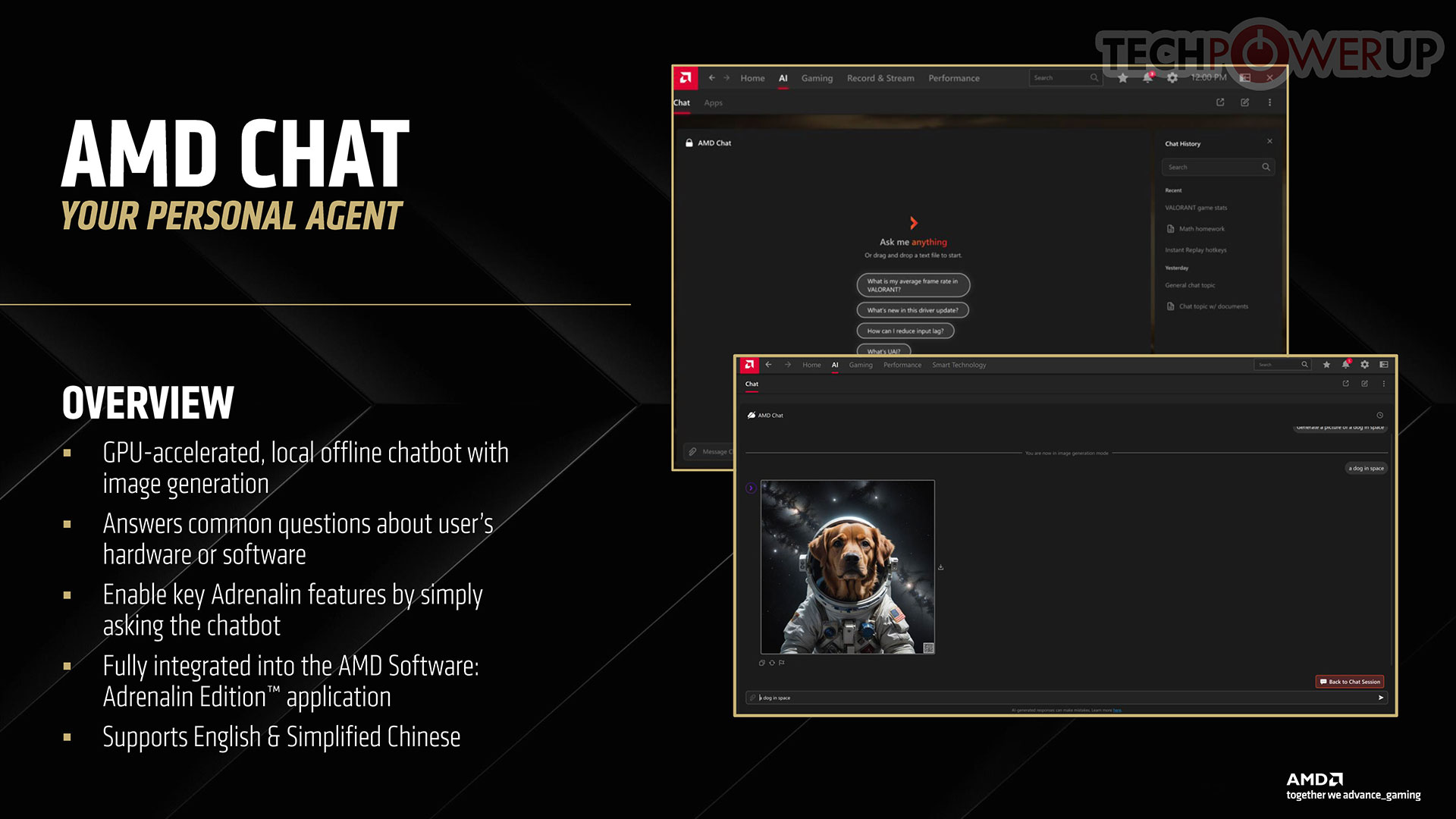
The company also introduced AMD Chat, which is an AI chatbot that runs locally, and is accelerated by the GPU. You can make plain language queries on configuring AMD Software features and settings; and also chat with it on AMD technologies. This is essentially AMD's answer to NVIDIA's ChatRTX, but we don't know if the utility can be trained with custom datasets.
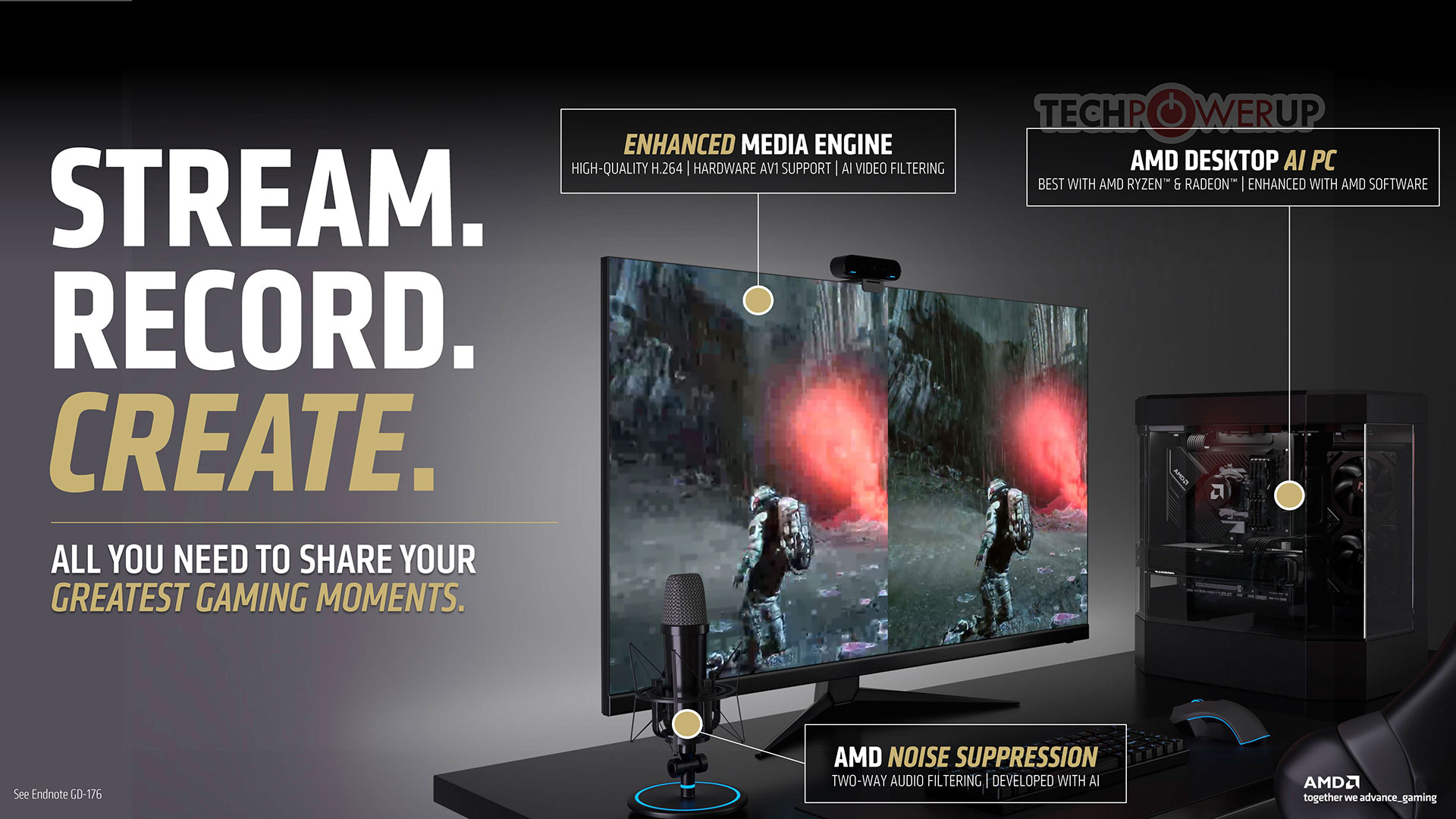

For streamers, AMD Software simplifies connecting their gameplay with their social media and streaming accounts. You can then take advantage of the new dual media engine of RDNA 4 that improves H.264 and HEVC image quality, and use other utilities such as AMD Noise Suppression, which is a 2-way AI-based audio filter.
AMD AI Apps Manager consolidates all your AI applications into a simple launcher-like interface resembling a game launcher.
Packaging


The Card


The XFX Mercury OC Magnetic Air uses the same design theme that we saw introduced with the RX 7900 XTX Magnetic Air. It's a very clean look, with some red highlights around the fans and along the top edge of the card. On the other side you'll find a metal backplate that has a cutout for air to flow through.


Dimensions of the card are 35.0 x 14.0 cm, and it weighs 1701 g.


Installation requires four slots in your system. We measured the card's width to be 70 mm.

Display connectivity includes three standard DisplayPort 2.1a and a HDMI 2.1b.
With RDNA 4, AMD put effort to improve its standing with game streamers and creative professionals. It's done this by giving Navi 48 a dual VCN solution, so the GPU has two concurrent hardware accelerators for encoding and decoding. Perhaps the biggest change at the silicon level is that AMD improved the encoding quality of its hardware H.264 and HEVC codecs. This was a niche complaint streamers had with AMD GPUs, and would avoid the brand altogether. The company also updated its AV1 hardware acceleration with support for B-frames, which are frames that lack image information, but math data that let the decoder reconstruct image data by comparing with the image data from adjacent I-frames containing it. This technique vastly improves streaming bitrates since half the frames lack image data.

The card uses three 8-pin power connectors, which allow a total power consumption of 450 W, plus 75 W from the PCIe slot.


XFX has installed an RGB lighting zone along the top edge of the card.

This BIOS switch lets you toggle between the default performance BIOS and a second BIOS. While other vendors offer a "quiet" BIOS here, XFX is shipping the same BIOS on both switch settings, which feels like a lost opportunity to me.


One of the highlights of this card are the magnetically attached fans. They plop right in, impossible to get it wrong. Removing them is just as easy, the force required is exactly right. With this feature it will be super easy to replace the fans, should they break in the future, also it's extremely easy to remove dust and dirt from the card.
Teardown


The XFX cooling solution uses eight heatpipes. The heatsink provides cooling not only for the GPU, but also for the memory chips and VRM circuitry.


The backplate protects the PCB against damage during handling and installation.
High-resolution PCB Pictures
These pictures are for the convenience of volt modders and people who would like to see all the finer details on the PCB. Feel free to link back to us and use these in your articles, videos or forum posts.

High-resolution versions are also available (front, back).
Our Patreon Silver Supporters can read articles in single-page format.
Nov 17th, 2026 15:08 CST
change timezone
Latest GPU Drivers
New Forum Posts
- Help with fixing Overclock (1)
- Without Jensen, PC gaming will be (30)
- [Poll] 12V-2x6 Connector Protection: What Are You Using? (WireView / Ampinel / Equalizer / Other / Nothing) (23)
- Latest method for DTS/DDL for Logitech Z906 (0)
- What are you playing? (26232)
- Security Apps (1)
- Honestly, do you care about GTA VI? (128)
- Meeting point of those who broke their GPUs. Please share what GPUs you've burned, shattered, ionized or melted accidentally. (43)
- Voltage glitch hack to unlock fuse off part of GPU core ? (2)
- 9070 GRE 3.9ghz validation reached. (14)
Popular Reviews
- Acemagic Retro X3 Review
- Corsair HX1000i Shift Crystal Review
- AMD Zen 6 Technical Deep Dive
- Upcoming Hardware Launches 2027 (Updated Nov 2026)
- ASUS ROG Strix B850-I Gaming Wi-Fi7 W Review
- Phantom Blade Zero Performance Benchmark Review - 35 GPUs Tested
- AMD Ryzen 7 9800X3D Review - The Best Gaming Processor
- Chieftec Iceberg PRO 360 DARK Review
- Montech King 95 3D PRO Review
- NZXT C1200 Platinum Review
TPU on YouTube
Controversial News Posts
- NVIDIA Co-Founder and CEO Jensen Huang Officially Resigns (456)
- Open Letter Asking NVIDIA to Reinstate Jensen Huang Passes 115,000 Signatures (184)
- OpenAI CEO Argues Home PCs Waste the World's Limited DRAM Supply (152)
- NVIDIA Launches Investigation Into Jensen Huang's Relationship With Suspected Chinese Spy (136)
- Report: Jensen Huang Eyes NVIDIA Comeback (132)
- Intel "Raptor Lake Next" 16-Core and 20-Core CPUs Surface (130)
- Legendary Game Studio BioWare Shuts Down Following EA Layoffs (104)
- Dell CEO Says the Memory Shortage Will Get Worse in 2027 (95)