 5
XPG Novakey RGB DDR5-6000 32 GB CL30 Review
Memory Average FPS »Relative Performance
1920×1080 Relative Performance
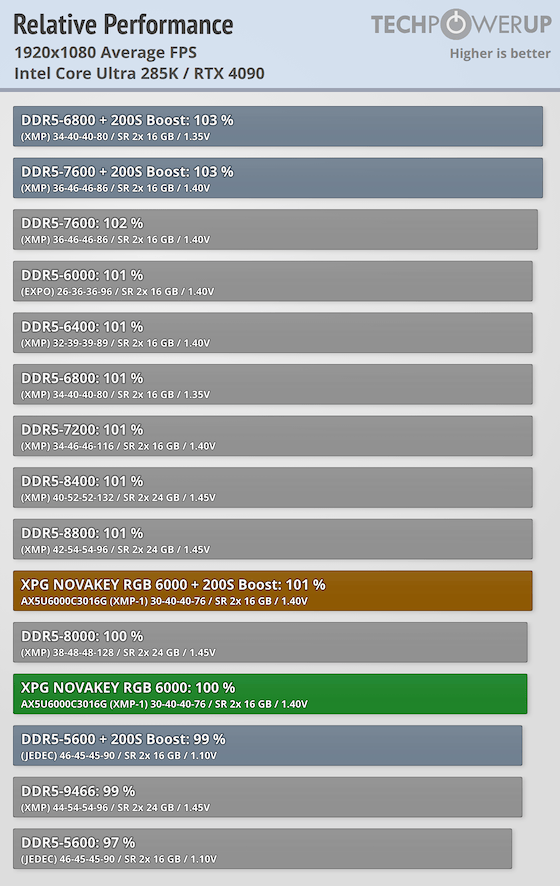
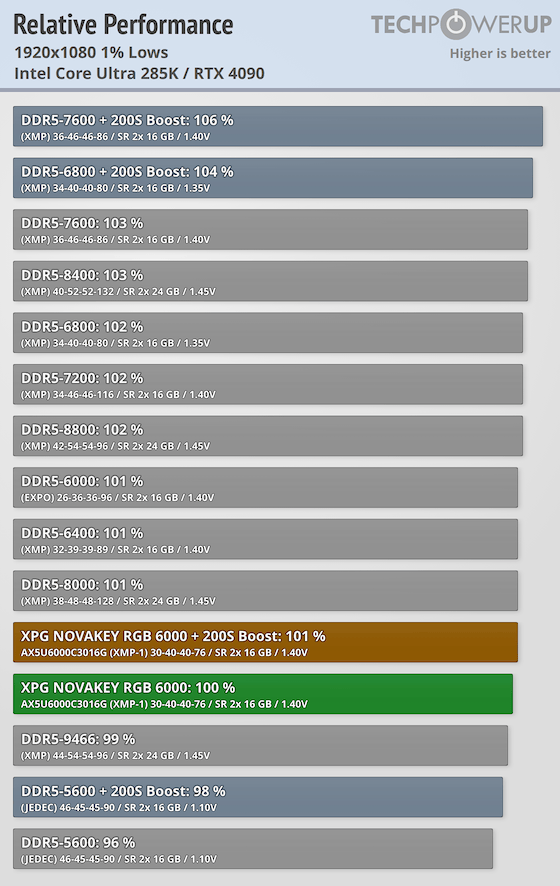
The XPG NOVAKEY RGB 6000 lands squarely in the mid-pack on the Intel Core Ultra 285K platform at 1920×1080, with 200S Boost giving it a small but consistent bump of 1%. 200S Boost raises the D2D ratio, but that extra bandwidth tends to benefit higher-speed memory more, which is reflected here: faster kits like DDR5-7600 and DDR5-6800 with 200S Boost see larger gains and lead both charts, while the NOVAKEY's more modest 6000 MT/s speed limits how much it can capitalize on the boost. Still, its 1.40 V CL30 timings keep it competitive with kits rated well beyond its own frequency, even edging out looser DDR5-9466 (Gear 4) and DDR5-8000 (Higher tRFC) configurations in 1% lows.
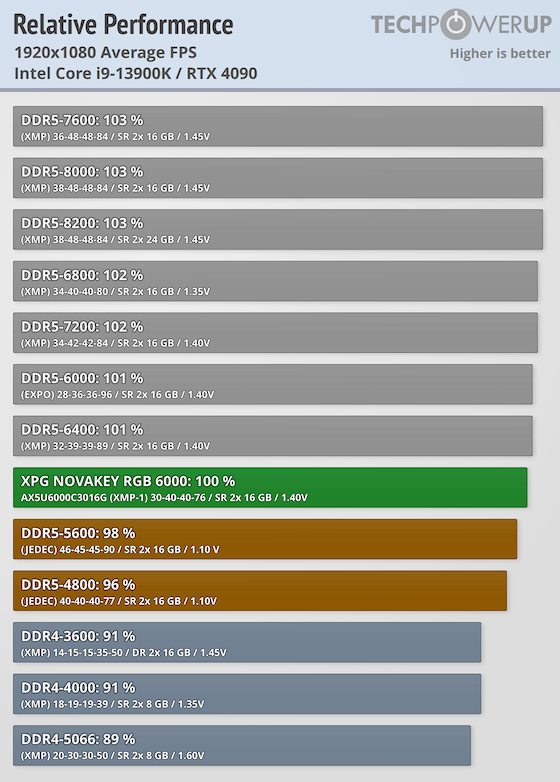
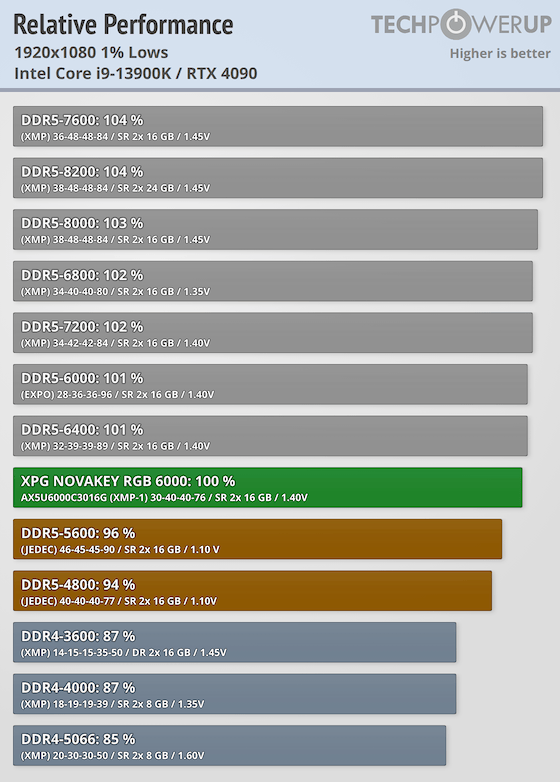
On the Intel Core i9-13900K, bandwidth is clearly king. With DDR5-7600 through DDR5-8200 all sit at the top of both charts, with average FPS at 103% and 1% lows reaching 103-104%, showing how much this platform rewards raw transfer speed over tight timings. The XPG NOVAKEY RGB 6000 lands at exactly 100% in both metrics, holding its own against faster-rated kits and outpacing every DDR5-5600, DDR5-4800, and DDR4 kit in the stack. That gap widens further down: DDR4-5066 trails at just 89% average FPS and 85% in 1% lows, underscoring how much performance is left on the table without sufficient bandwidth on this platform.
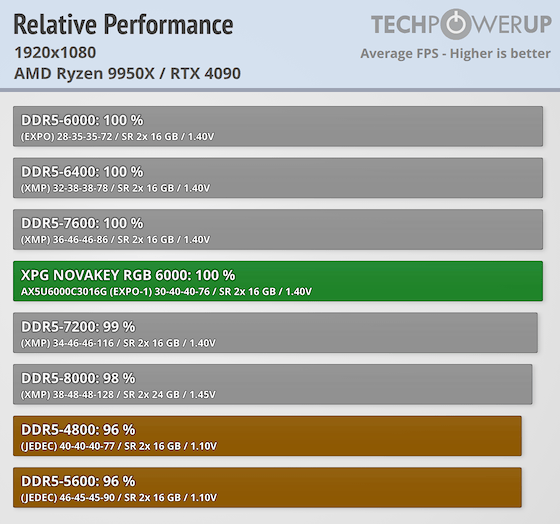
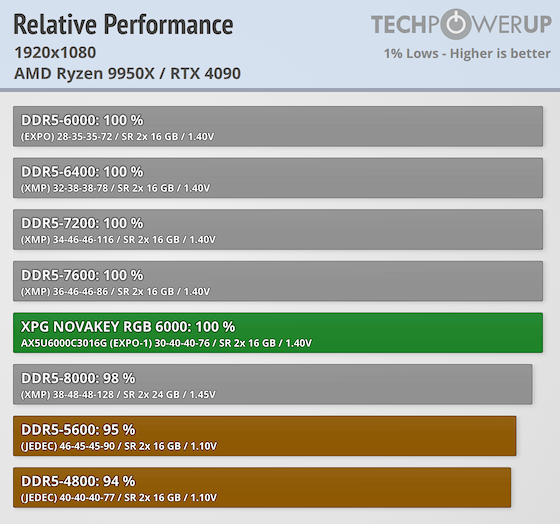
On the AMD Ryzen 9950X, the results are far more compact than on Intel platforms. Averages across multiple games flattens the small differences, with DDR5-6000 through DDR5-7600 all bunched at exactly 100% in both average FPS and 1% lows. The XPG NOVAKEY RGB 6000 sits right in that top cluster at 100% across the board, matching kits rated well above its own speed. Thanks to the new AGESA 1.3.0.1b update, even higher-latency memory holds up well here, with DDR5-5600 and DDR5-4800 only dipping to 94-96%, a much smaller falloff than the steep drops seen on the Intel platforms.
3840×2160 Relative Performance
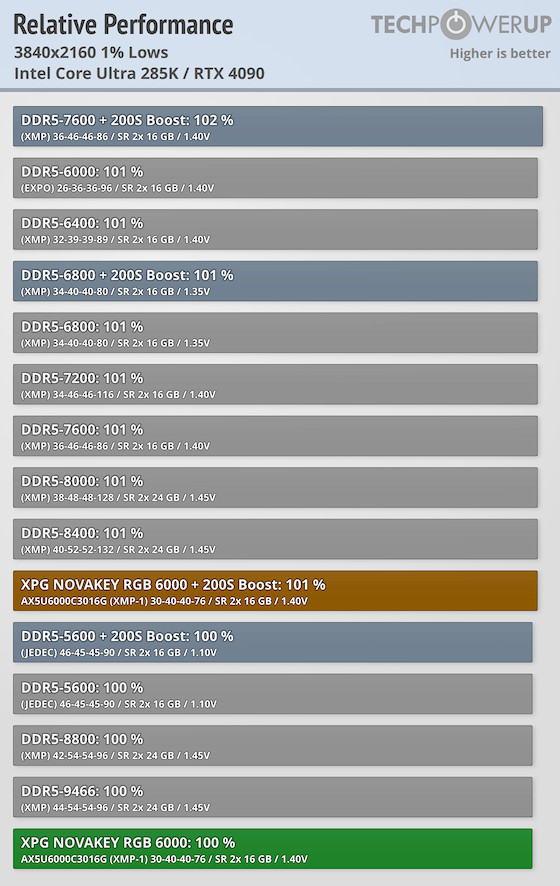
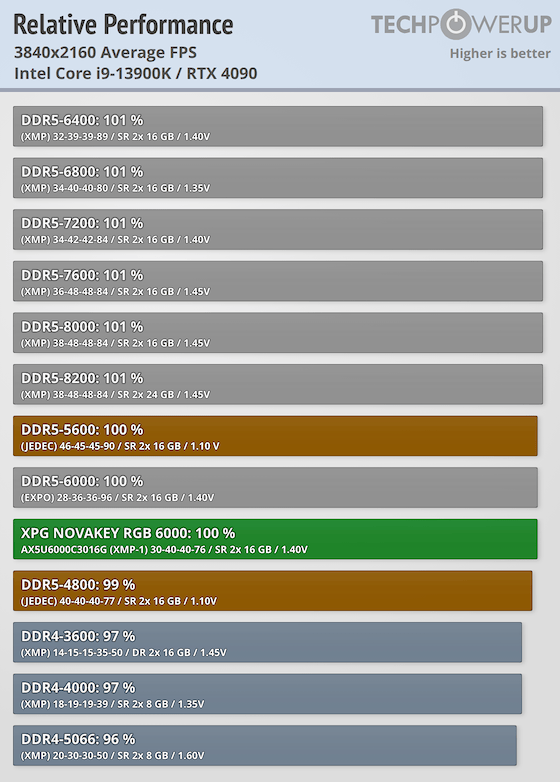
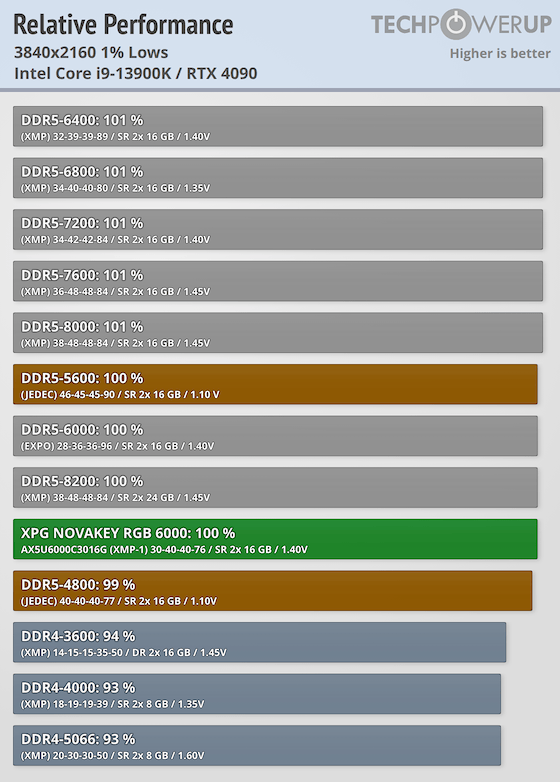
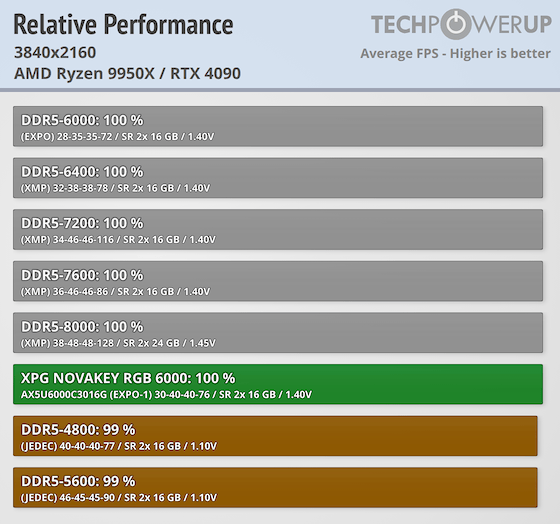
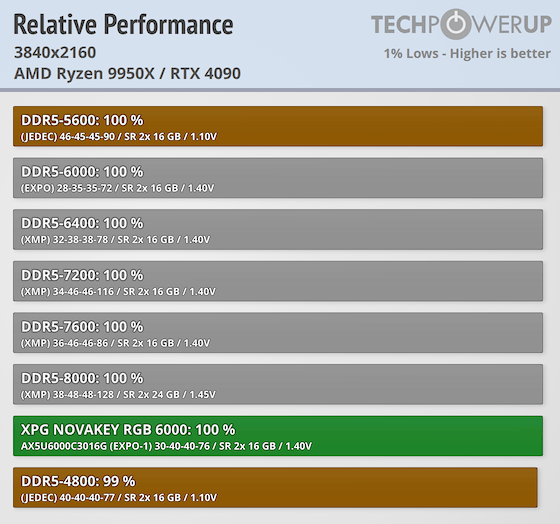
At 4K (3840×2160), the memory performance landscape shifts significantly across all three platforms, highlighting a fundamental aspect of how resolution influences the CPU-memory relationship. Once the RTX 4090 becomes the bottleneck rather than the CPU or memory subsystem, the entire stack compresses toward the 100% mark. On the Core Ultra 285K, everything from DDR5-5600 to DDR5-9466 falls within just 1-2 percentage points in both average FPS and 1% lows, and the 13900K and 9950X show the same pattern, with even DDR4 kits closing to within a few percent of their DDR5 counterparts. The XPG NOVAKEY RGB 6000 sits comfortably at 100% across every chart, essentially indistinguishable from far more expensive high-speed kits. This is the clearest illustration of being GPU-bound: when the graphics card can't feed frames fast enough to expose memory bandwidth or latency advantages, kit selection stops mattering, and the differences that were clearly visible at 1080p simply disappear.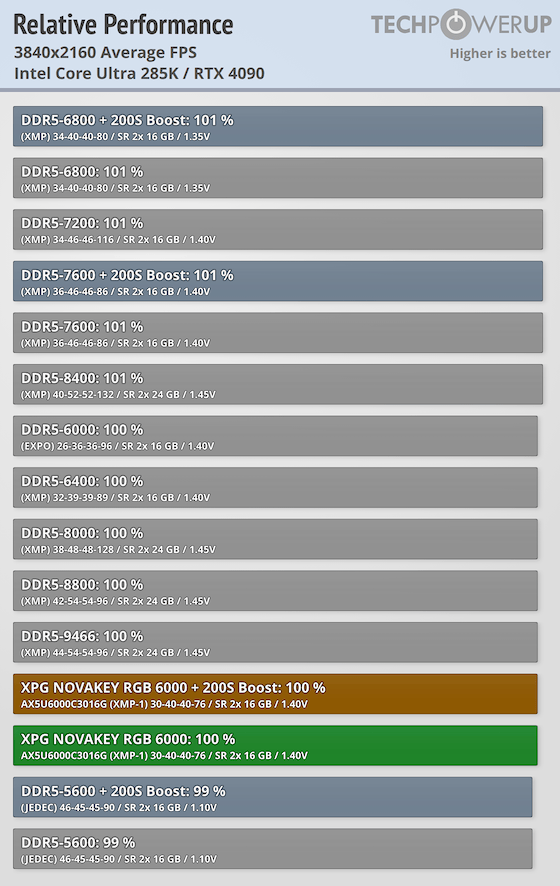
Nov 26th, 2026 23:07 CST
change timezone
Latest GPU Drivers
New Forum Posts
- Using sodimm+adapter instead of full size dimm DDR5? (102)
- Will zen 6 mobos have anything extra vs current ones? (62)
- What's your main Black Friday / Cyber Monday purchase? (25)
- Dell Dimension E510 Retro Gaming PC Upgrade & Modification (3)
- X79 and/or rampage IV OC'ing thread for those of us still left.... (2460)
- Gacha Games - Discussions, Pulls, Updates, etc. (1166)
- Wireless Internet sharing between PC and router both-ways, is it possible? (27)
- WarpCoreBench scores! (116)
- Can you guess Which game it is? (371)
- ASUS Prime 5060 ti 16gb x4 instead of x8 PCIe (12)
Popular Reviews
- VZMORE AX9 Max Review
- Upcoming Hardware Launches 2027 (Updated Nov 2026)
- ASRock X870E Challenger Wi-Fi White Review
- AMD Ryzen 7 9800X3D Review - The Best Gaming Processor
- Microsoft Surface Laptop Ultra Review - The Next-gen Arm Laptop
- AMD Zen 6 Technical Deep Dive
- Montech CyberFlow ARGB 360 Review
- Phantom Blade Zero Performance Benchmark Review - 35 GPUs Tested
- Corsair RM1200e (Second Generation) Review
- Pulsar Office Tour & First Look at P1 Dual-Sensor Mouse
TPU on YouTube
Controversial News Posts
- Jensen Huang Reinstated as CEO of NVIDIA (615)
- NVIDIA Co-Founder and CEO Jensen Huang Officially Resigns (492)
- Report: Jensen Huang Eyes NVIDIA Comeback (281)
- Open Letter Asking NVIDIA to Reinstate Jensen Huang Passes 115,000 Signatures (184)
- OpenAI CEO Argues Home PCs Waste the World's Limited DRAM Supply (152)
- NVIDIA Launches Investigation Into Jensen Huang's Relationship With Suspected Chinese Spy (136)
- Intel Razor Lake Gets a 12 P-Core bLLC Chip With No E-Cores, Per Leak (94)
- NVIDIA GeForce RTX 50-Series Scheduled for up to $500 Price Hike This Week (89)