 28
Zotac GeForce GTX 1080 Ti AMP! Extreme 11 GB Review
(28 Comments) »Introduction

The NVIDIA GeForce GTX 1080 Ti is a mean machine based on NVIDIA's second biggest implementation of its "Pascal" architecture, the 16 nm "GP102" silicon. This is the same chip that drives the TITAN X Pascal. The GTX 1080 Ti features the same number of CUDA cores as the latest TITAN, at 3,584 spread across 28 streaming multiprocessors. There is some cost-cutting here, but none that is designed to lower performance - the chip has a slightly narrower memory bus at 352 bit; that's one memory chip less than what you'd find on the TITAN X Pascal. The total memory amount is hence 11 GB. A cluster of ROPs is also disabled, so you now get 88 ROPs (as opposed to the 96 ROPs on the TITAN). The memory chips are, however, clocked 10% higher to make up for the 8.3% narrower memory bus. This move also translates into cost savings due to the lack of a 12th memory chip and probably better yields for the GP102 chip.

Zotac's GTX 1080 Ti AMP! Extreme is the company's new flagship GTX 1080 Ti. It is based on a revamped PCB, using a large triple-slot, triple-fan cooler. Also included is a large overclock out of the box, to a base clock of 1645 MHz, which is higher than most other GTX 1080 Tis we've reviewed before. The GDDR5X memory is overclocked too, to 1400 MHz. The card is available for $760 online.
| GeForce GTX 980 Ti | Radeon R9 Fury X | GeForce GTX 1070 | GeForce GTX 1080 | GeForce GTX 1080 Ti | ZOTAC GTX 1080 Ti AMP! Extreme | GeForce Titan XP | |
|---|---|---|---|---|---|---|---|
| Shader Units | 2816 | 4096 | 1920 | 2560 | 3584 | 3584 | 3840 |
| ROPs | 96 | 64 | 64 | 64 | 88 | 88 | 96 |
| Graphics Processor | GM200 | Fiji | GP104 | GP104 | GP102 | GP102 | GP102 |
| Transistors | 8000M | 8900M | 7200M | 7200M | 12000M | 12000M | 12000M |
| Memory Size | 6 GB | 4 GB | 8 GB | 8 GB | 11 GB | 11 GB | 12 GB |
| Memory Type | GDDR5 | HBM | GDDR5 | GDDR5X | GDDR5X | GDDR5X | GDDR5X |
| Memory Bus Width | 384 bit | 4096 bit | 256 bit | 256 bit | 352 bit | 352 bit | 384 bit |
| Core Clock | 1000 MHz+ | 1050 MHz | 1506 MHz+ | 1607 MHz+ | 1481 MHz+ | 1645 MHz+ | 1418 MHz+ |
| Memory Clock | 1750 MHz | 500 MHz | 2002 MHz | 1251 MHz | 1376 MHz | 1400 MHz | 1251 MHz |
| Price | $390 | $380 | $360 | $490 | $700 | $760 | $1200 |
Packaging


You will receive:
- Graphics card
- Documentation + driver disc
- 2x PCIe 6-pin to 8-pin adapter
The Card


Zotac's card is massive and looks really nice thanks to its metal construction. On the back, you will find a metal backplate. Dimensions of the card are 31.0 cm x 13.5 cm.

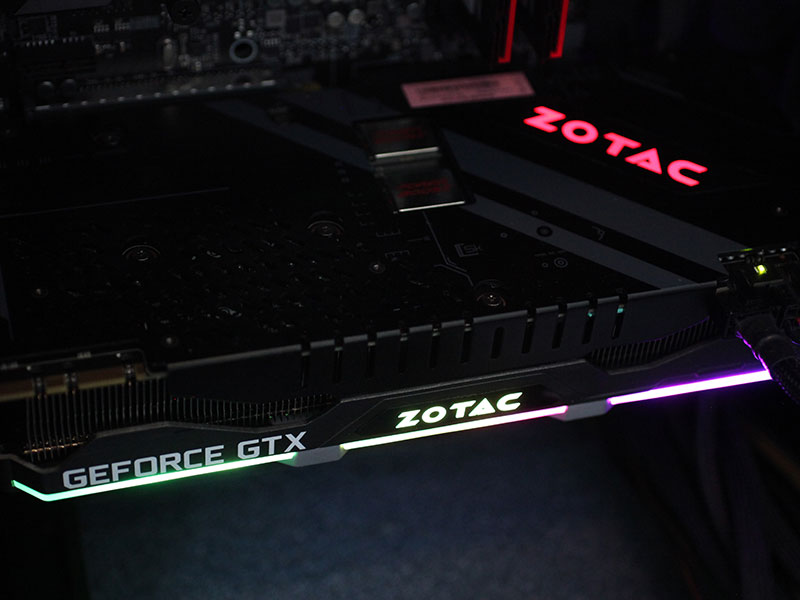

The card comes with adjustable RGB lighting.

Installation requires three slots in your system.

Display connectivity options include a DVI port, an HDMI port, and three DisplayPorts. It's nice to see that the DVI port has been brought back, which was missing on the GTX 1080 Ti Founders Edition.
Unlike previous-generation NVIDIA cards, the DVI port no longer includes the analog signal, so you'll have to use an active adapter. NVIDIA also updated DisplayPort to be 1.2 certified and 1.3/1.4 ready, which enables support for 4K at 120 Hz and 5K @ 60 Hz, or 8K @ 60 Hz with two cables.
The GPU also comes with an HDMI sound device. It is HDMI 2.0b compatible, which supports HD audio and Blu-ray 3D movies. The GPU's video-encoding unit has been updated to support HEVC at 10-bit and 12-bit.

We shine the light from a self-leveling line laser onto the card, which shows a little bit of sagging, but the card itself does not warp.
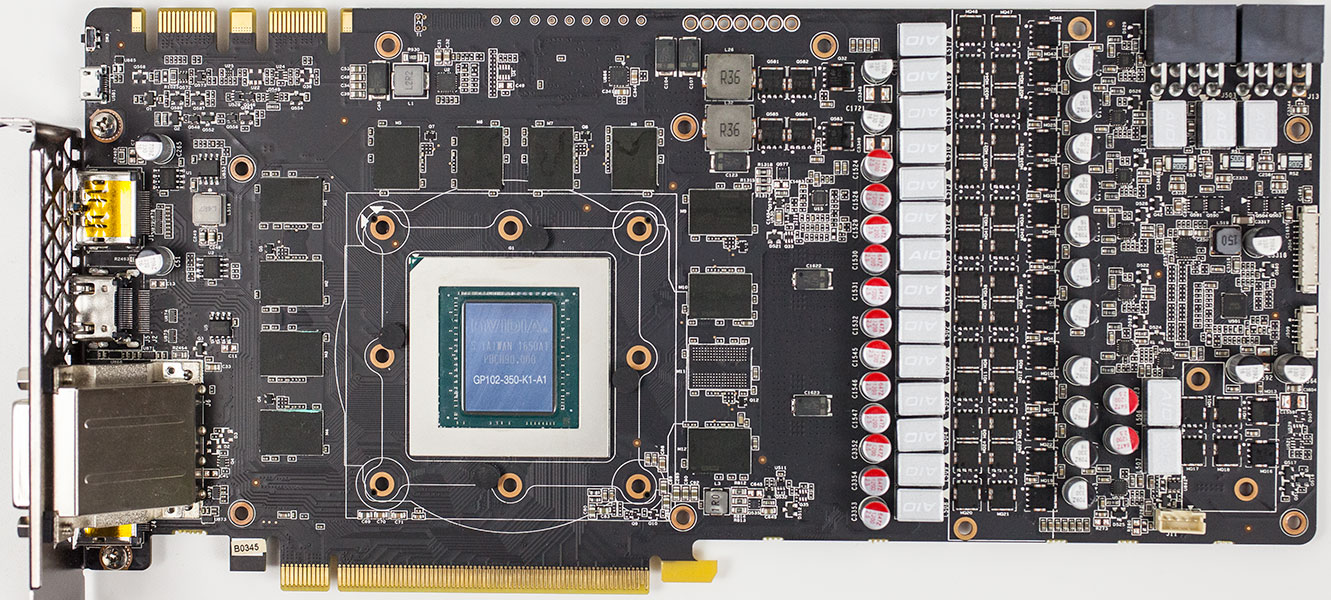

Pictured above are the front and back, showing the disassembled board. High-res versions are also available (front, back).
A Closer Look


Zotac's enormous cooler uses six heatpipes to keep the card cool. It also cools the memory chips.

Once the main heatsink is removed, you can see two additional heatsinks which sit over the voltage regulation circuitry. Note here how nicely the backplate wraps around the card.


The backplate is made from metal to protect the card against damage during installation and handling.

Zotac upgraded the power input configuration of the AMP! Extreme to dual 8-pins. This input configuration is specified for up to 375 watts of power draw.

With Pascal, NVIDIA made some changes to how SLI works. In a nutshell, for 4K at 60 Hz and above, NVIDIA recommends new high-bandwidth SLI bridges it dubbed "SLI HB." These bridges occupy both SLI fingers. Traditional triple- and quad-SLI setups are gone as well. Only certain benchmarks can run more than the dual-SLI setup to which all games are limited.
Our Patreon Silver Supporters can read articles in single-page format.
Nov 15th, 2026 17:11 CST
change timezone
Latest GPU Drivers
New Forum Posts
- Local LLM General Discussion (691)
- WarpCoreBench scores! (54)
- What are you playing? (26223)
- Folding Pie and Milestones!! (10205)
- Asus Rog Maximus Z890 Extreme. (Various questions). (25)
- Power supply noise stops when I move the mouse (9)
- TPU's Nostalgic Hardware Club (22165)
- HP Office Jet 7740 Pro - Supply system problem with replacement cartridge (3)
- Recommendations Wanted - Affordable Enterprise SSD for Boot (9)
- What can the FX 8320 do today? Here is the answer. (59)
Popular Reviews
- AMD Zen 6 Technical Deep Dive
- ASUS ROG Strix B850-I Gaming Wi-Fi7 W Review
- Corsair HX1000i Shift Crystal Review
- Upcoming Hardware Launches 2027 (Updated Nov 2026)
- Montech King 95 3D PRO Review
- NZXT C1200 Platinum Review
- NZXT H7 RGB+ Review
- NZXT H5 Review
- Phantom Blade Zero Performance Benchmark Review - 35 GPUs Tested
- AMD Ryzen 7 9800X3D Review - The Best Gaming Processor
TPU on YouTube
Controversial News Posts
- NVIDIA Co-Founder and CEO Jensen Huang Officially Resigns (422)
- Open Letter Asking NVIDIA to Reinstate Jensen Huang Passes 115,000 Signatures (184)
- OpenAI CEO Argues Home PCs Waste the World's Limited DRAM Supply (152)
- NVIDIA Launches Investigation Into Jensen Huang's Relationship With Suspected Chinese Spy (136)
- Intel "Raptor Lake Next" 16-Core and 20-Core CPUs Surface (130)
- Legendary Game Studio BioWare Shuts Down Following EA Layoffs (104)
- Dell CEO Says the Memory Shortage Will Get Worse in 2027 (95)
- NVIDIA GeForce RTX 50-Series Scheduled for up to $500 Price Hike This Week (89)