 10
Zotac GeForce RTX 3070 Twin Edge OC Review
(10 Comments) »Introduction

We review the new Zotac GeForce RTX 3070 Twin Edge OC, which is yet another of Zotac's performance-segment graphics cards designed to be as small and inexpensive as possible, optimized for the huge DIY market. Dating all the way back to its GTX 970 Twin Fan, Zotac has been developing compact graphics cards based on middle-of-the-market graphics cards that are of a short length, convenient to install, and have just the right custom-design bits to allow Zotac to sell the cards at close-to-reference pricing. The GeForce RTX 3070 Twin Edge OC in this review is no exception. The NVIDIA GeForce RTX 3070 itself is arguably the most important of the three RTX 30-series GPUs launched by NVIDIA thus far as it puts 4K-capable premium gaming performance into the hands of a much larger segment of the market.
With the RTX 3070, NVIDIA is debuting its second silicon based on the GeForce "Ampere" architecture, the 8 nm "GA104." This chip has lighter specs than those of the RTX 3080, but close to double the SIMD muscle as its predecessor, the RTX 2070. NVIDIA put an emphasis on the RTX 3070 being faster than the previous generation flagship, the RTX 2080 Ti. This would mean the RTX 3070 can not only give you maxed out 1440p performance with RTX cranked up, but is also capable of 4K Ultra HD gaming with high settings. It should also cater to high refresh rate e-sports gaming at 1440p and Full HD 1080p. For the full details on the RTX 3070 technology and architecture, refer to our RTX 3070 Founders Edition article.

The Twin Edge OC from Zotac is the most compact of the five RTX 3070 graphics cards we're reviewing today, with dimensions that make it better suited for mid-tower and mini-tower cases, and is strictly two slots thick, just like the Founders Edition. The card is designed for those who just want to game and don't care all that much about RGB bling to revel through their huge tempered glass panels. The company did direct efforts towards making the card quiet by using a dense aluminium fin-stack heatsink and two large fans of different diameters, along with a 3D backplate. You don't miss out on essentials such as idle fan stop. It also features a pair of common 8-pin PCIe power inputs, which means you don't have to deal with NVIDIA's new 12-pin power connector. There are two variants of this card, one which sticks to NVIDIA reference clock speeds and comes in at the $499 baseline price for this SKU and the Zotac RTX 3070 Twin Edge OC in this review as its OC variant, which offers a tiny 30 MHz factory overclock of 1755 MHz (compared to 1725 MHz reference) for a marginal premium of just $20. In our review, we put it through its paces to check if this is the card you should pick if all you want is the RTX 3070's near-stock gaming performance, and also how it competes with the NVIDIA Founders Edition.
| Price | Shader Units | ROPs | Core Clock | Boost Clock | Memory Clock | GPU | Transistors | Memory | |
|---|---|---|---|---|---|---|---|---|---|
| RX 5700 | $330 | 2304 | 64 | 1465 MHz | 1625 MHz | 1750 MHz | Navi 10 | 10300M | 8 GB, GDDR6, 256-bit |
| GTX 1080 | $330 | 2560 | 64 | 1607 MHz | 1733 MHz | 1251 MHz | GP104 | 7200M | 8 GB, GDDR5X, 256-bit |
| RTX 2060 Super | $380 | 2176 | 64 | 1470 MHz | 1650 MHz | 1750 MHz | TU106 | 10800M | 8 GB, GDDR6, 256-bit |
| RX Vega 64 | $400 | 4096 | 64 | 1247 MHz | 1546 MHz | 953 MHz | Vega 10 | 12500M | 8 GB, HBM2, 2048-bit |
| GTX 1080 Ti | $650 | 3584 | 88 | 1481 MHz | 1582 MHz | 1376 MHz | GP102 | 12000M | 11 GB, GDDR5X, 352-bit |
| RX 5700 XT | $370 | 2560 | 64 | 1605 MHz | 1755 MHz | 1750 MHz | Navi 10 | 10300M | 8 GB, GDDR6, 256-bit |
| RTX 2070 | $340 | 2304 | 64 | 1410 MHz | 1620 MHz | 1750 MHz | TU106 | 10800M | 8 GB, GDDR6, 256-bit |
| RTX 2070 Super | $450 | 2560 | 64 | 1605 MHz | 1770 MHz | 1750 MHz | TU104 | 13600M | 8 GB, GDDR6, 256-bit |
| Radeon VII | $680 | 3840 | 64 | 1802 MHz | N/A | 1000 MHz | Vega 20 | 13230M | 16 GB, HBM2, 4096-bit |
| RTX 2080 | $600 | 2944 | 64 | 1515 MHz | 1710 MHz | 1750 MHz | TU104 | 13600M | 8 GB, GDDR6, 256-bit |
| RTX 2080 Super | $690 | 3072 | 64 | 1650 MHz | 1815 MHz | 1940 MHz | TU104 | 13600M | 8 GB, GDDR6, 256-bit |
| RTX 2080 Ti | $1000 | 4352 | 88 | 1350 MHz | 1545 MHz | 1750 MHz | TU102 | 18600M | 11 GB, GDDR6, 352-bit |
| RTX 3070 | $500 | 5888 | 96 | 1500 MHz | 1725 MHz | 1750 MHz | GA104 | 17400M | 8 GB, GDDR6, 256-bit |
| Zotac RTX 3070 Twin Edge OC | $520 | 5888 | 96 | 1500 MHz | 1755 MHz | 1750 MHz | GA104 | 17400M | 8 GB, GDDR6, 256-bit |
| RTX 3080 | $700 | 8704 | 96 | 1440 MHz | 1710 MHz | 1188 MHz | GA102 | 28000M | 10 GB, GDDR6X, 320-bit |
| RTX 3090 | $1500 | 10496 | 112 | 1395 MHz | 1695 MHz | 1219 MHz | GA102 | 28000M | 24 GB, GDDR6X, 384-bit |
Packaging


The Card


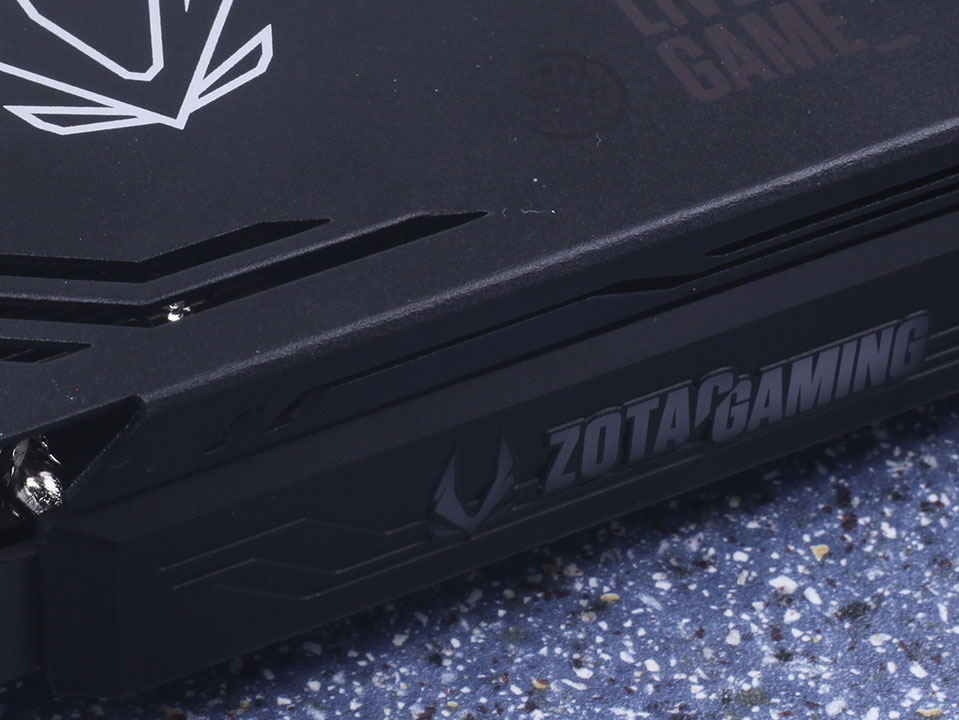
The Zotac GeForce RTX 3070 Twin Edge OC retains the Ice Storm 2 design scheme the company introduced with its RTX 30-series custom-design products. As we mentioned earlier, this is the most compact of the RTX 3070 cards we reviewed so far, but even then, it's both longer and taller than past generations of baseline x70-series designs by Zotac. The card is a good inch taller than the I/O bracket, and the two fans are clearly not of equal size, with the smaller fan 90 mm and the bigger one 100 mm. A metal backplate is included, too.

Dimensions of the card are 23 cm x 14 cm.

Installation requires two slots in your system.

Display connectivity options include three standard DisplayPort 1.4a and one HDMI 2.1. The DisplayPort 1.4a outputs support Display Stream Compression (DSC) 1.2a, which lets you connect 4K displays at 120 Hz and 8K displays at 60 Hz. Ampere can drive two 8K displays at 60 Hz with just one cable per display.
Ampere is the first GPU to support HDMI 2.1, which increases bandwidth to 48 Gbps to support higher resolutions, like 4K144 and 8K30, with a single cable. With DSC, this goes up to 4K240 and 8K120. NVIDIA's new NVENC/NVDEC video engine is optimized to handle video tasks with minimal CPU load. The highlight here is added support for AV1 decode. Just like on Turing, you may also decode MPEG-2, VC1, VP8, VP9, H.264, and H.265 natively, at up to 8K@12-bit.
The encoder is identical to Turing. It supports H.264, H.265 and lossless at up to 8K@10-bit.

Unlike the Founders Edition card with its wacky 12-pin connector, the RTX 3070 Twin Edge OC comes with two conventional 8-pin PCIe power connectors. Due to the way the cooler shroud is designed, the power inputs are recessed quite far into the card, which makes it difficult to plug in and out the PCIe power cables. Note that I accidentally bent the heatsink fins near the connectors because I was trying to get the cable plugged in.
The GeForce RTX 3070 does not support SLI. Only the RTX 3090 does, and it has very limited SLI support.
Teardown


The Zotac GeForce RTX 3070 Twin Edge uses five heatpipes to keep the GPU cool. This part of the heatsink also provides cooling for the memory chips and VRM circuitry.


The backplate is made out of metal and protects the card against damage during installation and handling. It is longer than the PCB, which lets it wrap around and looks great. Three thermal pads are installed to soak up a little bit of heat from the GPU area.
High-resolution PCB Pictures
These pictures are for the convenience of volt modders and people who would like to see all the finer details on the PCB. Feel free to link back to us and use these in your articles or forum posts.

High-res versions are also available (front, back).
Our Patreon Silver Supporters can read articles in single-page format.
Nov 15th, 2026 22:11 CST
change timezone
Latest GPU Drivers
New Forum Posts
- The Official Thermal Interface Material thread (2301)
- Asus Rog Maximus Z890 Extreme. (Various questions). (26)
- GPU Temperatures Rise Very Quickly in FurMark – Is This Normal? (7)
- Will zen 6 mobos have anything extra vs current ones? (46)
- Your PC ATM (36435)
- It’s been fascinating times in Retro agian r36s isn’t even worth 50-65 dollars no more and newly listed Rm36 64gb 4in IPS models for only 34 dollars. (6)
- Power supply noise stops when I move the mouse (10)
- Can you guess Which game it is? (320)
- What is the latest game you finished or 100% (203)
- HP Office Jet 7740 Pro - Supply system problem with replacement cartridge (4)
Popular Reviews
- ASUS ROG Strix B850-I Gaming Wi-Fi7 W Review
- Corsair HX1000i Shift Crystal Review
- AMD Zen 6 Technical Deep Dive
- Upcoming Hardware Launches 2027 (Updated Nov 2026)
- Montech King 95 3D PRO Review
- NZXT C1200 Platinum Review
- Phantom Blade Zero Performance Benchmark Review - 35 GPUs Tested
- AMD Ryzen 7 9800X3D Review - The Best Gaming Processor
- NZXT H5 Review
- NZXT H7 RGB+ Review
TPU on YouTube
Controversial News Posts
- NVIDIA Co-Founder and CEO Jensen Huang Officially Resigns (430)
- Open Letter Asking NVIDIA to Reinstate Jensen Huang Passes 115,000 Signatures (184)
- OpenAI CEO Argues Home PCs Waste the World's Limited DRAM Supply (152)
- NVIDIA Launches Investigation Into Jensen Huang's Relationship With Suspected Chinese Spy (136)
- Intel "Raptor Lake Next" 16-Core and 20-Core CPUs Surface (130)
- Legendary Game Studio BioWare Shuts Down Following EA Layoffs (104)
- Dell CEO Says the Memory Shortage Will Get Worse in 2027 (95)
- NVIDIA GeForce RTX 50-Series Scheduled for up to $500 Price Hike This Week (89)