 22
ZOTAC GeForce RTX 3090 Trinity Review
(22 Comments) »Introduction

ZOTAC today launched its GeForce RTX 3090 Trinity Ampere graphics card. The card combines NVIDIA's top-dog RTX 3090 GPU with 24 GB of GDDR6X memory, the latest IceStorm 2.0 cooling solution, and Spectra 2 ARGB illumination. ZOTAC also offers an industry-leading 5-year warranty subject to product registration. Unlike NVIDIA's RTX 3090 Founders Edition with its Dual-Axial Flow-Through cooler, ZOTAC takes a more conventional approach with its IceStorm 2.0 thermal solution. All three fans are where you'd expect them. The cooler is longer than the PCB, so some of the airflow from the third fan flows through, out the backplate.
NVIDIA has taken an unconventional approach to the enthusiast segment with its GeForce RTX 30-series Ampere family. The $700 RTX 3080 launched last week has been labeled "flagship" by NVIDIA, and has been extensively shown beating not just its predecessor, the RTX 2080, by a high double-digit percent, but also the previous-gen flagship RTX 2080 Ti by a fair margin, while at least $500 cheaper. The new RTX 3090, on the other hand, is being launched as a "halo segment" product and extensively compared to the Turing-based TITAN RTX, which launched at $3,000.

What's also unconventional about the GeForce Ampere series is NVIDIA's use of a common silicon between the RTX 3080 and RTX 3090—the 8 nm GA102 graphics processor. With the previous generation, the RTX 2080 and its refresh, the RTX 2080 Super, were based on the smaller TU104 silicon, while the RTX 2080 Ti and TITAN RTX were built using the larger TU102 die. Between the RTX 3080 and RTX 3090, NVIDIA left itself plenty of headroom for future product segmentation.
With the RTX 3080 already capable of 4K UHD gaming with raytracing, the RTX 3090 has an interesting market position at its $1,499 starting price, which is about 50% higher than the launch price of the RTX 2080 Ti, but exactly 50% lower than the TITAN RTX. Besides enabling all but two streaming multiprocessors on the GA102 silicon, the RTX 3090 enjoys the full 384-bit wide memory interface of the die—no 352-bit business this time around. NVIDIA took things a notch further by arming the RTX 3090 with a staggering 24 GB of GDDR6X memory clocked at 19.5 Gbps—an astounding 940 GB/s memory bandwidth.
The comparisons to the TITAN RTX begin to explain the main application of the RTX 3090 to consumers as it offers the highest possible performance from the Ampere generation, with 4K UHD gameplay at higher refresh rates than the RTX 3080 can handle, 8K gameplay leveraging DLSS 8K, and "TITAN-class creator performance," which probably underscores NVIDIA's decision to give it 24 GB of memory.
NVIDIA carved the RTX 3090 out of the same GA102 silicon the RTX 3080 is based on by disabling just 1 of the 42 TPCs present on the silicon. With 41 TPCs (82 SM), the RTX 3090 enjoys a jaw-dropping 10,496 CUDA cores, 328 Tensor cores, 82 RT cores, 328 TMUs, and 112 ROPs. The GPU Boost frequency goes up to 1695 MHz. NVIDIA leveraged the new 8 nanometer 8FFN silicon fabrication node by Samsung to build the GA102. Ampere represents the 2nd generation of NVIDIA's path-breaking RTX architecture that introduces real-time raytracing to the consumer segment by combining conventional raster 3D graphics with real-time raytraced elements, such as lighting, shadows, reflections, ambient-occlusion, and global illumination. The 2nd generation also introduces raytraced motion-blur and even has fixed-function hardware just to pull this otherwise difficult effect off. Find more details about the architecture in our NVIDIA Ampere Architecture article.
Unlike the TITAN RTX, which only comes in the reference-design Founders Edition version, the RTX 3090 can be built by partners, who have the freedom to implement their latest premium board designs with the chip. As we mentioned earlier, the Zotac RTX 3090 Trinity in this review comes with the company's IceStorm 2 cooler that features a long series of aluminium fin-stack heatsinks held together by copper heat pipes, ventilated by three fans that each spin at a speed independent of the others. The card sticks to the reference 1695 MHz GPU Boost frequency, and its memory ticks at 19.5 Gbps (GDDR6X-effective). In this review, we take the card for a spin across our exhaustive list of game tests and compare it to our vast selection of high-end graphics cards to tell you if you should start saving for one.
| Price | Shader Units | ROPs | Core Clock | Boost Clock | Memory Clock | GPU | Transistors | Memory | |
|---|---|---|---|---|---|---|---|---|---|
| GTX 1080 Ti | $650 | 3584 | 88 | 1481 MHz | 1582 MHz | 1376 MHz | GP102 | 12000M | 11 GB, GDDR5X, 352-bit |
| RX 5700 XT | $370 | 2560 | 64 | 1605 MHz | 1755 MHz | 1750 MHz | Navi 10 | 10300M | 8 GB, GDDR6, 256-bit |
| RTX 2070 | $340 | 2304 | 64 | 1410 MHz | 1620 MHz | 1750 MHz | TU106 | 10800M | 8 GB, GDDR6, 256-bit |
| RTX 2070 Super | $450 | 2560 | 64 | 1605 MHz | 1770 MHz | 1750 MHz | TU104 | 13600M | 8 GB, GDDR6, 256-bit |
| Radeon VII | $680 | 3840 | 64 | 1802 MHz | N/A | 1000 MHz | Vega 20 | 13230M | 16 GB, HBM2, 4096-bit |
| RTX 2080 | $600 | 2944 | 64 | 1515 MHz | 1710 MHz | 1750 MHz | TU104 | 13600M | 8 GB, GDDR6, 256-bit |
| RTX 2080 Super | $690 | 3072 | 64 | 1650 MHz | 1815 MHz | 1940 MHz | TU104 | 13600M | 8 GB, GDDR6, 256-bit |
| RTX 2080 Ti | $1000 | 4352 | 88 | 1350 MHz | 1545 MHz | 1750 MHz | TU102 | 18600M | 11 GB, GDDR6, 352-bit |
| RTX 3070 | $500 | 5888 | 96 | 1500 MHz | 1725 MHz | 1750 MHz | GA104 | 17400M | 8 GB, GDDR6, 256-bit |
| RTX 3080 | $700 | 8704 | 96 | 1440 MHz | 1710 MHz | 1188 MHz | GA102 | 28000M | 10 GB, GDDR6X, 320-bit |
| RTX 3090 | $1500 | 10496 | 112 | 1395 MHz | 1695 MHz | 1219 MHz | GA102 | 28000M | 24 GB, GDDR6X, 384-bit |
| Zotac RTX 3090 Trinity | $1500 | 10496 | 112 | 1395 MHz | 1695 MHz | 1219 MHz | GA102 | 28000M | 24 GB, GDDR6X, 384-bit |
Packaging


The Card
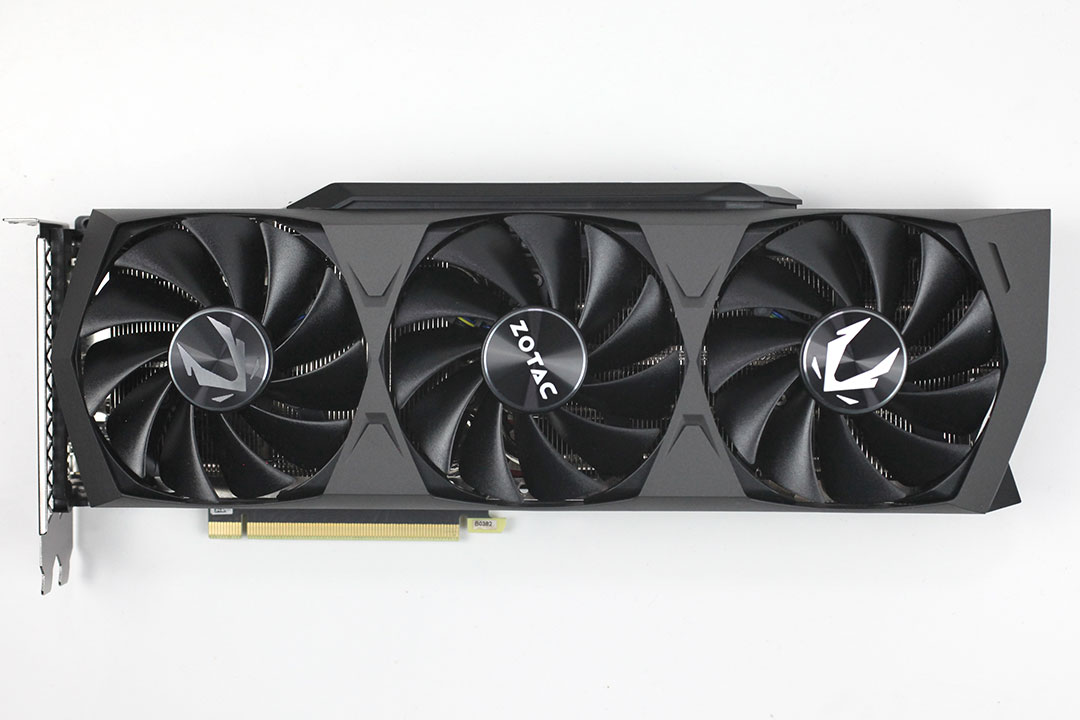


The ZOTAC GeForce RTX 3090 Trinity looks identical to the RTX 3080 Trinity we reviewed last week. It features a more traditional-looking card with a triple-slot, triple-fan setup of three 90 mm fans blowing air onto a pair of aluminium fin-stack heatsinks skewered by copper heatpipes that pull heat from the GPU through a vapor-chamber plate.

Dimensions of the card are 32 x 12 cm.


Installation requires three slots in your system.

Display connectivity options include three standard DisplayPort 1.4a and one HDMI 2.1. Interestingly, the USB-C port for VR headsets, which NVIDIA introduced on Turing Founders Editions, has been removed—guess it didn't take off as planned. The DisplayPort 1.4a outputs support Display Stream Compression (DSC) 1.2a, which lets you connect 4K displays at 120 Hz and 8K displays at 60 Hz. Ampere can drive two 8K displays at 60 Hz with just one cable per display.
Ampere is the first GPU to support HDMI 2.1, which increases bandwidth to 48 Gbps to support higher resolutions, like 4K144 and 8K30, with a single cable. With DSC, this goes up to 4K240 and 8K120. NVIDIA's new NVENC/NVDEC video engine is optimized to handle video tasks with minimal CPU load. The highlight here is added support for AV1 decode. Just like on Turing, you may also decode MPEG-2, VC1, VP8, VP9, H.264, and H.265 natively, at up to 8K@12-bit.
The encoder is identical to Turing. It supports H.264, H.265, and lossless at up to 8K@10-bit.

The card takes in two 8-pin PCIe power connectors. This setup is rated for 375 W.

The GeForce RTX 3090 supports SLI and features a newer-generation NVLink bridge interface, which means you can't use your NVLink bridge from your Turing cards. Be warned that with Ampere, NVIDIA isn't supporting SLI as in implicit multi-GPU (SLI as you know it), but explicit multi-GPU developed and supported by game developers. With multi-GPU game support being pretty much non-existent, this basically means SLI is dead. Perhaps creative and 3D modeling applications that support explicit multi-GPU can benefit from SLI.
Teardown


Disassembling the ZOTAC GeForce RTX 3090 Trinity is fairly straightforward. The cooler features seven heatpipes and three 90 mm fans.


Once the main heatsink is removed, a metal frame that provides rigidity for the card becomes visible. It also helps cool the VRM circuitry.


The backplate protects the card against damage during installation and handling. Punched-in holes towards the end have airflow from the third fan go right though. Since the RTX 3090 has memory chips on both sides of the PCB, the backplate plays an important role in cooling.
High-resolution PCB Pictures
These pictures are for the convenience of volt modders and people who would like to see all the finer details on the PCB. Feel free to link back to us and use these in your articles or forum posts.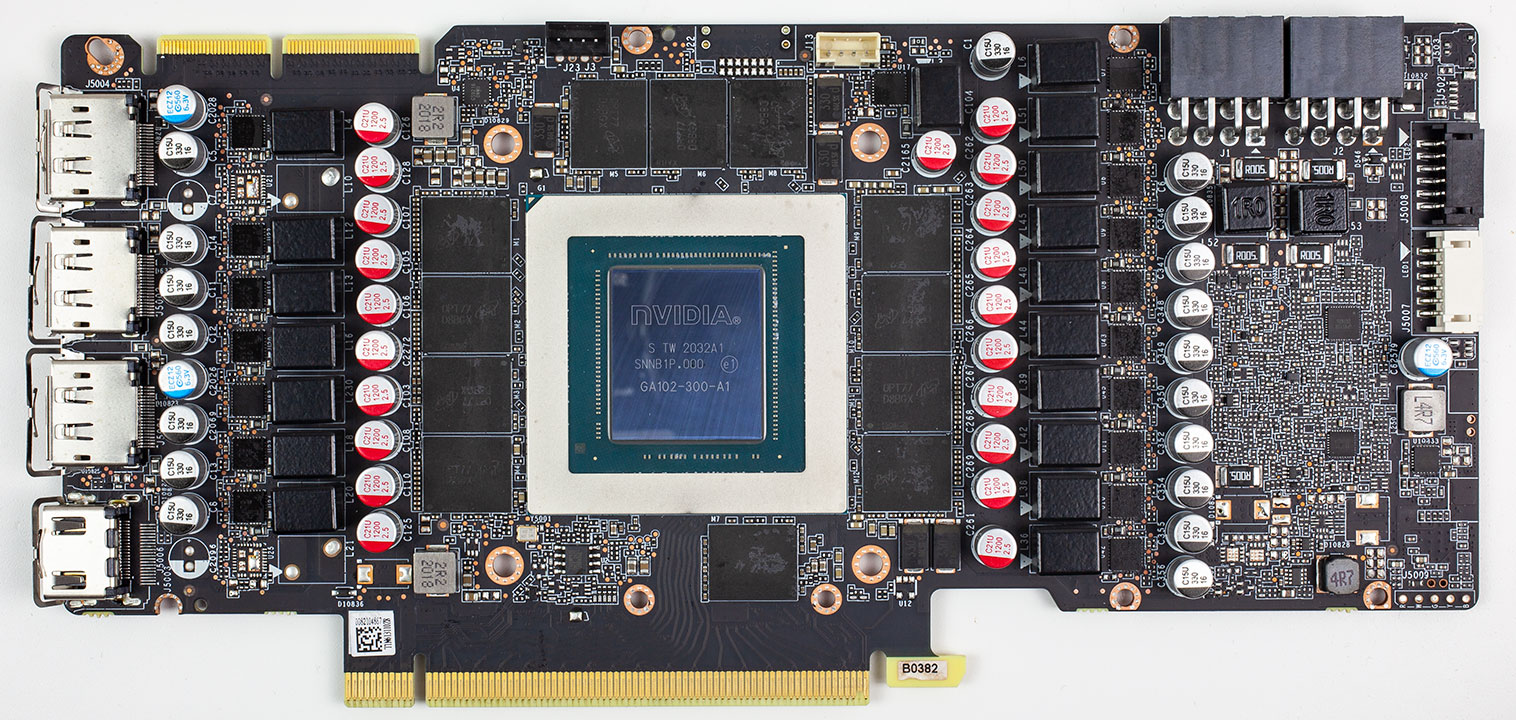
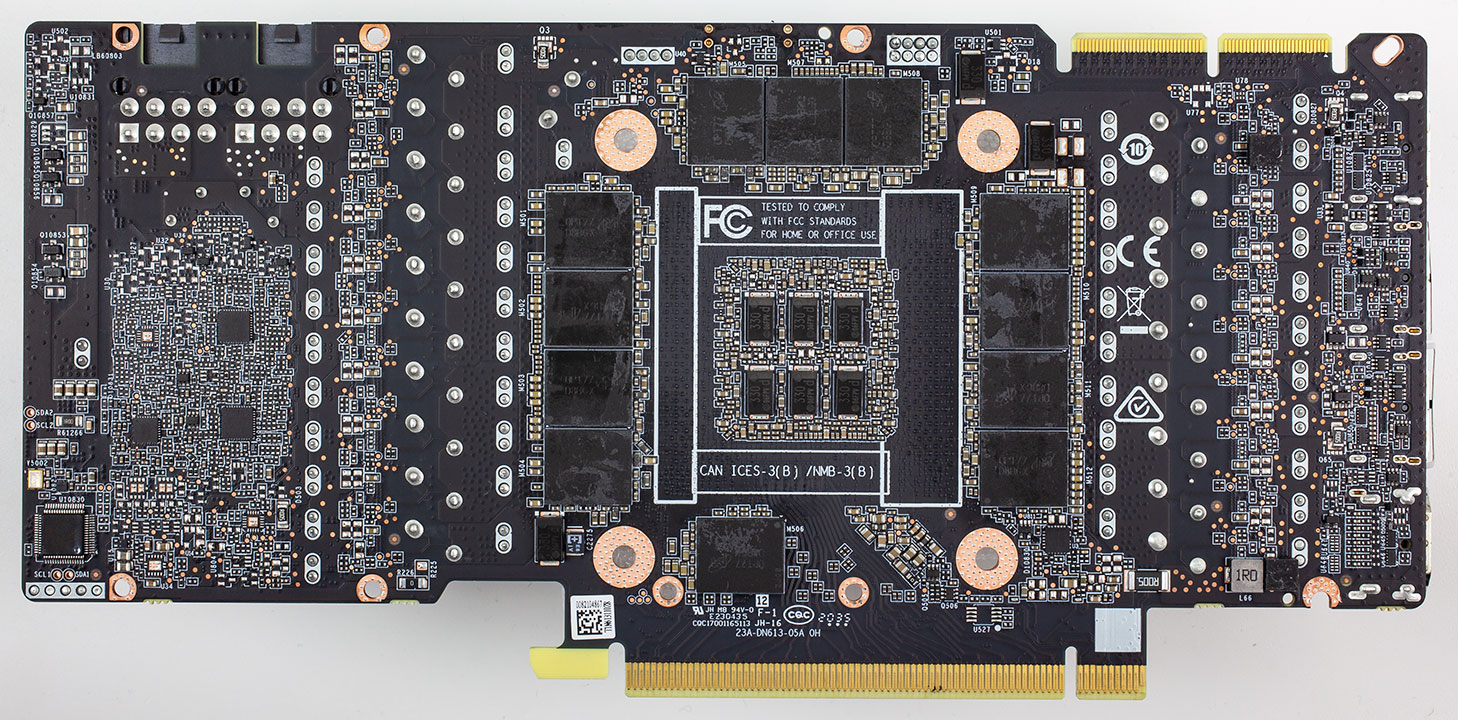
High-res versions are also available (front, back).
Our Patreon Silver Supporters can read articles in single-page format.
Nov 15th, 2026 12:29 CST
change timezone
Latest GPU Drivers
New Forum Posts
- What can the FX 8320 do today? Here is the answer. (57)
- WarpCoreBench scores! (49)
- What are you playing? (26221)
- How do you get games for PC? (59)
- WireView Pro II GPU Alignment: Wired | Variant: Black (5)
- What is the latest game you finished or 100% (202)
- Honestly, do you care about GTA VI? (61)
- Power supply noise stops when I move the mouse (7)
- HP Office Jet 7740 Pro - Supply system problem with replacement cartridge (1)
- Recommendations Wanted - Affordable Enterprise SSD for Boot (5)
Popular Reviews
- AMD Zen 6 Technical Deep Dive
- ASUS ROG Strix B850-I Gaming Wi-Fi7 W Review
- Corsair HX1000i Shift Crystal Review
- Upcoming Hardware Launches 2027 (Updated Nov 2026)
- Montech King 95 3D PRO Review
- NZXT C1200 Platinum Review
- NZXT H7 RGB+ Review
- NZXT H5 Review
- Phantom Blade Zero Performance Benchmark Review - 35 GPUs Tested
- AMD Ryzen 7 9800X3D Review - The Best Gaming Processor
TPU on YouTube
Controversial News Posts
- NVIDIA Co-Founder and CEO Jensen Huang Officially Resigns (415)
- Open Letter Asking NVIDIA to Reinstate Jensen Huang Passes 115,000 Signatures (160)
- OpenAI CEO Argues Home PCs Waste the World's Limited DRAM Supply (152)
- NVIDIA Launches Investigation Into Jensen Huang's Relationship With Suspected Chinese Spy (136)
- Intel "Raptor Lake Next" 16-Core and 20-Core CPUs Surface (130)
- Legendary Game Studio BioWare Shuts Down Following EA Layoffs (104)
- Dell CEO Says the Memory Shortage Will Get Worse in 2027 (95)
- NVIDIA GeForce RTX 50-Series Scheduled for up to $500 Price Hike This Week (89)