Sunday, June 2nd 2013
FinalWire AIDA64 v3.00 Released
FinalWire Ltd. today announced the immediate availability of AIDA64 Extreme Edition 3.00 software, a streamlined diagnostic and benchmarking tool for home users; and the immediate availability of AIDA64 Business Edition 3.00 software, an essential network management solution for small and medium scale enterprises.
The new AIDA64 release introduces completely rewritten memory bandwidth and memory latency benchmarks, optimized for AVX2, AVX and SSE capable AMD, Intel and VIA processors. The latest AIDA64 update also implements optimized 64-bit benchmarks for AMD "Kabini" and Intel "Haswell" processors, and supports the latest AMD Radeon and nVIDIA GeForce graphics accelerators.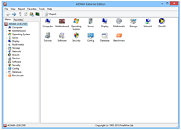 DOWNLOAD: AIDA64 v3.00 Installer, AIDA64 v3.00 ZIP
New features & improvements
The completely rewritten cache and memory bandwidth benchmarks now utilize AVX2, AVX and SSE instructions of the latest AMD, Intel and VIA processors; and use up to 32 threads for read, write and copy bandwidth measurement. The brand new cache and memory latency benchmark now uses a block-random method to eliminate the effect of hardware prefetchers, and to minimize TLB misses. For legacy processors all benchmarks and the System Stability Test are available in 32-bit version as well.
Optimized 64-bit benchmarks for AMD "Kabini" and "Temash" APUs
AIDA64 CPUID Panel, Cache & Memory Benchmark panel, System Stability Test, and all memory and processor benchmarks are fully optimized for AMD "Kabini" and "Temash"desktop, mobile and tablet APUs, utilizing AVX, SSE4.1 and AES-NI instructions. Detailed chipset information for AMD "Yangtze" integrated Fusion Controller Hub. Improved support for the upcoming AMD "Kaveri" and "Beema" APUs.
Next-generation Intel processors and chipsets support
AVX2 and FMA optimized 64-bit benchmarks for the upcoming Intel "Haswell" desktop and mobile processors. Extended chipset information for Intel "Lynx Point" and "Lynx Point-LP" PCHs, and for the integrated memory controller of Intel "Haswell" processors. AIDA64 benchmarks and System Stability Test utilize Advanced Vector Extensions 2 (AVX2), Fused Multiply-Add (FMA) instructions, and AES-NI hardware acceleration of the new Intel processors. Improved support for Intel "Avoton" and "Valleyview" SoC, "Haswell-E" and "Ivy Bridge-E" CPU. Preliminary L4 cache bandwidth and latency benchmarks for the upcoming Intel "Crystal Well" processor. Intel Centrino Mobile Technology 9th Generation (Shark Bay-MB) compliancy test.
Support for the latest hardware technologies
Graphics processor, OpenGL and GPGPU details, temperature and cooling fan monitoring for the latest GPUs: AMD Radeon HD 7730, Radeon HD 7990 "Malta"; nVIDIA GeForce GT 705M, GeForce GT 735M, GeForce GT 740M, GeForce GT 745M, GeForce GTX 760M, GeForce GTX 765M, GeForce GTX 770, GeForce GTX 770M, GeForce GTX 780, GeForce GTX 780M, GeForce GTX Titan LE, Tesla K20, Tesla K20X. Improved support for Crucial M500 and OCZ Vertex 450 SSDs.
The new AIDA64 release introduces completely rewritten memory bandwidth and memory latency benchmarks, optimized for AVX2, AVX and SSE capable AMD, Intel and VIA processors. The latest AIDA64 update also implements optimized 64-bit benchmarks for AMD "Kabini" and Intel "Haswell" processors, and supports the latest AMD Radeon and nVIDIA GeForce graphics accelerators.

New features & improvements
- Multi-threaded cache and memory bandwidth benchmarks with AVX2, AVX and SSE optimizations
- Block-random cache and memory latency benchmark
- Optimized 64-bit benchmarks for AMD "Kabini" and "Temash" APUs
- AVX2 and FMA optimized 64-bit benchmarks for Intel "Haswell" processors
- Preliminary support for L4 cache of Intel "Crystal Well" processors
- Crucial M500, OCZ Vertex 450 SSD support
- GPU details for AMD Radeon HD 7990 "Malta" and nVIDIA GeForce 700 Series
The completely rewritten cache and memory bandwidth benchmarks now utilize AVX2, AVX and SSE instructions of the latest AMD, Intel and VIA processors; and use up to 32 threads for read, write and copy bandwidth measurement. The brand new cache and memory latency benchmark now uses a block-random method to eliminate the effect of hardware prefetchers, and to minimize TLB misses. For legacy processors all benchmarks and the System Stability Test are available in 32-bit version as well.
Optimized 64-bit benchmarks for AMD "Kabini" and "Temash" APUs
AIDA64 CPUID Panel, Cache & Memory Benchmark panel, System Stability Test, and all memory and processor benchmarks are fully optimized for AMD "Kabini" and "Temash"desktop, mobile and tablet APUs, utilizing AVX, SSE4.1 and AES-NI instructions. Detailed chipset information for AMD "Yangtze" integrated Fusion Controller Hub. Improved support for the upcoming AMD "Kaveri" and "Beema" APUs.
Next-generation Intel processors and chipsets support
AVX2 and FMA optimized 64-bit benchmarks for the upcoming Intel "Haswell" desktop and mobile processors. Extended chipset information for Intel "Lynx Point" and "Lynx Point-LP" PCHs, and for the integrated memory controller of Intel "Haswell" processors. AIDA64 benchmarks and System Stability Test utilize Advanced Vector Extensions 2 (AVX2), Fused Multiply-Add (FMA) instructions, and AES-NI hardware acceleration of the new Intel processors. Improved support for Intel "Avoton" and "Valleyview" SoC, "Haswell-E" and "Ivy Bridge-E" CPU. Preliminary L4 cache bandwidth and latency benchmarks for the upcoming Intel "Crystal Well" processor. Intel Centrino Mobile Technology 9th Generation (Shark Bay-MB) compliancy test.
Support for the latest hardware technologies
Graphics processor, OpenGL and GPGPU details, temperature and cooling fan monitoring for the latest GPUs: AMD Radeon HD 7730, Radeon HD 7990 "Malta"; nVIDIA GeForce GT 705M, GeForce GT 735M, GeForce GT 740M, GeForce GT 745M, GeForce GTX 760M, GeForce GTX 765M, GeForce GTX 770, GeForce GTX 770M, GeForce GTX 780, GeForce GTX 780M, GeForce GTX Titan LE, Tesla K20, Tesla K20X. Improved support for Crucial M500 and OCZ Vertex 450 SSDs.
13 Comments on FinalWire AIDA64 v3.00 Released
Fiery
All this time reviewers have been telling us memory performance of triple/quad setups isn't much better than dual channel when in reality it is. Most review sites use AIDA for memory benchmarks, I don't know why you wouldn't update the memory benchmarks earlier if there is such a huge difference like this.
It could change people's purchasing decisions.
But I see many reports that just using AIDA64 (I assume older version than 3.0 ) it can be total stable in AIDA64 but not elsewhere when OC .
You can see HardOCP review of 4770k for example
Maybe you could add a extreme level ,which would keep what you have but add a bit more load .
Just a thought .
It touched a nerve with me because memory performance was one of the main reasons I was unhappy with my X79 quad channel system that I spent $1000 on. My Z77 dual channel system performed 25% better on memory benchmarks at the same clocks.....now it turns out the benchmarks weren't really accurate.
Not blaming AIDA, this should have been made clear by reviewers or Intel should have provided a tool or explanation or something.
Basically we're saying single threaded memory benchmarks that are all over the internet in many reviews going back for the last few years, are pretty much useless and inaccurate.
I do appreciate it is hard to do, and it took a long time, its better late than never I guess.....
BTW, on the HardOCP review... I don't mean to knock an otherwise great site, a great author and a great review, but what the author there explained about AIDA64 is just silly. Why would anyone consider an overheating (throttling) system stable? Why would you even want to get to a BSoD or lockup when your system is overheating? First, you should take care of properly cooling the overclocked system, and only after then you get to finding stability issues. The AIDA64 System Stability Test clearly shows the overheating state. Putting that to a review with huge screen shots, and then knocking AIDA64 System Stability Test is just not something I'd take too seriously :ohwell:
And BTW, on the X79 system, try to fall back to a 2-channel configuration by removing half of the memory modules. Then use a few benchmarks (not just AIDA64, but PCMark, some game timedemo, etc), to see how much performance would you lose. You won't lose that many percentage overall -- I'd say between 5 and 10%, but in most cases even less than that. And that's where relying on pure memory bandwidth scores turns out to be the wrong approach ;)Please don't blame Intel :) They reached to us before they introduced X79 and Sandy Bridge-E, but back then we were simply not ready to roll out the multi-threaded memory bandwidth benchmarks. We here at FinalWire are a sort of guys who still believe you need to release something only when it is ready. We don't publish something that we're not 100% certain about. We had to keep the old, single-threaded memory bandwidth benchmarks while we were developing the new ones. By releasing unfinished benchmarks that provide unreliable (albeit considerably higher) scores would just upset many of you guys ;)No, not at all. They are still accurate, although not quite relevant on 3 or 4-channel memory configurations. Would you consider any benchmarks running on Haswell and not having AVX2+FMA optimizations useless and inaccurate? (that would cover 99% of the benchmarks, except for AIDA64 v3.00 of course :cool: ) Would you consider SuperPI an inaccurate benchmark just because it's single-threaded? No and no, if you ask me.
is going to be totally stability if passed . you do need to run whatever apps/games to see if they are stable .
I guess what rubs me a little is AIDA64 is payware and if i understand it it not cut down after trail time period is up (like 3dmark ) . So I haven't tried it as I don't install trail stuff if its useless after that point . Maybe only exception would be photoshop or something .
Anyway, maybe you keep adding tests over time that would broaden the test base and maybe catch more things .
thanks for reply ,feedback .
Yes, to bad you released version 3.0 few days after reviews came out .
I am old school I basically use prime95 (newest version) and then test apps . I do agree LinX is not very realistic load , only thing it good for mainly is to see how thermal load goes (how good HS etc )