Tuesday, June 15th 2021

Spurred by M1 Performance, Apple Doubles Shipments of Mac Computers
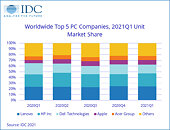
The M1 chip is usually found at a perception crossroads: fans of Apple tout its desktop CPU-level performance numbers in some workloads while comparatively sipping power (and even allowing for true fanless designs in the Apple Macbook Air), while non-fans are quick to point out that synthetic benchmarks aren't truly representative of performance. Whatever side of the fence you sit on (even if you straddle it by admitting that the M1 chip can actually outperform much more powerful and core-laden Ryzen CPUs in some specific workloads), the M1 has been a running success for the California-based company. So much so, in fact, that Apple more than doubled its shipments (a 111% increase) in 2021 compared to the previous year. The second manufacturer with the highest shipment growth is Acer, with 73% - and a slightly smaller overall shipment volume.
The success of Apple's M1 only served to increase Apple's confidence in its decision to abandon Intel, and the company is expected to announce the M1's successor sometime this year. Furthermore, a new version of MacOS further increases the divide to Intel-based Macs due to some features only working on their M1 counterparts. When you consider all of that, including the accelerating optimization of many applications for the platform (Capture One, Affinity, and most recently Adobe), the platform maturity that has been achieved in such a short while, and the announcement of even more powerful hardware for content creators, it may be the case that Apple actually keeps up its momentum and presents a rather competitive landscape to the Windows + x86 PC ecosystem (I won't use Wintel because that's, well, inaccurate and unfair to AMD). Apple is surely on the way to carve out more than its current 15,84% market share (which still places it in a second-place in the overall OS market).
Sources:
IDC, Spectrum IEEE, Stat Counter
The success of Apple's M1 only served to increase Apple's confidence in its decision to abandon Intel, and the company is expected to announce the M1's successor sometime this year. Furthermore, a new version of MacOS further increases the divide to Intel-based Macs due to some features only working on their M1 counterparts. When you consider all of that, including the accelerating optimization of many applications for the platform (Capture One, Affinity, and most recently Adobe), the platform maturity that has been achieved in such a short while, and the announcement of even more powerful hardware for content creators, it may be the case that Apple actually keeps up its momentum and presents a rather competitive landscape to the Windows + x86 PC ecosystem (I won't use Wintel because that's, well, inaccurate and unfair to AMD). Apple is surely on the way to carve out more than its current 15,84% market share (which still places it in a second-place in the overall OS market).

46 Comments on Spurred by M1 Performance, Apple Doubles Shipments of Mac Computers
You are correct, Apple CPUs only have one customer: Apple. That's also a huge disadvantage. If you have an extremely competitive product and you restrict it to only being sold with your products (which for apple inherently appeal to a very specific niche) you are loosing out on a ton of potential revenue. In addition, it also means sales of this processor are entirely dependent on the other parts of it's ecosystem from the Operating system, to the available apps, to the marketing, to the other hardware components. For windows you can simply swap out an innumerable number of parts. For apple though, launch a product with a flawed motherboard design for example isn't as easy to fix and it affect everyone who purchase that product.
For me, Apple doesn't have the right games, Apps, or hardware so it's irrelevant how good their CPU is as I will never be given the choice to use it with something that works for me.
Last, I very much doubt the M1 chip resulted in a significant increase in sales. That very likely was the pandemic. Most people I know who own apple laptops own them for the brand and sometimes app ecosystem. I have never heard someone say they purchased it for the processing power.
Also, ever since Apple launched m1, Mac revenue has surged 70 percent. Apple just announced that during its fiscal second quarter that ended March 27, the Mac business reached an all-time quarterly record of $9.1 billion. Yeah overall increased demand for computers during the pandemic might be part of the increase in Mac revenue, but other factors include the insane battery life of m1, how cool the m1 systems run (compared to their intel predecessors), and the performance increase relative to the predecessors of the low-end MacBook Air/Pro and Mac mini. My sister’s m1 MacBook gets over 16 hours of battery life. Customers are getting a better bang for the buck.
Unlike us enthusiasts, many consumers don’t care about modularity and upgradability. They just want a solution that works well out of the box. And m1 does that well.
All that being said, I’m just admiring the technology in m1 and the audacity to leave x86 behind. I’m not aware of any other intel customer (Dell, HP, Razer, Lenovo, etc) abandoning x86 and delivering their own cpu platform. Apple did, and it’s fascinating to me.
But I wholeheartedly agree that Apple has its quirks and some things I don’t like. Like a lack of modularity, lack of AAA games, forced obsolescence of perfectly working Intel macs, and so on. It’s by no means a perfect company.
(outdated AND SMALLER) 4800u, with lower power consumption beats 5nm M1 "goodness" of Apple native vs native.
www.anandtech.com/show/16252/mac-mini-apple-m1-tested/5
Apple's move is driven largely by greediness, those sweet margins of selling a dirt cheap chips for x86's price.
It does offer neither unseen performance (is pretty mediocre at it for a chip of that size and on 5nm) nor power consumption (even 5800h in a gaming notebook can do 10+ hours on battery).
I've seen a number of freelancers buying apple device for build quality reasons.
I haven't seen a single of them being excited about having to mess with M1.
Or anyone who would say "hey, now that Apple's margins on notebooks rose, let me buy a new notebook I do not need, just because I'm so easily influenced by nonsensical advertisement and that M1 was shoveled into my throat gazillion of times"Won't even bother clicking, but thanks for the effort.
And to correct, I did not buy it because of the advertisement. It was based on reviews that I read/ watched, and my own 2 days of testing that I decided to keep it. I am not a fan of Apple, but the product is good, and so objectively worth keeping/ using. My gaming system is still based on Windows.
Why don't more companies do it? Not many compaies are worth a trillion dollars plus.You are actually just parroting exactly what TIm Cook said on the conference call but Apple in fact does not provide data that specifically shows the M1 is the reason for the increase:
www.zdnet.com/article/apples-q2-crushes-estimates-as-iphone-mac-ipad-sales-surge/
It's stated but the provided data is the same as any other quarter. Of course, Apple will always tout to investors that it's their products when in reality anyone looking at the market or Apple's provided data can see you'd have to be inept to not being selling record numbers right now.
16 hours of battery life is not realistic, reviews have it pined at an average of 10.5, which is certainly achievable for x86 laptops without a discrete GPU.
Mind you it still starts at a $1,000 USD so bang for your buck would only be in comparison to other apple products.That really depends which apps you are running. If you are using a lot of x86 apps, you are looking at an average performance hit of 30%. Given the emulation layer, there's always the chance that an app can take a much larger performance hit at random as well. Apple made the bet that most of it's customers either a) just use basic apps b) won't care about having the best performance in x86 apps anyways. It will take a long time for things to fully transition over and many legacy apps will always be x86. It's fine if you are using the product casually but if you are doing anything serious I would not move over to the platform until extensive vetting is done. I'm not sure I'd call this out of character for Apple, they did remove the headphone jack and DAC from their phones in the name of "progress" so they are willing to take jumps like this because people will buy their products regardless. Then again they did manage to sell people $20 wireless earbuds for $200. As an audiophile myself, the sound output from the Airpods is worse then a $36 pair of Superlux budget cans.That are some misconceptions about the M1's performance: www.extremetech.com/computing/318020-flaw-current-measurements-x86-versus-apple-m1-performance
First is that Apple M1 does not in fact outclass X86. Desktop X86 blows the M1 away. AMD laptops in the same price range do as well, with over 30% more multi-threaded performance. The only time the M1 is going to beat an equally price X86 laptop performance wise is if the X86 laptop is either not plugged in or just bad. At $1,000 though you typically can get a decent graphics card in your laptop as well though, something that's going to vastly outperform what the M1 can do. The M1 is a big step up but let's not misrepresent things here. The M1 has amazing performance per watt but it doesn't take the performance crown.
Second is that Apple M1 prefers 1 thread per core while X86 prefers 2 threads per core. Tests need to take this into consideration.
Last is that X86 can utilize advances instructions whereas ARM (like the M1) can only utilize simple instructions. In applications that utilize things like AVX or SSE the X86 processor will almost always be faster. I don't know how Apple is emulating programs that do utilize those features but I imagine the emulator is telling the X86 software to use the code path with those features disabled.
There are many more considerations to comparing X86 vs M1 than simple X86 vs X86. If it fair to use AVX? Is it fair to only use 1 thread per core? Is the code path for the program equally as optimized for both platforms? Ect. That aside, what I do know is that Geekbench is and has always been utter trash and people should stop using it as any meaningful measure of performance.It really depends as many X86 devices aren't designed to be run off battery 24/7 whereas ARM device are. There are certainly X86 devices with good battery life. That said, it all isn't 100% down to the hardweare. The software plays a part too and windows doesn't have as many power saving features as most ARM based Operating Systems do. You have to come into this with the acknowledgement that most X86 devices are designed for performance first and foremost. You simply won't find a gaming laptop that'll do 10+ hour at a good performance level, ARM or otherwise. That said, Nvidia and AMD do offer more performance per watt in regards to graphics than Apple's M1.
Haters gonna hate I guess :shrug:
You were shown OUTDATED and SMALLER chip CONSUMING LESS POWER on OLDER fab beating M1 in NATIVE code.
The problem with arguing with certain kind of people is they do not realize how embarrassing their "arguments" are.
Are you ok, hater?
The problem with arguing with haters is that they’re irrational, don’t know who they’re yelling at at any given moment, or why, and can’t read the article they’re referring to/a basic bar graph that contradicts their claims :shrug:
You must realize that the (1st gen) m1 beat the 4800u you’re referring to in 6/9 of the benchmarks you posted, right? That’s why 6/9 of its bars are longer in that chart :love:
en.wikipedia.org/wiki/ARM_architecture
Also, just because it old doesn't mean it's useless. Look at ARM...
1. Intel is the main competition for M1 since it's the only other option for new Mac systems. You can choose any color you like as long as it's Intel; hence the message you replied to was itself a response about intel. AMD doesn't get chips in Macs, AMD chips barely run useful macOS apps properly since nobody fixed their virtualization issues forcing fallback methods and clunky workarounds.
2. Macs are built around specific workflows that are important to their primary customer base. When you're drawing a comparison of chip performance in a Mac, you generally use the library of Mac workflows that people actually buy the machines for.
3. We were addressing Rosetta2; the software translation of x86_64 to run on M1, and its performance. Not M1 directly. Performance of applications in Rosetta2 (I.E. x86_64 applications recompiled for RISC with some JIT interactions) was the main concern here, since again that's the context of the message you responded to.
Your own link to Anandtech shows M1 beating out Tiger Lake mobile handily (and sometimes the 5950X) and even states Rosetta2 to be 70-80% of AArch64 native, handily still outpacing Tiger Lake in places (541.leela from SPEC2017 for a cherry picked example, others as well if you look at the Rosetta2 page.) So let me ask you what do you think would have been in those M1 Macs if Intel had provided the chips instead. Think about it carefully now, it's a real brain teaser. (Hint: It would have been Tiger Lake.) In fact I'm not really sure why you posted that article, it's a glowing review of M1's performance and shows it trading blows with Zen 3 at its best, and beating the best Intel has at its worst.
"The performance of the new M1 in this “maximum performance” design with a small fan is outstandingly good. The M1 undisputedly outperforms the core performance of everything Intel has to offer, and battles it with AMD’s new Zen3, winning some, losing some. And in the mobile space in particular, there doesn’t seem to be an equivalent in either ST or MT performance – at least within the same power budgets." - Andrei Frumusanu, AnandtechDid you uh, look at the power and clock differences there bud? You betcha a chip with close to equivalent IPC, twice as many cores, running 50% higher clocks, and at twice the power draw at load is going to be faster. I'm not really sure what that argument does for you though? Yes, pushing much higher clocks and power got you more performance. The existence of higher clock, higher power CPUs doesn't negate the performance of M1 at its power tier. Did we suddenly forget that IPC is the measure of a core, not watts? I'm getting flashbacks to Zen 3's launch and all the Intel guys yelling about their 280W 5.4GHz i9s still being faster.
And as Apple would not be ok with its CEO having bried bottom, they comply with Zeus' request to strictly stick to Intel as 3rd party CPU supplier.
Sounds plausible.:D :D :D
Ok, let me recap actual customers that I know in person:
1) "I buy anything Apple" types, for those, performance/usability/ANYTHING, wait for it, does not matter at all. Most of the time they surf the web or do some lousy video editing using Apple's lousy apps.
Probably the most common type
2) Freelancers, that buy it for high quality (and write it off taxes they pay). These guys will feel the pain.
3) It's a single guy, but still quote notable: dude is literally looking for "most expensive shit there is". (I wish my income was as good :)). Yeah, as with #1, is it shit, or is it not, matters not.Look at the context again:
Look at 4800u (smaller chip, outdated chip, outdated fab, consumes less power) beating M1 which is, wait for it, larger, consumes more power and is on 5nm process, and consumes more and think again about all the mythical narrative that is being pushed:
from the "ARM's are soo uber power efficient" to "M1 is so uber fast x86 should be ashamed".
If you feel hurt, it's ok to mix in Intel's fab woes, if it would hurt you less.
(Yes, I know that's a bit hyperbolic.)