Monday, August 9th 2021
FORESEE XP1000 PCIe SSD Turns a New Page in the Post-Gen 3 Era
Driven by accelerated global digital transformation, the storage demand seen in various segments has continued to soar in 2021, granting a massive boost to the SSD market. As a key part of PC and server components, SSD has always been a focal point for major PC OEMs when it comes to performance, stability, and compatibility. Figuring out how to purchase SSD products that can accurately match the market has become a challenge, as resources are in short supply. To resolve this issue, the FORESEE SSD R&D team from Longsys has come up with a solution: FORESEE XP1000 PCIe SSD.
With a capacity of up to 2 TB, this guaranteed future success is one of the high-capacity products in the current FORESEE SSD product line. Compared with the previous generation of mainstream products, the performance of FORESEE XP1000 PCIe SSD has been improved by nearly 50%, up to 3500 MB/s and 3000 MB/s in sequential read/write, and 327K/294K IOPS in random read/write. The product supports L1.2 low power consumption. In actual tests, the product even achieved L1.2 at less than 3.3 mW, which can be effective in prolonging the battery life of the terminal device. Thanks to its excellent performance and low power consumption, FORESEE XP1000 PCIe SSD is expected to become a force to be reckoned with in the post-Gen 3 SSD era. FORESEE Customized Master Controls
Uses Multiple Features to Ensure Data Stability and Security
The FORESEE XP1000 PCIe SSD employs customized main controls and an enhanced local DRAM-less architecture with HMB technology support. The product conforms to the mainstream NVMe 1.4 protocol. Empowered by a built-in intelligent power management unit, it achieves ultra-low power consumption in both active and idle modes. In addition, FORESEE customized master controls incorporate multiple protection mechanisms, Smart Cache, power-on reset integrated within chip, multi-level power management, NAND boot partition and other functions, which ensure the stability and data security of storage products.
Compatibility Certified by Multiple Platforms
Complies with Mainstream Hardware Standards
In recent years, the Intel Evo platform has been making extensive upgrades to laptop components, technologies, functions, and appearance to improve the mobile user experience of laptops. The "1-second wake" function, meaning the laptop can awaken from the sleep state in less than 1 second, significantly optimizes the user experience. However, this function must be certified by Intel Modern Standby, which poses a huge challenge in regards to the performance and power consumption of SSD products. To meet the high hardware requirements of mainstream platforms, the FORESEE XP1000 PCIe SSD completed certification in July 2021, and will soon be applied to the Evo platform.
In addition, the FORESEE XP1000 PCIe SSD was also UNH-IOL-certified.
The University of New Hampshire InterOperability Laboratory (UNH-IOL) is a well-known public laboratory providing testing services in multiple fields. UNH-IOL defines NVMe Test Suites, including: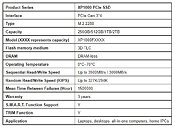
With a capacity of up to 2 TB, this guaranteed future success is one of the high-capacity products in the current FORESEE SSD product line. Compared with the previous generation of mainstream products, the performance of FORESEE XP1000 PCIe SSD has been improved by nearly 50%, up to 3500 MB/s and 3000 MB/s in sequential read/write, and 327K/294K IOPS in random read/write. The product supports L1.2 low power consumption. In actual tests, the product even achieved L1.2 at less than 3.3 mW, which can be effective in prolonging the battery life of the terminal device. Thanks to its excellent performance and low power consumption, FORESEE XP1000 PCIe SSD is expected to become a force to be reckoned with in the post-Gen 3 SSD era.

Uses Multiple Features to Ensure Data Stability and Security
The FORESEE XP1000 PCIe SSD employs customized main controls and an enhanced local DRAM-less architecture with HMB technology support. The product conforms to the mainstream NVMe 1.4 protocol. Empowered by a built-in intelligent power management unit, it achieves ultra-low power consumption in both active and idle modes. In addition, FORESEE customized master controls incorporate multiple protection mechanisms, Smart Cache, power-on reset integrated within chip, multi-level power management, NAND boot partition and other functions, which ensure the stability and data security of storage products.
Compatibility Certified by Multiple Platforms
Complies with Mainstream Hardware Standards
In recent years, the Intel Evo platform has been making extensive upgrades to laptop components, technologies, functions, and appearance to improve the mobile user experience of laptops. The "1-second wake" function, meaning the laptop can awaken from the sleep state in less than 1 second, significantly optimizes the user experience. However, this function must be certified by Intel Modern Standby, which poses a huge challenge in regards to the performance and power consumption of SSD products. To meet the high hardware requirements of mainstream platforms, the FORESEE XP1000 PCIe SSD completed certification in July 2021, and will soon be applied to the Evo platform.
In addition, the FORESEE XP1000 PCIe SSD was also UNH-IOL-certified.
The University of New Hampshire InterOperability Laboratory (UNH-IOL) is a well-known public laboratory providing testing services in multiple fields. UNH-IOL defines NVMe Test Suites, including:
- NVMe Conformance Test Suite
- NVMe Interoperability Test Suite
- This further proves the FORESEE XP1000 PCIe SSD's superior performance and low power management.

5 Comments on FORESEE XP1000 PCIe SSD Turns a New Page in the Post-Gen 3 Era