Tuesday, September 14th 2021
Rare Earth Metal Prices Are Skyrocketing, Electronics Prices Expected To Follow
If it wasn't bad enough that we're in the middle of a pandemic, which has resulted in major shipping issues globally and a semiconductor shortage, it now looks like electronics are likely to get even more expensive due to skyrocketing prices of many rare earth metals.
Nikkei is reporting that many often overlooked materials, such as neodymium and the lesser known praseodymium, have increased by almost 74 percent since the same time last year and that's only one of several key materials that have increased in price by 50 percent or more in a year.
It's no secret that lithium has increased in price and it now costs about 150 percent of what it was costing last year. However, many other, less obvious materials have also increased in price, with copper up over 37 percent and tin up almost 82 percent in a year. To TPU's readers this mainly means that you can expect higher costs for PCBs and all the components that are soldered onto them, as tin is used to solder just about every component in place. Neodymium and praseodymium are used in everything from simple speakers, to electrical car motors to wind turbines. With prices continuing to go up, as the demand is increasing due to governments in many western countries switching to a green economy and focusing on electrification of cars, while at the same time trying to go fossil fuel free, seems to be an undertaking that is poorly timed with the current state of the electronics industry.
Other materials like terbium oxide, which is used in LEDs, flat panel displays and high-temperature fuel cells among other things, have gone up by over 60 percent in price. Even good old aluminium is up over 55 percent, which means more expensive parts in just about everything that uses a lightweight metal structure or housing.
As the report goes, China controls 55 percent of the global market when it comes to production of rare earth metals and 85 percent of the refining process. The Chinese government has been putting tighter export controls in place this year, which is also part of the reason for the increase in costs. This might be a way for the nation to try and fight back against some of the trade disputes that have arisen with the US, but it's clearly affecting every nation in the world, as China is without a doubt the world's manufacturing hub.
What China seems to have missed though, is the fact that this is affecting local Chinese companies as well, since increased material costs have caused their profits to tumble, as they often have long term contracts with their business partners that can't be renegotiated easily. As such, many small and mid-sized Chinese suppliers are suffering losses and if this continues we might see some of these companies go out of business. Large, international corporations aren't unaffected by these price increases either, since at some point they're going to have to increase their prices to the end customer of their products, which is likely to translate into fewer sales.
Right now, a lot of negotiations are taking place all around the world to try to maintain pricing, but someone, somewhere is going to have to eat the cost and that can only go on for so long. So far, Sonos has already increased the pricing of its speakers, by anything from $10 to $100 depending on the product. This might be a sign of things to come, as Sonos is unlikely to be the only company to adjust prices accordingly.
Source:
Nikkei
Nikkei is reporting that many often overlooked materials, such as neodymium and the lesser known praseodymium, have increased by almost 74 percent since the same time last year and that's only one of several key materials that have increased in price by 50 percent or more in a year.
It's no secret that lithium has increased in price and it now costs about 150 percent of what it was costing last year. However, many other, less obvious materials have also increased in price, with copper up over 37 percent and tin up almost 82 percent in a year. To TPU's readers this mainly means that you can expect higher costs for PCBs and all the components that are soldered onto them, as tin is used to solder just about every component in place.
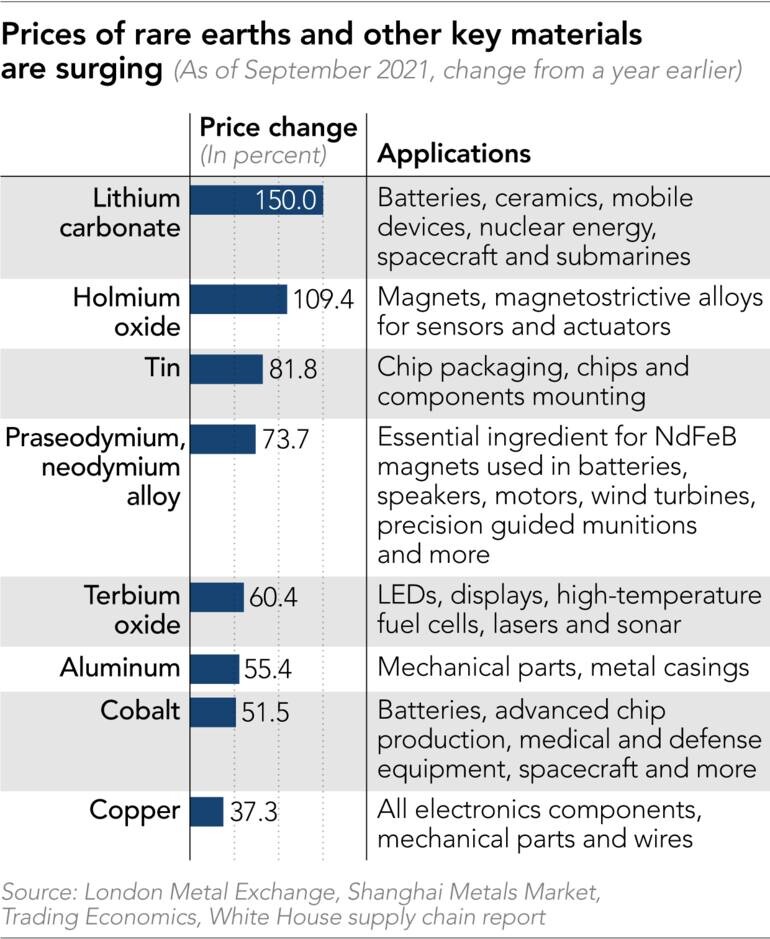
Other materials like terbium oxide, which is used in LEDs, flat panel displays and high-temperature fuel cells among other things, have gone up by over 60 percent in price. Even good old aluminium is up over 55 percent, which means more expensive parts in just about everything that uses a lightweight metal structure or housing.
As the report goes, China controls 55 percent of the global market when it comes to production of rare earth metals and 85 percent of the refining process. The Chinese government has been putting tighter export controls in place this year, which is also part of the reason for the increase in costs. This might be a way for the nation to try and fight back against some of the trade disputes that have arisen with the US, but it's clearly affecting every nation in the world, as China is without a doubt the world's manufacturing hub.
What China seems to have missed though, is the fact that this is affecting local Chinese companies as well, since increased material costs have caused their profits to tumble, as they often have long term contracts with their business partners that can't be renegotiated easily. As such, many small and mid-sized Chinese suppliers are suffering losses and if this continues we might see some of these companies go out of business. Large, international corporations aren't unaffected by these price increases either, since at some point they're going to have to increase their prices to the end customer of their products, which is likely to translate into fewer sales.
Right now, a lot of negotiations are taking place all around the world to try to maintain pricing, but someone, somewhere is going to have to eat the cost and that can only go on for so long. So far, Sonos has already increased the pricing of its speakers, by anything from $10 to $100 depending on the product. This might be a sign of things to come, as Sonos is unlikely to be the only company to adjust prices accordingly.
42 Comments on Rare Earth Metal Prices Are Skyrocketing, Electronics Prices Expected To Follow
Minerals might be rare, except in Australia
In my lifetime, I've only ever had 4 cell phones. I ran my Note 5 for 4 years. Plan on running my Note 10+ for another 2-3 years+. My carrier is trying to get my dad to upgrade his phone to a 5G phone but.. we don't need a 5G phone. 5G will never be deployed in my area so its not something we want. We are still on 2G and 3G its that bad here. lol. (but hey, as long as the carrier says.. "we have 4G deployed there, the FCC will have to believe us.. even when customers complain.")
Corporate America is a cesspool of garbage. It just sucks because the ones lower on the totem pole take the brunt of the attacks and have no recourse.
Also acting surprised people like electronic toys on a tech forum is a little ironic.
In that same amount of time, almost everyone I know had been through 2-3x as many cell phones as I have. I knew someone that upgraded his phone about every 8-10 months, once something newer came along. The rate most people go through cell phones is mind boggling. I wonder how much better off things would be if folks could limit themselves instead of gorging themselves on every little new phone iteration that came along.
One of the major distributors was working on moving to a larger production facility, so their output was cut sharply as they made their transition so inventory through them was a trickle.
A second major distributor we got it from was initiating a massive price hike and was allowing any orders up to X date to get in before the price jump....well, companies (like the one I worked at) purchased trucks loads worth so we could buy lower and keep lower prices and then slowly transition higher pricing as we started to bring in higher priced material. Well, that didn't work well because so many companies put in so many orders they couldn't fill them at the promised cost and the distributor ran itself too low on inventory too fast and had troubles catching back up....
Then the housing crash hit, we didn't really feel the ripples of it until around the summer of 2006. By winter half a dozen folks were let go and it continued to be a growing trend until winter of 2009 when a dozen folks that January were let go and I was one of them.
Hopefully something similar doesn't happen this time around. Right now from what I can see a lot of places were shut down or running limited production/skeleton crews that they got so far behind on orders they're all still playing catch up and also trying to accommodate new orders as they come through. It seems to be a world wide issue and will probably continue to be one for a while. Something will break in this system eventually, as it did with the housing bubble that popped, but I guess we just have to wait and see.