Monday, October 13th 2025

NVIDIA DGX Spark Arrives for World's AI Developers
NVIDIA today announced it will start shipping NVIDIA DGX Spark, the world's smallest AI supercomputer. AI workloads are quickly outgrowing the memory and software capabilities of the PCs, workstations and laptops millions of developers rely on today—forcing teams to shift work to the cloud or local data centers.
As a new class of computer, DGX Spark delivers a petaflop of AI performance and 128 GB of unified memory in a compact desktop form factor, giving developers the power to run inference on AI models with up to 200 billion parameters and fine-tune models of up to 70 billion parameters locally. In addition, DGX Spark lets developers create AI agents and run advanced software stacks locally. "In 2016, we built DGX-1 to give AI researchers their own supercomputer. I hand-delivered the first system to Elon at a small startup called OpenAI—and from it came ChatGPT, kickstarting the AI revolution," said Jensen Huang, founder and CEO of NVIDIA. "DGX-1 launched the era of AI supercomputers and unlocked the scaling laws that drive modern AI. With DGX Spark, we return to that mission—placing an AI computer in the hands of every developer to ignite the next wave of breakthroughs."
DGX Spark brings together the full NVIDIA AI platform—including GPUs, CPUs, networking, CUDA libraries and the NVIDIA AI software stack—into a system small enough for a lab or an office, yet powerful enough to accelerate agentic and physical AI development. By combining breakthrough performance with the reach of the NVIDIA ecosystem, DGX Spark transforms the desktop into an AI development platform.
DGX Spark systems deliver up to 1 petaflop of AI performance, accelerated by a NVIDIA GB10 Grace Blackwell Superchip, NVIDIA ConnectX -7 200 Gb/s networking and NVIDIA NVLink -C2C technology, providing 5x the bandwidth of fifth-generation PCIe with 128 GB of CPU-GPU coherent memory.
The NVIDIA AI software stack is preinstalled to enable developers to start working on AI projects out of the box. With DGX Spark, developers can access NVIDIA AI ecosystem tools including models, libraries, and NVIDIA NIM microservices, enabling local workflows such as customizing Black Forest Labs' FLUX.1 models to refine image generation, creating a vision search and summarization agent using the NVIDIA Cosmos Reason vision language model, or building an AI chatbot using Qwen3 that is optimized for DGX Spark.
To celebrate DGX Spark shipping worldwide, Huang hand-delivered one of the first units of DGX Spark to Elon Musk, chief engineer at SpaceX, today in Starbase, Texas. The exchange was a connection to the supercomputer's origins, as Musk was among the team that received the first NVIDIA DGX -1 supercomputer from Huang in 2016.
Other early recipients of DGX Spark, including Anaconda, Cadence, ComfyUI, Docker, Google, Hugging Face, JetBrains, LM Studio, Meta, Microsoft, Ollama and Roboflow, are testing, validating and optimizing their tools, software and models for DGX Spark.
Research organizations around the world, including the NYU Global Frontier Lab, previewed DGX Spark to boost their AI development.
"DGX Spark allows us to access peta-scale computing on our desktop," said Kyunghyun Cho, professor of computer and data science at the NYU Global Frontier Lab. "This new way to conduct AI research and development enables us to rapidly prototype and experiment with advanced AI algorithms and models — even for privacy- and security-sensitive applications, such as healthcare."
NVIDIA DGX Spark Now Shipping
Starting Wednesday, Oct. 15, DGX Spark can be ordered on NVIDIA.com. Partner systems will be available from Acer, ASUS, Dell Technologies, GIGABYTE, HP, Lenovo, MSI as well as Micro Center stores in the U.S., and from NVIDIA channel partners worldwide.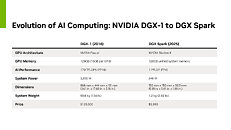
As a new class of computer, DGX Spark delivers a petaflop of AI performance and 128 GB of unified memory in a compact desktop form factor, giving developers the power to run inference on AI models with up to 200 billion parameters and fine-tune models of up to 70 billion parameters locally. In addition, DGX Spark lets developers create AI agents and run advanced software stacks locally.

DGX Spark brings together the full NVIDIA AI platform—including GPUs, CPUs, networking, CUDA libraries and the NVIDIA AI software stack—into a system small enough for a lab or an office, yet powerful enough to accelerate agentic and physical AI development. By combining breakthrough performance with the reach of the NVIDIA ecosystem, DGX Spark transforms the desktop into an AI development platform.
DGX Spark systems deliver up to 1 petaflop of AI performance, accelerated by a NVIDIA GB10 Grace Blackwell Superchip, NVIDIA ConnectX -7 200 Gb/s networking and NVIDIA NVLink -C2C technology, providing 5x the bandwidth of fifth-generation PCIe with 128 GB of CPU-GPU coherent memory.
The NVIDIA AI software stack is preinstalled to enable developers to start working on AI projects out of the box. With DGX Spark, developers can access NVIDIA AI ecosystem tools including models, libraries, and NVIDIA NIM microservices, enabling local workflows such as customizing Black Forest Labs' FLUX.1 models to refine image generation, creating a vision search and summarization agent using the NVIDIA Cosmos Reason vision language model, or building an AI chatbot using Qwen3 that is optimized for DGX Spark.
To celebrate DGX Spark shipping worldwide, Huang hand-delivered one of the first units of DGX Spark to Elon Musk, chief engineer at SpaceX, today in Starbase, Texas. The exchange was a connection to the supercomputer's origins, as Musk was among the team that received the first NVIDIA DGX -1 supercomputer from Huang in 2016.
Other early recipients of DGX Spark, including Anaconda, Cadence, ComfyUI, Docker, Google, Hugging Face, JetBrains, LM Studio, Meta, Microsoft, Ollama and Roboflow, are testing, validating and optimizing their tools, software and models for DGX Spark.
Research organizations around the world, including the NYU Global Frontier Lab, previewed DGX Spark to boost their AI development.
"DGX Spark allows us to access peta-scale computing on our desktop," said Kyunghyun Cho, professor of computer and data science at the NYU Global Frontier Lab. "This new way to conduct AI research and development enables us to rapidly prototype and experiment with advanced AI algorithms and models — even for privacy- and security-sensitive applications, such as healthcare."
NVIDIA DGX Spark Now Shipping
Starting Wednesday, Oct. 15, DGX Spark can be ordered on NVIDIA.com. Partner systems will be available from Acer, ASUS, Dell Technologies, GIGABYTE, HP, Lenovo, MSI as well as Micro Center stores in the U.S., and from NVIDIA channel partners worldwide.

31 Comments on NVIDIA DGX Spark Arrives for World's AI Developers
these are actually kind of fucking insane improvements. I'm assuming it's the same performance as the 2016 one, just showing the gains in cost and power usage?
The rest of the specs show just how much the industry moved in these 9 years, not just Nvidia but the industry, going from 16nm to 3nm has a tremendous impact in power consumption and with much cheaper laptop memory and everyone selling their own AI solution the impact in pricing.
I don't understand how this can be priced at 4K, profit margin must be huge.
wait that didn't happen.
Industry wages collapsed, investors lost huge fortunes and companies went belly up.
these machines will get their use especially if bought by individuals to do their development tasks on.
I think the pain will be most felt by the companies and organisations who just spend tens of millions on big systems and got very expensive personnel to develop their companies AI system
these machines can be loads of things if someone writes the software for it like serving as a very fancy nintendo switch 2 128GB edition
I mean sure, that's a way of 'salvaging things'. If you have twenty more of these ideas maybe you can break even on your expense - that is, if you consider all the labor involved as 'hobbying'.
DGX needs desperately more RAM bandwidth. Right now its just nicely small expensive box, that doesn't live up to its expectations.
But you basically have an ARM box with an integrated 5070 and 128GB of shared ram.
Yes AI is the most obvious use case and there is nothing stopping you from continuing using the machine to run models that fit in the sizeable memory when the bubble bursts.
When the internet bubble burst, the internet didn't suddenly vanish. Things got revalued but kept growing in importance the dumb money was just gone.
With that said, the raw compute is indeed better, but the DGX Spark is a bit anemic when it comes to memory bandwidth with its ~273GB/s. The P100 with HBM2 managed ~732GB/s per GPU, while the V100 did almost 900GB/s.It's fair in the sense that lots of folks WILL be using that lower precision, so in practice it does end up being faster in raw compute.
Each GP100 in the DGX-1 had 21.2 TFLOPS of FP16, without support for sparsity.
The DGX Spark has 1PFLOPs FP4 with Sparsity (which is rarely used, from what I've seen), so 500TFLOPs without it. Since the perf scales linearly with the data size, for non-sparsity it should provide 250TFLOPs in FP8, and 125 TFLOPs in FP16, which is still almost 6x higher than a single GP100, and identical to a single V100.
Nonetheless, the 250tflops FP8 and 500tflops FP4 are what really matters since lots of folks are using those as their default precision types.You totally can lol
/2 to dismiss sparsity, then /4 to get the perf number in FP16.Where did you get those numbers from? gpt-oss:120b only has 5.1B active params, and is a native FP4 model, so ~2.6GB in params per token. With its 273GB/s mem bandwidth is should manage a theoretical 105tok/s for generation, and WAY more than that for PP.
In practice we can compare it with Strix Halo, which with all of its deficiencies manages over 30tok/s for generation, this Spark should be equal or faster than Strix Halo.
And yeah blackwell fp4 PFlops are from tensor cores, so it would be 1000 FP4TFLOPS*104.8 TFLOPS/ 3352 FP4TFLOPS(rtx 5090 reference flops) ~ 31.26 TFLOPS fp16/fp32 for spark(rtx 5070 has 30.87TFLOPS at 2512 MHz core clock so set peak boost clock for spark would be 2544 MHz). So yes apples to apples comparison would have been in ball park of DGX-1 Pascal: 170TFLops, DGX Spark Blackwell: 30TFlops.
$3,9993,999 for this level of hardware is dumb money. The reason it has this price is because of the overblown promises of what it will do for you.
And if the bubble bursts, the revaluation of all those activities and promises means it sure as hell ain't valued at 3,999.
In other words, no matter how you twist this, you'll bleed money.
Strix Halo devices with 128GB of RAM go for $2~2.6k, so I'd say that this is competitive.Maybe if games are all you use a computer for, of course. This amount of unified, fast-ish memory is not that expensive.Adding to that, GG has already managed over 50tok/s:
github.com/ggml-org/llama.cpp/discussions/16578
Just the fact you've got a bunch of unified memory doesn't make money.
Same way no one is planning on having direct financial returns on Strix Halo systems.It's not meant to make money directly.