Thursday, January 15th 2026

Gigabyte CEO Wants 'Differentiation' Before Committing to Gaming Handheld
Handheld PC gaming has long been a niche category, but the launch of devices like the Valve Steam Deck and the subsequent ASUS ROG Ally and Lenovo Legion Go have resulted in the niche skyrocketing in popularity. Regardless, you'd have to be blind to not notice that a lot of the gaming handhelds on the market are eerily similar, aside from a few ergonomic tweaks, different color options and visual design, or slight variations in display size and specs. In a recent interview with PCWorld, Gigabyte's CEO, Eddie Lin, has identified this monotony as the reason Gigabyte has not yet launched an Aorus gaming handheld.
According to the executive, Gigabyte is considering a gaming handheld, but he doesn't want whatever gaming handheld Gigabyte might release to follow the same template that has been adopted by many handheld makers. He specifically calls out Chinese gaming handheld brands, likely referring to the likes of Ayaneo, OneXPlayer, and GPD, and suggests that it's easy to make a gaming handheld and meet demand if you are able to follow that template. To his point, even some of the more unorthodox gaming handheld designs, like the GPD Win 5 and the OneXPlayer OneXFly Apex are fairly similar, with the exception of the latter's optional liquid cooling kit.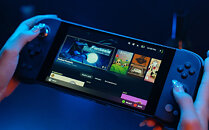
Source:
PCWorld on YouTube
According to the executive, Gigabyte is considering a gaming handheld, but he doesn't want whatever gaming handheld Gigabyte might release to follow the same template that has been adopted by many handheld makers. He specifically calls out Chinese gaming handheld brands, likely referring to the likes of Ayaneo, OneXPlayer, and GPD, and suggests that it's easy to make a gaming handheld and meet demand if you are able to follow that template. To his point, even some of the more unorthodox gaming handheld designs, like the GPD Win 5 and the OneXPlayer OneXFly Apex are fairly similar, with the exception of the latter's optional liquid cooling kit.

27 Comments on Gigabyte CEO Wants 'Differentiation' Before Committing to Gaming Handheld
Valve's also acknowledged this, IIRC they've explicitly stated they're waiting for breakthroughs in power efficiency/battery tech and performance before making another one.
Because that market on Steam is significantly larger then the handheld market is, and the vast majority of releases dont even look at MacOS at all.
If Sony had ever figured out their own Pokemon competitor we may have still had portable sony consoles.
It is such a wasted opportunity.
On topic: Imo, Gigabyte is just making up excuses. They are ok with churning out clamshell notebooks, smartphones, and NUC-likes. They have absolutely nothing against sticking to a standard form-factor (and neither does most of the market... most of the time).
Would have been much better if they just admitted they were being cautious of the still unclear economics of this market. Heck! That would be wisdom one tier removed from godhood these days...
There's potentially more variability in the gaming handheld space than e.g. the gaming laptop one. There's small 7" models and big 9" ones, LCD and OLED, monolithic designs and detachable controller designs, models with windows and with SteamOS, models with single or dual or no touchpad, even models with dettachable watercooling circuits to boost up thermal dissipation.
I call BS on these statements. Him and his board simply failed to predict correctly the market potential of gaming handhelds and now they're late to the game. That's really all there is to it.
-- Those handhelds could have potential in the current high price market. It is a cut down cheaper laptop motherboard with less components as a laptop.
Sure, a PS4 sells 10x this in a single gen. But still. These are handheld sales on top of all those consoles, and existing gaming PCs being sold. Not in place of. That's a lot of potential.
No, I really think its a differentiation issue. Its the same thing as what happens on tablets and mobile phones. People dgaf what chip is inside, most of the devices run all the content, except not as well as a full fat PC. And then handhelds are also far more limited in terms of size: screen diagonal, weight, and even button placement: almost everything is pretty much set in stone.
AAA developers could make a MacOS game if they wanted to, they don't lack resources. But the smaller devs? They need to get a whole new device for it, they need to use Xcode (which doesn't exist anywhere outside of Mac), they need to get the app notarized (which means paying Apple a fee)...
And all of that, for a market share that is irrelevant.
I see more likely that they just run whatever game it is through whatever Wine+Proton equivalent they may or may not have at MacOS than actually code it for Mac.
You have to appreciate the fact no PC sales are lost due to the emergence of the handheld.
It might even cost some console sales in favor of the PC market share, which is already climbing faster than consoles, effectively meaning the console is losing ground.
The Wii U for a comparison, did not share software environment. Niche does not just pertain to the absolute number of sales, but also to the characteristics of the thing. Though I agree purely on sales numbers, sure.
To add more context to the above... Meta has just fired 1500 employees around metaverse and VR development. VR sold way more than PC gaming handhelds did so far - but it does not share a software environment and is indeed, rapidly, starting to look like a Wii U situation. VR is dying. Now... look at what the consoles are doing and how the gaming libraries of all consoles starts overlapping more and more, and with the PC. Your content is available on any device, service, etc. Its clear that the industry thinks you just want maximum reach for all content that gets released, to maximize sales potential.