Wednesday, June 3rd 2026

Thermaltake DockPower is an Innovative Modular PSU Where the Connections Panel Comes Off
The slew of innovations from Thermaltake continues, with its new DockPower PSU. You've seen fully-modular PSUs, and you've seen PSUs like the Corsair RMx Shift, which orient the connections panel along the side of the PSU's body for easier access. Thermaltake DockPower has a very clever solution to the ease of connections problem. The PSU comes with a detachable connections panel. You detach the panel, connect all your cables to it, and slot it back in. This way, it doesn't matter how the connections panel is oriented, you always have easy access to even hard-to-reach connectors. Detaching the panel is as easy as undoing a mechanism (tool-free), and pulling the panel off. The video after the break shows you how this is done. At Computex, we were shown a 1000 W model with 80 Plus Gold efficiency, and a single 12V-2x6 connection, although we predict this trend will catch on across the Thermaltake PSU product stack.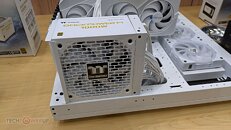
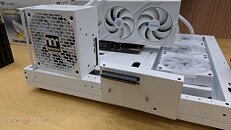
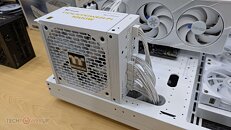
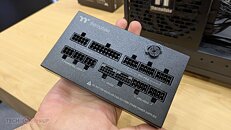 The animation from Thermaltake follows.


14 Comments on Thermaltake DockPower is an Innovative Modular PSU Where the Connections Panel Comes Off
Maybe someone could try add some minimal chamfer/radius to the connectors next.
just make the psu connect directly to the case, and add the "back connect" directly to it. (so, have the cables implemented into the case, and the motherboard conected directly there, it's kinda hard to explain)
whish i could ask someone from TT or any case-and-psu selling company, how bad of an idea it would be haha
The Thermaltake "solution" has cable connectors coming from the back instead of the side like Seasonic. Most cases do not have much space in the back panel.
Corsair's Shift power supplies have thinner cables to get around this problem. Thermaltake does not.
there is no merit in having "more cables", or "a cable extender or two", we literally could have none, cables could be pre-set in the case, if connectors were standard.
A lot less hassle to work, lowers the barrier of entry to building a pc(because there is less knowledge needed, as there are less cables in the mix), looks better, better airflow, easier to update standards (like ATX12VO keeps failing to do, mostly because "everyone would need to change almost everything").