Thursday, August 13th 2026

Qualcomm Introduces $300 Laptops With Snapdragon C, Outruns Intel N250 by Up to 67%
Qualcomm is finally unveiling the specifications of its entry-level, low-cost Snapdragon C platform. According to the specifications, the platform features up to eight Arm cores for systems expected to start around the $300 mark. In a market where DRAM and NAND Flash are extremely expensive, Qualcomm aims to give students, families, and basic office workers a modern laptop at a low price of just $300. Snapdragon C uses Qualcomm's Kryo CPU architecture, with frequencies reaching up to 3.0 GHz for single-core workloads and 2.0 GHz for multicore scenarios. The chip also includes 2 MB of cache, an integrated Adreno A643 GPU clocked at up to 900 MHz, and surprisingly a Hexagon NPU for lighter AI workloads. Qualcomm supports up to 16 GB of LPDDR4x, LPDDR5, or LPDDR5x memory, along with PCIe 3.0 NVMe storage, UFS 2.2/3.1, and a wide range of connectivity options. Interestingly, LPDDR4x memory might be less expensive compared to the others, which could make a $300 laptop dream feasible.
The company is comparing Snapdragon C against Intel's N250 "Twin Lake" platform and claims significant performance advantages while running on battery. Depending on the workload, Qualcomm reports gains ranging from 24% to 67%, with Cinebench showing the largest differences at 50% faster single-threaded performance and up to 67% better multithreaded performance. Geekbench and Speedometer, which may better represent everyday laptop usage, are also claimed to favor Snapdragon C. Qualcomm's figures also indicate substantially better efficiency, including 106% higher efficiency during Netflix playback, 68% during web browsing, and 74% during Teams video calls. The company promotes this chip for all-day battery life, although real-world runtime will heavily depend on the configuration chosen by each manufacturer.


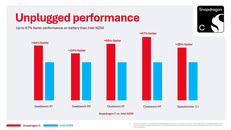
 The Snapdragon C platform will soon appear in laptops from Acer, ASUS, HP, and Lenovo, giving Qualcomm a chance to carve out a niche in the budget Windows-on-Arm segment. With budget section adopting Qualcomm's WoA designs, they will naturally transition to more powerful Snapdragon X2 Plus and X2 Elite designs. The $300 target will be particularly interesting given rising memory and component costs, which have made cheaper laptops harder to produce. On paper, Snapdragon C could offer a compelling combination of responsiveness, low power consumption, and modern connectivity at the lower end of the market. Whether Qualcomm's performance and efficiency claims translate into a genuinely better $300 laptop will ultimately depend on actual retail pricing, and what memory/storage configurations come at that price point.
Source:
via Tom's Hardware
The company is comparing Snapdragon C against Intel's N250 "Twin Lake" platform and claims significant performance advantages while running on battery. Depending on the workload, Qualcomm reports gains ranging from 24% to 67%, with Cinebench showing the largest differences at 50% faster single-threaded performance and up to 67% better multithreaded performance. Geekbench and Speedometer, which may better represent everyday laptop usage, are also claimed to favor Snapdragon C. Qualcomm's figures also indicate substantially better efficiency, including 106% higher efficiency during Netflix playback, 68% during web browsing, and 74% during Teams video calls. The company promotes this chip for all-day battery life, although real-world runtime will heavily depend on the configuration chosen by each manufacturer.


29 Comments on Qualcomm Introduces $300 Laptops With Snapdragon C, Outruns Intel N250 by Up to 67%
4-5GB with OBS. I still believe we need better browsers but also whatever kernel you're on, this one ain't it either. Accelerate! (=゚ω゚)
Of course this is a rack with minimal network but I'm sure all of this stuff is fair for workstation and gaming. It's creation that I question.
Is the Neo okay for making videos? I'm not familiar with the Apple VT Encoder.
Windows 11 with Windows Defender behaves the same. As far as performance goes, it behaves even better when properly setup - MacBook Neo have advantage of battery life, quality chassis and display and that is it.
Corporage management app is terribly wide - some are decent, some are awful resource hogs that slows down even i7-class workstations with 32 GB of RAM...I would be if Qualcomm was serious. With their kind of support, I am afraid :)Eh, from this point of view, maybe whole Chromium approach was mistake. Now we are plagued by web-apps and "apps" and even simple news reading, or checking email launch full-scale Chromium with 99% options that are not used most of the time.
Simple web browser for simple tasks, something more serious on-demand would be nice...