Thursday, August 13th 2026

Qualcomm Introduces $300 Laptops With Snapdragon C, Outruns Intel N250 by Up to 67%
Qualcomm is finally unveiling the specifications of its entry-level, low-cost Snapdragon C platform. According to the specifications, the platform features up to eight Arm cores for systems expected to start around the $300 mark. In a market where DRAM and NAND Flash are extremely expensive, Qualcomm aims to give students, families, and basic office workers a modern laptop at a low price of just $300. Snapdragon C uses Qualcomm's Kryo CPU architecture, with frequencies reaching up to 3.0 GHz for single-core workloads and 2.0 GHz for multicore scenarios. The chip also includes 2 MB of cache, an integrated Adreno A643 GPU clocked at up to 900 MHz, and surprisingly a Hexagon NPU for lighter AI workloads. Qualcomm supports up to 16 GB of LPDDR4x, LPDDR5, or LPDDR5x memory, along with PCIe 3.0 NVMe storage, UFS 2.2/3.1, and a wide range of connectivity options. Interestingly, LPDDR4x memory might be less expensive compared to the others, which could make a $300 laptop dream feasible.
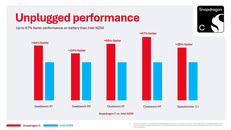
The company is comparing Snapdragon C against Intel's N250 "Twin Lake" platform and claims significant performance advantages while running on battery. Depending on the workload, Qualcomm reports gains ranging from 24% to 67%, with Cinebench showing the largest differences at 50% faster single-threaded performance and up to 67% better multithreaded performance. Geekbench and Speedometer, which may better represent everyday laptop usage, are also claimed to favor Snapdragon C. Qualcomm's figures also indicate substantially better efficiency, including 106% higher efficiency during Netflix playback, 68% during web browsing, and 74% during Teams video calls. The company promotes this chip for all-day battery life, although real-world runtime will heavily depend on the configuration chosen by each manufacturer.


 The Snapdragon C platform will soon appear in laptops from Acer, ASUS, HP, and Lenovo, giving Qualcomm a chance to carve out a niche in the budget Windows-on-Arm segment. With budget section adopting Qualcomm's WoA designs, they will naturally transition to more powerful Snapdragon X2 Plus and X2 Elite designs. The $300 target will be particularly interesting given rising memory and component costs, which have made cheaper laptops harder to produce. On paper, Snapdragon C could offer a compelling combination of responsiveness, low power consumption, and modern connectivity at the lower end of the market. Whether Qualcomm's performance and efficiency claims translate into a genuinely better $300 laptop will ultimately depend on actual retail pricing, and what memory/storage configurations come at that price point.
Source:
via Tom's Hardware
The company is comparing Snapdragon C against Intel's N250 "Twin Lake" platform and claims significant performance advantages while running on battery. Depending on the workload, Qualcomm reports gains ranging from 24% to 67%, with Cinebench showing the largest differences at 50% faster single-threaded performance and up to 67% better multithreaded performance. Geekbench and Speedometer, which may better represent everyday laptop usage, are also claimed to favor Snapdragon C. Qualcomm's figures also indicate substantially better efficiency, including 106% higher efficiency during Netflix playback, 68% during web browsing, and 74% during Teams video calls. The company promotes this chip for all-day battery life, although real-world runtime will heavily depend on the configuration chosen by each manufacturer.


29 Comments on Qualcomm Introduces $300 Laptops With Snapdragon C, Outruns Intel N250 by Up to 67%
I'm assuming it has something between 4 to 8GB of RAM and 256GB of storage.
This is something it should have done right from the start, back when memory was cheap. Now, I'm not sure what it can achieve, especially when consumers will later have the option to switch to an ARM platform powered by Nvidia graphics.
And as for performance, what a massive feat that with 8 Kryo cores, it manages to beat Intel's 4 Efficient cores—and only when laptops are running on battery, no less. Why doesn't Qualcomm tell us how its chip performs against the N250 when laptops are plugged in? Because things probably aren't so favorable there.
Practically speaking, in my opinion, we're talking about a laptop with performance from ten years ago, albeit with great battery life. Perhaps a suitable choice for those who don't want—or never got used to—tablets. But that's as far as it goes.
Yet another company that tried to pass off a premium brand image to consumers just to enjoy high profit margins only to fail. And now is scrambling to offer budget options so it doesn't become completely irrelevant.
All they've done is eat all the early adopter compatibility pain of getting ARM on Windows functional, just so someone competent (nvidia) can reap the rewards with better CPUs.
Yes, it is slow, but new & cheap and that always sells.
Of course, Windows will need serious debloating to work on that basic 8 GB RAM / 256 GB storage, but given market conditions and forecast, maybe Microsoft will be forced to do that...
A) the snapdragon C, being 1/3rd the speed, is going to struggle with even the most basic tasks.
and
B) Windows is much mroe resource intensive then MacOS, and WoA isnt as polished as you'd expect, AND their translator isnt near Apples, AND it wont have the translator hardware M chips have.
All that adds up to a very slow, laggy netbook tier experience.Oh they'll install just fine, and run fine, assuming they use DX12.
Now if they call back to older APIs, or older Windows components......hold on for dear life.
The issue comes in from Qualcomm's drivers for the GPU. They do not fully support anything beyond DX12 and Vulkan, so anything that makes calls for older APIs has to be translated, and their driver and hardware SUCKS at it.
It is possible that these issues lay with the x86 translator, but we will have to wait for widespread Spark testing with nvidia GPU instead of Qualcomms to verify that.
Still, from other specs alone it sacrifices a lot. So it's probably best to hold out for something better. I'm guessing one with more than 4GB RAM.
But then again, if you want a broadcasting box, you can buy them already for $300 with better supported hardware.
So, this Snapdragon can only be worse, and anything higher than mentioned 300$ will mean it is DoA. For 300$, as disposable cheap laptop, it will probably sell...
As for the platform itself I think the offering from Qualcomm is interesting and there is potential there, but unless Qualcomm either becomes a computer seller and makes a big splash or can get one or more of the established ones to make and sell computers based on their platform nothing will happen.
Competition is good. We need alternatives to x86 and the Apple cult doesn't qualify.
I don't see how these qualcomm laptops would sell for $300 with 8GB of RAM unless they're the most low end laptops with a crap TN display and eMMC storage, and then Qualcomm has issues with drivers which would make these even slower. I expect these would struggle doing anything but these cheap laptops would probably sell anyway.
The Neo can at least manage 2-3 tabs while remaining sufficiently performant.