News Posts matching #A725

Return to Keyword Browsing

NVIDIA N1 Gaming SoC Surfaces on Laptop Motherboard with 128 GB LPDDR5X Memory

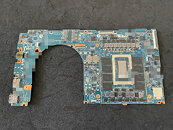
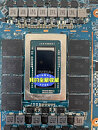
NVIDIA's upcoming N1 SoC, designed for gaming laptops, has officially appeared for the first time alongside its motherboard intended for a laptop. Featuring 128 GB of LPDDR5X memory running at 8,533 MT/s, the SoC is paired with SK hynix modules. NVIDIA's OEM partners for this launch, including Dell and Lenovo, have confirmed that the new NVIDIA laptop platform will be available this year, and we have seen early benchmark submissions of the N1 SoC. As NVIDIA prepares to enter the gaming laptop market, the company initially released its GB10 SoC for the DGX Spark mini workstation. This chip allowed NVIDIA to test its collaboration with MediaTek on developing new low-power SoCs that offer unusually high-performance graphics for AI applications, as well as very high RAM capacity.

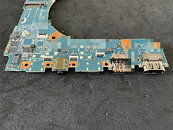
In the latest images that appeared on Goofish, we see a laptop motherboard equipped with the NVIDIA N1 SoC and 128 GB of LPDDR5X memory closely packed in a specialized PCB area. This area might be designated for the cooler, which could potentially also cool the LPDDR5X memory modules. NVIDIA plans to introduce its N1/N1X SoCs with Arm-based CPU cores around Computex 2026. These will offer consumers 20 CPU cores, consisting of 10 Cortex-X925 and 10 Cortex-A725 CPU cores based on the Armv9.2 ISA, along with a "Blackwell" GPU optimized for low power settings with up to 6,144 CUDA cores in the higher-end form. You can also see the port selection on the side of the PCB, which seems to be USB-C or Thunderbolt 4/5, USB-A, and an HDMI connection. Since we don't know which laptop model this is, we have to wait a bit more before getting final details.
EA Working on Javelin Anticheat Port for Windows-on-Arm

EA posted a job listing seeking an engineer to port its Javelin Anticheat, a kernel-level anticheat solution, to the Windows-on-Arm (WoA) platform. This is a significant indicator of where the industry is headed, confirming that the biggest game developers are officially porting their game engines, games, and anticheat solutions to Arm-based PCs running the Windows 11 operating system. Interestingly, this coincides with NVIDIA's introduction of its N1/N1X SoCs with Arm-based CPU cores, which are expected to launch in the first half of this year. These will offer consumers 20 CPU cores, consisting of 10 Cortex-X925 and 10 Cortex-A725 CPU cores based on the Armv9.2 ISA, along with a "Blackwell" GPU optimized for low power settings with 6,144 CUDA cores. Adding to the growing ecosystem of WoA solutions, NVIDIA will be competing with Qualcomm's recent Snapdragon X2 Elite and X2 Plus SoCs.

If readers recall Valve's efforts to port regular Windows games to Linux, one of the biggest issues was the use of kernel-based anti-cheat solutions that simply couldn't work on the non-standard Windows 11 platform. A similar situation is now occurring even between Windows versions, as EA needs to develop a specialized solution that will work on non-x86 deployments like the standard Windows-on-Arm. It will likely be a few months before the official deployment is released, but the job listing suggests that some internal work is in progress. This means that the senior engineer EA is looking for could arrive to quickly bring these pieces together and make the new platform work without any issues.

NVIDIA's N1x CPU Hits New Roadblock: Launch Pushed to Late 2026

NVIDIA's long-awaited entry into Arm-based laptop CPUs has hit yet another obstacle, according to insiders close to SemiAccurate. Despite publicly declaring the N1 and its sibling N1x is in full production, the company now faces fresh engineering challenges that threaten to push shipping dates as far back as late 2026. Sources speaking to SemiAccurate describe that the newest issue may require a modification to the actual silicon. This setback follows an earlier hiccup, reported in early 2025, when some subtle flaws emerged during initial validation. NVIDIA engineers managed to correct those without a respin, restoring confidence and nudging the timetable back to early next year.

Performance teasers we spotted a month ago showed a prototype "NVIDIA N1x" scoring 3,096 in single-thread and 18,837 in multi-thread tests on Geekbench 6.2.2. The sample chip, believed to power an HP "8EA3" development notebook with 20 logical cores clocked at 2.81 GHz and backed by 128 GB of RAM running Ubuntu 24.04.1 LTS, suggested a significant performance in big.LITTLE arrangement built from standard 10 Cortex-X925 performance cores and 10 Cortex-A725 efficiency cores. The N1x's integrated graphics and neural-processing unit would close the gap with Qualcomm's Snapdragon Elite series and even Apple's M3-class silicon. Now, with the latest issues looming, OEM partners may have to recalibrate their Windows laptop plans. NVIDIA will need to balance the risk of further delays against the need to demonstrate a polished, reliable experience before its CPU ambitions can truly challenge established players in the laptop arena. Late 2026 now appears set to become the new milestone for when the first N1-powered notebooks might finally reach store shelves.

Google's Upcoming Tensor G5 and G6 Specs Might Have Been Revealed Early

Details of what is claimed to be Google's upcoming Tensor G5 and G6 SoCs have popped up over on Notebookcheck.net and the site claims to have found the specs on a public platform, without going into any further details. Those that were betting on the Tensor G5—codenamed Laguna—delivering vastly improved performance over the Tensor G4, are likely to be disappointed, at least on the CPU side of things. As previous rumours have suggested, the chip is expected to be manufactured by TSMC, using its N3E process node, but the Tensor G5 will retain the single Arm Cortex-X4 core, although it will see a slight upgrade to five Cortex-A725 cores vs. the three Cortex-A720 cores of the Tensor G4. The G5 loses two Cortex-A520 cores in favour of the extra Cortex-A725 cores. The Cortex-X4 will also remain clocked at the same peak 3.1 GHz as that of the Tensor G4.

Interestingly it looks like Google will drop the Arm Mali GPU in favour of an Imagination Technologies DXT GPU, although the specs listed by Notebookcheck doesn't add up with any of the specs listed by Imagination Technologies. The G5 will continue to support 4x 16-bit LPDDR5 or LPDDR5X memory chips, but Google has added support for UFS 4.0 memory, something that's been a point of complaint for the Tensor G4. Other new additions is support for 10 Gbps USB 3.2 Gen 2 and PCI Express 4.0. Some improvements to the camera logic has also been made, with support for up to 200 Megapixel sensors or 108 Megapixels with zero shutter lag, but if Google will use such a camera or not is anyone's guess at this point in time.

Arm Announces the Cortex-X925 and Cortex-A725 Armv9 CPU Cores

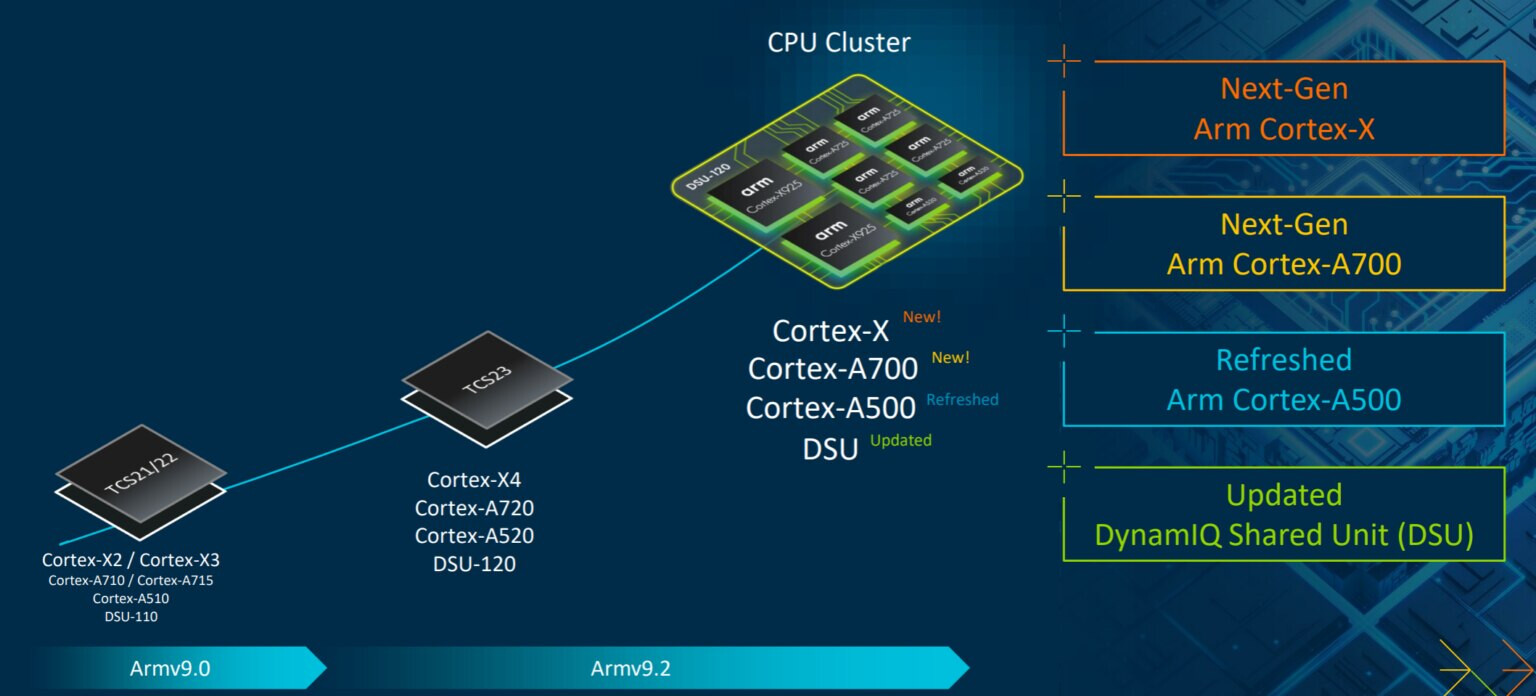
Arm has announced a pair of new Armv9 CPU cores today, alongside a refresh of a third. The new additions are the Cortex-X925—which is a huge model number jump from the previous Cortex-X4—and the Cortex-A725 which should be an upgraded Cortex-A720. Finally the Cortex-A520 has been refreshed to bring a 15 percent power efficiency improvement as well as support for 3 nm production nodes. Arm claims that the Cortex-A925 delivers its highest performance improvement ever over a previous generation with a single core uplift of up to 36 percent and an AI performance improvement of up to 46 percent compared to the Cortex-X4. The Cortex-X925 will support up to 3 MB private L2 cache and is tape-out ready for 3 nm production nodes.

The Cortex-A725 is said to offer a 35 percent performance efficiency improvement over the Cortex-A720 and it's been given performance boosts both when it comes to AI and gaming workloads. It's said to be up to 25 percent more power efficient than the Cortex-A720 and L3 cache traffic has been improved by up to 20 percent. Again, the Cortex-A720 is ready for production on a 3 nm node. Finally, Arm has also updated its DynamIQ Shared Unit to the DS-120 and here Arm has managed to reduce the typical workload power by up to 50 percent and the cache miss power by up to 60 percent. The DSU-120 scales to up to 14 Arm cores, suggesting that we might get to see some interesting new SoC implementations in the coming years from Arm's partners, although Arm's reference platform is a 2-4-2 configuration of the new cores.
Return to Keyword Browsing
Nov 14th, 2026 19:15 CST change timezone

New Forum Posts

Popular Reviews

TPU on YouTube

Controversial News Posts