News Posts matching #ASMedia

Return to Keyword Browsing

ASMedia Offices Raided over USB 3.0 Controller Design Infringement Allegations

Offices of semiconductor company ASMedia were raided by law enforcement agencies in Taiwan, late last month, over allegations of intellectual property (IP) theft of physical-layer component (PHY) design of USB 3.0 host controllers. While the agencies did not disclose who is behind the allegations, it is rumored to be VIA, which sells USB 3.0 host, hub, and device controllers under the VIA Labs Inc (VLI) brand. Many of ASMedia's engineers are former employees of VIA, who are believed to have trafficked its IP over to their new employers.

Following the raid, ASMedia president Lin Che-wei held a press-conference in Taipei, announcing full cooperation with the authorities over the investigation. It remains to be seen how the investigation affects supplies of ASMedia's USB 3.0 controllers. A PC motherboard maker we spoke with expressed concern over the developments.


ASMedia Readies Controllers for Thunderbolt Devices

ASUS-subsidiary ASMedia made its mark as a vendor of high cost/performance 2-port USB 3.0 SuperSpeed host controllers, 2-port SATA 6 Gb/s controllers, and PCIe-PCI bridge chips, with good adoption by PC motherboard vendors. The company now eyes the emerging Thunderbolt-IO market. Thunderbolt will begin seeing adoption by the PC market starting this year, and the adoption of the interconnect by data storage device manufacturers, particularly of fast external storage, for use in the content-creation industry.

Thunderbolt host controllers are yet to receive widespread adoption due to three factors:
  • Cost of the controller. Intel is yet to bring its Thunderbolt host controllers down to an a reasonable price.
  • Deficiency of alternative controller providers, high scope for price-reductions the moment there are alternative providers
  • A looming transition from Thunderbolt copper-electric to fiber-optic medium, which could make current 10 Gb/s-over-copper standard obsolete
ASMedia could address at least two factors here, it could provide an alternative to Intel-made controllers, and could offer a competitive price (or at least price-performance ratio). ASMedia president Lin Che-Wei told DigiTimes that his company will be ready with Thunderbolt-compatible SATA 6 Gb/s controllers, by the second half of 2012.

Sapphire Intros Pure Platinum A55V Motherboard

Sapphire released the new Pure Platinum A55V motherboard to the market. The board offers a value socket FM1 platform based on AMD A55 FCH chipset, in the ATX form-factor. The motherboard supports AMD A4, A6, A8, and Athlon II "Llano" APU/CPUs in the FM1 package. This model is not exactly designed to be "no-frills", as it does pack an interesting mix of features that could help it grab a comfy price-point in the market.

The FM1 socket is powered by a 6-phase VRM, which uses a simple whine-free choke + DPAK MOSFET design, but throws in a heatsink to cool the MOSFETs. The socket is wired to four DDR3 DIMM slots, supporting up to 16 GB of dual-channel DDR3 memory, with speeds of over DDR3-1600 MHz with overclocking. The APU is also wired to a PCI-Express 2.0 x16 slot, and two PCI-Express 2.0 x1 slots. Apart from these, you get three legacy PCI slots, wired to the FCH.

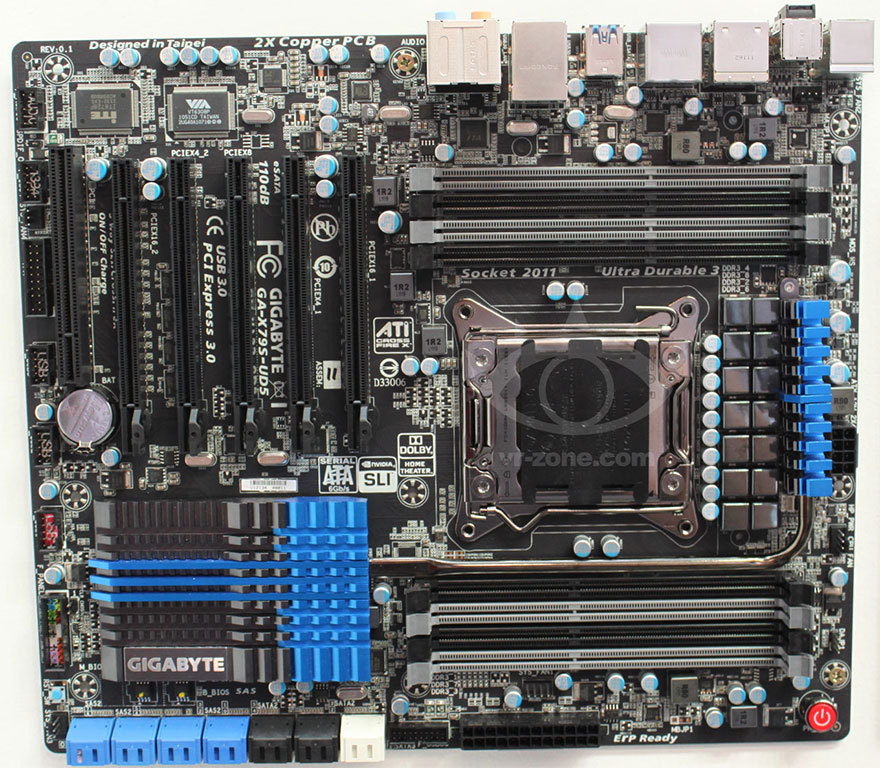
Gigabyte Unveils X79S-UD5 Workstation Motherboard

At CeBIT, Gigabyte unveiled what many may have overlooked for bearing a strong resemblance to the GA-X79-UD5, the GA-X79S-UD5. This board is designed to be a 1P workstation-grade motherboard, probably with out of the box support for the latest Xeon processors in the LGA2011 package, apart from Core i7 ones. The upper-half of this board is nearly identical to that of the X79-UD5. The LGA2011 CPU is powered by a 14-phase VRM, wired to eight DDR3 DIMM slots (two on either sides), supporting quad-channel memory. There are minor differences (as far as the upper-half is concerned). Tantulum capacitors on the X79-UD5 are replaced with cylindrical solid-state ones on the X79S-UD5, the FrescoLogic-made USB 3.0 controller is replaced with a VLI-made one.

It's the lower half of the X79S-UD5, where all the action is. The expansion slot load-out consists of five long PCI-Express x16 slots. Among these, two are PCI-Express 3.0 x16 capable, one is PCI-Express 3.0 x8 capable (by taking 8 lanes from one of the two x16 links), and two appear to be PCI-Express 2.0 x4. Then there's a legacy PCI slot. The PCH heatsink is identical to the one on the X79-UD5, but what's under it is what counts. Although named "X79"S-UD5, the board is actually based on the Intel C606 "Patsburg", which is an enterprise-grade chipset for Intel's Sandy Bridge-EP platforms. Apart from six SATA ports (2x 6 Gb/s + 4x 3 Gb/s), the C606 PCH provides eight SAS (Serial-attached SCSI) ports, running at 3 Gb/s speeds. The rest of the connectivity is completely identical to that of the X79-UD5.

Buffalo Readies USB 3.0 Add-on Cards

Buffalo is working on two new 2-port USB 3.0 add-on cards for desktops and notebooks. Slated for launch in late-January, these products are the IFC-PCIE2U3S2, a low-profile desktop PCIe x1 add-on card; and IFC-EC2U3/UC2, an ExpressCard-34 add-on card for notebooks. While USB 3.0 add-on card products may not be new to Buffalo, these cards are probably based on newer ASMedia-made USB 3.0 controllers. The IFC-PCIE2U3S2 includes a low-profile bracket, it draws power from a 4-pin floppy power connector. Both cards will be priced at 3,255 JPY (about US $42), in the Japanese market.

Sapphire Z77 Motherboard Pictured

Here is the first picture of Sapphire's socket LGA1155 motherboard in the works, based on Intel Z77 "Panther Point" chipset. Carrying the model number PT-CI7Z77, the board will probably carry the company's "Pure Black" branding. Its chipset and VRM heatsink designs have not been finalized, yet. To begin with, the LGA1155 socket, which supports upcoming "Ivy Bridge" processors out of the box, is powered by a 10-phase VRM. This VRM uses ferrite-core chokes, Driver-MOSFETs, and a secondary NEC-TOKIN multi-phase capacitor to condition power. Three other phases handle memory and miscellaneous power domains on the board.

The processor is wired to four DDR3 DIMM slots, supporting dual-channel DDR3 memory. It is also wired to two PCI Express 3.0 long slots, which are auto-configured as x16/NC or x8/x8, depending on the second slot being populated. Other slots include a PCI Express 2.0 x1, and a PCI Express 2.0 long slot (gray), which is electrically PCIe 2.0 x4, and wired to the Z77 PCH. There are two legacy PCI slots, driven by an ASMedia-made bridge chip.

AREA Also Intros SATA 6 Gb/s Card with Switchable Internal/External Ports

Apart from the powerful little Mr. Clone 3.0 drive-cloning and docking device, Japanese company AREA also launched the SATA 6 Gb/s TwinTurbo Hybrid addon-card. 2-port SATA 6 Gb/s cards aren't new, but they either come in 2-port internal SATA, or 2-port eSATA forms, making you have to choose between the two types. This addon-card from AREA features two internal SATA 6 Gb/s ports, two eSATA 6 Gb/s ports, and uses a common 2-port SATA 6 Gb/s controller.

The ingenuity here is a simple jumper-based way of configuring those two SATA channels to individually work as internal SATA or eSATA. So now you can set the card to have two eSATA 6 Gb/s ports, two internal SATA ports, or one internal SATA and an eSATA, whichever way you'd like, by simply toggling two sets of four jumpers switching which way the data traces of each SATA channel end up. The card uses an ASMedia ASM1061 2-port PCIe SATA 6 Gb/s controller, which supports IDE, AHCI, and simple RAID modes. It connects to the host over PCI-Express 2.0 x1. Slated for May 2012, the AREA SATA TwinTurbo Hybrid will be priced at 2,980 JPY, or $38.
Return to Keyword Browsing
Nov 13th, 2026 21:57 CST change timezone

New Forum Posts

Popular Reviews

TPU on YouTube

Controversial News Posts