News Posts matching #ASR

Return to Keyword Browsing

Intel Arc Pro B65 Now Available in US for $910

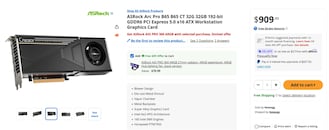
Following the official announcement of the Intel Arc Pro B65 alongside the B70, earlier this year, the ASRock Intel Arc Pro B65 has silently launched in US retail markets, giving us an indication of pricing for Intel's workstation-grade Arc Battlemage GPUs. The ASRock Intel Arc Pro B65 is available on Newegg for a price of $909.99, making it just $100 cheaper than Intel's reference design Arc Pro B70 and only $90 cheaper than the $999.99 ASRock Intel Arc Pro B70, despite the B65 having 37.5% fewer Xe cores than its B70 counterpart.

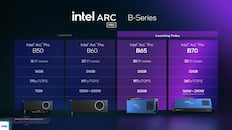
The B65 is also a whopping $250 more expensive than the ASRock Arc Pro B60, which shares the same core configuration as the B65 but with less VRAM. The Arc Pro B65 features 20 Xe cores and 32 GB of VRAM, while the Arc Pro B70 has 32 Xe cores and 32 GB of VRAM, and the Arc Pro B60 has 20 Xe cores paired with 20 GB of VRAM. Given the current hardware shortage situation, especially with regard to DRAM, it's not surprising to see the biggest price differentiator between the various versions of the Arc Pro B-series GPUs is VRAM, although it's unclear if prices will come down if and when the DRAM crisis cools.

Cadence Unveils Its Sixth Generation Tensilica Hi-Fi iQ DSP

Cadence (Nasdaq: CDNS) today announced the Cadence Tensilica Hi-fi iQ DSP IP, the sixth generation of its highly successful Hi-fi DSP family, based on a new architecture purpose-built for next-generation voice AI and emerging immersive audio. As these applications proliferate in the home entertainment, automotive infotainment and smartphone markets, the Hi-fi iQ DSP delivers the performance and energy efficiency required to meet growing SoC computational demands. Compared to the industry-leading Tensilica Hi-fi 5s DSP, the Hi-fi iQ DSP offers 2X greater compute performance, 8X higher AI performance and more than 25% energy savings for most workloads—delivering over 40% performance uplift on numerous audio codecs.

"With the increased growth of AI across virtually every facet of the industry, audio and language have become critical interfaces for users," said Anshel Sag, VP and principal analyst, Moor Insights and Strategy. "The AI performance and energy savings with Cadence's new flagship Tensilica Hi-fi iQ DSP position it to enable future AI-enhanced applications and offload processing from other IPs."

ASRock Extends Motherboard Warranty Amid CPU Burning, but Only in Japan

We covered the issue of burning AMD Ryzen 9000 series CPU on ASRock motherboards many times. However, ASRock has been working to address this problem with BIOS version 3.40 for its AMD 800-series motherboards. Now, the company is offering an extended warranty for its motherboards, but this is limited to Japan. ASRock board users in Japan who register through the ASRock Fan Club by the end of the year will receive a three-year warranty instead of the standard two years. This campaign runs until the end of the year and is exclusive to Japanese customers, leaving the rest of the world with the usual two-year warranty.

In the past, AMD has attributed unusual behaviors, such as CPU burn, to motherboard vendors and BIOS ODMs, suggesting that these vendors may use BIOS versions that don't fully comply with AMD's official specifications. AMD is reportedly collaborating with board partners to develop and optimize BIOS updates to address these issues, but the problem appears to persist. On the unofficial r/ASRock subreddit, reports of more bricked AMD CPUs continue to accumulate. We are still awaiting ASRock's response and any new BIOS version that might prevent this issue from recurring. For users with already damaged processors, a BIOS update cannot reverse hardware failure or burn, but regularly updating your BIOS may reduce the likelihood of further incidents by enforcing safer defaults.

Arm's Accuracy Super Resolution (ASR) Upscaler Lands in Fortnite

Delivering a good visual experience on mobile devices remains a significant engineering challenge: limited GPU power, stricter memory bandwidth, and tighter thermal constraints all threaten to undermine the game's signature smooth frame rates and high-fidelity visuals. To combat these challenges, Epic Games is partnering with Arm to integrate Arm's Accuracy Super Resolution (ASR) upscaling technology into Fortnite Mobile, also being the first ASR-enhanced title. Rather than overhauling Fortnite's existing rendering pipeline, Epic is embedding ASR through a dedicated Unreal Engine 5 plug-in, which will be compatible with both Android and iOS devices. By leveraging a temporal upscaling approach, which is rooted in AMD's FidelityFX Super Resolution 2 framework, ASR analyzes multiple frames to reconstruct a higher-quality image.

Early demonstrations at GDC 2025 showed that devices using Arm's Immortalis-G720 GPU can achieve up to a 53% increase in frame rates while reducing power consumption by approximately 20%. Consequently, gamers can look forward to longer play sessions without worrying about overheating or excessive battery drain. For Fortnite players, ASR's integration translates into noticeably sharper textures in fast-paced encounters, crisper detail when surveying distant environments, and fewer visible artifacts overall. Importantly, these improvements are achieved without sacrificing artistic intent: Epic's artists and engineers retain full control over color accuracy and visual effects, even as the game renders at a lower internal resolution. Tests in collaboration with MediaTek further confirmed similar power savings on Dimensity 9300 chipsets, addressing one of the most pressing mobile concerns: battery life.

Arm Releases Open-Source ASR Upscaler Based on AMD FSR 2 Technology

Arm has officially unveiled its Accuracy Super Resolution (ASR) upscaling technology at Game Developer Conference 2025, delivering an open-source upscaling solution for mobile and low-power devices. Built upon AMD's FidelityFX Super Resolution 2 (FSR 2) framework, ASR promises up to 53% higher frame rates while reducing power consumption by 20% on devices utilizing the Immortalis-G720 GPU. This technology addresses a critical performance gap in the Android ecosystem, which has historically lagged behind Apple's MetalFX implementation. The temporal upscaling approach employed by ASR combines information from multiple frames to generate higher-quality images, offering superior visual fidelity compared to Qualcomm's Game Super Resolution (GSR), which relies on the older spatial-based FSR 1 technique. In benchmark testing with complex scenes, Arm demonstrated that ASR helps maintain stable device temperatures, preventing thermal throttling that can compromise user experience.

Collaboration with MediaTek confirmed significant power savings on Dimensity 9300 chipsets, directly addressing battery life concerns for mobile gamers. Arm plans to release pre-built plugins for Unity and Unreal Engine by year-end, streamlining integration for developers working with these widely-used game engines. During GDC demonstrations, Arm showcased the "Mori" demo running in Unreal Engine 5, where ASR delivered 30% performance improvements without visual compromises. Licensed under MIT open-source terms, ASR's accessibility extends across the entire Arm ecosystem, potentially benefiting smartphones running MediaTek Dimensity, Qualcomm Snapdragon, Samsung Exynos, and even Arm-powered laptops featuring Snapdragon X series SoCs.

Arm Unveils "Accuracy Super Resolution" Based on AMD FSR 2

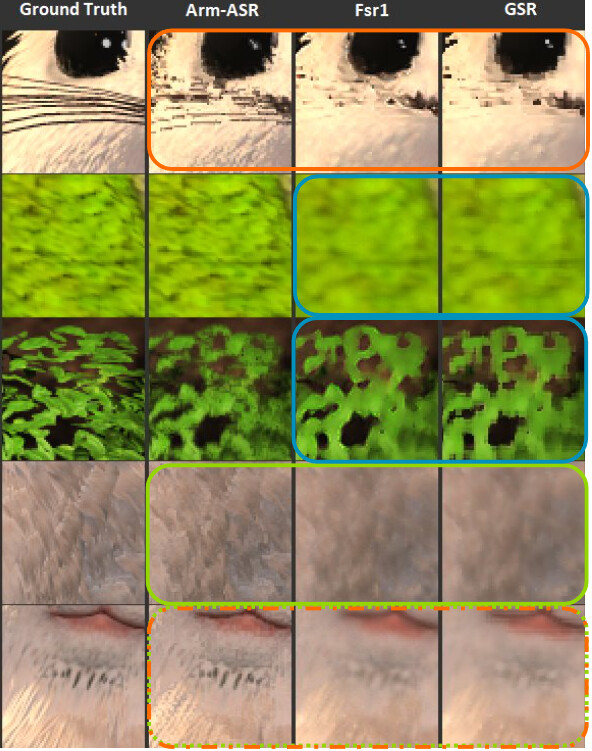
In a community blog post, Arm has announced its new Accuracy Super Resolution (ASR) upscaling technology. This open-source solution aims to transform mobile gaming by offering best-in-class upscaling capabilities for smartphones and tablets. Arm ASR addresses a critical challenge in mobile gaming: delivering high-quality graphics while managing power consumption and heat generation. By rendering games at lower resolutions and then intelligently upscaling them, Arm ASR promises to significantly boost performance without sacrificing visual quality. The technology builds upon AMD's FidelityFX Super Resolution 2 (FSR 2) and adapts it specifically for mobile devices. Arm ASR utilizes temporal upscaling, which combines information from multiple frames to produce higher-quality images from lower-resolution inputs. Even though temporal upscaling is more complicated to implement than spatial frame-by-frame upscaling, it delivers better results and gives developers more freedom.

This approach allows for more ambitious graphics while maintaining smooth gameplay. In benchmark tests using a complex scene, Arm demonstrated impressive results. Devices featuring the Arm Immortalis-G720 GPU showed substantial framerate improvements when using Arm ASR compared to native resolution rendering and Qualcomm's Game Super Resolution (GSR). Moreover, the technology helped maintain stable temperatures, preventing thermal throttling that can compromise user experience. Collaboration with MediaTek revealed significant power savings when using Arm ASR on a Dimensity 9300 handset. This translates to extended battery life for mobile gamers, addressing key concerns. Arm is releasing ASR under an MIT open-source license, encouraging widespread adoption and experimentation among developers. Below you can see the comparison of various upscalers.

Return to Keyword Browsing
Nov 14th, 2026 00:32 CST change timezone

New Forum Posts

Popular Reviews

TPU on YouTube

Controversial News Posts